
As a dedicated member of the radio frequency management team, I have been directly involved in numerous high-stakes operations to ensure the electromagnetic security of large-scale drone shows. These drone performances represent a fusion of technology and art, where thousands of drones operate in synchronized patterns to create breathtaking aerial displays. The success of any drone performance hinges on the integrity of the radio frequency environment, as even minor interference can disrupt navigation, communication, and control systems, leading to potential failures. In this comprehensive account, I will detail the methodologies, challenges, and solutions employed to safeguard these events, drawing from firsthand experiences and incorporating analytical tools like tables and formulas to elucidate key concepts. The core of our work revolves around pre-emptive monitoring, real-time surveillance, and rapid response to any anomalies, all aimed at preserving the seamless execution of drone shows.
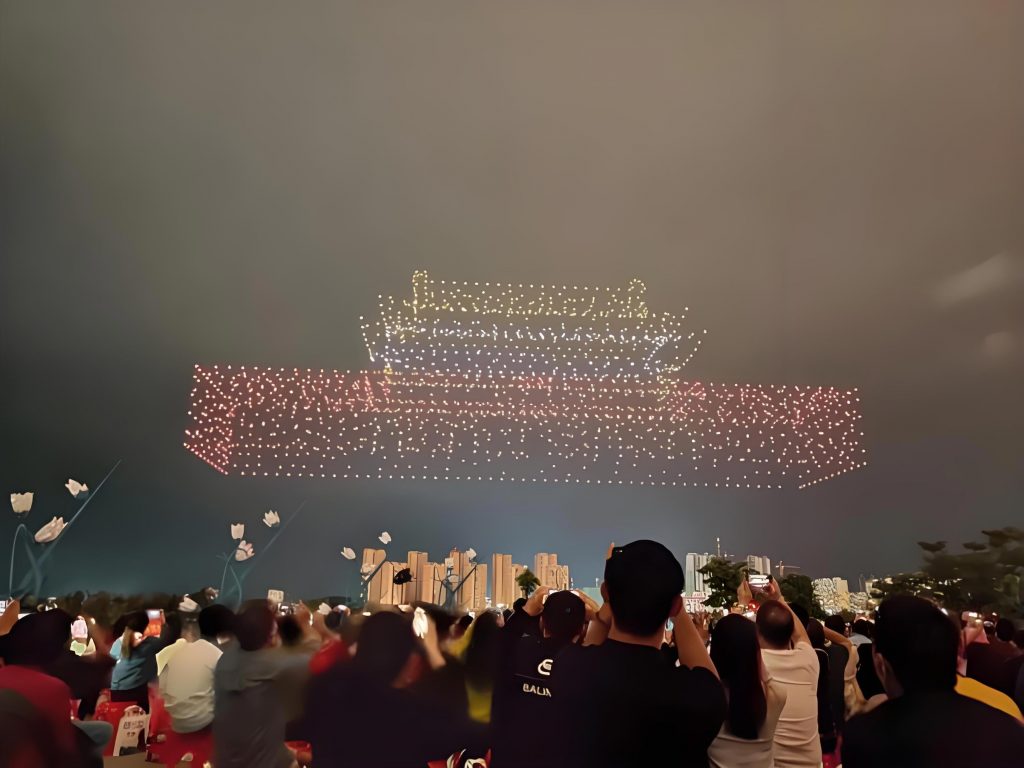
One of the most memorable drone performances I supported involved a massive formation of over 10,000 drones, which set a world record for the largest simultaneous aerial display. This drone show was designed to celebrate a national holiday, with the theme “Sky City, Infinite Possibilities,” emphasizing innovation and communal joy. Our team’s primary objective was to eliminate any radio frequency interference that could compromise the drone performance. We began by engaging in thorough discussions with the drone performance organizers to identify high-risk points, such as frequency overlaps from nearby transmitters or environmental factors. Based on this, we developed a robust monitoring plan that focused on critical bands: high-precision positioning frequencies (e.g., GPS and BeiDou), navigation bands, and communication control channels. The table below summarizes the key frequency bands monitored and their associated risks during such drone shows.
| Frequency Band | Purpose in Drone Performance | Typical Risk Level | Mitigation Strategies |
|---|---|---|---|
| 1.2-1.6 GHz | High-precision positioning (e.g., GPS L1) | High | Continuous spectrum analysis and backup systems |
| 2.4 GHz | Communication control and data links | Medium to High | Frequency hopping and power regulation |
| 5.8 GHz | Video transmission and auxiliary controls | Medium | Shielding and directional antennas |
| 118-137 MHz | Aviation navigation and safety | Low to Medium | Coordination with aviation authorities |
In the days leading up to the drone show, we deployed a combination of fixed monitoring stations and mobile units to conduct protective surveillance of these bands. This pre-event phase was critical for assessing potential interference sources, such as unauthorized transmitters or natural obstacles. Using advanced spectrum analyzers, we measured signal strengths and identified any deviations from expected patterns. One fundamental formula we applied to evaluate interference risks is the free-space path loss model, which estimates signal attenuation over distance. For a frequency \( f \) in MHz and distance \( d \) in kilometers, the path loss \( L \) in decibels is given by:
$$ L = 20 \log_{10}(d) + 20 \log_{10}(f) + 32.44 $$
This equation helped us predict how signals might degrade or interfere with drone operations, allowing us to adjust transmitter placements and power levels accordingly. For instance, in urban environments like those common for drone performances, multipath fading can exacerbate losses, so we incorporated additional factors such as reflection coefficients and obstacle densities into our models. Our recommendations to the drone performance team included optimizing frequency allocations and implementing redundant communication pathways to enhance resilience.
During the actual drone performance, our vigilance intensified. We established a command center with real-time data feeds from all monitoring points, enabling us to track the electromagnetic environment continuously. On the night of the show, as the drones ascended into the sky, we analyzed 36 suspicious radio signals, none of which posed a threat due to our pre-emptive measures. The drone show proceeded flawlessly, with the drones forming intricate patterns and messages that captivated the audience. This success underscored the importance of our radio frequency assurance protocols, which have become a benchmark for similar drone performances worldwide. The integration of technology and artistry in such drone shows is a testament to human ingenuity, and our role ensures that the radio spectrum remains a reliable medium for innovation.
Beyond this specific drone performance, our team has applied these principles to a variety of scenarios, including disaster response and international sporting events. For example, in one instance involving a severe typhoon, we were tasked with securing communication networks for emergency services. Although not a drone show, the radio frequency management strategies mirrored those used in drone performances: we conducted pre-event assessments, deployed mobile monitoring vehicles, and maintained 24/7 vigilance to prevent interference. The table below compares the radio frequency challenges and solutions between a typical drone performance and a disaster response operation, highlighting the adaptability of our approaches.
| Event Type | Primary Frequency Bands | Key Risks | Common Solutions |
|---|---|---|---|
| Drone Performance | GPS, 2.4 GHz, 5.8 GHz | Signal jamming, multipath interference | Real-time spectrum monitoring, frequency agility |
| Disaster Response | VHF, UHF, satellite bands | Infrastructure damage, congestion | Portable systems, priority channel allocation |
In another context, such as an international sports championship, the radio frequency demands focused on ensuring clear communication for officials and broadcasters. While this did not involve a drone performance, the underlying principles of electromagnetic compatibility and interference mitigation were similar. We performed site surveys, optimized base station layouts, and conducted iterative testing to safeguard against disruptions. The effectiveness of these measures can be quantified using the signal-to-interference-plus-noise ratio (SINR), a critical metric for evaluating communication quality. For a received signal power \( P_r \), interference power \( I \), and noise power \( N \), the SINR is defined as:
$$ \text{SINR} = \frac{P_r}{I + N} $$
Maintaining a high SINR is essential for reliable operations in any radio-dependent event, whether it is a drone show or a sports game. Our team consistently aims for SINR values above a threshold of 10 dB to ensure minimal packet loss and maximal data integrity. This involves calculating expected power levels based on transmitter specifications and environmental conditions, then adjusting parameters dynamically during the event. The drone performance paradigm has greatly influenced our methodology, as the high density of transmitters in a drone show requires meticulous planning to avoid co-channel interference.
Reflecting on the evolution of drone performances, I have observed a trend toward larger scales and more complex formations, which amplifies the radio frequency challenges. Each drone in a performance acts as a node in a distributed network, relying on precise timing and coordination. To model the communication reliability in such networks, we often use probability theory. For instance, the probability of successful data transmission \( P_s \) in a drone swarm can be expressed as a function of the number of drones \( n \), the bit error rate \( \text{BER} \), and the packet size \( L \):
$$ P_s = (1 – \text{BER})^L \cdot n $$
This formula helps us estimate the likelihood of communication failures and design redundancy mechanisms, such as retransmission protocols or mesh networking, to enhance the robustness of the drone performance. In practice, we have implemented these insights by incorporating error-correcting codes and diversity techniques, which have proven effective in maintaining synchronization during high-wind conditions or other environmental stressors. The continuous improvement of drone show technologies drives us to innovate in radio frequency management, ensuring that each performance is not only visually stunning but also technically resilient.
The integration of artificial intelligence and machine learning into our monitoring systems has further elevated our capabilities. For example, we now use predictive algorithms to forecast potential interference sources based on historical data and real-time inputs. During a recent drone performance, these systems flagged an anomalous signal that, upon investigation, was traced to a nearby industrial device. By addressing it proactively, we averted a potential disruption. This highlights the importance of adaptive learning in radio frequency assurance, where each drone show serves as a data point for refining our models. The table below outlines the evolution of monitoring technologies and their impact on drone performance security over the years.
| Era | Monitoring Technology | Impact on Drone Performance | Key Advancements |
|---|---|---|---|
| Early 2000s | Basic spectrum analyzers | Limited to small-scale shows | Manual frequency allocation |
| 2010s | Automated scanning systems | Enabled larger formations | Real-time interference detection |
| 2020s | AI-driven predictive analytics | Support for ultra-large drone performances | Proactive risk mitigation |
In conclusion, the radio frequency assurance for drone performances is a multifaceted discipline that blends engineering rigor with operational excellence. As a participant in this field, I have seen how each drone show pushes the boundaries of what is possible, demanding ever more sophisticated approaches to electromagnetic security. The formulas and tables presented here are not just theoretical constructs but practical tools that guide our daily work. From pre-event planning to real-time execution, our goal remains constant: to create a safe and interference-free environment that allows the magic of drone performances to shine. The future promises even grander spectacles, and I am committed to advancing our methods to meet those challenges, ensuring that every drone performance is a testament to human creativity and technological prowess.
Looking ahead, we are exploring the use of software-defined radios (SDRs) to dynamically allocate frequencies during a drone performance, adapting to changing conditions in real time. This approach could revolutionize how we manage the radio spectrum, making drone shows more resilient to unexpected interference. Additionally, the rise of quantum-resistant encryption for communication links in drone performances is an area of active research, as it would protect against future threats to data security. The enduring appeal of drone performances lies in their ability to inspire awe, and as stewards of the radio frequency domain, we take pride in enabling these experiences through unwavering dedication and innovation.