
As a media professional deeply immersed in the evolution of aerial photography, I have witnessed firsthand how first person view (FPV) drones have transformed the landscape of visual storytelling. The ability to soar through waterfalls, dive alongside cascading water, and navigate dense forests with the agility of a bird offers an unparalleled immersive experience. This first person view perspective, once a distant dream, is now a reality thanks to the proliferation of FPV drones. Their speed, wide-angle capabilities, and dynamic maneuvers are redefining productivity in short-form media, making them indispensable tools for creators worldwide. In this article, I explore the rise of FPV drones, their applications, technical nuances, and future potential, emphasizing how they are shaping the future of media production.
The term “FPV drone” refers to a type of unmanned aerial vehicle operated with a first person view system, where the pilot sees exactly what the drone sees in real-time through goggles or a screen. This contrasts with traditional drones, which often rely on automated features like hovering and stabilization. The core of the FPV experience lies in its immersive first person view, which allows for a direct, adrenaline-pumping connection between the pilot and the flight path. Over the years, the China FPV community has grown significantly, contributing to innovations that push the boundaries of what’s possible. For instance, the speed and agility of an FPV drone enable it to perform maneuvers that are impossible for conventional drones, such as rapid rolls and dives, making it a favorite in competitive and creative fields alike.
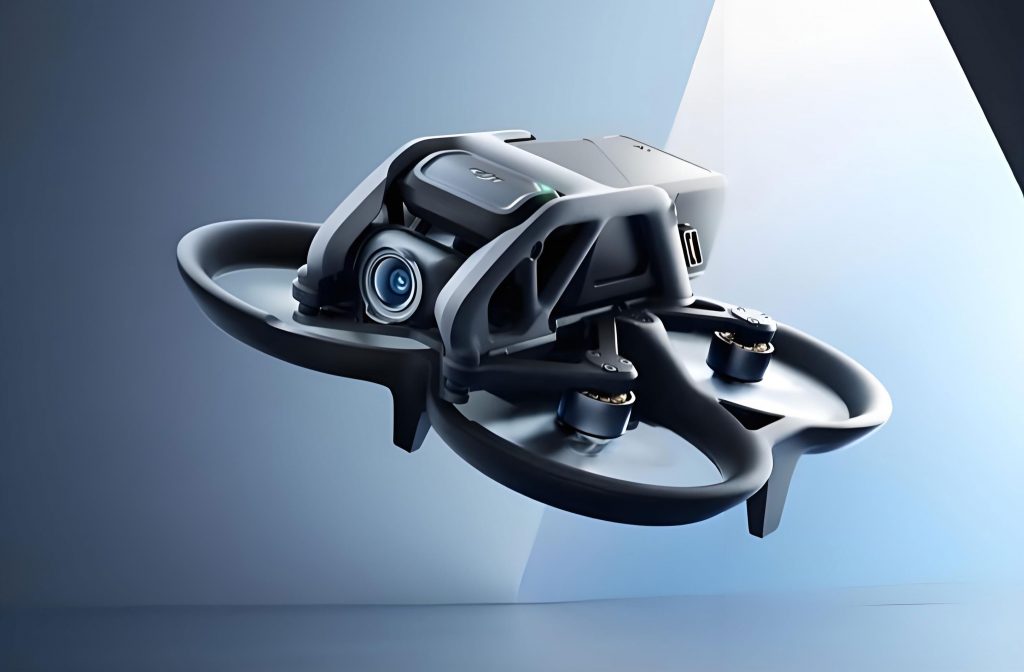
To understand the distinct advantages of FPV drones, it’s essential to compare them with traditional multi-rotor drones. The table below summarizes key differences based on performance metrics and operational logic:
| Feature | FPV Drone | Traditional Drone |
|---|---|---|
| Maximum Speed | Over 100 km/h (up to 300 km/h for racing models) | 50-90 km/h |
| Flight Stability | No auto-hover or altitude hold; manual control required | Automated stabilization and hovering |
| Maneuverability | Capable of rolls, flips, and dives | Limited to smooth, level flights |
| Camera Perspective | Fixed wide-angle lens for immersive first person view | Adjustable gimbal for varied angles |
| Typical Use Cases | Racing, immersive videos, obstacle navigation | Aerial photography, surveillance, mapping |
The speed of an FPV drone can be modeled using basic physics principles. For example, the kinetic energy $E_k$ of a drone in motion is given by the formula: $$E_k = \frac{1}{2}mv^2$$ where $m$ is the mass of the drone and $v$ is its velocity. This high energy allows an FPV drone to achieve velocities exceeding 100 km/h, making it ideal for capturing fast-paced scenes. In contrast, traditional drones operate at lower speeds, which limits their ability to produce the same level of dynamic footage. The first person view aspect amplifies this, as the pilot’s real-time feedback loop enables precise control even at high velocities, a hallmark of the China FPV scene where pilots often push limits in competitions.
In media production, FPV drones have become game-changers, particularly in covering large-scale projects. For example, in documenting massive construction sites, an FPV drone can fly through narrow passages and over structures, creating a “game-like” experience for viewers. This first person view approach was notably used in projects like hydroelectric dam tours, where the drone weaves through turbines and along dam walls, offering perspectives that were previously unattainable. The immersive quality of the first person view makes audiences feel as if they are part of the action, enhancing engagement. Moreover, the use of augmented reality (AR)-inspired subtitles that track movement adds a layer of interactivity, turning static data into dynamic narratives. This synergy of technology and storytelling is a testament to how FPV drones are revolutionizing media, with the China FPV community leading in innovative applications.
Cultural and tourism videos have also benefited immensely from FPV drone technology. The first person view allows for flights over scenic landscapes, such as mountain ranges and historical sites, evoking a sense of “sword-like flight” that resonates with viewers. In one instance, a first person view footage of ancient architectures intertwined with natural vistas went viral, accumulating millions of views online. This highlights the power of the FPV drone in creating emotional connections through visual immersion. The table below illustrates the impact of FPV drones in tourism media, based on engagement metrics:
| Application | Viewer Engagement | Key Features |
|---|---|---|
| Heritage Site Tours | High (e.g., over 1 million views on platforms) | First person view immersion, historical context |
| Natural Landscapes | Moderate to High | Wide-angle shots, dynamic maneuvers |
| Urban Explorations | Growing | Obstacle navigation, speed effects |
However, FPV drones are not without limitations. The fixed wide-angle lens, while excellent for immersive first person view, restricts the ability to capture detailed close-ups. This can be described using the lens equation: $$\frac{1}{f} = \frac{1}{u} + \frac{1}{v}$$ where $f$ is the focal length, $u$ is the object distance, and $v$ is the image distance. For an FPV drone, $f$ is typically short, resulting in a wide field of view but poor resolution for distant objects. Additionally, the lack of automated features means that pilots must rely on skill to execute smooth flights, which can lead to challenges in maintaining consistency. To address this, media producers often combine FPV drone footage with traditional drone shots. For instance, while an FPV drone handles high-speed chases, a traditional drone can provide stable, zoomed-in views, creating a complementary workflow. This hybrid approach ensures that the final product leverages the strengths of both technologies, with the first person view adding excitement and the traditional shots offering clarity.
The economic and training aspects of using FPV drones cannot be overlooked. Mastering an FPV drone requires hundreds of hours of practice, often starting with simulators before moving to actual flights. The learning curve can be steep, and the risk of crashes—commonly referred to as “crashes” in the community—adds to the cost and safety concerns. The probability of a successful flight $P_s$ can be modeled as a function of pilot experience $E$ and environmental factors $F$: $$P_s = k \cdot \frac{E}{F}$$ where $k$ is a constant. This equation highlights that as experience increases, success rates improve, but external factors like wind or obstacles pose ongoing risks. In the China FPV sector, this has led to a growing market for professional pilots who offer their services to media houses, reducing the burden on in-house teams. Weighing the costs versus benefits is crucial; for high-impact projects, investing in skilled FPV drone operators can yield superior results, while for routine work, traditional drones might suffice.
Looking ahead, the potential of FPV drones in新媒体 extends beyond video into interactive experiences. For example, integrating first person view footage with H5 or小程序 platforms could allow users to choose their own flight paths, creating personalized “cloud tours.” Moreover, the use of virtual reality (VR) with FPV drone videos can enhance immersion, as viewers don headsets to feel the thrill of flying over cliffs and through urban canyons. The China FPV industry is at the forefront of these innovations, experimenting with 3D formats and real-time streaming. The future growth can be projected using a simple exponential model: $$G = G_0 e^{rt}$$ where $G$ is the growth in applications, $G_0$ is the initial base, $r$ is the rate of innovation, and $t$ is time. This suggests that as technology advances, FPV drones will become even more integral to media, offering new ways to engage audiences.
In conclusion, FPV drones have undeniably revolutionized aerial cinematography through their unique first person view capabilities. From capturing the grandeur of engineering feats to the serenity of natural wonders, the FPV drone delivers an immersive experience that traditional tools cannot match. The China FPV community continues to drive this evolution, pushing the limits of speed and creativity. However, it is the combination of skilled piloting, thoughtful editing, and strategic planning that truly unlocks the potential of first person view footage. As we move forward, embracing these tools while acknowledging their challenges will be key to producing compelling media that resonates in a fast-paced digital world. The journey of the FPV drone is just beginning, and its impact on storytelling will only deepen with time.