
In recent years, the rapid advancement of microelectronics and computer technologies has propelled the widespread adoption of unmanned aerial vehicles (UAVs), particularly multi-rotor drones, across various sectors. As a key enabler of the low altitude economy, these drones have been recognized as a strategic emerging industry in national economic policies, driving innovation and growth. The low altitude economy encompasses economic activities conducted in airspace below 1,000 meters, where multi-rotor drones play a pivotal role due to their versatility and efficiency. From agriculture to logistics, these drones are transforming industries by offering cost-effective and scalable solutions. In this article, I will explore the characteristics, applications, and structural components of multi-rotor drones, emphasizing their significance in fostering the low altitude economy. Through detailed analysis, including tables and mathematical models, I aim to provide a comprehensive understanding of how these drones are shaping the future of aerial operations.
Multi-rotor drones are remotely controlled or autonomous aircraft capable of vertical take-off and landing (VTOL), characterized by multiple rotors arranged in symmetric configurations. Historically, the concept dates back to 1907 with the Breguet brothers’ early experiments, but it was not until the 1990s that advancements in micro-electromechanical systems (MEMS), brushless motors, and microprocessors made stable flight control feasible. Today, brands like DJI have dominated the global market, showcasing the potential of multi-rotor drones in consumer and industrial applications. The low altitude economy relies heavily on such technologies to unlock new opportunities in urban air mobility, surveillance, and beyond. For instance, the ability of drones to operate in confined spaces and their minimal noise pollution make them ideal for densely populated areas, aligning with the goals of sustainable development in the low altitude economy.
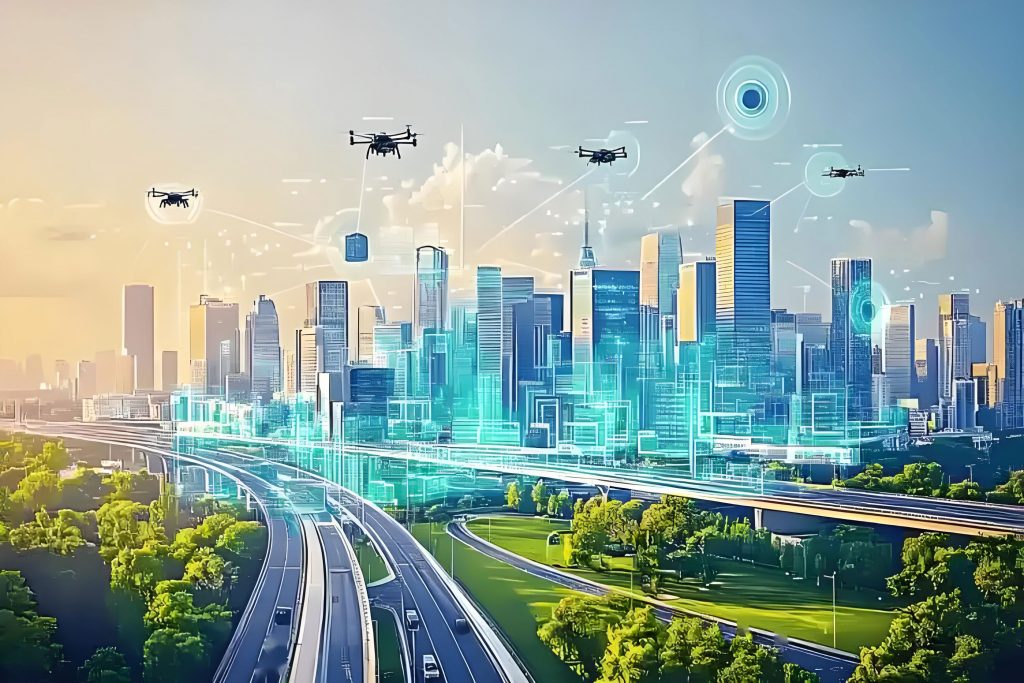
The advantages of multi-rotor drones over other UAV types, such as fixed-wing aircraft or single-rotor helicopters, are numerous. Structurally, they feature simple designs with fewer moving parts, reducing maintenance costs and enhancing safety. Their compact size and lightweight nature, often powered by lithium-polymer batteries, allow for easy portability and low operational expenses. Moreover, the symmetric rotor arrangement, typically in an X-shaped layout for quadcopters, enables precise control of flight maneuvers through variations in rotor speeds. This is mathematically represented by the thrust and torque equations. For a quadcopter, the total thrust $T$ generated by the four rotors can be expressed as:
$$T = \sum_{i=1}^{4} k \cdot \omega_i^2$$
where $k$ is a thrust constant and $\omega_i$ is the angular velocity of the $i$-th rotor. The torques $\tau$ that control roll, pitch, and yaw are given by:
$$\tau_{\text{roll}} = l \cdot k (\omega_4^2 – \omega_2^2)$$
$$\tau_{\text{pitch}} = l \cdot k (\omega_3^2 – \omega_1^2)$$
$$\tau_{\text{yaw}} = b (\omega_1^2 + \omega_3^2 – \omega_2^2 – \omega_4^2)$$
Here, $l$ is the distance from the center of mass to a rotor, and $b$ is a drag coefficient. These equations highlight how adjusting rotor speeds allows for stable hover and agile movements, crucial for applications in the low altitude economy. The following table summarizes key advantages of multi-rotor drones compared to other UAV types:
| Feature | Multi-rotor Drones | Fixed-wing UAVs | Single-rotor Helicopters |
|---|---|---|---|
| VTOL Capability | Yes | No | Yes |
| Mechanical Complexity | Low | Moderate | High |
| Noise Level | Low | High | Moderate to High |
| Maneuverability | High | Low | Moderate |
| Cost Efficiency | High | Moderate | Low |
Applications of multi-rotor drones in the low altitude economy span diverse fields, each leveraging their unique capabilities. In aerial photography, drones equipped with stabilized gimbals and high-resolution cameras capture stunning visuals for filmmaking, infrastructure inspection, and environmental monitoring. This supports the low altitude economy by enabling efficient data collection and reducing human risk in hazardous areas. For agriculture, drones automate tasks like pesticide spraying and seed dispersal, optimizing resource use and minimizing labor costs. The low altitude economy benefits from such precision agriculture through increased yields and sustainability. In logistics, companies use drones for last-mile delivery, overcoming ground traffic constraints and enhancing supply chain efficiency. The table below outlines major application areas and their contributions to the low altitude economy:
| Application Domain | Key Functions | Impact on Low Altitude Economy |
|---|---|---|
| Aerial Photography | Real-time imaging, surveillance, mapping | Enhances media, security, and urban planning |
| Agriculture | Spraying, seeding, crop monitoring | Boosts productivity and reduces environmental footprint |
| Logistics | Package delivery, inventory management | Streamlines transportation and lowers costs |
| Military and Defense | Reconnaissance, targeted strikes | Improves situational awareness and safety |
| Sports and Recreation | FPV racing, aerial acrobatics | Drives entertainment and tourism sectors |
| Education and Research | Platform for STEM studies, algorithm testing | Fosters innovation and skill development |
In the military sector, multi-rotor drones provide stealthy reconnaissance and combat support, as seen in conflicts where they offer cost-effective alternatives to traditional systems. This aligns with the low altitude economy by demonstrating how drone technology can be adapted for high-stakes environments. Similarly, in sports, first-person view (FPV) drones have created a thrilling racing scene, attracting enthusiasts and boosting local economies through events and tourism. The low altitude economy thrives on such niche applications, which generate revenue and promote technological adoption.
The structural composition of multi-rotor drones is integral to their performance in the low altitude economy. A typical drone consists of the airframe, power system, and control system. The airframe, often made from carbon fiber or nylon, includes the body, arms, and landing gear. The number of arms defines the drone’s configuration, such as quadcopter or hexacopter, with the axis distance influencing payload capacity. For example, a larger axis distance allows for bigger propellers and higher lift, which is crucial for carrying heavier payloads in logistics applications within the low altitude economy. The power system comprises brushless motors, electronic speed controllers (ESCs), propellers, and batteries. Brushless motors are preferred for their efficiency and longevity, driven by ESCs that regulate motor speed based on flight controller commands. The thrust $F$ produced by a propeller can be modeled as:
$$F = C_T \cdot \rho \cdot n^2 \cdot D^4$$
where $C_T$ is the thrust coefficient, $\rho$ is air density, $n$ is rotational speed in revolutions per second, and $D$ is propeller diameter. This equation underscores the importance of propeller design in optimizing flight efficiency for the low altitude economy. Lithium-polymer batteries, commonly used due to their high energy density, are arranged in series (e.g., 3S for three cells) to provide sufficient power. The energy $E$ stored in a battery is given by:
$$E = V \cdot I \cdot t$$
where $V$ is voltage, $I$ is current, and $t$ is time. This relates to flight endurance, a critical factor in applications like aerial mapping for the low altitude economy.
The control system is the brain of the drone, enabling autonomous operations essential for the low altitude economy. It includes remote controllers, receivers, flight controllers, data transmission platforms, and ground control stations. The flight controller processes data from an inertial measurement unit (IMU), which combines gyroscopes, accelerometers, magnetometers, and barometers to monitor orientation, acceleration, direction, and altitude. For instance, the attitude of the drone can be represented using Euler angles $\phi$ (roll), $\theta$ (pitch), and $\psi$ (yaw), with dynamics described by:
$$\begin{aligned}
I_{xx} \ddot{\phi} &= \tau_{\text{roll}} – (I_{zz} – I_{yy}) \dot{\theta} \dot{\psi} \\
I_{yy} \ddot{\theta} &= \tau_{\text{pitch}} – (I_{xx} – I_{zz}) \dot{\phi} \dot{\psi} \\
I_{zz} \ddot{\psi} &= \tau_{\text{yaw}} – (I_{yy} – I_{xx}) \dot{\phi} \dot{\theta}
\end{aligned}$$
where $I_{xx}$, $I_{yy}$, and $I_{zz}$ are moments of inertia. These equations facilitate stable flight control, allowing drones to perform complex maneuvers in the low altitude economy. Additional sensors like GPS, ultrasonic sensors, and optical flow sensors enhance navigation accuracy. For example, in agricultural applications, drones use real-time kinematic (RTK) positioning for centimeter-level precision in spraying operations. The integration of these components ensures reliable performance, as summarized in the table below:
| Component | Function | Role in Low Altitude Economy |
|---|---|---|
| Airframe | Structural support and payload housing | Enables customization for specific tasks |
| Brushless Motor | Converts electrical energy to mechanical thrust | Provides efficient propulsion for various applications |
| ESC | Controls motor speed and power distribution | Ensures precise flight adjustments |
| Lithium-polymer Battery | Power source for all systems | Determines flight duration and operational range |
| Flight Controller | Processes sensor data and executes flight plans | Facilitates autonomy in complex environments |
| Ground Control Station | Monitors and commands drone operations | Allows remote management for scalable deployments |
A typical application in the low altitude economy is agricultural crop protection using multi-rotor drones. In this scenario, the drone follows a pre-planned route from a take-off point, ascending to a set altitude using barometric data and GPS coordinates. During flight, the IMU continuously adjusts attitude based on sensor inputs, while ultrasonic sensors detect obstacles to avoid collisions. The flight path can be optimized using waypoint navigation, where the drone’s position $(x, y, z)$ is controlled by PID controllers to minimize error. For example, the altitude control might use:
$$u(t) = K_p e(t) + K_i \int_0^t e(\tau) d\tau + K_d \frac{de(t)}{dt}$$
where $u(t)$ is the control output, $e(t)$ is the error between desired and actual altitude, and $K_p$, $K_i$, $K_d$ are proportional, integral, and derivative gains. This ensures stable hovering and accurate spraying, contributing to the low altitude economy by reducing chemical usage and increasing farm efficiency. Data transmission systems, operating on frequencies like 433 MHz or 915 MHz, enable real-time communication with ground stations, allowing operators to modify tasks mid-flight. In urban settings, this technology supports the low altitude economy by facilitating drone-based delivery services that bypass traffic congestion.
Looking ahead, the low altitude economy is poised for exponential growth, driven by policy support and technological innovations. Governments worldwide are integrating low-altitude airspace into national strategies, recognizing multi-rotor drones as catalysts for economic development. For instance, initiatives to standardize air traffic management for drones will unlock new possibilities in urban air mobility, further embedding the low altitude economy into daily life. Research in AI and machine learning is enhancing autonomous capabilities, allowing drones to perform complex tasks like swarm coordination for large-scale operations. The potential for job creation and industry transformation underscores the importance of continued investment in the low altitude economy.
In conclusion, multi-rotor drones are indispensable to the expansion of the low altitude economy, offering scalable solutions across sectors. Their adaptability, coupled with advancements in control systems and energy efficiency, ensures they will remain at the forefront of aerial innovation. As regulations evolve and public acceptance grows, the low altitude economy will likely see increased integration of drones into infrastructure, commerce, and recreation. By fostering collaboration between industry and academia, we can address challenges such as battery life and airspace congestion, ultimately realizing the full potential of the low altitude economy. Through this exploration, I have highlighted how multi-rotor drones serve as the backbone of this emerging economic paradigm, promising a future where the skies become a new frontier for growth and opportunity.