
In recent years, the rapid development of the low altitude economy has introduced transformative opportunities across various sectors, particularly in transportation. As a backbone of comprehensive transport systems, railways stand to benefit significantly from integrating low altitude technologies, such as unmanned aerial vehicles (UAVs) and electric vertical take-off and landing (eVTOL) aircraft. This article explores the global evolution of the low altitude economy, its current applications in railway operations, and future scenarios where these technologies could revolutionize infrastructure, freight logistics, and passenger services. I will delve into the technological advancements, challenges, and strategic directions, emphasizing how the low altitude economy can enhance efficiency, safety, and sustainability in rail transport.
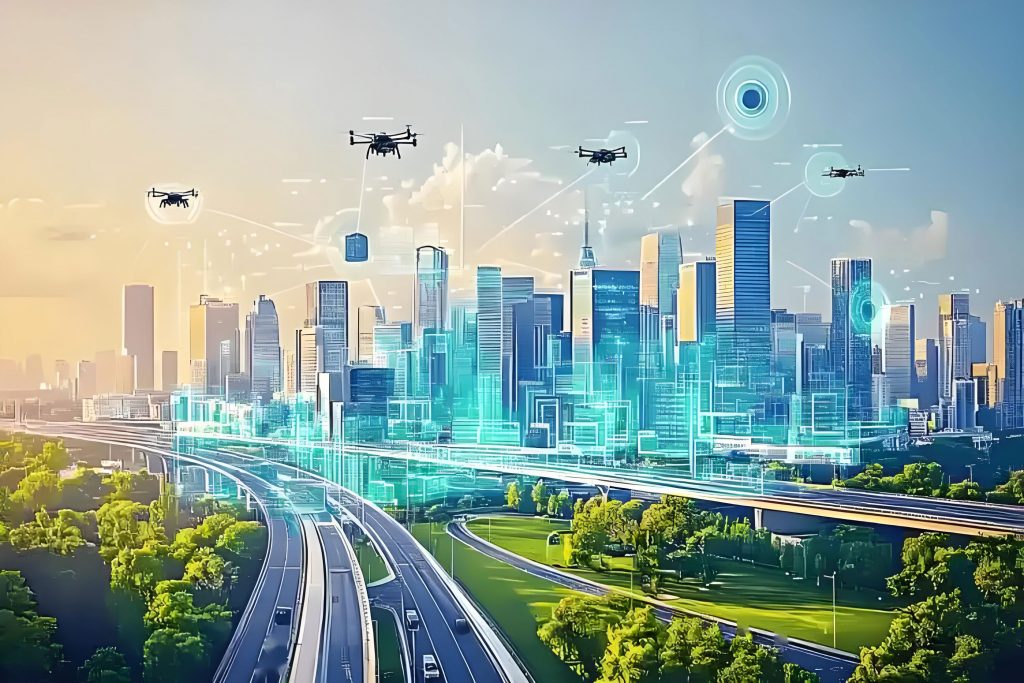
The concept of the low altitude economy refers to economic activities conducted in airspace up to 1,000 meters above ground, extending to 3,000 meters for specific needs, primarily involving civil manned and unmanned aircraft. This sector encompasses low-altitude manufacturing, flight operations, support services, and integrated applications, driving innovation in areas like urban air mobility (UAM). In railway contexts, the low altitude economy leverages UAVs and other aerial systems to address traditional limitations in surveying, construction, maintenance, and emergency response. For instance, UAVs enable rapid data collection and real-time monitoring, reducing human labor and improving accuracy. As the low altitude economy expands globally, its synergy with railways promises to foster new growth engines, such as integrated freight networks and multimodal passenger services. This article aims to provide a comprehensive analysis, drawing on international experiences and projecting future pathways for the low altitude economy in rail systems.
Global Development of the Low Altitude Economy
Internationally, the low altitude economy has evolved under various frameworks, notably as urban air mobility (UAM) in developed regions. The United States, Europe, and Japan have pioneered UAM initiatives, each with distinct approaches and milestones. In the U.S., the Federal Aviation Administration (FAA) and NASA have advanced UAM and advanced air mobility (AAM) concepts, focusing on integrating low-altitude operations into existing airspace. For example, the FAA’s airspace classification designates specific zones for UAVs, such as Class G airspace below 120 meters, to facilitate safe drone operations. Europe, through initiatives like the Single European Sky (SES) and U-Space, has emphasized regulatory harmonization and digital services for drones, aiming to achieve seamless integration by 2030. Japan’s government-led strategies, such as the “Next-Generation Air Mobility Vision,” target commercial eVTOL services by 2030, with pilot projects in urban areas. These efforts highlight how the low altitude economy is shaping transport policies and technological innovation worldwide.
A comparative analysis of these regions reveals key trends in the low altitude economy. The table below summarizes the development paths, regulatory frameworks, and market projections for the U.S., Europe, and Japan:
| Region | Key Initiatives | Regulatory Focus | Market Projections |
|---|---|---|---|
| United States | UAM/AAM concepts, FAA oversight | Airspace integration, safety standards | UAM market to grow significantly by 2040 |
| Europe | SESAR, U-Space, Horizon Europe | Digitalization, sustainability | UAM market estimated at €4.2B by 2030 |
| Japan | Next-Generation Air Mobility, SkyDrive projects | Government-led commercialization | eVTOL services planned from 2025 onward |
These international experiences offer valuable lessons for advancing the low altitude economy. For instance, the U.S. model demonstrates the importance of phased implementation—starting with initial operations and progressing to mature UAM corridors. Europe’s emphasis on U-Space underscores the need for automated air traffic management systems, while Japan’s focus on public-private partnerships highlights the role of targeted investments. In railway applications, these insights can inform strategies for adopting low altitude technologies, such as developing standardized protocols for UAV inspections or integrating eVTOLs with rail hubs. The low altitude economy, therefore, serves as a catalyst for cross-sector innovation, and railways can leverage these global best practices to enhance their operational frameworks.
Current State of the Low Altitude Economy in China
In China, the low altitude economy has gained momentum as a strategic emerging industry, supported by a series of policies and technological advancements. Since 2010, when low-altitude airspace management reforms began, the government has issued numerous directives to promote the sector, including its inclusion in the 2024 Government Work Report. The low altitude economy in China is characterized by a robust industrial chain, covering upstream components (e.g., batteries and sensors), midstream manufacturing (e.g., UAVs and eVTOLs), and downstream applications (e.g., logistics and surveillance). Key technologies driving this growth include advanced flight control systems, digital airspace management, and smart infrastructure like vertiports and communication networks. For example, cities like Shenzhen have deployed integrated low-altitude systems, featuring operational centers and “four networks”—facility, air connectivity, route, and service networks—to support UAV operations.
The applications of the low altitude economy in China span various domains, which can be categorized into operational, safety, and mobility scenarios. The table below outlines these primary application areas:
| Category | Application Scenarios | Examples |
|---|---|---|
| Operational | Power inspection, agricultural spraying, surveying | UAVs for crop monitoring and infrastructure mapping |
| Safety | Emergency response, law enforcement, disaster management | Drones for search and rescue in earthquakes |
| Mobility | Low-altitude tourism, air taxis, logistics | eVTOL trials for urban passenger transport |
Technologically, the low altitude economy in China faces challenges such as limited battery life and communication range for UAVs, but innovations in 5G-A connectivity and BeiDou navigation are addressing these issues. The growth of the low altitude economy is also quantified through economic models; for instance, the potential market size can be estimated using a compound annual growth rate (CAGR) formula: $$ CAGR = \left( \frac{V_f}{V_i} \right)^{\frac{1}{n}} – 1 $$ where \( V_f \) is the future value (e.g., projected market size), \( V_i \) is the initial value, and \( n \) is the number of years. With China’s low altitude economy expected to reach CNY 3.5 trillion by 2035, such calculations highlight its rapid expansion. In railways, these technologies are already being piloted, such as using UAVs for track inspections, demonstrating the practical benefits of the low altitude economy in enhancing efficiency and reducing costs.
Applications of Low Altitude Economy Technologies in Railways
The integration of the low altitude economy into railway systems has unlocked numerous applications, primarily centered around UAVs for data collection, monitoring, and logistics. In railway engineering and design, UAVs equipped with LiDAR and tilt cameras facilitate high-precision surveying, generating digital models for route planning and BIM-based designs. For example, drones capture topographic data and create 3D maps, reducing the time and risk associated with manual surveys. During construction, UAVs support digital施工 by monitoring progress, calculating earthwork volumes, and ensuring compliance with designs through real-time imagery. The data collected can be processed using photogrammetry techniques, such as structure from motion (SfM), which reconstructs 3D models from 2D images. The accuracy of these models can be expressed as: $$ \text{Accuracy} = \frac{\text{Number of Correct Identifications}}{\text{Total Identifications}} \times 100\% $$ achieving over 85% in defect detection for infrastructure inspections.
In maintenance and inspection, the low altitude economy enables automated UAV patrols for tracks, bridges, tunnels, and power systems. These drones identify issues like cracks or corrosion, transmitting data to central platforms for analysis. The table below summarizes common railway inspection scenarios using UAVs, along with typical challenges:
| Inspection Area | Key Tasks | Common Challenges |
|---|---|---|
| Track Lines | Detect rail wear, alignment issues | GPS denial in tunnels; weather interference |
| Bridges | Assess structural integrity, corrosion | Limited access to hidden areas; wind effects |
| Tunnels | Monitor lining conditions, water leakage | Low light; obstacle avoidance |
| Power Systems | Inspect catenary lines, components | Electromagnetic interference; high-voltage risks |
For emergency response, the low altitude economy enhances railway safety through UAV-based disaster assessment and rescue operations. Drones provide aerial views of accident sites, deliver supplies, and establish communication links, significantly reducing response times. In emerging transport services, the low altitude economy fosters innovations like “railway trunk + low-altitude branch” logistics, where goods are transported long-distance by rail and last-mile by UAVs or eVTOLs. Similarly, passenger services integrate eVTOLs with high-speed rail, offering seamless intermodal travel. However, these applications face共性 challenges, such as navigation in complex environments and data processing bottlenecks. For instance, UAV autonomy relies on advanced algorithms for obstacle avoidance, which can be modeled as: $$ \min \sum_{i=1}^{n} (d_i – d_{\text{safe}})^2 $$ where \( d_i \) is the distance to obstacles and \( d_{\text{safe}} \) is the minimum safe distance. Addressing these issues is crucial for scaling the low altitude economy in railways, and ongoing research in AI and sensor fusion promises to overcome these hurdles.
Future Prospects of the Low Altitude Economy in Railway Systems
Looking ahead, the low altitude economy is poised to deeply integrate with railway operations, driving advancements in infrastructure lifecycle management, freight logistics, and passenger services. For infrastructure, a full-lifecycle low-altitude technology system could encompass surveying, construction, and maintenance phases. UAVs and eVTOLs would enable continuous monitoring, with data analytics predicting maintenance needs. The efficiency gain can be quantified using a productivity index: $$ PI = \frac{\text{Output with Low Altitude Tech}}{\text{Traditional Output}} $$ where values greater than 1 indicate improvements. In freight logistics, a three-dimensional system combining railway trunk lines with low-altitude支线s could optimize supply chains. For example, long-haul rail transport would connect to UAV-based middle-mile and last-mile delivery, reducing costs and emissions. The overall logistics efficiency \( E \) might be expressed as: $$ E = \frac{\text{Total Distance Covered}}{\text{Time} \times \text{Cost}} $$ highlighting how the low altitude economy enhances performance.
In passenger transport, the low altitude economy could enable “smart high-speed rail + low-altitude mobility” models, where eVTOLs provide feeder services to rail stations, cutting travel times. This aligns with urban planning goals, such as achieving 30-minute city access. The table below outlines key future directions for the low altitude economy in railways:
| Focus Area | Future Scenario | Expected Impact |
|---|---|---|
| Infrastructure | AI-driven UAV inspections; digital twin integration | Reduced downtime; predictive maintenance |
| Freight Logistics | Integrated rail-UAV networks; automated hubs | Lower logistics costs; faster delivery |
| Passenger Services | Seamless eVTOL-rail transfers; ticketing platforms | Enhanced mobility; reduced congestion |
However, the expansion of the low altitude economy in railways also presents risks, including safety concerns from UAV failures, economic hurdles from high initial investments, and social acceptance issues related to noise and privacy. Mitigation strategies involve stringent regulations, phased commercialization, and public engagement. For instance, safety protocols could include redundancy in navigation systems, modeled as: $$ R_{\text{system}} = 1 – (1 – R_{\text{component}})^n $$ where \( R_{\text{system}} \) is system reliability and \( R_{\text{component}} \) is component reliability. By addressing these aspects, the low altitude economy can sustainably transform railway systems, fostering innovation and resilience.
Conclusion
In summary, the low altitude economy represents a paradigm shift in transportation, with profound implications for railways. From enhancing surveying and maintenance to enabling multimodal logistics and passenger services, low-altitude technologies like UAVs and eVTOLs offer tangible benefits in efficiency, safety, and sustainability. Drawing on global experiences, railways can adopt best practices in policy, technology, and risk management to harness the full potential of the low altitude economy. As research and pilot projects advance, the integration of these technologies will likely become more seamless, driving the evolution toward smarter, more connected rail systems. Ultimately, the low altitude economy is not just an adjunct but a core enabler of future railway development, promising to unlock new levels of performance and service quality in the years to come.