
In recent years, the integration of the digital economy with the low altitude economy has initiated a profound transformation in the logistics industry. As traditional ground-based logistics systems struggle with inefficiencies, high carbon emissions, and rising labor costs, the low altitude economy emerges as a pivotal solution. This article explores how the maturation of the digital economy enables the low altitude economy to reconstruct logistics across three dimensions: efficiency, greening, and economic value. By contrasting traditional and digitally mature perspectives, I analyze the underlying logic, identify current challenges, and propose breakthrough paths. The low altitude economy, characterized by unmanned aerial vehicles (UAVs), electric vertical take-off and landing (eVTOL) aircraft, and other low-altitude craft, leverages digital technologies like AI, 5G, and blockchain to overcome historical limitations. Through this lens, I demonstrate that the low altitude economy is not merely a supplementary tool but a core driver of systemic change in logistics.
The traditional logistics model, reliant on two-dimensional ground transport, faces mounting pressures. For instance, logistics-related carbon emissions account for approximately 9% of China’s total, with freight transport contributing up to 85% of that share. Coupled with traffic congestion and escalating labor expenses, these factors prolong delivery times and inflate costs. The low altitude economy, operating in airspace below 1,000 meters (extendable to 3,000 meters), offers a viable alternative. However, under traditional economic conditions, the low altitude economy achieves only marginal improvements due to manual调度, limited coordination, and isolated operations. In contrast, the mature digital economy—marked by deep AI integration, ubiquitous digital infrastructure, mature service platforms, and robust digital trust—unlocks the full potential of the low altitude economy. This shift facilitates a transition from localized optimizations to comprehensive logistics restructuring.
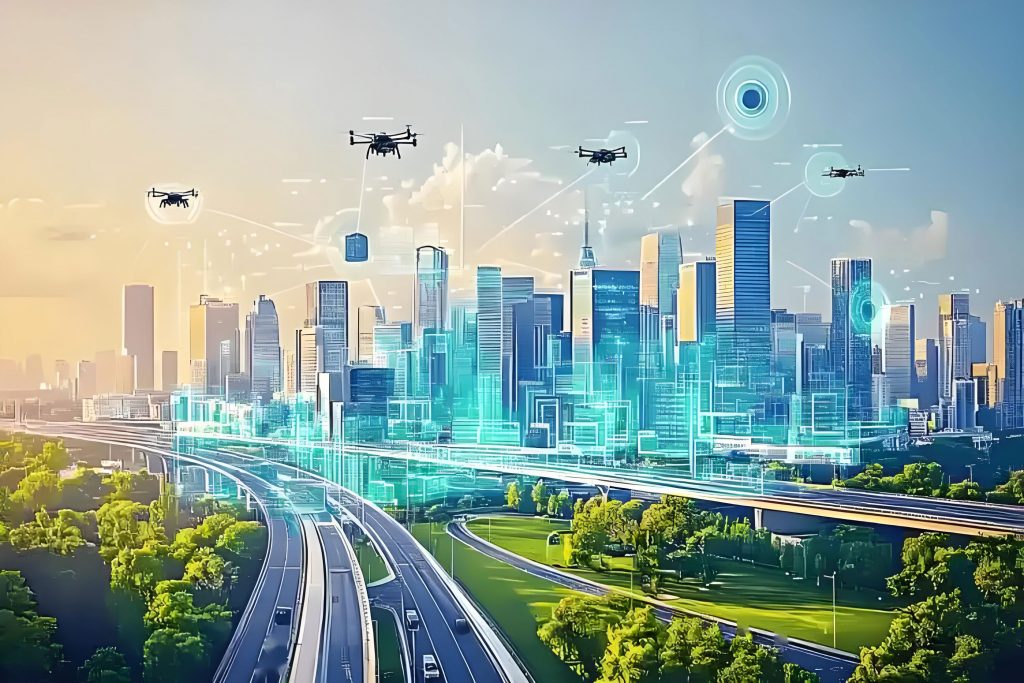
To frame this analysis, I adopt a three-dimensional framework: efficiency reconstruction, greening reconstruction, and economic value reconstruction. Each dimension is examined through formulas and tables to quantify impacts. For example, efficiency gains can be modeled using optimization algorithms, while environmental benefits are assessed through emission reduction metrics. The low altitude economy, empowered by digital maturity, not only enhances operational performance but also aligns with global sustainability goals and economic incentives. Nonetheless, the path forward is fraught with obstacles, including regulatory rigidities, technological bottlenecks, and societal resistance. By addressing these challenges through targeted strategies, the low altitude economy can evolve into a central component of the logistics ecosystem.
Literature Review
Existing research on the low altitude economy spans its application models, integration with digital technologies, and regional economic impacts. Studies highlight its utility in sectors like agriculture, tourism, and surveillance, where UAVs improve efficiency and reduce costs. For instance, in precision agriculture, drones enable targeted pesticide application and crop monitoring, boosting productivity by over 50%. Similarly, in tourism, the low altitude economy fosters innovative experiences through aerial sightseeing, driven by policy support and infrastructure development. The fusion with digital tools, such as AI and 5G-A communication, enhances navigation, safety, and automation. AI algorithms optimize flight paths and resource allocation, while blockchain ensures data integrity and trust in operations. Digital twins allow for simulation-based planning, reducing risks in low-altitude projects.
In logistics, the low altitude economy is recognized for breaking spatial constraints and enhancing supply chain resilience. It supports last-mile delivery, reduces transportation time, and mitigates environmental impacts through electric propulsion. Empirical evidence suggests that the low altitude economy positively influences regional business model innovation, with entrepreneurial environments acting as moderators. However, most studies focus on synergistic developments rather than a systematic reconstruction of logistics. Few works delve into the tripartite logic of efficiency, greening, and economic value under digital maturity. This gap motivates my analysis, which aims to provide a holistic view of how the low altitude economy, coupled with digital advancements, can redefine logistics paradigms.
Logic of Low Altitude Economy Restructuring Logistics under Digital Economy Maturity
The transformative potential of the low altitude economy hinges on four conditions: pervasive AI adoption, comprehensive digital infrastructure, mature service platforms, and established digital trust. When these elements converge, the low altitude economy transcends its traditional role, enabling large-scale logistics reconstruction. Below, I elaborate on the three-dimensional logic using formulas and tables to illustrate key points.
Efficiency Reconstruction
Efficiency reconstruction lies at the heart of logistics transformation. Traditionally, the low altitude economy offered limited efficiency gains through point-to-point optimizations, such as drone-based last-mile delivery. However, manual调度 and lack of integration hindered systemic improvements. Under digital maturity, AI-driven调度 and air-ground-space协同 networks dismantle spatiotemporal barriers. For example, dynamic route optimization models, powered by AI and real-time data from 5G-A and BeiDou navigation, minimize delivery times. The efficiency improvement can be expressed as:
$$ \Delta E = \frac{T_{\text{traditional}} – T_{\text{low altitude}}}{T_{\text{traditional}}} \times 100\% $$
where $\Delta E$ represents the percentage efficiency gain, $T_{\text{traditional}}$ is the time taken by traditional methods, and $T_{\text{low altitude}}$ is the time achieved through low altitude solutions. In practice, companies like Meituan and SF Express have reduced delivery times from 30 minutes to 8 minutes in dense urban areas, yielding efficiency gains of up to 360%. Additionally, the “low altitude + ground” multimodal transport model, facilitated by IoT and 5G, enables seamless coordination between aerial and terrestrial assets. This integration is summarized in Table 1, which compares key efficiency metrics.
| Metric | Traditional Logistics | Low Altitude Logistics (Digital) |
|---|---|---|
| Average Delivery Time (3 km radius) | 30 minutes | 8 minutes |
| Resource Utilization Rate | 60-70% | 90-95% |
| Operational Hours | Limited by human shifts | 24/7 autonomous operations |
| Coordination Efficiency | Low (manual调度) | High (AI-driven dynamic调度) |
Furthermore, the low altitude economy enables 24/7 operations through automation, eliminating human physiological limits. This continuous workflow significantly boosts logistics throughput and reliability, as demonstrated by cases like the Chengdu Railway Port, where cross-border e-commerce deliveries achieved “minute-level” speeds via “China-Europe Railway + low altitude logistics” integration.
Greening Reconstruction
Greening reconstruction addresses the environmental footprint of logistics. The low altitude economy contributes through clean energy adoption, AI-optimized energy use, and noise reduction. Electric and hydrogen-powered aircraft achieve near-zero emissions, while AI algorithms fine-tune power consumption based on real-time environmental data. The carbon reduction impact can be modeled as:
$$ C_{\text{reduction}} = \sum_{i=1}^{n} (E_{\text{traditional},i} – E_{\text{low altitude},i}) \times \text{EF}_i $$
where $C_{\text{reduction}}$ is the total carbon reduction, $E$ denotes energy consumption, $\text{EF}$ is the emission factor, and $i$ represents different transport segments. For instance, electric UAVs reduce CO₂ emissions by 50-80% compared to diesel vehicles. Noise pollution is mitigated through AI-controlled propeller adjustments, maintaining decibel levels within acceptable ranges. Policy support, such as China’s “Dual Carbon” goals and the Green Aviation Manufacturing Outline, accelerates this transition. Table 2 outlines environmental benefits.
| Aspect | Traditional Logistics | Low Altitude Logistics (Digital) |
|---|---|---|
| Carbon Emissions (g/ton-km) | 150-200 | 20-50 |
| Energy Efficiency (kWh/km) | 0.5-1.0 (fossil fuels) | 0.1-0.3 (electric) |
| Noise Level (dB) | 70-90 | 40-60 |
| Policy Alignment | Basic compliance | High (e.g., carbon trading integration) |
By aligning with national and local policies, the low altitude economy fosters a harmonious balance between economic growth and ecological preservation, essential for sustainable development.
Economic Value Reconstruction
Economic value reconstruction revolves around cost optimization and revenue diversification. Traditionally, the low altitude economy lowered energy and labor costs but faced scalability issues. Digital maturity disrupts this through AI-driven labor substitution, dynamic resource allocation, and innovative business models. The cost savings can be expressed as:
$$ \text{Savings} = C_{\text{labor}} + C_{\text{energy}} + C_{\text{storage}} – C_{\text{digital}} $$
where $C_{\text{labor}}$, $C_{\text{energy}}$, and $C_{\text{storage}}$ are traditional costs, and $C_{\text{digital}}$ represents digital implementation expenses. For example, SF Express’s drones in the Pearl River Delta cut costs by 60% per delivery. Moreover, AI optimizes inventory turnover through dynamic warehousing, reducing storage expenses by 30-50%. Revenue streams expand into emergency response, medical logistics, and carbon trading. In carbon markets, blockchain-based smart contracts automate transactions, enabling logistics firms to monetize emission allowances. The revenue model is enhanced as:
$$ R_{\text{total}} = R_{\text{base}} + R_{\text{premium}} + R_{\text{carbon}} $$
where $R_{\text{base}}$ is standard delivery revenue, $R_{\text{premium}}$ comes from customized services, and $R_{\text{carbon}}$ is carbon credit income. Government incentives, such as tax breaks and R&D deductions, further bolster profitability. Table 3 contrasts economic aspects.
| Indicator | Traditional Logistics | Low Altitude Logistics (Digital) |
|---|---|---|
| Cost per km (USD) | 0.15-0.20 | 0.05-0.10 |
| Labor Cost Share | 40-50% | 10-20% |
| Inventory Turnover | 5-10 times/year | 15-25 times/year |
| Revenue Diversification | Low (single streams) | High (multiple streams) |
Thus, the low altitude economy, underpinned by digital tools, redefines value creation in logistics, moving beyond cost reduction to holistic economic enhancement.
Current Challenges
Despite its promise, the low altitude economy faces significant hurdles in restructuring logistics. These challenges span policy, technology, and societal domains, impeding widespread adoption.
Policy and Regulatory Limitations
Regulatory inflexibility is a primary barrier. Airspace management remains rigid, with only 20-30% of airspace available for civilian use, prioritizing military needs. This restricts low-altitude operations, causing delays and reducing reliability. Certification standards for UAVs are outdated, lacking tailored frameworks for logistics-specific requirements like payload and endurance. Policy fragmentation across regions creates inconsistent standards, hindering cross-border logistics integration. For instance, varying local regulations increase compliance costs and complicate nationwide network development.
Technological and Infrastructure Limitations
Technological shortcomings include limited UAV endurance due to battery constraints—current energy densities of 285 Wh/kg allow only 30-minute flights, insufficient for long-haul logistics. AI computational power is inadequate, reliant on imported chips, which curtails real-time data processing capabilities. Infrastructure gaps involve a scarcity of take-off/landing sites—only 449 general airports and 32 flight service stations nationwide—and poor integration with logistics hubs. Charging facilities are sparse, and communication networks, especially in remote areas, suffer from low 5G coverage, disrupting UAV-ground connectivity. Service platforms lack advanced data processing, hindering dynamic调度 and resource optimization.
Social Acceptance Challenges
Public concerns over privacy and safety deter adoption. UAVs equipped with cameras and sensors risk data breaches, while operational failures could cause physical harm. Employment displacement is another issue; as drones replace delivery personnel, social resistance grows. In China, where logistics jobs provide significant employment, workforce transitions must be managed carefully to maintain stability.
Breakthrough Paths
To overcome these challenges, I propose targeted strategies that leverage digital advancements and policy reforms.
Optimizing Policies and Regulations
Reforming airspace management through digitalization is crucial. Implementing hierarchical airspace classification and streamlined, online approval systems can enhance resource allocation. For example, AI-based调度 can prioritize logistics UAVs in shared airspace. Certification standards should be updated via multi-stakeholder collaboration, incorporating logistics-specific criteria. Policy harmonization at the national level, supported by cross-departmental coordination, can reduce fragmentation and foster a unified low altitude economy ecosystem.
Enhancing Technological Innovation and Infrastructure
Boosting R&D in battery technology, such as developing solid-state batteries, can extend UAV endurance. Hydrogen fuel cells offer another avenue for improvement. AI compute autonomy should be pursued through domestic chip development and international partnerships. Infrastructure must be expanded by increasing the number of vertiports and integrating them with logistics centers. Deploying 5G networks in underserved areas and leveraging satellite communications can ensure uninterrupted connectivity. Service platforms need AI-powered data analytics for real-time调度 and standardized data protocols to facilitate interoperability.
Improving Social Acceptance
Addressing privacy concerns requires robust data protection measures, including encryption and blockchain-based security. Public education campaigns can demystify UAV operations and promote responsible usage. For employment, reskilling programs can transition workers into roles like UAV operators or maintenance technicians, supported by government incentives. Enhancing safety protocols and emergency response mechanisms will build public trust in low-altitude logistics.
Conclusion
The low altitude economy, driven by digital maturity, holds immense potential to reconstruct the logistics industry. By enhancing efficiency, promoting greening, and unlocking economic value, it transitions from a niche supplement to a core component. However, realizing this vision demands concerted efforts to address policy, technological, and social barriers. Through strategic interventions, the low altitude economy can catalyze a sustainable, intelligent, and resilient logistics future, contributing significantly to global economic and environmental goals.