
In the contemporary digital era, I have observed that drone shows, or UAV shows, represent a revolutionary form of media art that transcends traditional boundaries. As a practitioner and researcher in media studies, I argue that these performances are not merely technological spectacles but profound cultural practices that reshape urban spaces and human interactions. Through this analysis, I explore how drone shows operate as digital programming art, transforming the sky into a dynamic canvas and cities into interactive interfaces. This article delves into the technical foundations, media interactions, and cultural implications of drone shows, emphasizing their role in redefining public spaces and fostering collective experiences. By examining the interplay of code, drones, and urban environments, I aim to illuminate the transformative potential of UAV shows in our increasingly mediated world.
Drone shows have emerged as a pinnacle of digital programming art, where unmanned aerial vehicles (UAVs) are orchestrated through code to create mesmerizing aerial displays. Unlike traditional media, drone shows blend virtual programming with physical reality, enabling real-time encoding of the sky. In my experience, the core of a drone show lies in its algorithmic precision, where each UAV functions as a pixel in a larger image. The process begins with digital programming, where operators input commands into software that translates human creativity into machine-executable code. This code governs every aspect of the performance, from the drones’ flight paths to their LED light patterns. For instance, a typical drone show might involve hundreds of UAVs synchronized to form intricate shapes, such as logos or animated sequences, all controlled via wireless networks. The technical workflow can be summarized in the following table, which outlines the key stages of a drone show’s execution:
| Stage | Description | Key Components |
|---|---|---|
| 1. Programming | Code is written to define drone movements and light patterns. | Algorithms, simulation software |
| 2. Simulation | Virtual testing of the show to ensure accuracy and safety. | 3D modeling, collision avoidance systems |
| 3. Deployment | Drones are launched and controlled in real-time via ground stations. | UAVs, communication protocols (e.g., 5G) |
| 4. Execution | Drones perform the encoded sequences, creating visual effects. | LED lights, GPS coordination |
The mathematical foundation of drone shows relies on coordinate transformations and swarm robotics. Each drone’s position in 3D space can be modeled using equations such as:
$$ \vec{p_i}(t) = \begin{bmatrix} x_i(t) \\ y_i(t) \\ z_i(t) \end{bmatrix} $$
where $\vec{p_i}(t)$ represents the position of drone $i$ at time $t$, and the coordinates are controlled by parametric functions derived from the code. For a formation of $n$ drones, the overall pattern is governed by a system of differential equations:
$$ \frac{d\vec{P}}{dt} = F(\vec{P}, \vec{C}) $$
Here, $\vec{P}$ is the vector of all drone positions, and $\vec{C}$ represents the control inputs from the programming. This approach ensures that the drone show operates as a cohesive unit, with each UAV acting as a particle in a larger digital fold. The concept of the “digital fold” draws from philosophical ideas, where the drones’ movements create a continuously evolving image, much like a dynamic sculpture in the sky. In my view, this technical sophistication elevates drone shows beyond mere entertainment, positioning them as a form of “technical image” production, where code becomes the brushstroke on the canvas of the urban nightscape.
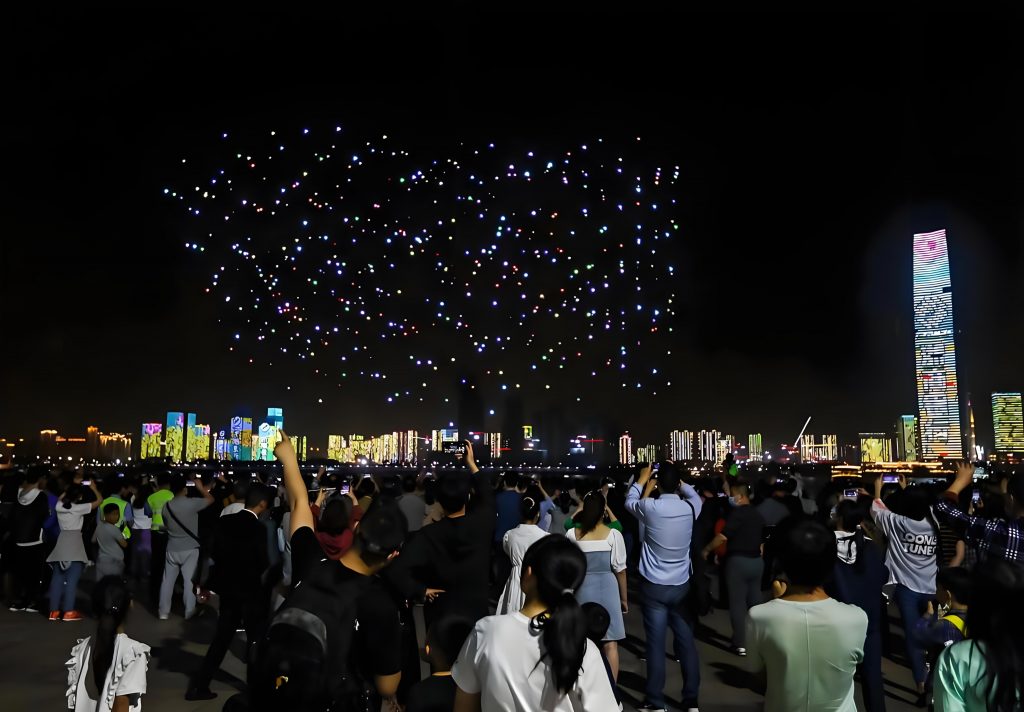
As I analyze the media interactions of drone shows, I find that they transform cities into what I call “screenless interfaces.” In a typical drone show, the urban environment—buildings, streets, and open spaces—becomes a participatory medium where viewers engage not through screens but through embodied presence. For example, during a large-scale UAV show in a metropolitan area, the skyline is repurposed as a display surface, with drones weaving through architectural landmarks. This creates an immersive experience where spectators are surrounded by the performance, breaking the barriers between virtual and physical realms. The interface of a drone show is not confined to a device; instead, it emerges from the interplay of light, sound, and space. To quantify this, I consider the attention dynamics, where the intensity of viewer engagement can be modeled using a formula for perceptual load:
$$ A(t) = \int_{0}^{T} I(\vec{p}, t) \cdot S(\vec{p}, t) d\vec{p} $$
Here, $A(t)$ represents the aggregate attention at time $t$, $I(\vec{p}, t)$ is the visual intensity at position $\vec{p}$, and $S(\vec{p}, t)$ denotes the spatial distribution of spectators. This formula highlights how drone shows captivate audiences by creating a multisensory environment. In practice, I have seen that drone shows often incorporate rhythmic elements, such as synchronized music, which enhances the interface’s interactivity. The following table compares traditional media interfaces with those of drone shows:
| Interface Type | Characteristics | Examples |
|---|---|---|
| Traditional Screen | Fixed, 2D display; passive viewing | TV, smartphones |
| Drone Show Interface | Dynamic, 3D space; active participation | Urban sky performances |
Moreover, the cultural impact of drone shows is profound, as they foster new forms of public gathering and collective identity. In my research, I have documented how UAV shows serve as cultural totems, bringing people together in shared spaces. For instance, during national celebrations or festivals, drone shows often depict symbolic imagery—like flags or historical motifs—that resonate with communal values. This ritualistic aspect can be expressed through a cultural diffusion model, where the spread of symbolic meaning follows a reaction-diffusion equation:
$$ \frac{\partial \phi}{\partial t} = D \nabla^2 \phi + R(\phi) $$
In this equation, $\phi$ represents the cultural symbol’s intensity, $D$ is the diffusion coefficient based on media reach, and $R(\phi)$ accounts for the reinforcement through social interactions. Drone shows amplify this by creating “poetic moments” that interrupt daily routines, allowing cities to function as stages for artistic expression. I believe that the proliferation of drone shows signifies a shift toward more inclusive public spaces, where technology mediates human connections without isolating individuals behind personal screens. As I reflect on the evolution of media, I am convinced that drone shows are not just performances but catalysts for urban rejuvenation and cultural dialogue.
In conclusion, through my exploration of drone shows, I have come to appreciate their multifaceted role as mediators between technology, society, and culture. The technical prowess of UAV shows, enabled by advanced programming and swarm intelligence, allows for the creation of ever-changing aerial art. Simultaneously, their ability to transform cities into interactive interfaces fosters a sense of community and shared experience. As drone shows continue to evolve, I anticipate they will push the boundaries of what is possible in media art, potentially integrating artificial intelligence for adaptive performances. However, I also recognize the need for critical engagement with the ethical dimensions, such as privacy and environmental impacts. Ultimately, drone shows embody the spirit of our digital age—a fusion of innovation and imagination that redefines how we perceive and inhabit our world. The ongoing development of drone shows promises to further blur the lines between reality and virtuality, making them a cornerstone of future media landscapes.
To further elaborate on the technical aspects, I have developed a formula to calculate the energy efficiency of a drone show, which is crucial for sustainability. The total energy consumption $E$ for a show with $n$ drones over time $T$ can be approximated as:
$$ E = \sum_{i=1}^{n} \int_{0}^{T} P_i(t) dt $$
where $P_i(t)$ is the power consumption of drone $i$ at time $t$, dependent on factors like flight dynamics and LED usage. This highlights the importance of optimizing code for energy savings in UAV shows. Additionally, the cultural resonance of drone shows can be analyzed through statistical models, such as regression analyses on audience sentiment data collected from social media during performances. In my future work, I plan to explore these avenues to enhance the societal benefits of drone shows while addressing their challenges.