
In recent years, the rapid advancement of drone technology has revolutionized various sectors, including military reconnaissance, civilian surveillance, and disaster response. As Unmanned Aerial Vehicles (UAVs) operate in increasingly complex environments, the demand for robust autonomous systems capable of accurate target recognition and tracking has grown. Traditional methods, which rely on manually predefined rules or templates, often struggle to adapt to dynamic conditions. The integration of artificial intelligence (AI) offers a transformative approach, enabling drones to learn from data and perform with higher precision. This study explores the development of an AI-driven system that combines deep learning algorithms with advanced tracking techniques to enhance the autonomy of Unmanned Aerial Vehicles in challenging scenarios. By focusing on real-time applications, we aim to improve the efficiency and reliability of drone operations across diverse fields.
The core of our approach lies in constructing an integrated framework that leverages AI for both recognition and tracking. We employ convolutional neural networks (CNNs) to extract features from visual data, allowing for high-accuracy identification of targets. Additionally, we incorporate tracking algorithms like Kalman filters and particle filters to maintain target lock in dynamic environments. Sensor fusion techniques further bolster system robustness, enabling Unmanned Aerial Vehicles to handle occlusions, lighting variations, and other complexities. Through extensive testing, we demonstrate that this AI-enhanced system significantly boosts the performance of drone technology in tasks such as monitoring and reconnaissance. Below, we delve into the system architecture, technical methodologies, and fusion strategies that underpin our research.
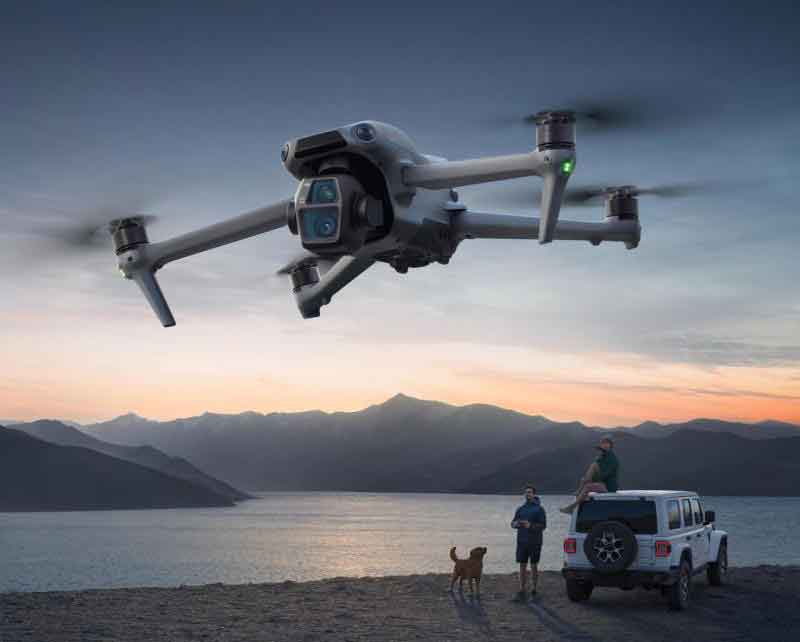
To build an effective AI-based recognition and tracking system for drone technology, we designed a modular architecture comprising several key components. This system integrates radar systems, electro-optical turrets, encoding devices, fiber optic transceivers, main control computers, switches, and network video recorder (NVR) storage, all extendable to higher-level command systems. The radar system serves as the front-end detection unit, emitting waves to identify the presence and approximate location of Unmanned Aerial Vehicles. The electro-optical turret then refines this data using photoelectric sensors to capture precise positional and visual characteristics. Encoding devices convert this information into digital signals, which are transmitted via fiber optic transceivers to the main control computer. As the system’s core, the main control computer utilizes powerful computational resources to apply pattern recognition and deep learning algorithms for real-time analysis, enabling the classification of drone types and flight paths. The switch connects the computer to NVR storage, ensuring all critical data is logged for post-mission analysis. This integrated setup not only enhances the autonomy of Unmanned Aerial Vehicles but also supports scalability for urban air traffic management and environmental monitoring. The following table summarizes the key components and their functions in the system:
| Component | Function | Role in Drone Technology |
|---|---|---|
| Radar System | Detects UAV presence and rough location | Initial target acquisition for Unmanned Aerial Vehicles |
| Electro-Optical Turret | Captures precise visual and positional data | Enhances recognition accuracy in drone operations |
| Encoding Device | Converts analog signals to digital format | Facilitates data processing for AI algorithms |
| Main Control Computer | Processes data using deep learning models | Core of AI-driven decision-making in drone technology |
| NVR Storage | Records and stores mission data | Supports post-analysis for improving Unmanned Aerial Vehicle systems |
In the realm of drone recognition, AI techniques play a pivotal role in transforming raw data into actionable insights. The recognition process begins with image acquisition through high-resolution cameras mounted on Unmanned Aerial Vehicles, followed by preprocessing steps like noise reduction and contrast enhancement to improve input quality. Feature extraction focuses on identifying key attributes such as shape, color, and texture, which are invariant to environmental changes. For instance, shape features are derived through contour extraction and edge detection, while color features utilize color space transformations and histogram analysis. Deep learning algorithms, particularly CNNs, automate this process by learning hierarchical representations from data, eliminating the need for manual feature engineering. A CNN typically consists of multiple convolutional and pooling layers that extract spatial hierarchies, followed by fully connected layers for classification. The mathematical representation of a convolutional layer can be expressed as:
$$y_{ij} = \sigma \left( \sum_{m} \sum_{n} w_{mn} \cdot x_{i+m, j+n} + b \right)$$
where \(y_{ij}\) is the output feature map, \(\sigma\) is the activation function, \(w_{mn}\) represents the kernel weights, \(x\) is the input, and \(b\) is the bias term. This allows the system to adapt to various drone models and conditions. To optimize recognition performance, we employ data augmentation techniques such as rotation, scaling, and cropping to increase dataset diversity. Moreover, model training involves selecting appropriate loss functions and optimizers; for example, the cross-entropy loss for multi-class classification is given by:
$$L = -\sum_{c=1}^{M} y_{o,c} \log(p_{o,c})$$
where \(M\) is the number of classes, \(y_{o,c}\) is the binary indicator for class \(c\), and \(p_{o,c}\) is the predicted probability. Through iterative training and validation, we achieve high accuracy in identifying Unmanned Aerial Vehicles, even in cluttered backgrounds. The table below compares different feature extraction methods and their effectiveness in drone recognition:
| Feature Type | Extraction Method | Advantages in Drone Technology | Limitations |
|---|---|---|---|
| Shape | Contour detection, edge analysis | Robust to lighting changes for Unmanned Aerial Vehicles | Sensitive to occlusions |
| Color | Color histograms, space conversion | Effective for high-contrast scenarios in drone operations | Vulnerable to illumination variations |
| Texture | Texture analysis, Gabor filters | Useful for distinguishing drone surfaces | Computationally intensive |
Drone tracking technology builds upon recognition outcomes to ensure continuous target monitoring. The fundamental principle involves using computer vision algorithms to estimate the state of a target over time, based on sequential data from sensors. Common tracking methods include visual-based tracking, which relies on image sequences, and fusion-based approaches that combine GPS and inertial measurement units (IMU) for improved accuracy. However, challenges such as rapid target movement, occlusions, and multi-target scenarios persist. AI addresses these issues through algorithms like Kalman filters, which predict and update target states recursively. The Kalman filter equations for prediction and update are:
$$x_{k|k-1} = F_k x_{k-1|k-1} + B_k u_k$$
$$P_{k|k-1} = F_k P_{k-1|k-1} F_k^T + Q_k$$
for the prediction step, and
$$K_k = P_{k|k-1} H_k^T (H_k P_{k|k-1} H_k^T + R_k)^{-1}$$
$$x_{k|k} = x_{k|k-1} + K_k (z_k – H_k x_{k|k-1})$$
$$P_{k|k} = (I – K_k H_k) P_{k|k-1}$$
for the update step, where \(x\) is the state vector, \(P\) is the error covariance, \(F\) is the state transition matrix, \(K\) is the Kalman gain, and \(z\) is the measurement. Particle filters, on the other hand, use a set of particles to represent the posterior distribution, making them suitable for non-linear systems. In multi-target tracking, deep learning techniques like attention mechanisms enable the system to focus on relevant targets, enhancing performance in dense environments. Optimization strategies involve dynamic adjustment of tracking parameters based on real-time feedback, ensuring that Unmanned Aerial Vehicles maintain lock even under adverse conditions. The integration of these AI-driven tracking methods significantly improves the reliability of drone technology in applications such as surveillance and search-and-rescue.
The fusion of recognition and tracking technologies is crucial for achieving full autonomy in drone operations. By combining these capabilities, Unmanned Aerial Vehicles can not only identify targets but also follow them seamlessly. This integration is facilitated through a unified framework that processes data from multiple sensors, such as cameras, radar, and lidar. Sensor fusion algorithms, like the extended Kalman filter or deep fusion networks, merge data to provide a comprehensive view of the environment. For example, the fusion of visual and radar data can be modeled as:
$$z_{\text{fused}} = \alpha z_{\text{visual}} + \beta z_{\text{radar}}$$
where \(\alpha\) and \(\beta\) are weighting coefficients optimized for minimal error. This approach enhances robustness against sensor failures and environmental noise. In practice, the recognition module feeds target information to the tracker, which then adjusts the drone’s flight path using control algorithms. The dynamic adjustment can be formulated as a optimization problem:
$$\min_{u} \sum_{t=1}^{T} \| x_t – x_{\text{target}} \|^2 + \lambda \| u_t \|^2$$
where \(u\) represents control inputs, \(x\) is the drone’s state, and \(\lambda\) is a regularization parameter. AI algorithms further optimize this process through online learning, allowing the system to adapt to new targets or environments. For instance, transfer learning can fine-tune pre-trained models on specific drone datasets, reducing training time and improving accuracy. The table below illustrates the impact of fusion techniques on system performance metrics:
| Fusion Technique | Components Integrated | Improvement in Drone Technology | Application Example |
|---|---|---|---|
| Data-Level Fusion | Raw sensor data (e.g., images, radar signals) | Enhances target detection range for Unmanned Aerial Vehicles | Urban monitoring in low-light conditions |
| Feature-Level Fusion | Extracted features (e.g., shapes, velocities) | Improves recognition accuracy in cluttered scenes | Agricultural drone surveys |
| Decision-Level Fusion | Outputs from multiple algorithms | Increases reliability in multi-target tracking | Military reconnaissance missions |
Algorithm optimization plays a vital role in refining the fusion of recognition and tracking for drone technology. We employ techniques such as model pruning and quantization to reduce computational complexity, enabling real-time performance on resource-constrained Unmanned Aerial Vehicles. For example, pruning removes redundant weights from neural networks, which can be expressed as:
$$\min_{W’} \| f(W) – f(W’) \|^2 \quad \text{subject to} \quad \|W’\|_0 \leq k$$
where \(W\) and \(W’\) are the original and pruned weights, respectively, and \(k\) is the sparsity constraint. Additionally, distributed training methods accelerate model development by parallelizing computations across multiple GPUs. The synergy between AI algorithms and sensor fusion not only boosts the accuracy of drone operations but also extends their applicability to complex tasks like autonomous navigation and collaborative swarming. As drone technology evolves, continuous improvements in AI-driven fusion will unlock new potentials for Unmanned Aerial Vehicles in smart cities and disaster management.
In conclusion, the integration of AI into drone recognition and tracking systems marks a significant leap forward for autonomous Unmanned Aerial Vehicles. By leveraging deep learning for feature extraction and combining it with robust tracking algorithms, we have developed a system that excels in dynamic environments. Sensor fusion further augments this capability, ensuring high performance under varying conditions. This research underscores the transformative potential of AI in advancing drone technology, paving the way for wider adoption in military and civilian domains. Future work will focus on enhancing real-time processing and adapting to emerging challenges, ultimately making Unmanned Aerial Vehicles more intelligent and dependable.