
In recent years, drone technology has revolutionized various applications, including surveillance, logistics, and emergency response, due to the flexibility and mobility of Unmanned Aerial Vehicles (UAVs). However, ensuring secure communication in UAV-assisted networks remains a critical challenge, especially when UAVs experience jittering caused by random airflow and body vibrations. This jittering leads to channel estimation errors, degrading the performance of physical layer security. To address this, we propose a novel scheme that leverages active Reconfigurable Intelligent Surfaces (RIS) to enhance secure communication while minimizing the transmit power of UAV-mounted base stations. Unlike passive RIS, which suffers from the “double fading” effect, active RIS can amplify reflected signals, compensating for path loss and improving security. Our work focuses on robust beamforming design under channel uncertainties induced by UAV jittering, using Taylor series linearization to model angle errors. We formulate a power minimization problem with secrecy rate constraints and solve it via alternating optimization. Simulation results demonstrate that our scheme significantly reduces transmit power and maintains secure communication rates even under severe jittering conditions, highlighting the potential of active RIS in advancing drone technology.
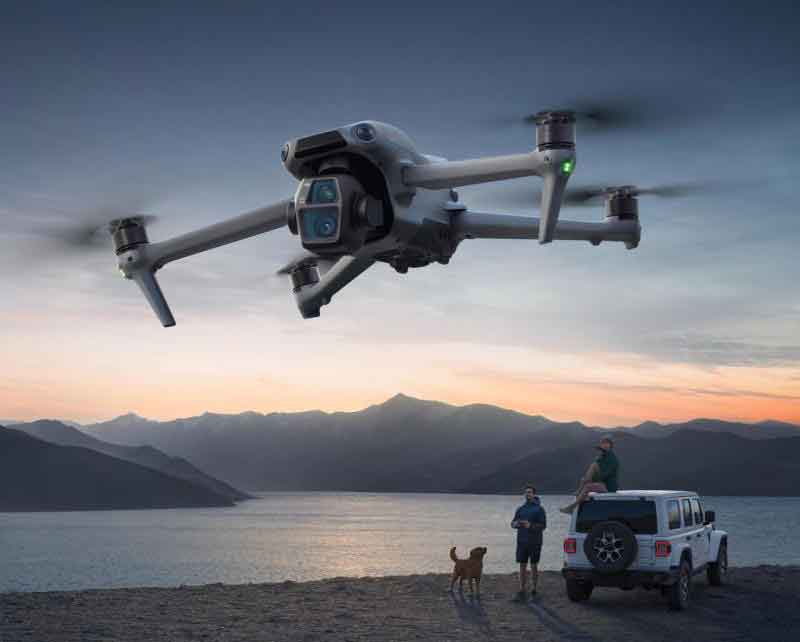
The integration of drone technology into modern communication systems has opened new avenues for efficient data transmission, but it also introduces vulnerabilities, particularly in security. Unmanned Aerial Vehicles often operate in dynamic environments where jittering—resulting from factors like wind gusts and mechanical vibrations—can destabilize communication links. This jittering causes deviations in the Angle of Departure (AOD) and Angle of Arrival (AOA), leading to imperfect Channel State Information (CSI). In such scenarios, traditional passive RIS elements may not provide sufficient gains due to their inability to amplify signals. Our approach employs active RIS, which incorporates reflective amplifiers to enhance signal strength and mitigate the impact of jittering. By jointly optimizing the precoding matrix at the UAV base station and the reflection coefficients of the active RIS, we achieve robust secure communication with minimal power consumption. This paper delves into the system model, problem formulation, and solution methodology, supported by extensive simulations that validate the efficacy of our scheme in real-world scenarios involving Unmanned Aerial Vehicle operations.
System Model and Channel Characterization
We consider an air-to-ground communication system where a UAV-mounted base station (UBS) serves a legitimate user, Alice, in the presence of an eavesdropper, Eve. The UBS is equipped with a uniform rectangular array (URA) of $N = N_x \times N_y$ antennas, while the active RIS consists of $M = M_x \times M_y$ reflecting elements (REs). The active RIS is deployed on a ground structure to assist the communication by reflecting and amplifying signals. The coordinates of the UBS, Alice, Eve, and the RIS reference point are denoted as $(x_U, y_U, z_U)$, $(x_A, y_A, 0)$, $(x_E, y_E, 0)$, and $(x_I, y_I, z_I)$, respectively. The distances between nodes are approximated based on these coordinates, and channels follow Rician fading to account for both Line-of-Sight (LOS) and Non-Line-of-Sight (NLOS) components.
The channel from UBS to Alice, $\mathbf{h}_U$, is modeled as a combination of LOS and NLOS components:
$$ \mathbf{h}_U = \sqrt{\frac{A_L d_U^{-\alpha_L} K_U}{1 + K_U}} \mathbf{h}_{U,L} + \sqrt{\frac{A_N d_U^{-\alpha_N}}{1 + K_U}} \mathbf{h}_{U,N} $$
where $d_U$ is the distance between UBS and Alice, $K_U$ is the Rician factor, $A_L$ and $A_N$ are the path loss factors for LOS and NLOS components, and $\alpha_L$ and $\alpha_N$ are the path loss exponents. The LOS component $\mathbf{h}_{U,L}$ depends on the AOD, while the NLOS component $\mathbf{h}_{U,N}$ follows a complex Gaussian distribution with zero mean and unit variance. Similarly, channels for Eve ($\mathbf{h}_E$) and the RIS ($\mathbf{H}_I$) are defined. The active RIS reflection coefficient matrix is $\boldsymbol{\Theta} = \text{diag}(\beta_1 e^{j\theta_1}, \beta_2 e^{j\theta_2}, \dots, \beta_M e^{j\theta_M})$, where $\beta_m \geq 1$ denotes the amplification factor and $\theta_m$ the phase shift for the $m$-th RE.
UAV jittering introduces uncertainties in the AOD and AOA. For instance, the elevation angle $\phi_U$ and azimuth angle $\psi_U$ for the UBS-Alice link are affected by random variations:
$$ \phi_U = \hat{\phi}_U + \Delta \phi_U, \quad \psi_U = \hat{\psi}_U + \Delta \psi_U $$
where $\hat{\phi}_U$ and $\hat{\psi}_U$ are estimated angles, and $\Delta \phi_U$, $\Delta \psi_U$ are bounded uncertainties. The set of possible uncertainties for Alice is defined as $\mathcal{U}_U = \{ (\Delta \phi_U, \Delta \psi_U) : |\Delta \phi_U| \leq \delta_{U1}, |\Delta \psi_U| \leq \delta_{U2} \}$. Similar sets apply for Eve and the RIS. To handle the nonlinear dependence of LOS channels on angles, we use a first-order Taylor expansion. For example, the LOS component for UBS-Alice is approximated as:
$$ \mathbf{h}_{U,L} \approx \hat{\mathbf{h}}_{U,L} + \frac{\partial \mathbf{h}_{U,L}}{\partial \phi_U} \Delta \phi_U + \frac{\partial \mathbf{h}_{U,L}}{\partial \psi_U} \Delta \psi_U $$
where $\hat{\mathbf{h}}_{U,L}$ is the estimated channel. The partial derivatives are computed based on the array response vectors for URA. This linearization allows us to express the channel error as a bounded model. The overall channel with uncertainty is then:
$$ \mathbf{h}_U = \hat{\mathbf{h}}_U + \Delta \mathbf{h}_U $$
where $\Delta \mathbf{h}_U$ represents the error due to jittering. Similarly, the cascaded channels via RIS, $\mathbf{G}_U = \text{diag}(\mathbf{h}_{I,U}^H) \mathbf{H}_I$ for Alice and $\mathbf{G}_E = \text{diag}(\mathbf{h}_{I,E}^H) \mathbf{H}_I$ for Eve, are derived with their respective error models.
| Parameter | Description | Value |
|---|---|---|
| $N$ | Number of UBS antennas | 4 (2×2 URA) |
| $M$ | Number of RIS elements | 16 (4×4 URA) |
| $K_U, K_E, K_I$ | Rician factors | 4.5, 1, 3 |
| $\alpha_L, \alpha_N$ | Path loss exponents | 2.09, 3.75 |
| $A_L, A_N$ | Path loss factors (dB) | 2.14, 3.14 |
| $\delta_{U1}, \delta_{U2}$ | Uncertainty bounds for Alice | 0.1 rad |
Signal Model and Secrecy Rate Analysis
The received signal at Alice combines the direct link from UBS and the reflected link via the active RIS:
$$ y_U = \mathbf{h}_U^H \mathbf{w} s + \mathbf{h}_{I,U}^H \boldsymbol{\Theta} \mathbf{H}_I \mathbf{w} s + \mathbf{h}_{I,U}^H \boldsymbol{\Theta} \mathbf{n}_I + n_U $$
where $\mathbf{w}$ is the precoding vector at UBS, $s$ is the data symbol with unit power, $\mathbf{n}_I \sim \mathcal{CN}(0, \sigma_I^2 \mathbf{I}_M)$ is the noise at the RIS, and $n_U \sim \mathcal{CN}(0, \sigma_U^2)$ is the noise at Alice. Similarly, the signal at Eve is:
$$ y_E = \mathbf{h}_E^H \mathbf{w} s + \mathbf{h}_{I,E}^H \boldsymbol{\Theta} \mathbf{H}_I \mathbf{w} s + \mathbf{h}_{I,E}^H \boldsymbol{\Theta} \mathbf{n}_I + n_E $$
The achievable rates for Alice and Eve are given by:
$$ R_U = \log_2 \left(1 + \frac{|\mathbf{h}_U^H \mathbf{w} + \mathbf{h}_{I,U}^H \boldsymbol{\Theta} \mathbf{H}_I \mathbf{w}|^2}{\sigma_U^2 + \|\mathbf{h}_{I,U}^H \boldsymbol{\Theta}\|^2 \sigma_I^2}\right) $$
$$ R_E = \log_2 \left(1 + \frac{|\mathbf{h}_E^H \mathbf{w} + \mathbf{h}_{I,E}^H \boldsymbol{\Theta} \mathbf{H}_I \mathbf{w}|^2}{\sigma_E^2 + \|\mathbf{h}_{I,E}^H \boldsymbol{\Theta}\|^2 \sigma_I^2}\right) $$
The worst-case secrecy rate, considering channel uncertainties, is defined as:
$$ R_{\text{sec}} = \min_{\Delta \mathbf{h}_U, \Delta \mathbf{G}_U \in \mathcal{U}_U} R_U – \max_{\Delta \mathbf{h}_E, \Delta \mathbf{G}_E \in \mathcal{U}_E} R_E $$
To ensure security, we require $R_{\text{sec}} > 0$. The power consumption at the active RIS is constrained by the amplification power budget $P_F$:
$$ \|\boldsymbol{\Theta} \mathbf{H}_I \mathbf{w}\|^2 + \|\boldsymbol{\Theta}\|_F^2 \sigma_I^2 \leq P_F $$
Additionally, each RE has a maximum amplification factor $\beta_{\text{max}}$, and the UBS transmit power is limited by a peak power $P_{\text{peak}}$.
Problem Formulation for Power Minimization
Our objective is to minimize the UBS transmit power while satisfying the secrecy rate constraint and power limits. The optimization problem is formulated as:
$$ \min_{\mathbf{w}, \boldsymbol{\Theta}} \|\mathbf{w}\|^2 $$
subject to:
$$ \|\mathbf{w}\|^2 \leq P_{\text{peak}} $$
$$ \min_{\Delta \mathbf{h}_U, \Delta \mathbf{G}_U \in \mathcal{U}_U} R_U \geq \bar{R}_U $$
$$ \max_{\Delta \mathbf{h}_E, \Delta \mathbf{G}_E \in \mathcal{U}_E} R_E \leq \bar{R}_E $$
$$ \|\boldsymbol{\Theta} \mathbf{H}_I \mathbf{w}\|^2 + \|\boldsymbol{\Theta}\|_F^2 \sigma_I^2 \leq P_F $$
$$ |\beta_m| \leq \beta_{\text{max}}, \quad \forall m $$
where $\bar{R}_U$ and $\bar{R}_E$ are the target rates for Alice and Eve, respectively. This problem is non-convex due to the coupling between $\mathbf{w}$ and $\boldsymbol{\Theta}$, and the worst-case constraints. We employ an alternating optimization (AO) approach, iteratively solving for $\mathbf{w}$ and $\boldsymbol{\Theta}$.
Alternating Optimization Solution
The AO method decomposes the problem into two subproblems: one for optimizing the precoding vector $\mathbf{w}$ with fixed $\boldsymbol{\Theta}$, and another for optimizing the reflection coefficients $\boldsymbol{\Theta}$ with fixed $\mathbf{w}$. We use the S-lemma to transform the worst-case rate constraints into Linear Matrix Inequalities (LMIs) for tractability.
Subproblem 1: Optimizing Precoding Vector $\mathbf{w}$
For fixed $\boldsymbol{\Theta}$, the subproblem for $\mathbf{w}$ involves minimizing $\|\mathbf{w}\|^2$ subject to the secrecy rate and power constraints. Using the S-lemma, the worst-case constraint for Alice’s rate can be rewritten as an LMI. For example, the signal power constraint for Alice becomes:
$$ \begin{bmatrix} \mathbf{I}_N & \mathbf{0} \\ \mathbf{0} & -\mathbf{V}_U \end{bmatrix} + \lambda_U \begin{bmatrix} \mathbf{A}_U & \mathbf{a}_U \\ \mathbf{a}_U^H & 0 \end{bmatrix} \succeq 0 $$
where $\mathbf{V}_U$ is a function of the channel estimates and uncertainties, and $\lambda_U \geq 0$ is a slack variable. Similarly, for Eve’s constraint. The RIS power constraint is handled using the Schur complement:
$$ \begin{bmatrix} P_F – \sigma_I^2 \|\mathbf{v}\|^2 & \mathbf{w}^H \mathbf{H}_I^H \text{diag}(\mathbf{v}) \\ \text{diag}(\mathbf{v}) \mathbf{H}_I \mathbf{w} & \mathbf{I}_M \end{bmatrix} \succeq 0 $$
where $\mathbf{v}$ is the vector of diagonal elements of $\boldsymbol{\Theta}$. This subproblem is a convex Semidefinite Program (SDP) solvable with CVX.
Subproblem 2: Optimizing Reflection Coefficients $\boldsymbol{\Theta}$
For fixed $\mathbf{w}$, we optimize $\mathbf{v}$ to maximize the secrecy rate margin. Introducing slack variables $\tau_U$ and $\tau_E$ for the rate constraints, the subproblem becomes:
$$ \max_{\mathbf{v}, \tau_U, \tau_E} \tau_U – \tau_E $$
subject to the LMIs for Alice and Eve, and the RIS power constraint. This is also a convex SDP. The AO algorithm iterates until convergence, ensuring a local optimum.
| Variable | Description | Constraint Type |
|---|---|---|
| $\mathbf{w}$ | Precoding vector | Power and secrecy rate |
| $\mathbf{v}$ | RIS reflection coefficients | Amplification and power |
| $\lambda_U, \lambda_E$ | Slack variables for LMIs | Non-negativity |
Simulation Results and Performance Analysis
We simulate the proposed scheme using MATLAB with parameters based on practical drone technology scenarios. The UBS is at $(10, 20, 10)$, RIS at $(10, 0, 10)$, Alice at $(20, 20, 0)$, and Eve at $(10, 40, 0)$. We set $P_F = 10$ dBm, $\beta_{\text{max}} = 30$ dB, $P_{\text{peak}} = 40$ dBm, and noise power $\sigma_I^2 = \sigma_U^2 = \sigma_E^2 = -10$ dBm. The uncertainty bounds are $\delta_{U1} = \delta_{U2} = 0.1$ rad for Alice and similar for Eve.
First, we analyze the impact of channel uncertainty due to UAV jittering on the transmit power. Figure 1 shows the transmit power versus the AOD variation ratio for Alice ($\Delta \phi_U / \hat{\phi}_U$). As the jittering increases, the required transmit power rises to maintain the secrecy rate. However, our active RIS scheme significantly reduces power compared to passive RIS, especially with fewer REs. For instance, with $M=20$ REs, active RIS cuts power by up to 10 times when the jittering ratio is 0.02.
Next, we examine the effect of RIS size on performance. Figure 2 plots the transmit power against the number of RIS elements $M$. Active RIS achieves optimal power with only 15-20 REs, beyond which power increases due to amplified noise. In contrast, passive RIS requires over 90 REs to match the performance, underscoring the efficiency of active RIS in drone technology applications.
These results highlight the robustness of our scheme against UAV jittering, ensuring secure communication with minimal power consumption. The integration of active RIS into Unmanned Aerial Vehicle networks thus offers a promising solution for enhancing security in dynamic environments.
Conclusion
In this paper, we addressed the challenge of secure communication in jitter-prone UAV networks by proposing an active RIS-assisted scheme. Using Taylor linearization to model channel errors and alternating optimization for joint beamforming, we minimized transmit power while guaranteeing secrecy rates. Simulations confirmed that active RIS outperforms passive RIS, particularly under significant jittering, enabling efficient use of drone technology in secure air-to-ground links. Future work could explore multi-user scenarios and deep learning-based optimization for real-time adaptation in Unmanned Aerial Vehicle systems.