
In recent years, the rapid advancement of wireless technologies has permeated various aspects of societal production and daily life, with drone shows emerging as a prominent example. As environmental regulations have tightened globally, traditional firework displays have gradually been phased out, making way for drone formation performances as a high-tech alternative. These drone shows have become integral to celebrations and major events, offering a spectacular visual experience. However, the explosive growth in demand for drone shows has exposed significant safety concerns, including incidents of失控, crashes, and collisions due to uneven technical standards, inadequate performance experience, and poor management organization. These issues pose risks to public safety, urban aesthetics, and environmental integrity. Therefore, strengthening the safety management of drone shows has become a critical challenge for regulatory bodies. In this article, I will delve into the inherent safety hazards of drone shows and propose comprehensive strategies to mitigate these risks, drawing from industry observations and analytical frameworks.
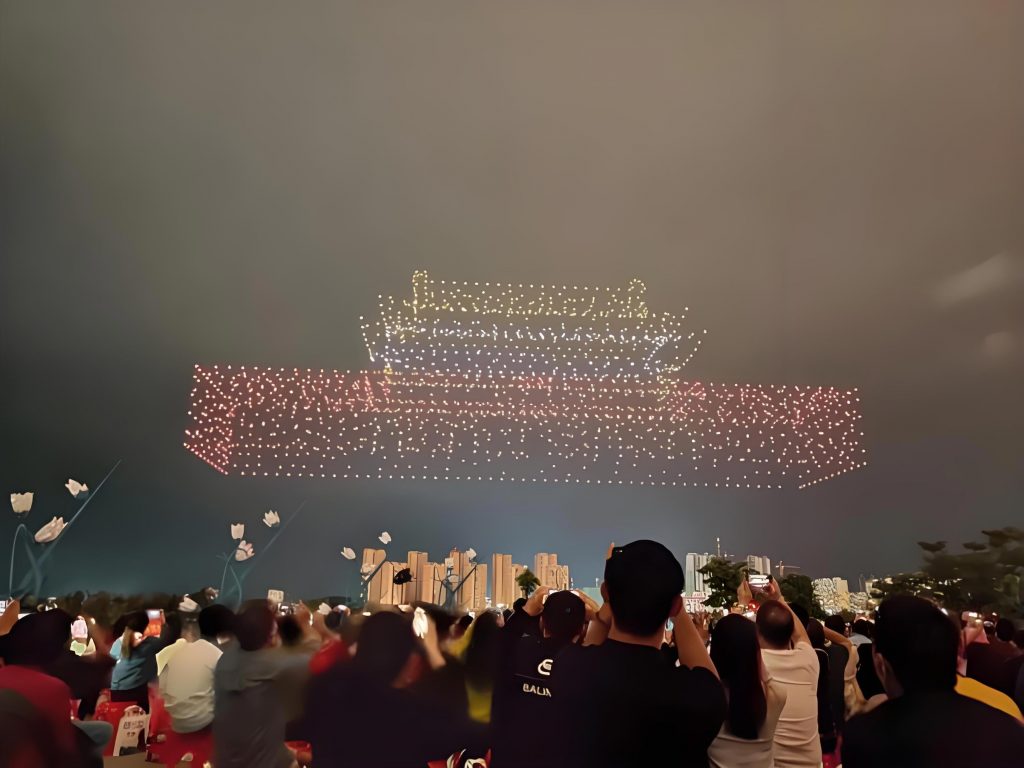
The proliferation of drone shows has highlighted several vulnerabilities that require immediate attention. A drone show involves coordinating multiple unmanned aerial vehicles (UAVs) to perform synchronized maneuvers, often in densely populated areas. While this technology offers immense creative potential, it also introduces complex safety dynamics. From my perspective, the core issues stem from technological immaturity, regulatory gaps, and operational inefficiencies. For instance, during a typical drone show, factors such as equipment reliability, operator skill, weather conditions, and public infrastructure can all contribute to accidents, potentially leading to injuries or fatalities. To systematically address these concerns, I will analyze the primary safety hazards in drone shows, utilizing tables and formulas to summarize key points and enhance clarity.
First and foremost, the equipment used in drone shows presents significant safety risks. Many commercial companies, in an effort to reduce costs, deploy drones with basic flight and lighting functions but lack advanced感知避障 sensors. This omission increases the likelihood of mid-air collisions, especially in complex formations. The probability of a collision in a drone show can be modeled using a simple risk formula: $$ R_c = N \times P_c \times S $$ where \( R_c \) represents the collision risk, \( N \) is the number of drones in the show, \( P_c \) is the probability of collision per drone, and \( S \) is the severity factor based on environmental conditions. For example, in a large-scale drone show with hundreds of units, even a small \( P_c \) can lead to a high \( R_c \) if not properly managed. The table below summarizes common equipment-related hazards in drone shows:
| Hazard Category | Description | Risk Level |
|---|---|---|
| Lack of避障 Sensors | Drones without collision avoidance systems are prone to crashes, especially in dynamic environments. | High |
| Battery Failures | Inadequate power management can cause sudden shutdowns, leading to uncontrolled descents. | Medium |
| Communication Dropouts | Weak or interrupted signals between controllers and drones can result in loss of control. | High |
Secondly, management deficiencies in drone shows exacerbate safety concerns. Regulatory bodies often struggle with the volume of flight plan applications, lacking robust tools for assessing risks related to设备属性, environmental factors, and operator teams. Moreover, in the event of an incident, there is a notable absence of effective溯源 techniques, making it difficult to attribute responsibility. The current monitoring technologies for drone shows, such as wireless communication and navigation systems, are often ill-suited for low-altitude targets, and the scarcity of urban low-altitude monitoring基站 further complicates oversight. From my experience, the risk associated with management can be quantified using a formula for overall system reliability: $$ R_s = \prod_{i=1}^{n} (1 – F_i) $$ where \( R_s \) is the system reliability, \( n \) is the number of components, and \( F_i \) is the failure rate of each component (e.g., communication, navigation). In a poorly managed drone show, \( F_i \) values are high, leading to a low \( R_s \) and increased accident probability. The table below outlines key management hazards in drone shows:
| Management Aspect | Issue | Impact |
|---|---|---|
| Risk Assessment | Inadequate evaluation of drone specifications, weather, and operator credentials. | Delayed response to threats |
| Post-Incident溯源 | Lack of technical means to trace drone origins and flight paths after accidents. | Hindered accountability |
| Low-Altitude Monitoring | Insufficient network of monitoring stations for urban drone shows. | Reduced situational awareness |
Another critical area is the cluster control technology used in drone shows. While commercial applications of drone swarm control have seen success, emerging technologies remain immature and prone to failures. For instance, algorithms governing formation flying and synchronization may not account for real-time disturbances, leading to cascading errors. The stability of a drone show formation can be expressed through a control theory formula: $$ \dot{x} = A x + B u $$ where \( x \) represents the state vector of drones (e.g., position, velocity), \( A \) is the system matrix, \( B \) is the input matrix, and \( u \) is the control input. In suboptimal cluster control, matrix \( A \) may have eigenvalues with positive real parts, indicating instability. This underscores the need for rigorous testing and development in drone show technologies to prevent accidents.
Frequency-related hazards also pose a significant threat to drone shows. The operational frequencies typically include navigation signals (e.g., GPS L1, L2 bands,北斗 B1 band), data transmission frequencies for cluster communication (often combining WiFi bands like 2400MHz–2483.5MHz and 5725MHz–5850MHz with 433MHz pathways), and RTK positioning frequencies. Interference from surrounding radio signals can disrupt these frequencies, causing performance failures or even crashes. The signal-to-interference ratio (SIR) for a drone show communication link can be modeled as: $$ \text{SIR} = \frac{P_t G_t G_r}{P_i L} $$ where \( P_t \) is the transmitted power, \( G_t \) and \( G_r \) are antenna gains, \( P_i \) is the interference power, and \( L \) is the path loss. If SIR falls below a threshold, the drone show may experience control loss. The table below details frequency bands and associated risks in drone shows:
| Frequency Type | Band | Potential Interference Sources |
|---|---|---|
| Navigation | GPS L1, L2; 北斗 B1 | Other GPS devices, solar activity |
| Data Transmission | WiFi 2400-2483.5MHz, 5725-5850MHz; 433MHz | Consumer electronics, industrial equipment |
| RTK Positioning | GPS+北斗 dual-mode | Multipath effects, signal jamming |
To address these hazards, I propose a multi-faceted approach categorized into pre-event, during-event, and post-event measures. In the pre-event phase, enhancing legal frameworks and training is crucial. Although China has established regulations like the “Trial Regulations for Light and Small UAV Operations” and “Regulations for Civil UAV Pilots,” these are primarily departmental rules lacking the force of national law. From my viewpoint, a dedicated civil UAV law is needed to clarify regulatory authorities and strengthen penalties. This can be supported by a risk-based formula for regulatory effectiveness: $$ E_r = \frac{C_c}{C_t} $$ where \( E_r \) is regulatory efficiency, \( C_c \) is compliance cost, and \( C_t \) is total cost of accidents. By minimizing \( C_t \) through robust laws, the safety of drone shows can be improved. Additionally, mandatory training and flight plan submissions should be institutionalized, as summarized in the table below:
| Pre-Event Measure | Description | Expected Outcome |
|---|---|---|
| Legal Reform | Enact national UAV-specific laws and enhance production, sales, and usage regulations. | Clear accountability and reduced violations |
| Training Programs | Standardize operator certification and simulation-based drills for drone shows. | Improved pilot skills and accident prevention |
| Flight Plan报备 | Require detailed submissions including route maps and contingency plans. | Better airspace management and risk mitigation |
During the event,联动监控 and立体防控 are essential. I recommend that aviation authorities implement technical systems to manage operator and drone data, integrating airspace,民航, and positioning information to form a comprehensive预警管控体系. This system can automate flight path planning, avoid restricted zones, and include features like emergency stop and automatic return. For example, the probability of successful intervention in a drone show emergency can be expressed as: $$ P_i = 1 – e^{-\lambda t} $$ where \( P_i \) is the intervention probability, \( \lambda \) is the rate of system responsiveness, and \( t \) is time. Higher \( \lambda \) values, achieved through advanced monitoring, increase \( P_i \). Furthermore, drone show companies should collaborate with local radio management agencies to conduct pre-performance electromagnetic environment tests and minimize frequency interference. The deployment of anti-drone technologies, such as radar detection and radio monitoring, can create layered protection zones (预警区,拒止区,保护区). The effectiveness of these measures can be quantified using a coverage formula: $$ C_a = \frac{A_m}{A_t} $$ where \( C_a \) is the coverage area ratio, \( A_m \) is the monitored area, and \( A_t \) is the total area of the drone show. Ideally, \( C_a \) should approach 1 for full protection. The table below outlines during-event strategies for drone shows:
| During-Event Strategy | Implementation | Benefit |
|---|---|---|
| Integrated Monitoring | Use of drone radar, radio direction-finding, and optical sensors for real-time tracking. | Rapid detection and response to anomalies |
| Electromagnetic Testing | Pre-show frequency coordination and interference checks. | Reduced signal disruption in drone shows |
| Anti-Drone Systems | Deploy jamming and takeover technologies with regulated usage to avoid collateral interference. | Containment of rogue drones in drone shows |
Post-event measures focus on保障服务 and追究责任. Effective溯源 is foundational to accountability; only by tracing each drone’s manufacturer, seller, owner, operator, and flight path can legal responsibilities be fully enforced. UAV实名制登记 is a pivotal step, enabling statistics on drone numbers and owner details, which can predict potential airspace conflicts. The traceability efficiency for a drone show can be modeled as: $$ T_e = \frac{N_t}{N_t + N_m} $$ where \( T_e \) is traceability efficiency, \( N_t \) is the number of traceable drones, and \( N_m \) is the number of missing or untraceable drones. Maximizing \( T_e \) requires a unified detection and certification platform, where manufacturers embed chips or software for real-time定位, monitoring, and强制接管. This approach not only deters misconduct but also builds public trust in drone shows. The table below summarizes post-event actions for drone shows:
| Post-Event Action | Description | Impact |
|---|---|---|
| Real-Name Registration | Mandatory database for all drones used in shows, linked to owner identities. | Enhanced源头 management and data collection |
| Traceability Mechanisms | Implement technical interfaces for authorities to access drone data and conduct audits. | Swift incident resolution and liability assignment |
| Public Reporting | Establish channels for reporting drone show incidents and sharing lessons learned. | Continuous improvement in safety standards |
In conclusion, the rapid evolution of drone shows demands a holistic safety management system encompassing education, flight operations, security controls, and support services. While the industry holds great promise, the current lack of a comprehensive regulatory framework necessitates urgent action. By adopting the proposed strategies—strengthening laws, enhancing real-time monitoring, and ensuring accountability—we can foster a safer environment for drone shows. The integration of formulas and tables in this discussion aims to provide a structured analysis, and I believe that with collaborative efforts, the drone show sector can achieve sustainable growth while minimizing risks to public safety. As drone shows continue to captivate audiences worldwide, prioritizing safety will be key to unlocking their full potential without compromising on security.