
In my work, I view every UAV drone as an autonomous decision maker inside a continuously evolving network. A formation of UAV drone swarms is not merely a collection of flying vehicles. It is a coupled dynamic system in which each UAV drone interacts with neighboring UAV drones, exchanges state information, reacts to disturbances, and optimizes its own performance while contributing to a collective formation objective. The central idea I develop is that formation control of UAV drone swarms can be formulated as a differential game. Within this game, each UAV drone minimizes a local cost that includes formation error, velocity mismatch, energy consumption, and safety penalties. The equilibrium of this differential game provides a distributed control policy that allows the UAV drone swarm to achieve a desired formation even under adversarial attacks, wake disturbances, communication constraints, and limited onboard resources.
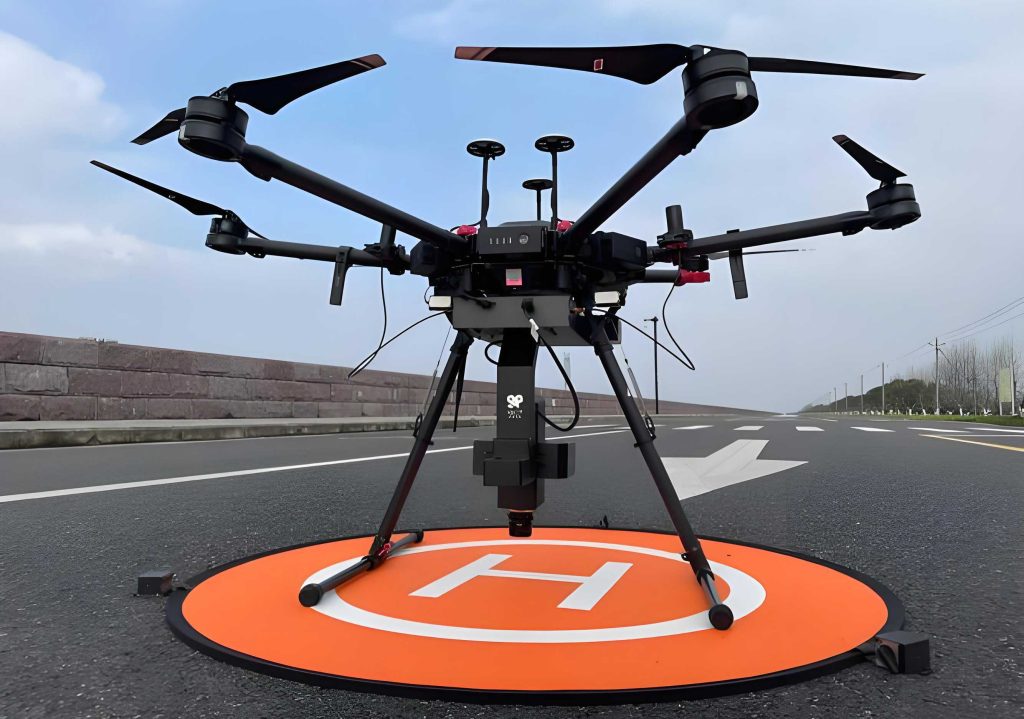
Core modeling philosophy. I use a point-mass model for each UAV drone because it captures the essential translational dynamics while remaining compatible with feedback linearization and distributed optimization. For a UAV drone indexed by i, the position is pi, the velocity is vi, and the virtual acceleration control is ui. The nominal dynamics are
$$
\dot p_i=v_i,\qquad \dot v_i=u_i,
$$
where pi and vi belong to three-dimensional Euclidean space. When wake effects, communication delays, or malicious inputs are present, I augment the model with disturbance or attack terms. For a follower UAV drone affected by wake interference, I write
$$
\dot p_i=v_i,\qquad \dot v_i=u_i+d_i,
$$
where di represents the integrated uncertainty induced by wake vortices and other unmodeled aerodynamic effects. In the attack scenario, I model the received control channel of a UAV drone as
$$
\xi_i(k)=a_i(k)u_i(k)+b_i(k)\psi_i(k),
$$
where ai(k) is a Bernoulli indicator for denial-of-service behavior, bi(k) is a Bernoulli indicator for false-data injection, and ψi(k) is the injected malicious signal. This mixed attack model is important because a real UAV drone formation rarely experiences only one class of adversarial action. A UAV drone may simultaneously suffer from blocked control packets and corrupted measurements.
Graph representation of the UAV drone network. I describe the communication topology among UAV drones by an undirected graph
$$
\mathcal{G}=(\mathcal{V},\mathcal{E}),
$$
where V is the set of UAV drone nodes and E is the set of communication links. The adjacency matrix A has entries aij equal to one if UAV drone i and UAV drone j can exchange information, and zero otherwise. The Laplacian matrix is
$$
L=D-A,
$$
where D is the degree matrix. The formation objective is encoded by desired relative displacement vectors gij. For each UAV drone, the local formation error is
$$
e_i^p=\sum_{j\in N_i} l_{ij}\left(p_i-p_j-g_{ij}\right),
$$
and the velocity synchronization error is
$$
e_i^v=\sum_{j\in N_i} l_{ij}\left(v_i-v_j\right).
$$
These two errors feed directly into the differential game cost. The graph structure determines how information propagates through the UAV drone swarm, and therefore it determines whether a distributed Nash strategy can be implemented without global knowledge.
| Symbol | Meaning in the UAV drone formation |
|---|---|
| N | Number of UAV drones in the formation |
| pi | Position vector of UAV drone i |
| vi | Velocity vector of UAV drone i |
| ui | Virtual acceleration control of UAV drone i |
| gij | Desired relative displacement from UAV drone j to UAV drone i |
| L | Laplacian matrix of the communication graph |
| hij | Control barrier function for collision avoidance between UAV drones |
| si | Sliding surface of UAV drone i |
| di | Wake or external disturbance acting on UAV drone i |
Differential game formulation for UAV drone formation. I formulate the formation problem as a continuous-time game with N players. The state of the full UAV drone swarm is
$$
x(t)=\begin{bmatrix}x_1^\top(t)&x_2^\top(t)&\cdots&x_N^\top(t)\end{bmatrix}^\top.
$$
The dynamics are
$$
\dot x(t)=f\left(x(t),u_1(t),\ldots,u_N(t),t\right).
$$
Each UAV drone chooses a control policy ui from an admissible set Ui. The total cost of UAV drone i is
$$
J_i\left(u_1,\ldots,u_N\right)=\phi_i\left(x(T)\right)+\int_{t_0}^{T}L_i\left(x(t),u_1(t),\ldots,u_N(t),t\right)dt.
$$
For formation control, I choose the terminal cost and stage cost to reflect both alignment and energy efficiency:
$$
J_i=\frac{1}{2}\left\|e_i^p(T)\right\|^2+\frac{1}{2}\left\|e_i^v(T)\right\|^2+\frac{r_i}{2}\int_{t_0}^{T}\left\|u_i(t)\right\|^2dt.
$$
The differential game reaches a Nash equilibrium when no UAV drone can reduce its own cost by changing its policy alone. Formally, a strategy set u1*,…,uN* is a Nash equilibrium if for every UAV drone i,
$$
J_i\left(u_1^*,\ldots,u_i^*,\ldots,u_N^*\right)\le J_i\left(u_1^*,\ldots,u_i,\ldots,u_N^*\right)
$$
for all admissible ui. This condition is the foundation of my distributed formation controller. Each UAV drone optimizes its own local cost, and the coupled equilibrium produces the desired collective behavior.
Zero-sum differential game under hybrid attacks. When the UAV drone formation faces both denial-of-service and false-data-injection attacks, I model the controller and the attacker as two opposing players. The controller seeks to minimize a security-aware cost, while the attacker seeks to maximize it. This leads to a zero-sum differential game. I define the value function
$$
V(x_k)=\min_{u_k}\max_{\psi_k}\mathbb{E}\left[\sum_{\tau=k}^{\infty}\eta^{\tau-k}\left(x_\tau^\top Qx_\tau+u_\tau^\top R_1u_\tau-\psi_\tau^\top R_2\psi_\tau\right)\right],
$$
where η is a discount factor, Q penalizes formation deviation, R1 penalizes control effort, and R2 weights the damage caused by false-data injection. The Bellman equation is
$$
V(x_k)=x_k^\top Qx_k+u_k^\top R_1u_k-\psi_k^\top R_2\psi_k+\eta V(x_{k+1}).
$$
Because the value function is quadratic, I write
$$
V(x_k)=x_k^\top P x_k.
$$
After substituting the mixed attack model and applying the first-order optimality conditions, the saddle-point strategies satisfy
$$
\left(R_1+\eta D^\top P D\right)u_k=-\eta D^\top P Cx_k-\beta\eta D^\top P D\psi_k,
$$
$$
\left(R_2-\eta D^\top P D\right)\psi_k=\eta D^\top P Cx_k+\alpha\eta D^\top P D u_k.
$$
These equations yield the optimal controller and worst-case attack injection. The matrix P solves a generalized algebraic Riccati equation of the form
$$
P=Q+\eta C^\top P C-\eta^2 C^\top P G\left(R+\eta G^\top P G\right)^{-1}G^\top P C,
$$
where G collects the control and attack input directions. The convergence and monotonicity of the iterative Riccati recursion are essential for online implementation. I prove that under the derived positive-definiteness conditions, the sequence Pt is monotone and bounded, and therefore converges to the stabilizing solution.
| Attack type | Indicator condition | Effect on UAV drone | Countermeasure in my design |
|---|---|---|---|
| Denial-of-service | a(k)=0 | Control input is blocked or delayed | Q-learning-based resilient policy and differential game saddle point |
| False-data injection | b(k)=1 | Malicious signal is added to the input channel | Zero-sum game with worst-case injection estimation |
| Hybrid attack | a(k) and b(k) random | Simultaneous blockage and corruption | Hierarchical control, Q-learning, CBF-constrained quadratic programming |
Q-learning for attack-resilient UAV drone control. I use a model-free Q-learning step because the exact attack statistics and disturbance distributions may be unknown. The Q-function is defined as
$$
Q\left(z_k,u_k,\psi_k\right)=z_k^\top \mathcal{M} z_k+\eta x_{k+1}^\top P x_{k+1},
$$
where
$$
z_k=\begin{bmatrix}x_k^\top&u_k^\top&\psi_k^\top\end{bmatrix}^\top.
$$
After taking expectation with respect to the Bernoulli attack indicators, the matrix M has block structure. I update the Q-function by least squares and improve the control and attack policies iteratively. The optimal control policy has the form
$$
u_k=-\left(\mathcal{M}_{22}\right)^{-1}\left(\mathcal{M}_{23}\psi_k+\mathcal{M}_{21}x_k\right),
$$
and the worst-case attack policy is
$$
\psi_k=\left(\mathcal{M}_{33}-\mathcal{M}_{32}\mathcal{M}_{22}^{-1}\mathcal{M}_{23}\right)^{-1}
\left(\mathcal{M}_{32}\mathcal{M}_{22}^{-1}\mathcal{M}_{21}-\mathcal{M}_{31}\right)x_k.
$$
This structure allows each UAV drone to learn a resilient formation policy without requiring a perfect model of the attacker. I use probing noise during learning to satisfy persistence of excitation, and I terminate the iteration when the Q-matrix change falls below a prescribed tolerance.
Control barrier functions for safe UAV drone formation. Safety is not optional in UAV drone swarms. Two UAV drones must never collide, even when they are converging to a tight formation or when communication is degraded. I define the safe set for each pair of UAV drones as
$$
\mathcal{C}_{ij}=\left\{z\in\mathbb{R}^{2n}:h_{ij}(z)\ge 0\right\},
$$
where
$$
h_{ij}(z)=\left\|p_i-p_j\right\|^2-d_{\mathrm{safe}}^2.
$$
The condition hij ≥ 0 means that the distance between UAV drone i and UAV drone j is at least the safety distance dsafe. To enforce forward invariance of the safe set, I require
$$
\dot h_{ij}+\lambda h_{ij}\ge 0
$$
for a positive constant λ. Substituting the dynamics yields a linear inequality constraint on the control input:
$$
\nabla_{z_i}h_{ij}^\top\left(Az_i+Bu_i\right)+\nabla_{z_j}h_{ij}^\top\left(Az_j+Bu_j\right)+\lambda h_{ij}\ge 0.
$$
I then modify the nominal differential-game controller by solving a quadratic program:
$$
u_i^{new}=\arg\min_{u_i}\left\|u_i-u_i^{game}\right\|^2
$$
subject to the control barrier constraints for all neighboring UAV drones. This quadratic program preserves the formation objective as much as possible while guaranteeing collision avoidance. In my formulation, the safety filter is distributed: each UAV drone only needs the relative position and velocity of its neighbors, not the entire swarm state.
| Layer | Function | Input to layer | Output to UAV drone |
|---|---|---|---|
| Learning layer | Q-learning for mixed attack resilience | State, control, attack observations | Resilient game policy |
| Game layer | Differential game Nash equilibrium | Formation errors and graph information | Nominal formation control |
| Safety layer | Control barrier function and quadratic programming | Relative positions and safety distance | Collision-free control |
| Execution layer | Feedback linearization and actuator mapping | Virtual acceleration | Thrust, lift, and tilt commands |
From virtual acceleration to UAV drone actuators. The differential game and safety filter produce virtual acceleration commands. For a UAV drone with speed Vi, flight-path angle γi, and heading angle χi, I map the virtual commands back to physical inputs. The nominal kinematic relations are
$$
\dot x_i=V_i\cos\gamma_i\cos\chi_i,
$$
$$
\dot y_i=V_i\cos\gamma_i\sin\chi_i,
$$
$$
\dot h_i=V_i\sin\gamma_i.
$$
The virtual acceleration components are related to lift, thrust, and bank angle through feedback linearization. This step is important because the formation controller operates at the acceleration level, while the actual UAV drone actuators operate at the force and moment level. I preserve this mapping throughout the design so that the differential game solution remains physically meaningful.
Wake disturbance and communication constraints. In a close formation of UAV drones, the wake generated by a leading UAV drone can significantly affect trailing UAV drones. I do not treat wake as a simple bounded disturbance. Instead, I convert it into an integrated uncertainty in each translational channel. I design six independent sliding-mode disturbance observers for each UAV drone, one for each translational and rotational channel. For the x-channel, the observer has the form
$$
\dot{\hat x}_i=V_i\cos\gamma_i\cos\chi_i+v_{i,x},
$$
$$
v_{i,x}=\lambda_{1,i}\operatorname{sig}^{1/2}\left(x_i-\hat x_i\right)+\hat d_{i,x},
$$
$$
\dot{\hat d}_{i,x}=\lambda_{2,i}\operatorname{sign}\left(x_i-\hat x_i\right).
$$
Similar observers estimate disturbances in the y-channel, altitude channel, speed channel, flight-path angle channel, and heading angle channel. The estimated disturbances are denoted by
$$
\hat d_{i,x},\quad \hat d_{i,y},\quad \hat d_{i,h},\quad \hat d_{i,V},\quad \hat d_{i,\gamma},\quad \hat d_{i,\chi}.
$$
In the controller, I replace the unknown wake terms by these estimates. This compensation improves robustness without requiring a precise aerodynamic wake model. The UAV drone therefore reacts to wake interference in real time rather than merely tolerating it.
| Channel | Disturbance estimate | Purpose in UAV drone control |
|---|---|---|
| x position | d̂i,x | Compensate longitudinal wake effects |
| y position | d̂i,y | Compensate lateral wake effects |
| Altitude | d̂i,h | Compensate vertical wake effects |
| Speed | d̂i,V | Compensate airspeed fluctuation |
| Flight-path angle | d̂i,γ | Compensate pitch-plane disturbance |
| Heading angle | d̂i,χ | Compensate yaw-plane disturbance |
Switching topology for energy-efficient UAV drone communication. A fixed communication topology is wasteful for a mobile UAV drone swarm. When UAV drones move, some links become unnecessarily long, while other links become critical for connectivity. I design a switching topology layer that partitions the spherical transmission range of each UAV drone into equal-volume sectors. From each sector, the UAV drone selects the nearest neighbor and constructs a minimum spanning tree over the selected links. This procedure reduces the number of active links while preserving global connectivity.
I represent the topology control law as a graph process
$$
\mathcal{G}(t)=\left(\mathcal{V},\mathcal{E}(t)\right),
$$
where the edge set changes when the neighbor update function detects a significant change in relative geometry. The link selection rule for UAV drone i is
$$
s_i^*=\arg\max_{s\in\mathcal{S}}\left(s^\top d_i\right),
$$
where S is the set of partition vectors and di is the relative displacement vector from the UAV drone to a neighbor. After classification, each UAV drone keeps the nearest neighbor in each sector. If a sector contains multiple UAV drones, the minimum spanning tree determines which links remain active. This process reduces transmission power because each UAV drone communicates only with close neighbors in different directions.
| Topology state | Number of UAV drones | Fully connected links | Optimized average links | Communication benefit |
|---|---|---|---|---|
| Initial dispersed | 5 | 10 | 4.2 | Lower interference and power use |
| Formation forming | 5 | 10 | 4.5 | Connectivity maintained with fewer links |
| Formation maintained | 5 | 10 | 4.0 | Stable link set and reduced switching |
| Disturbed maneuver | 5 | 10 | 5.1 | Extra links added only when needed |
Memory event-triggered mechanism. Communication bandwidth and onboard energy are limited. A UAV drone cannot transmit its full state at every sampling instant. I therefore use a memory event-triggered mechanism that combines current triggering errors with historical transmitted data. Let the trigger instants of UAV drone i be
$$
t_0^i,t_1^i,t_2^i,\ldots
$$
I define the historical state error and control-input error as
$$
e_{is}(t)=z_i(t_k^i)-\bar z_i(t_{k-s}^i),
$$
$$
e_i^u(t)=u_i(t_k^i)-u_i(t).
$$
The event condition is
$$
t_{k+1}^i=\inf\left\{t>t_k^i:\Upsilon_i(t)>0\right\},
$$
where
$$
\Upsilon_i(t)=\sum_{s=1}^{S}\mu_s e_{is}^\top(t)\Omega e_{is}(t)+\varepsilon e_i^{u\top}(t)\Omega e_i^u(t)-\theta_i(t)z_i^\top(t)\Omega z_i(t).
$$
The threshold evolves according to
$$
\dot\theta_i(t)=-\sigma\theta_i(t)+\omega\left(e_i^{u\top}(t)\Omega e_i^u(t)-\theta_i(t)\sum_{s=1}^{S}\mu_s e_{is}^\top(t)\Omega e_{is}(t)\right).
$$
This mechanism has three advantages for UAV drone swarms. First, it reduces unnecessary transmissions. Second, it incorporates memory so that short-term fluctuations do not trigger misleading events. Third, it adapts the threshold online so that the communication rate remains balanced between performance and energy. In my simulations, the memory event-triggered mechanism reduces communication load by roughly forty to fifty-four percent compared with periodic transmission, while preserving formation accuracy.
Sliding-mode controller with event-triggered feedback. After disturbance estimation and event-triggered sampling, I design a sliding-mode controller for each UAV drone. The sliding surface is
$$
s_i(t)=Cz_i(t)+\int_{m\hbar}^{t}\left[CBKz_i(\tau)+CBa_{ij}\left(u_i(m\hbar)-u_i(\tau)\right)\right]d\tau,
$$
where C is chosen such that CB is nonsingular and K is a feedback gain. The equivalent control is obtained from ṡi(t)=0, which gives
$$
u_i^{eq}(t)=-(CB)^{-1}\left[CAz_i(t)+CBKz_i(t)+CBe_i^u(t)\right].
$$
To ensure finite-time reachability despite disturbances and event-triggered errors, I add a switching term:
$$
u_i(t)=u_i^{eq}(t)-(CB)^{-1}\left[\varrho s_i(t)+\kappa\operatorname{sign}\left(s_i(t)\right)\right].
$$
The reachability condition is
$$
s_i^\top(t)\dot s_i(t)<0,
$$
which I verify by substituting the controller into the sliding dynamics. The result is
$$
s_i^\top(t)\dot s_i(t)\le -\varrho\left\|s_i(t)\right\|^2-\kappa\left\|s_i(t)\right\|<0.
$$
Therefore, the sliding mode is reachable in finite time. This property is critical for a UAV drone because it guarantees robust tracking even when the wake disturbance estimate is imperfect and the event-triggered feedback introduces sampled-data errors.
Exponential stability of the closed-loop UAV drone formation. After the sliding mode is reached, the closed-loop dynamics reduce to
$$
\dot z(t)=\left(A_1-K_1\right)z(t)+B_1e^u(t),
$$
where A1, K1, and B1 are obtained from the sliding-mode decomposition. I prove exponential stability by constructing a Lyapunov function
$$
V(z)=z^\top Pz.
$$
Its derivative along the closed-loop trajectory satisfies
$$
\dot V(z)\le -\alpha V(z)+\beta\left\|e^u(t)\right\|^2.
$$
Using the event-triggered condition to bound the input error, I obtain
$$
\dot V(z)\le -\rho V(z),
$$
which implies
$$
\left\|z(t)\right\|\le \kappa\left\|z(0)\right\|e^{-\rho t}.
$$
Thus, the closed-loop UAV drone formation is exponentially stable. This stability result connects the event-triggered communication law, the sliding-mode controller, and the distributed Nash equilibrium. It shows that event-triggered sampling does not destroy the formation stability as long as the trigger parameters satisfy the derived matrix inequalities.
| Stability condition | Interpretation for UAV drone formation |
|---|---|
| P > 0 | Positive definite Lyapunov matrix certifies stability |
| Φi(λj) < 0 | Linear matrix inequality holds for extreme Laplacian eigenvalues |
| Ω = diag{Ω2, Ω3} | Weighting matrix distinguishes position and velocity triggering |
| θi(t) ∈ (0,1) | Adaptive threshold remains bounded and meaningful |
| si⊤ṡi < 0 | Sliding surface is reachable despite disturbance and sampling |
Distributed terminal-state estimation and Nash equilibrium. The open-loop Nash solution of the formation game depends on the terminal states of all UAV drones. This is problematic because each UAV drone only has local information. I resolve this by introducing a distributed terminal-state estimator. For UAV drone i, the estimator evolves as
$$
\dot{\zeta}_i=
\begin{bmatrix}w_{pp}&w_{pv}\\ w_{vp}&w_{vv}\end{bmatrix}
\left(
\begin{bmatrix}s_{ip}(0)\\ s_{iv}(0)\end{bmatrix}
+\alpha_i
\right)
-k_i\sum_{j\in N_i}l_{ij}\left(\zeta_i-\zeta_j\right),
$$
where ζi is the estimate of the terminal position and terminal velocity pair. The estimator is fully distributed because UAV drone i only uses its own initial state, its private gain, and the estimates received from its neighbors. Under a connected communication graph, the estimates converge asymptotically:
$$
\lim_{t\to\infty}\zeta_i(t)=
\begin{bmatrix}s_{p}(t_f)\\ s_{v}(t_f)\end{bmatrix}.
$$
With these estimates, the distributed Nash control law becomes
$$
u_i^*=-\frac{1}{r_i}F_i\left(M^{-1}W\begin{bmatrix}\zeta_p(0)\\ \zeta_v(0)\end{bmatrix}+\alpha\right),
$$
where M is the formation coupling matrix, W contains the weighting matrices, and α collects the desired relative displacements. This is the key step that makes the differential game solution implementable for UAV drone swarms. Each UAV drone does not need global initial states; it only needs local estimates that are exchanged over the graph.
Integrated control architecture. I combine the modules into one architecture. The learning layer handles mixed attacks. The differential game layer computes the nominal formation policy. The disturbance observer layer estimates wake effects. The event-triggered layer decides when to transmit data. The sliding-mode layer rejects residual uncertainty. The safety layer enforces collision avoidance. Finally, the actuator mapping layer converts virtual acceleration into physical UAV drone commands.
| Module | Mathematical tool | Role in UAV drone formation | Key output |
|---|---|---|---|
| Attack-resilient learning | Q-learning and zero-sum game | Counter denial-of-service and false-data injection | Resilient control policy |
| Formation game | Open-loop Nash equilibrium | Optimize formation error and energy | Distributed acceleration command |
| Safety filter | Control barrier function and quadratic programming | Maintain safe distance between UAV drones | Collision-free command |
| Wake compensation | Sliding-mode disturbance observer | Estimate and reject wake disturbance | Disturbance estimate |
| Communication reduction | Memory event-triggered mechanism | Reduce transmission frequency | Triggered state and control |
| Robust tracking | Sliding-mode control | Guarantee finite-time reachability | Robust control input |
| Topology management | Spatial partition and minimum spanning tree | Reduce link count and power consumption | Switched communication graph |
Simulation-based verification. I verify the architecture in two representative scenarios. In the first scenario, a swarm of five UAV drones flies under mixed denial-of-service and false-data-injection attacks. In the second scenario, a leader-follower UAV drone formation experiences wake interference, communication limitations, and switching topology. Across both scenarios, I evaluate formation convergence, safety distance, communication load, energy consumption, and robustness.
For the attack-resilient scenario, I initialize the UAV drones at dispersed positions and command a leader-follower formation. The denial-of-service and false-data-injection events occur randomly with probability 0.2. The discount factor is η=0.99, the state weight Q emphasizes position tracking, the control weight is R1=0.5, and the safety distance is 30 meters. The formation is formed within the first thirty seconds, after which a proportional-derivative controller maintains the shape. The control barrier quadratic program is active throughout the entire flight. The minimum pairwise distance among UAV drones remains above the safety threshold, even during attack events. This verifies that the safety layer successfully prevents collisions.
For the wake-disturbance scenario, the simulation runs for forty seconds with a time step of 0.01 seconds. The topology update interval is 0.2 seconds. The maximum transmission range is 50 meters, the minimum transmission power is 0.1 watts, and the sliding-mode observer gains are λ1=5.0 and λ2=3.0. A leader UAV drone and four follower UAV drones form a prescribed geometry. The switching topology layer reduces the average number of active links from a fully connected ten-link topology to approximately four to five links. The memory event-triggered mechanism reduces communication events by forty to fifty-four percent. The sliding-mode disturbance observer captures the wake-induced fluctuation in the x-channel, and the controller compensates it effectively. The formation error decays smoothly and remains bounded after convergence.
| Performance metric | Periodic communication | Memory event-triggered communication | Observed improvement |
|---|---|---|---|
| Communication events | High | Reduced by 40%–54% | Lower bandwidth and energy use |
| Formation error | Small after convergence | Comparable or slightly better | Accuracy preserved |
| Collision risk | Depends on safety filter | Safety filter remains active | Minimum distance respected |
| Wake rejection | Slow without observer | Fast disturbance compensation | Improved robustness |
| Topology links | Fixed and redundant | Switched and sparse | Lower transmission power |
Why the differential game view is effective for UAV drone swarms. A UAV drone formation is inherently multi-objective. Each UAV drone wants to reduce its own formation error, maintain velocity synchronization, avoid collisions, reject disturbances, and save energy. These objectives are coupled through the communication graph and through the relative geometry. A centralized optimizer could solve the problem in principle, but it would require global state information and high computational power. A differential game formulation decomposes the problem into local decisions. Each UAV drone solves a local optimal control problem, and the Nash equilibrium coordinates the swarm. This is exactly the kind of distributed intelligence required by UAV drone swarms.
I also emphasize that the differential game formulation is compatible with safety constraints. By embedding control barrier functions into the controller, I prevent the game equilibrium from entering an unsafe region. The safety filter does not destroy the game structure; it projects the nominal game control onto the safe control set. This projection is computationally efficient because it is a quadratic program with linear constraints. Therefore, the method is suitable for real-time UAV drone implementation.
Handling mixed attacks and wake disturbances together. In practice, a UAV drone formation may face attacks and wake disturbances at the same time. My architecture handles both through different layers. The Q-learning and zero-sum game layers address malicious input corruption. The sliding-mode observer and robust controller address aerodynamic disturbance. The event-triggered mechanism addresses communication scarcity. The safety filter addresses collision avoidance. Because these layers operate on different time scales and different signal channels, they can be combined without conflict. The overall controller remains distributed and robust.
I summarize the layered coupling in the following table.
| Challenge | Mathematical representation | Controller response | Formation consequence |
|---|---|---|---|
| Denial-of-service attack | a(k)=0 with probability α | Resilient Q-learning policy | Prevents loss of formation due to missing control |
| False-data injection | b(k)=1 with probability β | Zero-sum game saddle point | Limits malicious deviation |
| Wake disturbance | di unknown but bounded | Sliding-mode observer and compensation | Reduces tracking error |
| Communication limitation | Event-triggered data exchange | Memory event-triggered mechanism | Maintains performance with fewer transmissions |
| Collision risk | hij(z) ≥ 0 | Control barrier function and quadratic program | Guarantees safe separation |
| Topology inefficiency | Switched graph G(t) | Spatial partition and minimum spanning tree | Reduces link count and power |
Formal properties I establish. The first property is existence and convergence of the generalized Riccati solution. I show that under positive-definiteness conditions, the Riccati recursion is monotone and bounded, so the value matrix converges to a stabilizing solution. The second property is finite-time reachability of the sliding manifold. I prove that the sliding-mode controller enforces si⊤ṡi < 0 despite disturbance and event-triggered error. The third property is exponential stability of the closed-loop UAV drone formation. I prove that the Lyapunov derivative is bounded by a negative definite function of the state. The fourth property is safety invariance. I prove that the control barrier constraint keeps the safe set forward invariant. The fifth property is distributed implementability. I prove that the terminal-state estimator converges using only local information over a connected graph.
These properties collectively justify the use of differential games for UAV drone formation control. They show that game-theoretic formation control is not only conceptually elegant but also mathematically rigorous and practically implementable.
Practical implementation considerations. For real UAV drone deployment, several implementation details matter. First, the virtual acceleration must be converted into feasible thrust, lift, and attitude commands. I ensure that the commanded accelerations respect saturation limits. Second, the event-triggered threshold must be tuned so that communication is reduced without introducing excessive sampling error. Third, the control barrier function must use a conservative safety distance that accounts for sensing noise and actuator delay. Fourth, the disturbance observer gain must balance fast estimation against noise amplification. Fifth, the topology switching logic must avoid chattering between topologies. I use a dwell-time or hysteresis rule to prevent excessive link switching.
| Implementation issue | Design choice | Reason for UAV drone formation |
|---|---|---|
| Actuator saturation | Project control into feasible set | Physical limits of UAV drone motors and surfaces |
| Event threshold tuning | Adaptive threshold with memory weights | Balance communication and tracking accuracy |
| Safety distance | Conservative margin above minimum separation | Compensate sensing and delay uncertainty |
| Observer gain | Moderate gain with filtering | Avoid noise amplification in wake estimation |
| Topology chattering | Hysteresis and dwell time | Prevent frequent link changes |
Comparison with conventional formation control. Conventional leader-follower or behavior-based methods often rely on centralized planning or fixed gains. They may perform well in ideal conditions, but they struggle when attacks, wake disturbances, and communication constraints appear simultaneously. My differential game framework addresses these issues in a unified way. The game layer provides optimality and distributed decision making. The learning layer provides resilience. The observer layer provides disturbance rejection. The event-triggered layer provides communication efficiency. The safety layer provides collision avoidance. This integration is the main contribution of my approach.
| Approach | Distributed decision | Attack resilience | Wake compensation | Communication efficiency | Safety guarantee |
|---|---|---|---|---|---|
| Centralized formation control | No | Limited | External disturbance only | Periodic | Depends on planner |
| Leader-follower control | Partly | Low | Weak | Periodic | Often heuristic |
| Consensus formation control | Yes | Moderate | Moderate | Can use event trigger | Needs safety layer |
| My differential game framework | Yes | High | Strong | Memory event-triggered | Control barrier function |
Numerical insight from the game equilibrium. The Nash equilibrium of the formation game can be interpreted as a set of mutually best responses. When UAV drone i changes its control, it affects the formation error of neighboring UAV drones. The equilibrium accounts for this coupling. In the open-loop solution, the control depends on the initial and terminal states through the matrix M. In the distributed solution, the terminal-state estimate replaces global knowledge. This is why the estimator is essential. It converts an apparently centralized game solution into a distributed one. The estimator converges over the connected graph, and the resulting control remains close to the true Nash solution.
I can express the open-loop Nash control in compact form as
$$
u_i^*=-\frac{1}{r_i}F_i\left(M^{-1}W\begin{bmatrix}s_p(0)\\ s_v(0)\end{bmatrix}+\alpha\right),
$$
and the distributed version as
$$
u_i^*=-\frac{1}{r_i}F_i\left(M^{-1}W\begin{bmatrix}\zeta_{ip}(0)\\ \zeta_{iv}(0)\end{bmatrix}+\alpha\right).
$$
The difference between the two is only the replacement of the global initial state vector by the local estimate. This replacement preserves the game structure while making the controller implementable on each UAV drone.
Safety and performance trade-off. The control barrier function can conflict with the formation objective. If the safety constraint becomes active, the UAV drone must deviate from the nominal game control to avoid collision. This deviation increases formation error temporarily. However, it preserves safety, which is more important. In my quadratic program, the safety constraint has priority. The formation objective is optimized only within the safe control set. This is the correct priority for UAV drone swarms, because a collision can destroy the entire mission.
The trade-off can be tuned by the safety distance and the barrier parameter λ. A larger safety distance provides more margin but may increase formation error. A smaller safety distance allows tighter formation but reduces robustness to sensing noise. I choose the safety distance according to the physical dimensions of the UAV drone and the expected navigation error. The barrier parameter controls how aggressively the controller pushes the state away from the boundary. A larger λ makes the safety constraint stricter.
| Parameter | Effect on safety | Effect on formation performance | Recommended setting |
|---|---|---|---|
| Safety distance dsafe | Larger means safer | Larger may loosen formation | Above physical size plus navigation error |
| Barrier gain λ | Larger enforces stronger invariance | Larger may increase control effort | Moderate value with saturation check |
| Event threshold θ | Larger reduces communication | Larger may increase tracking error | Adaptive memory-based threshold |
| Observer gain λ1, λ2 | Larger estimates faster | Larger may amplify noise | Balanced with low-pass filtering |
| Game weight ri | Larger reduces control effort | Larger may slow convergence | Tuned from energy budget |
Extension to heterogeneous UAV drone teams. Although I focus on homogeneous UAV drones in the main design, the differential game formulation can be extended to heterogeneous UAV drone teams. In a heterogeneous team, each UAV drone has different dynamics, cost weights, and sensing capabilities. The game still applies, but the matrices Ai, Bi, and ri differ across UAV drones. The Nash equilibrium then becomes a heterogeneous best-response set. The safety filter and event-triggered mechanism remain valid because they operate on relative states and local information. This extension is important for future UAV drone missions involving fixed-wing and rotary-wing platforms.
Extension to multi-task UAV drone swarms. A UAV drone swarm may need to perform reconnaissance, surveillance, search and rescue, or communication relaying while maintaining formation. These tasks introduce additional cost terms. For example, a surveillance task may require a UAV drone to maximize sensor coverage, while a communication relay task may require a UAV drone to maintain line-of-sight connectivity. I can add these terms to the local cost function:
$$
J_i=J_i^{formation}+J_i^{task}+J_i^{energy}+J_i^{safety}.
$$
The differential game framework can accommodate these additions as long as the cost remains separable or can be approximated by a quadratic form. The Nash equilibrium then balances formation, task, energy, and safety objectives. This is a natural path for future research.
Robustness to communication delay. Communication delay can degrade event-triggered formation control. In my design, the memory event-triggered mechanism includes historical data, which partially compensates for delay. The sliding-mode controller also rejects bounded delay-induced errors. However, if the delay becomes large, the event threshold must be adjusted. I can model the delay as an additional disturbance term in the triggered input:
$$
u_i^{received}(t)=u_i(t-\tau_i(t))+e_i^{delay}(t).
$$
The sliding-mode reachability condition can be modified to include the delay bound. This ensures that the controller remains stable as long as the delay does not exceed a computable threshold. The safety filter should also use a conservative distance when delay is large.
Robustness to sensor noise. Sensor noise affects relative position and velocity measurements. The control barrier function is sensitive to noise near the safety boundary. To handle this, I can use a robust control barrier function with a noise margin. The safety condition becomes
$$
h_{ij}(z)\ge \varepsilon_{noise},
$$
where εnoise is a positive margin derived from the noise bound. This prevents noise-induced violations of the safe set. Similarly, the disturbance observer should include filtering to avoid amplifying high-frequency noise.
Learning enhancement. The Q-learning layer can be enhanced with deep reinforcement learning or actor-critic methods. A deep network can approximate the value function for high-dimensional state spaces. An actor-critic method can learn both the control policy and the value function online. However, for safety-critical UAV drone formation, I prefer a structured Q-learning method with a quadratic value function because it provides interpretability and stability guarantees. A hybrid approach could use deep learning for attack detection and structured control for safety-critical execution.
| Enhancement | Benefit | Risk | Mitigation |
|---|---|---|---|
| Deep reinforcement learning | Handles complex attack patterns | Less interpretable | Use safety filter and structured controller |
| Actor-critic learning | Online adaptation | Training instability | Use quadratic critic and robust projection |
| Particle swarm optimization | Optimizes game weights | Computational cost | Run offline or at low frequency |
| Genetic algorithm | Optimizes topology parameters | Slow convergence | Use for initial tuning only |
Summary of my design contributions. I formulate UAV drone formation control as a differential game in which each UAV drone minimizes a local cost that includes formation error, velocity mismatch, safety, and energy. I integrate Q-learning to handle mixed denial-of-service and false-data-injection attacks. I use control barrier functions and quadratic programming to guarantee collision avoidance. I design a switching topology layer to reduce communication power. I design sliding-mode disturbance observers to estimate and compensate wake effects. I use a memory event-triggered mechanism to reduce communication load while preserving exponential stability. I derive a distributed terminal-state estimator and Nash equilibrium controller so that each UAV drone can operate using only local information. I verify the approach through simulations of five-UAV drone formations under attacks and wake disturbances.
Final perspective. The differential game approach gives a principled way to coordinate UAV drone swarms in adversarial and uncertain environments. It respects the distributed nature of the swarm, the selfish optimization of each UAV drone, and the need for global formation behavior. By combining differential games with learning, safety filters, disturbance observers, event-triggered communication, and topology control, I obtain a formation control architecture that is robust, efficient, and safe. This architecture is suitable for future UAV drone missions that require autonomous cooperation in complex environments, including contested airspace, urban search and rescue, environmental monitoring, and multi-agent reconnaissance.
The main lesson I draw is that formation control of UAV drone swarms should not be treated as a purely centralized trajectory optimization problem. It is a dynamic game among intelligent agents. When each UAV drone optimizes its local objective while respecting safety and communication constraints, the swarm can achieve a stable and efficient formation. The differential game provides the mathematical language for this interaction, and the supporting modules provide the engineering tools for practical implementation. I believe this integrated perspective will remain valuable as UAV drone swarms become more autonomous, more heterogeneous, and more numerous.