
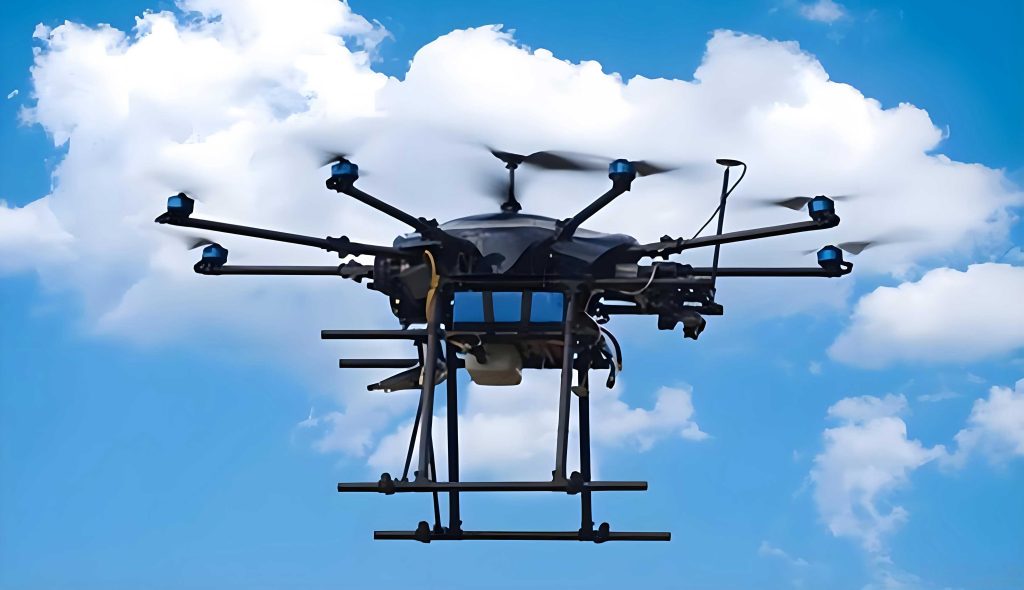
In this thesis, I focus on the design of energy consumption optimization schemes for non-orthogonal multiple access (NOMA) based unmanned aerial vehicles (UAVs) assisted mobile edge computing (MEC) systems. The rapid growth of Internet of Things (IoT) devices and their applications has imposed tremendous pressure on conventional wireless networks. Traditional intelligent terminals with limited computing capability and battery capacity are no longer capable of satisfying the increasingly stringent quality-of-service (QoS) requirements, especially for latency-critical and computation-intensive tasks. Mobile edge computing provides a promising paradigm by allowing terminal devices to offload their computation tasks to edge servers with stronger computing abilities, thereby reducing both task completion latency and terminal energy consumption. With the remarkable advancement of UAV technology, UAVs have been widely applied in scenarios such as ecological monitoring, disaster emergency response, and urban facility surveillance. To meet the low-latency requirement of MEC systems, the MEC server can be deployed on a UAV, taking advantage of the high mobility and flexible deployment of UAVs to establish line-of-sight (LoS) links with ground devices, thus achieving higher offloading rates and better channel quality. In order to fully exploit time-frequency resources and improve system performance, NOMA is introduced into UAV-assisted MEC systems for efficient task offloading. Since the onboard battery of a UAV is limited, how to effectively reduce system energy consumption while guaranteeing QoS becomes a critical issue. Moreover, the broadcast nature of wireless channels makes task offloading vulnerable to malicious eavesdroppers. Because the offloaded data often contains private information, security is also a major concern. In this thesis, I investigate energy minimization problems from two perspectives: latency-critical task offloading with SIC order design, and secure covert communication under malicious eavesdropping.
In the first part, I address the issue of successive interference cancellation (SIC) ordering in uplink NOMA-based UAV-assisted MEC systems. The SIC order is a key bottleneck that limits the transmission performance of the uplink task offloading link. In many previous studies, the SIC order is simply determined by the descending order of channel gains. However, in a MEC system, each device has a specific task delay constraint. I show that channel-gain-only ordering may lead to excessive transmit power for some devices, especially when a device with a moderate channel gain has a very tight delay requirement. To satisfy its delay constraint, this device must increase its transmit power. In power-domain NOMA, the devices decoded earlier are required to have transmit power no less than those decoded later. Therefore, the devices before this particular device in the SIC order also have to increase their transmit power, thereby causing higher energy consumption. To overcome this drawback, I propose an optimal SIC ordering rule that jointly considers the channel gain and the task delay constraint. The main idea is to sort the devices in each time slot according to the ratio of the channel gain to the task delay bound. I prove that this ordering minimizes the total energy consumption of the system. Based on this optimal SIC order, I then formulate an optimization problem to minimize the total energy consumption, which includes the task offloading energy, the task computing energy, and the UAV flight energy. The problem is subject to the task delay constraint, the maximum transmit power constraint, and the UAV trajectory constraints. Since the original problem is a non-convex mixed-integer nonlinear programming (MINLP) problem, it is difficult to solve directly. I adopt an alternating optimization method to solve the problem. In particular, I decompose the problem into two subproblems: one for power allocation and UAV trajectory optimization with fixed user grouping, and the other for user grouping design using matching theory. The proposed low-complexity device grouping algorithm can efficiently obtain a near-optimal grouping scheme. Simulation results demonstrate that the proposed optimal SIC order achieves lower system energy consumption than other SIC orders under the same task delay constraints. The matching-theory-based grouping algorithm also shows better performance than existing grouping schemes.
In the second part, I focus on the security issue of UAV-assisted MEC systems. Traditional physical layer security (PLS) techniques aim at protecting the content of the transmitted signal, but the transmission behavior itself may still be detected by eavesdroppers. Such detection can leak confidential information, such as user location or traffic pattern. To provide a stronger level of protection, I introduce covert communication into the UAV-assisted MEC system. In this model, the UAV acts as both a MEC server and a jammer. It receives computation tasks offloaded from ground devices using NOMA, while simultaneously transmitting artificial noise (AN) to interfere with the eavesdropper’s detection. The goal is to ensure that the eavesdropper cannot reliably determine whether a ground device is actively offloading tasks. I consider a scenario where two ground devices are served in each time slot. Due to the power-domain NOMA constraint, the device with a higher channel gain transmits with higher power, making its transmission more vulnerable to detection. The AN emitted by the UAV is designed to mask the stronger signal from the eavesdropper’s perspective, thereby satisfying a predefined covertness constraint expressed as a lower bound on the minimum detection error probability. I derive the expression of the detection error probability at the eavesdropper under the uniform distribution of the AN power. Then, I formulate an optimization problem to minimize the total energy consumption of the system, including offloading energy, AN energy, computing energy, and UAV flight energy, subject to the covertness constraint, the UAV trajectory constraints, the transmit power limits, and the computational resource constraints. This problem is highly coupled and non-convex. I propose a two-stage iterative optimization algorithm that alternately optimizes the ground device transmit powers, the UAV trajectory, the AN power, the UAV computation resource allocation, and the ground device grouping. Simulation results show that the proposed scheme can effectively reduce the system energy consumption while satisfying the covertness requirement. The dynamic grouping algorithm is also compared with several baselines, and the results confirm its superiority.
The remainder of this thesis is organized as follows. First, I introduce the system model and problem formulation for the latency-aware SIC design. Then I present the optimal SIC order and the alternating optimization framework with matching-based grouping. After that, I describe the covert communication system model and the corresponding optimization approach. Finally, I show extensive numerical results and conclude the thesis.
System Model for NOMA-based UAV-assisted MEC with Delay-aware SIC Order
I consider a system where \(K\) ground devices are randomly distributed in a square area, and one UAV equipped with a MEC server flies at a fixed altitude \(H\). The flight period is divided into \(N\) time slots. In each time slot, \(M=K/N\) devices are scheduled to offload their computation tasks to the UAV using NOMA. The devices transmit simultaneously on the same frequency band. The UAV performs SIC to decode the superimposed signals. The position of the \(k\)-th device is denoted as \(\mathbf{w}_k = [x_k,y_k,0]^T\). The UAV’s position in slot \(n\) is \(\mathbf{q}(n) = [X(n), Y(n), H]^T\), with initial position \(\mathbf{Q}_0\) and final position \(\mathbf{Q}_F\). The channel between the UAV and device \(k\) follows the free-space path loss model, which is expressed as:
\[
g_{k,n} = \frac{\rho_0}{\| \mathbf{q}(n)-\mathbf{w}_k \|^2}, \quad \forall k,n,
\]
where \(\rho_0\) is the channel power gain at a reference distance of 1 meter. The grouping matrix \(\mathbf{A}\) has entries \(a_{kn}\in\{0,1\}\), where \(a_{kn}=1\) indicates that device \(k\) is offloaded in slot \(n\). The constraints on grouping are:
\[
\sum_{n=1}^{N} a_{kn}=1, \quad \forall k, \qquad \sum_{k=1}^{K} a_{kn}=M, \quad \forall n, \qquad a_{kn}\in\{0,1\}.
\]
In slot \(n\), the devices are ordered according to a specific SIC decoding sequence. Let \(\mathbf{r}(n) = [r_1(n), r_2(n), \ldots, r_M(n)]\) denote the decoding order, where \(r_i(n)\) is the original index of the \(i\)-th decoded device. For a given order, the achievable offloading rate of the \(i\)-th decoded device is:
\[
R_{r_i(n)}(n) = B \log_2\left(1+\frac{p_{r_i(n)} g_{r_i(n),n}}{X_{r_i(n)}(n) + B\sigma^2}\right),
\]
where \(B\) is the total bandwidth, \(\sigma^2\) is the noise power spectral density, and \(X_{r_i(n)}(n)\) is the interference caused by devices decoded after device \(r_i(n)\), computed as:
\[
X_{r_i(n)}(n) = \sum_{j>i} p_{r_j(n)} g_{r_j(n),n}.
\]
The offloading time of device \(r_i(n)\) is given by \(T^{\text{off}}_{r_i(n)} = D / R_{r_i(n)}(n)\), where \(D\) is the size of the computation task in bits, which is assumed equal for all devices. The total task offloading energy is:
\[
E^{\text{off}} = \sum_{n=1}^{N}\sum_{i=1}^{M} p_{r_i(n)} T^{\text{off}}_{r_i(n)}.
\]
For the computing part, the UAV assigns an equal share of computation resources to the \(M\) devices in each slot. If the UAV’s total CPU frequency is \(f_{\text{CPU}}\), then the computing time for each device is:
\[
T^{\text{comp}}_{r_i(n)} = \frac{C D}{f_{\text{CPU}}/M},
\]
where \(C\) is the number of CPU cycles required to compute 1 bit of data. The computing energy consumption is expressed as:
\[
E^{\text{comp}} = \sum_{n=1}^{N}\sum_{i=1}^{M} \kappa_U T^{\text{comp}}_{r_i(n)} (f_{\text{CPU}}/M)^3,
\]
with \(\kappa_U\) being the effective capacitance coefficient of the UAV processor. The UAV flight energy is modeled as:
\[
E^{\text{fly}} = \frac{W}{2} \sum_{n=1}^{N} \| \mathbf{q}(n+1)-\mathbf{q}(n) \| v,
\]
where \(W\) is the UAV mass and \(v\) is the average flight velocity. The total energy is \(E = E^{\text{off}} + E^{\text{comp}} + E^{\text{fly}}\).
The time duration of slot \(n\) must be sufficient to complete both offloading and computing for all devices in that slot:
\[
T_n = \max_{i} \{ T^{\text{off}}_{r_i(n)} + T^{\text{comp}}_{r_i(n)} \} \le T_{r_i(n)}, \quad \forall i,n,
\]
where \(T_{r_i(n)}\) is the delay constraint of the corresponding device. Additionally, the transmit power of each device is constrained by \(0 \le p_k \le p_{\text{th}}\). The UAV trajectory satisfies:
\[
\mathbf{q}(0)=\mathbf{Q}_0, \quad \mathbf{q}(N+1)=\mathbf{Q}_F, \quad \|\mathbf{q}(n+1)-\mathbf{q}(n)\| \le d,
\]
where \(d\) is the maximum distance allowed between two consecutive time slots. The optimization problem is:
\[
\min_{\mathbf{A},\mathbf{Q},\mathbf{P}} E \quad \text{s.t.} \quad \text{grouping constraints}, \text{trajectory constraints}, \text{delay constraints}, \text{power constraints}.
\]
Optimal SIC Order
To obtain the optimal SIC order, I consider two adjacent devices in the decoding sequence, denoted as device \(i\) and device \(j\). They have channel gains \(g_i(n)\) and \(g_j(n)\), and task delay constraints \(T_i\) and \(T_j\). The key question is whether device \(i\) should be decoded before device \(j\) or vice versa. I prove that the optimal ordering is based on the descending order of \(g_m(n)/T_m\) for all \(m\) in the same slot. The proof follows from the analysis of the transmit power feasible region. For a given minimum signal-to-interference-plus-noise ratio requirement \(\eta_m = 2^{D/(B T_m^{\text{off}})}-1\), the transmit power of device \(m\) must satisfy certain inequalities. If device \(i\) is decoded first, then we need \(p_i \ge p_j\) due to the power-domain NOMA requirement. The minimal feasible powers are determined by these rate constraints. By comparing the sum of offloading energies for the two possible orders, I conclude that when \(g_i(n)/T_i \ge g_j(n)/T_j\), the order with device \(i\) first yields lower total energy. Therefore, the optimal SIC order is to decode devices in decreasing order of \(g_m(n)/T_m\).
Once the optimal SIC order is known, the achievable rate of device \(i\) becomes:
\[
R_i(n) = B \log_2\left(1+\frac{p_i g_i(n)}{\sum_{j: g_j(n)/T_j \ge g_i(n)/T_i, j\ne i} p_j g_j(n) + B\sigma^2}\right).
\]
This formulation is used in the subsequent optimization. For fixed grouping, the problem reduces to joint power allocation and trajectory optimization. I propose an iterative algorithm based on quadratic transforms to handle the fractional structure in the objective. The quadratic transform converts the sum-of-ratios problem into a sequence of convex subproblems. For the trajectory optimization, I apply the successive convex approximation (SCA) technique to handle the non-convex terms. The detailed algorithm is given below.
Alternating Optimization for Power and Trajectory
For a fixed device grouping, I split the original problem into two subproblems. In the first subproblem, the UAV trajectory is fixed, and I optimize the transmit powers. In each time slot, the power allocation subproblem is independent. For slot \(n\), the objective is:
\[
\min_{\mathbf{p}(n)} \sum_{i=1}^{M} \frac{p_i D}{R_i(n)} \quad \text{s.t.} \quad T_n \le T_i, \quad 0 \le p_i \le p_{\text{th}}.
\]
This is a non-convex fractional programming problem. I use the quadratic transform to shift the denominator into a concave form. Specifically, define auxiliary variables \(y_i\) and \(z_i\) as:
\[
y_i = \frac{p_i}{R_i(n)}, \qquad z_i = \frac{p_i}{R_i(n)^2}.
\]
Then the objective can be equivalently rewritten as a convex function in the auxiliary variables. The transformed problem becomes:
\[
\min_{\mathbf{p}(n)} \sum_{i=1}^{M} \left( p_i D \cdot 2 y_i – y_i^2 R_i(n) \right) \quad \text{subject to the same constraints}.
\]
I solve this iteratively using a standard fractional programming approach. In the second subproblem, the transmit powers are fixed, and I optimize the UAV trajectory. The offloading energy term contains the channel gain \(g_i(n)\), which depends on the UAV position. I again employ the quadratic transform to handle the ratio form, and then use SCA to linearize the channel gain around the previous trajectory. Define the lower bound of \(g_i(n)\) as:
\[
g_i(n) \ge \frac{\rho_0 (2 \|\mathbf{q}(n)-\mathbf{w}_i\|^2 – \|\mathbf{q}^*(n)-\mathbf{w}_i\|^2)}{\|\mathbf{q}^*(n)-\mathbf{w}_i\|^4},
\]
where \(\mathbf{q}^*(n)\) is the trajectory from the previous iteration. Using this bound, the trajectory optimization subproblem becomes convex and can be efficiently solved by CVX. The two subproblems are updated alternately until the total energy converges.
| Algorithm 1: Alternating optimization for fixed grouping |
|---|
| Initialize UAV trajectory \(\mathbf{Q}\), device transmit powers \(\mathbf{P}\), precision \(\xi\), max iterations \(T_{\max}\). |
| Repeat: |
| 1. Solve power allocation subproblem with fixed \(\mathbf{Q}\); update \(\mathbf{P}\). |
| 2. Solve trajectory subproblem with fixed \(\mathbf{P}\); update \(\mathbf{Q}\). |
| 3. Compute total energy \(E\). |
| Until \(|E – E_{\text{prev}}| < \xi\) or iteration limit reached. |
Matching-based Device Grouping
To find the optimal device grouping, the exhaustive search is computationally prohibitive for large \(K\). I model the grouping problem as a many-to-one matching game between devices and time slots. In this game, each device prefers the time slot that results in lower system energy, and each time slot prefers devices that reduce its local energy. I define a swap matching operation as exchanging the assigned slots of two devices from different time slots. A swap is allowed if it decreases the total system energy. The algorithm starts from an arbitrary feasible matching and iteratively performs all allowed swaps until a swap-stable matching is reached. The complexity of the proposed matching algorithm is polynomial in \(K\), while exhaustive search has factorial complexity. This makes the algorithm suitable for practical implementation. Table 1 shows an example of the grouping results before and after optimization for \(K=50\), \(N=10\), \(M=5\).
In the simulation, I set the device area to 50 m × 50 m, \(H=15\) m, \(K=50\), \(N=10\), \(M=5\). The task size is \(D=100\) Kbits, task delay constraints are uniformly distributed in [5,10] s, and the maximum transmit power is \(p_{\text{th}}=10\) W. The UAV flight speed is \(v=2\) m/s, and the maximum inter-slot distance is \(d=10\) m. The results show that the optimal SIC order outperforms both the channel-gain-based order and the delay-based order in terms of total energy consumption. With the same delay constraints, the NOMA-based scheme with the proposed SIC order achieves significant energy savings compared to an OMA-based scheme. Additionally, trajectory optimization brings extra gains, as shown in Figure 4. The system energy decreases with the number of allowed swap operations and converges to a stable value, which verifies the effectiveness of the matching-based grouping algorithm.
Covert Communication in UAV-assisted MEC
In the second part of this thesis, I study the secure transmission issue in a NOMA-based UAV-assisted MEC system under the presence of a malicious ground eavesdropper. The UAV serves as a MEC server and also as a friendly jammer that emits artificial noise (AN) to confuse the eavesdropper. In each time slot, exactly two ground devices are served via NOMA. Let the device with the higher channel gain to the UAV be called Bob and the other device Roy. According to the principle of power-domain NOMA, Bob transmits with higher power than Roy. Therefore, Bob’s transmission is more likely to be detected by the eavesdropper. The UAV transmits AN with power \(P_u[n]\) during the offloading slot. The AN power varies randomly in each slot following a uniform distribution over \([0, P_{u,\max}]\). This randomness is beneficial for covertness because it creates uncertainty at the eavesdropper.
The channel models are as follows. The device-to-UAV channel gain is given by:
\[
h_{k,u}[n] = \frac{\beta_0}{H^2 + \|\mathbf{q}[n]-\mathbf{w}_k\|^2},
\]
where \(\beta_0\) is the reference channel power at 1 m. The device-to-eavesdropper channel gain is:
\[
h_{k,e} = \frac{\beta_0}{H_e^2 + \|\mathbf{q}_e-\mathbf{w}_k\|^2},
\]
with \(\mathbf{q}_e\) being the eavesdropper’s position. The UAV-to-eavesdropper channel gain is:
\[
h_{u,e}[n] = \frac{\beta_0}{H^2 + \|\mathbf{q}[n]-\mathbf{q}_e\|^2}.
\]
At the UAV, the received signal in slot \(n\) is:
\[
y_u[n] = \sqrt{p_r[n]} h_{r,u}[n] s_r + \sqrt{p_b[n]} h_{b,u}[n] s_b + \sqrt{P_u[n]} g_{u,u}[n] s_u + n_u,
\]
where \(g_{u,u}[n]\) is the residual self-interference channel after cancellation, with \(\rho\) being the cancellation coefficient, and \(n_u\) is Gaussian noise with variance \(\sigma_u^2\). The UAV decodes Bob first (since he has a stronger channel) and then Roy. The achievable rates are:
\[
R_b[n] = \log_2\left(1+\frac{p_b[n] h_{b,u}[n]}{p_r[n] h_{r,u}[n] + P_u[n] g_{u,u}[n] \rho^2 + \sigma_u^2}\right),
\]
\[
R_r[n] = \log_2\left(1+\frac{p_r[n] h_{r,u}[n]}{P_u[n] g_{u,u}[n] \rho^2 + \sigma_u^2}\right).
\]
The offloading times are \(T_b^{\text{off}}[n] = D_b[n]/R_b[n]\) and \(T_r^{\text{off}}[n] = D_r[n]/R_r[n]\). The total offloading energy including the AN energy is:
\[
E^{\text{off+AN}} = \sum_{n=1}^{N} \left(p_r[n] T_r^{\text{off}}[n] + p_b[n] T_b^{\text{off}}[n] + P_u[n] T_b^{\text{off}}[n]\right).
\]
The computing energy of the UAV is given by:
\[
E^{\text{comp}} = \sum_{n=1}^{N} \left(\kappa_u c_r[n]^2 D_r[n] s_r + \kappa_u c_b[n]^2 D_b[n] s_b\right),
\]
where \(c_r[n]\) and \(c_b[n]\) are the computational resources allocated to Roy and Bob in slot \(n\), and \(s_r,s_b\) are the required CPU cycles per bit. The UAV flight energy is:
\[
E^{\text{fly}} = \frac{W_u}{2}\sum_{n=1}^{N}\| \mathbf{q}[n+1]-\mathbf{q}[n]\| v_u.
\]
In each slot, the eavesdropper performs hypothesis testing to decide whether Bob is transmitting. The received signal at the eavesdropper under hypothesis \(H_0\) (Bob is silent) and \(H_1\) (Bob is transmitting) is:
\[
H_0: y_e[n] = \sqrt{p_r[n]} h_{r,e} s_r + \sqrt{P_u[n]} h_{u,e}[n] s_u + n_e,
\]
\[
H_1: y_e[n] = \sqrt{p_r[n]} h_{r,e} s_r + \sqrt{p_b[n]} h_{b,e} s_b + \sqrt{P_u[n]} h_{u,e}[n] s_u + n_e.
\]
Let \(F[n] = p_r[n] h_{r,e}^2 + P_{u,\max} h_{u,e}^2[n] + \sigma_w^2\) and \(M[n] = p_r[n] h_{r,e}^2 + p_b[n] h_{b,e}^2 + P_{u,\max} h_{u,e}^2[n] + \sigma_w^2\). Since \(P_u[n]\) is uniformly distributed, the detection error probability \(\xi[n]\) is a function of \(P_u[n]\). The minimum detection error probability at the eavesdropper is derived as:
\[
\xi^*[n] = \frac{F[n]}{M[n]}.
\]
Here, a smaller \(\xi^*[n]\) means the eavesdropper can detect Bob more reliably. To guarantee covertness, we impose the constraint \(\xi^*[n] \ge 1-\epsilon\), where \(\epsilon\in(0,1)\) is a small parameter determining the required level of covertness. Substituting the expressions, the covertness constraint becomes:
\[
\frac{p_r[n] h_{r,e}^2 + P_{u,\max} h_{u,e}^2[n] + \sigma_w^2}{p_r[n] h_{r,e}^2 + p_b[n] h_{b,e}^2 + P_{u,\max} h_{u,e}^2[n] + \sigma_w^2} \ge 1-\epsilon.
\]
After rearranging, this yields a convex constraint on the transmit powers and AN power for each slot.
Problem Formulation for Secure System
I aim to minimize the total system energy, which includes the offloading energy, AN energy, computing energy, and UAV flight energy. The decision variables are the ground device transmit power vector \(\mathbf{P}\), the UAV AN power vector \(\mathbf{P}_u\), the UAV trajectory \(\mathbf{Q}\), the computation resource allocation \(\mathbf{C}\), and the ground device grouping matrix \(\mathbf{A}\). The optimization problem is:
\[
\min_{\mathbf{A},\mathbf{Q},\mathbf{P},\mathbf{P}_u,\mathbf{C}} E^{\text{off+AN}} + E^{\text{comp}} + E^{\text{fly}},
\]
subject to the following constraints:
\[
\sum_{n=1}^{N} a_{kn}=1, \quad \sum_{k=1}^{K} a_{kn}=2, \quad a_{kn}\in\{0,1\},
\]
\[
\mathbf{q}[1]=\mathbf{Q}_0, \quad \mathbf{q}[N+1]=\mathbf{Q}_F, \quad \|\mathbf{q}[n+1]-\mathbf{q}[n]\| \le d,
\]
\[
0 \le P_u[n] \le P_{u,\max}, \quad 0 \le p_k \le p_{\max}, \quad \forall k,n,
\]
\[
c_r[n]+c_b[n] \le c_{u,\max}, \quad \forall n,
\]
\[
\xi^*[n] \ge 1-\epsilon, \quad \forall n.
\]
This problem is non-convex due to the coupled variables and the fractional expressions in the rates. I propose a two-stage iterative algorithm. In the first stage, the grouping matrix is fixed. I then apply the quadratic transform to decouple the numerator and denominator in the rate expressions. The whole problem is split into two subproblems: power and AN optimization, and trajectory and computation resource optimization. These two subproblems are solved alternately until convergence. In the second stage, I update the device grouping using a dynamic grouping algorithm. The grouping rule is designed to select two devices with the largest product of transmit power and channel gain so that their sum rate is approximately maximized. Specifically, for the remaining unscheduled devices, I compute \(G_k = p_k \|h_{k,u}[n]\|^2\) and pick the two largest values to form a pair for the current slot. This algorithm is repeated until all devices are assigned. The overall algorithm is summarized below.
| Algorithm 2: Overall energy minimization with covert communication |
|---|
| Initialize \(\mathbf{Q}^{(0)}\), \(\mathbf{P}^{(0)}\), \(\mathbf{P}_u^{(0)}\), \(\mathbf{C}^{(0)}\), and grouping \(\mathbf{A}^{(0)}\). |
| Repeat: |
| 1. For fixed grouping, update \(\mathbf{P},\mathbf{P}_u\) by solving the convexified power subproblem for each slot. |
| 2. Update \(\mathbf{Q},\mathbf{C}\) by solving the convexified trajectory/computation subproblem. |
| 3. Update grouping \(\mathbf{A}\) using the dynamic grouping rule. |
| 4. Compute total energy \(E\). |
| Until convergence or maximum iterations reached. |
The complexity of this algorithm is dominated by the convex optimization steps. With \(N\) time slots, the per-iteration complexity is \(O(T_{\max} (K+N)^3)\), where \(T_{\max}\) is the number of iterations. The dynamic grouping step has complexity \(O(KN)\). This is much lower than exhaustive enumeration.
Simulation Results for Covert Communication
In the simulations for the covert system, I consider \(K=20\) ground devices randomly located in a 50 m × 50 m area. The UAV flies at altitude \(H=15\) m with speed \(v=2\) m/s. The flight period is divided into \(N=10\) slots, so each slot serves two devices. The UAV starts at \([0,25,15]\) m and ends at \([50,25,15]\) m. The eavesdropper is located at \([25,25,0]\) m. The task sizes are uniformly distributed in [50,150] Kbits. The noise powers at the UAV and the eavesdropper are both \(-100\) dBm. The maximum device transmit power is 10 dBW, and the maximum AN power is 20 dBW. The total computational capability of the UAV is \(c_{u,\max}=2\) GHz, and each bit requires \(10^3\) cycles. The self-interference cancellation coefficient is \(\rho=0.01\).
Figure 5 shows the total system energy versus the number of iterations for different values of the covertness parameter \(\epsilon\). As expected, the energy decreases and converges within a few iterations. A smaller \(\epsilon\) represents a stronger covertness requirement, leading to a higher minimum detection error probability at the eavesdropper. To achieve this, the UAV must increase its AN power, which consumes more energy. Therefore, the total system energy increases when \(\epsilon\) decreases. This tradeoff is clearly observed in the simulation.
Figure 6 compares the energy consumption with and without UAV trajectory optimization for different number of devices and for two typical covertness values. The results show that optimizing the trajectory always yields a significant energy reduction. The reason is that the UAV can move closer to the scheduled device pairs, improving the channel gains and reducing the required transmit power. At the same time, the AN power can be reduced to satisfy the same covertness constraint. Thus, trajectory optimization is essential in UAV-assisted MEC systems.
I also compare the proposed dynamic grouping algorithm with two baseline grouping methods: random grouping and the grouping algorithm proposed in [78] that maximizes the sum rate. The results are shown in Figure 7. It is evident that my dynamic grouping algorithm achieves the lowest energy consumption among all schemes. This confirms the importance of intelligent pairing in uplink NOMA systems, especially when the two devices have different channel gains and task sizes.
Conclusion
In this thesis, I have designed energy consumption minimization schemes for NOMA-based UAV-assisted mobile edge computing systems from two different aspects. In the first part, I studied the impact of the SIC order on the system energy consumption. I proposed an optimal SIC order that jointly considers channel gain and task delay constraints. I developed an alternating optimization framework to optimize power allocation and UAV trajectory, and a matching-theoretic algorithm to determine the device grouping. The numerical results demonstrated significant energy savings compared to conventional SIC orders. In the second part, I introduced covert communication into the UAV-assisted MEC system to protect the transmission behavior of ground devices from being detected by an eavesdropper. The UAV serves as both the MEC server and a jammer, transmitting artificial noise to satisfy the covertness constraint. I formulated a joint optimization problem and proposed a two-stage iterative algorithm. The simulation results verified the effectiveness of the proposed scheme. Future work could extend the current system to a multi-UAV scenario with partially offloading strategies and cloud-edge collaboration.