
In recent years, the rapid advancement of wireless communication technologies has significantly promoted the development of unmanned aerial vehicle (UAV) systems. Single UAV platforms are capable of executing simple missions, but complex missions often demand the coordinated operation of multiple UAVs, forming a UAV swarm. The UAV swarm, inspired by natural collective behaviors, has emerged as a powerful paradigm to enhance mission efficiency, robustness, and adaptability. However, the deployment of a UAV swarm introduces severe challenges in spectrum resource management. The number of UAVs is large, their transmission characteristics are heterogeneous, and the available spectrum is inherently scarce. Moreover, mission scenarios are often dynamic and may involve malicious jamming. Consequently, efficient spectrum allocation and cooperation mechanisms are crucial to guarantee reliable communications and successful mission execution.
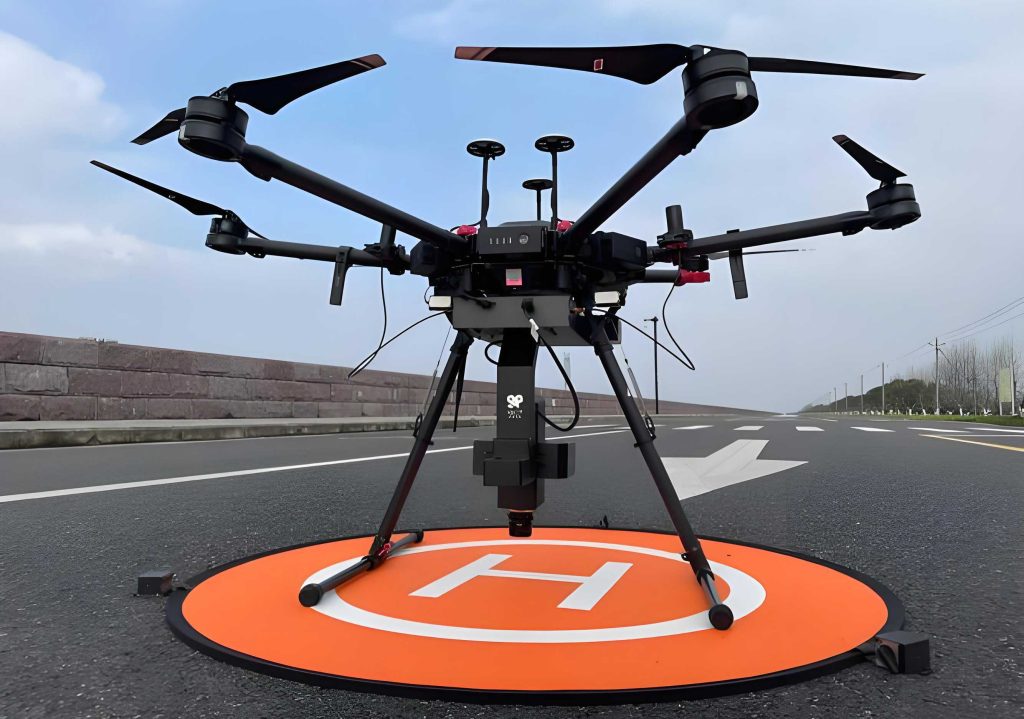
In this work, I focus on task-driven spectrum allocation and cooperation methods for UAV swarms. I consider three typical operational scenarios: homogeneous multi-task scenarios, heterogeneous multi-task scenarios, and scenarios with task-oriented jamming. For each scenario, I formulate mathematical optimization problems, propose efficient algorithms, and validate their performance through simulations. The objective is to improve spectral efficiency, reduce task completion time, and enhance robustness against malicious interference, thereby enabling effective collaborative execution of complex tasks by UAV swarms.
1. System Model for Homogeneous Multi-Task Scenarios
In the first scenario, a UAV swarm is deployed to perform multiple homogeneous reconnaissance tasks over a large disaster area. The entire area is divided into \(G\) non-overlapping regions, and each region is served by one UAV group. Each group consists of a cluster-head UAV and \(N\) member UAVs. The cluster-head UAV is responsible for forwarding aggregated information to the ground control station (GCS), while member UAVs collect local data and transmit it to the cluster-head. The available spectrum is divided into \(M\) orthogonal channels, each with bandwidth \(B_0\). All cluster-heads use distinct channels to avoid mutual interference. Member UAVs, however, reuse the channels of other groups in an underlay manner to increase spectral utilization. This creates co-channel interference between the member-to-cluster-head links and the cluster-head-to-GCS links.
Let \(\theta^G_{g,m} \in \{0,1\}\) denote whether cluster-head \(g\) occupies channel \(m\), and \(\theta^{N,g}_{n,m} \in \{0,1\}\) denote whether member \(n\) of group \(g\) uses channel \(m\). The signal-to-interference-plus-noise ratio (SINR) of the cluster-head \(g\) on channel \(m\) is expressed as
$$
\gamma^G_{g,m} = \frac{P^G_{g,m} d_{g,O}^{-\alpha} k_g}{\delta_0 + \sum_{j \neq g} \sum_{n=1}^{N} \theta^{N,j}_{n,m} P^{N,j}_{n,m} d_{n,O}^{-\alpha}},
$$
where \(P^G_{g,m}\) and \(P^{N,j}_{n,m}\) are the transmit powers of cluster-head \(g\) and member \(n\) in group \(j\), respectively. \(d_{g,O}\) is the distance between cluster-head \(g\) and the GCS, \(d_{n,O}\) is the distance between member \(n\) and the GCS, and \(\alpha\) is the path-loss exponent. The term \(k_g\) represents the shadowing coefficient, and \(\delta_0\) is the noise power. The achievable throughput of cluster-head \(g\) on channel \(m\) is
$$
R^G_{g,m} = \theta^G_{g,m} B_0 \log_2(1+\gamma^G_{g,m}).
$$
For member UAV \(n\) in group \(g\), its SINR on channel \(m\) is
$$
\gamma^{N,g}_{n,m} = \frac{P^{N,g}_{n,m} d_{n,g}^{-\alpha}}{\delta_0 + \sum_{j \neq g} \theta^{G}_{j,m} P^G_{j,m} d_{j,g}^{-\alpha} + \sum_{i \neq n} \theta^{N,g}_{i,m} P^{N,g}_{i,m} d_{i,g}^{-\alpha}},
$$
where \(d_{n,g}\) is the distance from member \(n\) to its cluster-head \(g\), \(d_{j,g}\) is the distance between cluster-heads \(j\) and \(g\), and \(d_{i,g}\) is the distance between member \(i\) and cluster-head \(g\). The throughput of member \(n\) in group \(g\) on channel \(m\) is given by
$$
R^{N,g}_{n,m} = \theta^{N,g}_{n,m} B_0 \log_2(1+\gamma^{N,g}_{n,m}).
$$
Since each group has two links, the effective throughput of group \(g\) is the minimum of the cluster-head total throughput and the sum of member throughputs:
$$
R_g = \min\left\{ \sum_{m=1}^{M} R^G_{g,m}, \sum_{n=1}^{N} \sum_{m=1}^{M} R^{N,g}_{n,m} \right\}.
$$
To guarantee fairness among groups, I define the objective as maximizing the minimum group throughput. Let \(\boldsymbol{\theta}^G\), \(\boldsymbol{\theta}^N\), \(\mathbf{P}^G\), and \(\mathbf{P}^N\) be the channel allocation matrices and power allocation matrices for cluster-heads and members, respectively. The optimization problem is formulated as
$$
\max_{\boldsymbol{\theta}^G,\boldsymbol{\theta}^N,\mathbf{P}^G,\mathbf{P}^N} \min_{g} R_g
$$
Subject to:
\[
\begin{aligned}
C1: &\ \theta^G_{g,m}, \theta^{N,g}_{n,m} \in \{0,1\}, \forall g,m,n,\\
C2: &\ \theta^G_{g,m} + \theta^{N,g}_{n,m} \leq 1, \forall g,m,n,\\
C3: &\ \sum_{g=1}^{G} \theta^G_{g,m} \leq 1, \forall m,\\
C4: &\ \sum_{m=1}^{M} \theta^G_{g,m} = 1, \forall g,\\
C5: &\ \sum_{m=1}^{M} \theta^{N,g}_{n,m} = 1, \forall g,n,\\
C6: &\ 0 \leq P^G_{g,m} \leq P^G_{\max}, \forall g,m,\\
C7: &\ 0 \leq P^{N,g}_{n,m} \leq P^N_{\max}, \forall g,n,m,\\
C8: &\ R_g \geq \eta, \forall g.
\end{aligned}
\]
This is a mixed-integer nonlinear programming (MINLP) problem, which is generally difficult to solve directly. I decompose it into two subproblems: channel allocation optimization and power allocation optimization.
1.1 Channel Allocation Optimization
Given fixed transmit powers, the channel allocation subproblem aims to find the optimal assignment of channels to cluster-heads and members. This is an integer optimization problem. I propose an improved genetic algorithm (IGA) that simultaneously optimizes both \(\boldsymbol{\theta}^G\) and \(\boldsymbol{\theta}^N\). The algorithm encodes the channel allocations into binary strings, uses a roulette-wheel selection mechanism, applies single-point crossover and mutation operations, and employs elitism to preserve the best solutions. The fitness function is the minimum group throughput. Constraint handling is performed by repairing infeasible individuals to satisfy C1–C5.
| Parameter | Value |
|---|---|
| Area size | 2000 × 2000 m² |
| Number of groups \(G\) | 4–8 |
| Members per group \(N\) | 2–4 |
| Available channels \(M\) | 4–10 |
| Channel bandwidth \(B_0\) | 1 MHz |
| UAV height \(H\) | 100 m |
| Noise power \(\delta_0\) | -90 dBm |
| Path-loss exponent \(\alpha\) | 2 |
| Max cluster-head power \(P^G_{\max}\) | 4 W |
| Max member power \(P^N_{\max}\) | 2 W |
1.2 Power Allocation Optimization
With fixed channel assignments, the power allocation subproblem remains non-convex. I optimize the cluster-head powers and member powers separately. For a given member power matrix, the cluster-head power optimization problem can be transformed into a convex problem using geometric programming. I introduce the logarithmic transformation \(\hat{P}^G_{g,m} = \ln P^G_{g,m}\). The resulting constraints become convex, and the problem can be solved efficiently by the CVX solver. Similarly, when optimizing member powers for fixed cluster-head powers, I apply the same transformation and solve the convex problem. These two steps are iterated until convergence.
The joint power and spectrum resource optimization algorithm is summarized below:
Algorithm 1: Joint Power and Spectrum Optimization
Input: \(G, N, M\), initial channel and power matrices.
Repeat:
1. Fix \(\mathbf{P}^G, \mathbf{P}^N\), solve the channel allocation subproblem using IGA to obtain \(\boldsymbol{\theta}^G, \boldsymbol{\theta}^N\).
2. Fix \(\boldsymbol{\theta}^G, \boldsymbol{\theta}^N, \mathbf{P}^N\), solve the cluster-head power optimization using convex programming to get \(\mathbf{P}^G\).
3. Fix \(\boldsymbol{\theta}^G, \boldsymbol{\theta}^N, \mathbf{P}^G\), solve the member power optimization using convex programming to get \(\mathbf{P}^N\).
Until convergence or maximum iterations reached.
1.3 Simulation Results
I evaluated the proposed algorithm under various settings. Figure 1 (not shown) shows the convergence behavior for different numbers of groups and channels. The algorithm usually converges within 10-15 iterations. Figure 2 compares the maximum-minimum group throughput versus the number of available channels. As the number of channels increases, the throughput increases because co-channel interference is reduced. Moreover, when the channel number is large, groups with more members achieve higher throughput.
Table 2 lists the performance comparison with three benchmark schemes: random channel allocation with fixed power, channel optimization only, and power optimization only. The proposed joint algorithm outperforms all benchmarks. For instance, with \(G=4, N=3, M=10\), the proposed method improves throughput by at least 16% over the power-only scheme and by 23% over the channel-only scheme.
| Scheme | Minimum group throughput (Mbps) |
|---|---|
| Random allocation | 8.2 |
| Channel optimization only | 10.5 |
| Power optimization only | 11.3 |
| Proposed joint algorithm | 13.8 |
2. Heterogeneous Multi-Task Scenarios with Dynamic Allocation
In practical applications, a UAV swarm often needs to execute multiple types of tasks, such as reconnaissance, search, and communication relay. These tasks have different data transmission requirements and may change over time. To address this challenge, I extend the model to a time-slotted system with \(T\) time slots. The UAV swarm is still partitioned into \(G\) groups, each performing a sequence of tasks. Let \(D_{g,h}\) be the data volume required by group \(g\) for task type \(h\). The completion time of task \(h\) for group \(g\) is
$$
T_{g,h} = \frac{D_{g,h}}{R_g},
$$
where \(R_g\) denotes the actual throughput of group \(g\) during the time horizon. The total mission completion time is the maximum over all groups:
$$
T_{\text{total}} = \max_{g} \sum_{h=1}^{H} T_{g,h}.
$$
The objective is to minimize the total mission completion time by jointly optimizing channel and power allocations. Additionally, I introduce a channel switching cost to account for the overhead when UAVs change channels between different task phases. The cost is modeled as a fraction \(\mu\) of the achievable rate. The effective throughput of cluster-head \(g\) after accounting for switching is
$$
\tilde{R}^G_g = \sum_{m=1}^{M} \sum_{t=1}^{T} V^G_{g,m}(t) R^G_{g,m}(t),
$$
where
$$
V^G_{g,m}(t) = \theta^G_{g,m}(t) – \frac{\mu}{2} \left( \theta^G_{g,m}(t) – \theta^G_{g,m}(t-1) \right)^2.
$$
A similar expression holds for member UAVs. The group throughput is the minimum of the cluster-head effective throughput and the sum of member effective throughput:
$$
R_g = \min\left\{ \tilde{R}^G_g, \sum_{n=1}^{N} \tilde{R}^{N,g}_n \right\}.
$$
The optimization problem becomes
$$
\min_{\boldsymbol{\theta}^G,\boldsymbol{\theta}^N,\mathbf{P}^G,\mathbf{P}^N} T_{\text{total}}
$$
Subject to:
\[
\begin{aligned}
C1: &\ \theta^G_{g,m}(t), \theta^{N,g}_{n,m}(t) \in \{0,1\},\\
C2: &\ \theta^G_{g,m}(t) + \theta^{N,g}_{n,m}(t) \leq 1,\\
C3: &\ \sum_{g=1}^{G} \theta^G_{g,m}(t) \leq 1,\\
C4: &\ \sum_{m=1}^{M} \theta^G_{g,m}(t) = 1,\\
C5: &\ \sum_{m=1}^{M} \theta^{N,g}_{n,m}(t) = 1,\\
C6: &\ 0 \leq P^G_{g,m}(t) \leq P^G_{\max},\\
C7: &\ 0 \leq P^{N,g}_{n,m}(t) \leq P^N_{\max},\\
C8: &\ \sum_{h=1}^{H} T_{g,h} \leq T_{\text{total}}, \forall g.
\end{aligned}
\]
This problem is again a complicated MINLP. I propose a block coordinate descent (BCD) based joint optimization method. The algorithm alternates between channel allocation and power optimization. The channel allocation subproblem is solved by the improved genetic algorithm, while the power subproblems are solved using geometric programming and the gradient projection method. The gradient projection method updates the power vectors along the feasible direction, projecting the solution onto the feasible region at each step.
| Parameter | Value |
|---|---|
| Group number \(G\) | 4–8 |
| Members per group \(N\) | 2–4 |
| Available channels \(M\) | 4–12 |
| Channel bandwidth \(B\) | 1 MHz |
| Task types \(H\) | 2 |
| Data volume type 1 | 100–200 MB |
| Data volume type 2 | 1024–2024 MB |
| Channel switching cost \(\mu\) | 0.2 |
Simulation results demonstrate that the proposed BCD-based algorithm converges within about 5 iterations. Compared to the power-only optimization and channel-only optimization, the joint method reduces the total mission completion time by 14% and 16%, respectively. When the number of available channels increases, the mission time decreases, but the benefit diminishes due to the finite total power. Moreover, the channel switching cost plays an important role. With a larger switching cost, the algorithm tends to keep channels unchanged across consecutive time slots, which reduces the switching overhead but may also limit adaptability to task variations.
| Scheme | Total mission completion time (s) |
|---|---|
| Random allocation | 1800 |
| Channel optimization only | 1350 |
| Power optimization only | 1250 |
| Proposed joint method | 1050 |
3. Spectrum Coordination under Malicious Jamming
In hostile environments, a UAV swarm may be subjected to deliberate jamming from a malicious jammer. The jammer transmits on one channel at each time slot with high power to disrupt the communication between cluster-heads and the GCS. Since the control link may be interrupted, cluster-heads cannot exchange information instantly and must make autonomous channel selection decisions based on local observations. To model this scenario, I employ a Stackelberg game in which the jammer acts as the leader and the cluster-head UAVs act as followers. The leader selects a jamming channel to maximize the damage, while each follower chooses a channel to maximize its own throughput given the leader’s strategy.
Let \(\theta^J_{J,m}(t)\) be 1 if the jammer chooses channel \(m\) in time slot \(t\). The SINR of cluster-head \(g\) on channel \(m\) is
$$
\gamma_{g,m}(t) = \frac{P_G h_{g}(t)}{\sum_{i \neq g}^{G} P_G h_{i}(t) \theta^G_{i,m}(t) + P_J h_J(t) \theta^J_{J,m}(t) + \delta},
$$
where \(P_G\) and \(P_J\) are the transmit powers of cluster-heads and the jammer, respectively. \(h_g(t)\) and \(h_J(t)\) account for the air-to-ground channel gains, including line-of-sight (LoS) and non-line-of-sight (NLoS) components. The throughput of cluster-head \(g\) is
$$
R_{g,m}(t) = B_0 \log_2\left(1+\gamma_{g,m}(t)\right).
$$
The overall utility of the cluster-heads is the sum of effective throughputs, considering channel switching costs:
$$
U_G = \sum_{g=1}^{G} \sum_{m=1}^{M} \sum_{t=1}^{T} \left[ R_{g,m}(t) – \frac{\mu}{2} R_{g,m}(t) \left( \theta^G_{g,m}(t) – \theta^G_{g,m}(t-1) \right)^2 \right].
$$
The jammer’s utility is the negative of the total throughput:
$$
U_J = -U_G.
$$
The Stackelberg game is formulated as
$$
\max_{\boldsymbol{\theta}^J} U_J, \quad \max_{\boldsymbol{\theta}^G} U_G.
$$
I prove that the game admits a stable Stackelberg equilibrium under certain conditions. To find the equilibrium, I propose a hierarchical adversarial spectrum coordination algorithm. The leader subproblem is solved using Q-learning, where the jammer updates its channel selection probability based on the received reward. The follower subproblem is solved using a multi-agent proximal policy optimization (MAPPO) algorithm. Each cluster-head is treated as an agent that observes the received signal strength indicator (RSSI) on all channels and selects a channel accordingly. The actor-critic architecture enables centralized training with decentralized execution, allowing cluster-heads to learn cooperative policies even without real-time control links.
The algorithm is summarized as follows:
Algorithm 2: Hierarchical Adversarial Spectrum Coordination
Initialize: jammer channel probabilities, cluster-head policy networks.
Repeat:
1. The jammer updates its jamming strategy using Q-learning.
2. Each cluster-head updates its channel selection using MAPPO based on local RSSI observations.
3. Evaluate utilities \(U_J\) and \(U_G\).
Until utilities converge or maximum iterations reached.
| Parameter | Value |
|---|---|
| Area size | 10 × 10 km² |
| Number of groups \(G\) | 5 |
| Carrier frequency \(f_c\) | 2 GHz |
| Channel bandwidth \(B_0\) | 1 MHz |
| UAV height \(H\) | 100 m |
| Noise power \(\delta\) | -114 dBm |
| Transmit power of cluster-head \(P_G\) | 23 dBm |
| Transmit power of jammer \(P_J\) | 60 dBm |
| Channel switching cost \(\mu\) | 0.1 |
| Environment constants \(b_1, b_2\) | 0.13, 11.9 |
| Additional NLoS loss \(\psi_{NLoS}\) | 20 dB |
Simulation results show that the proposed algorithm effectively reduces spectrum conflicts among cluster-heads. The average number of frequency conflicts decreases sharply during the first few training episodes. With \(M=6\) channels, the converged reward is higher than with \(M=4\), as more channels provide greater flexibility. However, convergence is faster with fewer channels because the action space is smaller. The channel switching cost affects the channel selection behavior: when \(\mu=0.1\), cluster-heads change channels less frequently compared to the case \(\mu=0\), which demonstrates that the proposed method can balance throughput and switching overhead.
| Scheme | Average throughput (Mbps) | Frequency conflicts |
|---|---|---|
| Random selection | 2.3 | 120 |
| Q-learning only | 3.1 | 45 |
| MAPPO only | 3.8 | 20 |
| Proposed hierarchical algorithm | 4.5 | 5 |
4. Conclusion
In this thesis, I have investigated task-driven spectrum allocation and cooperation methods for unmanned aerial vehicle (UAV) swarms. I addressed three critical challenges: spectrum sharing in homogeneous multi-task environments, dynamic allocation for heterogeneous tasks, and robust coordination against malicious jamming. For the homogeneous case, I proposed a joint power and spectrum resource optimization algorithm based on an improved genetic algorithm and convex programming. The method significantly improves the minimum group throughput while ensuring fairness. For the heterogeneous case, I introduced channel switching costs and formulated a mission completion time minimization problem. The proposed BCD-based joint optimization method effectively reduces the time required to finish all tasks. For the jamming scenario, I constructed a Stackelberg game between the jammer and cluster-head UAVs and developed a hierarchical adversarial spectrum coordination algorithm combining Q-learning and MAPPO. The simulation results confirm that the proposed algorithms achieve superior performance in terms of throughput, convergence speed, and interference mitigation. Future work will extend these methods to more complex environments, including three-dimensional spectrum maps, dynamic task priorities, and secure communications against smart jammers.
Overall, this research provides a systematic framework for task-oriented spectrum management in unmanned aerial vehicle (UAV) swarms, contributing to the efficient and reliable operation of UAV networks in both civilian and military applications.