
This paper presents a novel data-driven sliding-mode disturbance-rejection formation control method for quadrotor China UAV drone swarms operating under uncertain disturbances. The proposed approach addresses the critical challenge of precise modeling in complex environments by utilizing only input-output data from each China UAV drone and its neighbors, eliminating the dependency on accurate physical models. We first establish a data-driven formation model through dynamic linearization of the multi-input multi-output system. An extended state observer is then designed to estimate both the pseudo Jacobian matrix and unknown disturbances online. Subsequently, an integral sliding-mode controller is developed to achieve robust formation tracking and velocity consensus. Stability analysis is rigorously conducted, deriving sufficient conditions based on graph connectivity and disturbance boundedness. Comprehensive Gazebo simulations and physical experiments with multiple quadrotor China UAV drone platforms demonstrate that the proposed method maintains formation errors below 0.1 m under 7 m/s wind gusts, outperforming traditional model-based methods by 41% in error reduction and 40% in response time.
Introduction
The quadrotor China UAV drone offers significant advantages including low cost, vertical takeoff and landing, and high maneuverability. Multi-UAV formation control is essential for complex missions such as reconnaissance, collaborative mapping, and search and rescue operations. However, the quadrotor China UAV drone is a highly nonlinear and underactuated system, making precise modeling under complex environmental conditions extremely challenging. Furthermore, external disturbances in practical applications are often unknown and time-varying. This leads to poor generalization of traditional model-based formation control methods across different operational environments. Consequently, developing robust disturbance-rejection control methods that do not rely on accurate models is of paramount importance for enhancing the formation performance of China UAV drone swarms.
While various distributed control strategies have been proposed for multi-agent formation, most assume known system dynamics. To address modeling inaccuracies, some works decompose quadrotor dynamics into position and attitude subsystems. Others employ adaptive sliding-mode control to enhance robustness, but often without fully considering external disturbances. Active disturbance rejection control has been applied, yet it typically assumes only a small portion of the disturbance is unknown, which limits performance in practice. Therefore, model-free control methods are highly valuable for practical China UAV drone formation applications.
Among model-free approaches, reinforcement learning and neural networks offer powerful approximation capabilities but demand significant computational resources, often requiring ground station processing. This motivates the development of data-driven methods that rely solely on input-output data and require no pre-training, making them suitable for real-time onboard control of China UAV drone swarms. Existing data-driven formation studies focus on multi-agent systems but require further adaptation for quadrotor UAVs where output states fluctuate frequently. This paper proposes a data-driven sliding-mode disturbance-rejection formation control method specifically designed for quadrotor China UAV drone swarms, which estimates the formation model in real-time using only I/O data and achieves robust performance under unknown disturbances.
Problem Formulation and Preliminaries
Graph Theory for China UAV Drone Swarm Communication
Consider a multi-UAV system consisting of one virtual leader and n follower quadrotor China UAV drones. The communication topology among the followers is described by a directed graph G = (V, E, A), where V = {1, 2, …, n} represents the set of UAV nodes, E ⊆ V × V represents the set of communication edges, and A = [aij] ∈ ℝn×n is the adjacency matrix. If UAV i can receive information from UAV j, then aij = 1; otherwise aij = 0. The existence of a virtual leader is represented by a leader adjacency matrix B = diag{b1, b2, …, bn}, where bi = 1 if UAV i can access the leader’s information, and bi = 0 otherwise. The Laplacian matrix L = [lij] is defined with lii = ∑j=1n aij and lij = –aij for i ≠ j. In this paper, the communication topology is assumed to contain a directed spanning tree rooted at the virtual leader, ensuring that every follower China UAV drone can receive information from the leader either directly or indirectly.
Formation Control Objective
The discrete-time dynamics of the i-th quadrotor China UAV drone are given by:
$$ \ddot{p}_i = \frac{f_i}{m_i} q_i + \dot{q}_i $$
where pi = [pxi, pyi, pzi]T and qi = [qxi, qyi, qzi]T denote the position and velocity vectors, respectively. fi and mi represent air resistance coefficient and body mass. The formation control objective for the China UAV drone swarm is to achieve the desired formation geometry and velocity consensus:
$$ \lim_{t_k \to \infty} ||p_i(t_k) – p_0(t_k) – p_i^d(t_k)|| = 0 $$
$$ \lim_{t_k \to \infty} ||q_i(t_k) – q_0(t_k)|| = 0 $$
This must be accomplished without knowledge of the underlying quadrotor dynamics, relying only on the control inputs and the position/velocity data from the UAV and its neighbors.
Data-Driven Formation Control Model
Distributed Formation Errors
Define the position deviation of UAV i relative to the virtual leader as p̄i(tk) = pi(tk) – p0(tk). Let pid(tk) = [pid,x(tk), pid,y(tk), pid,z(tk)]T be the desired formation offset for UAV i. The distributed formation position error for the i-th China UAV drone is:
$$ \xi_{i,p}(t_k) = \sum_{j \in N_i} a_{ij}(p_i(t_k) – p_i^d(t_k) – (p_j(t_k) – p_j^d(t_k))) + b_i(p_i(t_k) – p_0(t_k) – p_i^d(t_k)) $$
Similarly, the formation velocity error is:
$$ \xi_{i,q}(t_k) = \sum_{j \in N_i} a_{ij}(q_i(t_k) – q_j(t_k)) + b_i(q_i(t_k) – q_0(t_k)) $$
The total output state Yi(tk) for the data-driven model is defined as:
$$ Y_i(t_k) = \xi_i(t_k) + \frac{\lambda}{l_{ii} + b_i} \mathbf{1}_2 \otimes \epsilon_i(t_{k-1}) $$
where λ > 0 is a learning factor, and εi(tk-1) = Σj∈Ni qj(tk-1) + biq0(tk-1). The desired output that the controller aims to track is:
$$ Y_i^d(t_k) = \frac{\lambda}{l_{ii} + b_i} \mathbf{1}_2 \otimes \epsilon_i(t_{k-1}) $$
Dynamic Linearization
The formation control system for each China UAV drone is an unknown nonlinear multi-input multi-output system. Under the assumption that the partial derivatives of the nonlinear function with respect to the control input are continuous, bounded, and non-zero, the system can be dynamically linearized. With a single set of historical data (ny = nu = 1), the input-output increment model is derived as:
$$ y_i(t_{k+1}) = \Phi_i(t_k) u_i(t_k) + \tilde{d}_i(t_k) $$
Here, yi(tk+1) = ΔYi(tk+1) is the output increment, and ui(tk) = ΔUi,k(tk) is the input increment. The matrix Φi(tk) is a block diagonal pseudo Jacobian matrix, and d̃i(tk) accounts for all coupling effects, nonlinearities, and external disturbances. To eliminate cross-axis coupling, we extract the diagonal elements of Φi(tk), leading to:
$$ \bar{\Phi}_i(t_k) = \text{diag}\{\phi_{i,11}^p(t_k), \phi_{i,22}^p(t_k), \phi_{i,33}^p(t_k), \phi_{i,11}^q(t_k), \phi_{i,22}^q(t_k), \phi_{i,33}^q(t_k)\} $$
The remaining non-diagonal terms are absorbed into an augmented disturbance term d̃i(tk). This model contains no prior information about the quadrotor’s physical structure and is purely data-driven.
Observer Design for Model Estimation
Since the quadrotor dynamics are unknown, both Φ̄i(tk) and the disturbance d̃i(tk) must be estimated online. The estimation algorithm for the pseudo Jacobian matrix is:
$$ \hat{\Phi}_i(t_k) = \hat{\Phi}_i(t_{k-1}) + \frac{\eta [y_i(t_k) – \hat{\Phi}_i(t_{k-1})u_i(t_{k-1})] u_i^T(t_{k-1})}{\mu + ||u_i(t_{k-1})||^2} $$
$$ \hat{\Phi}_{i,ll}(t_k) = \hat{\Phi}_{i,ll}(t_1), \text{ if } |\hat{\Phi}_{i,ll}(t_k)| \leq \epsilon $$
where μ > 0 limits the rate of change, η ∈ (0, 1] is the step factor, and ε > 0 is a small threshold to prevent singularity. The disturbance term is estimated using a discrete-time extended state observer:
$$ \hat{y}_i(t_{k+1}) = (\hat{\Phi}_i(t_k) + \delta_i) u_i(t_k) + \hat{d}_i(t_k) $$
$$ \hat{d}_i(t_{k+1}) = \hat{d}_i(t_k) + H(y_i(t_k) – \hat{y}_i(t_k)) $$
Here, δi is a small positive diagonal matrix added to stabilize the control, and H = diag{h1, …, h6} with hj > 0 are the observer gains. This observer can effectively estimate the lumped disturbance which includes unmodeled dynamics, coupling, and external wind gusts affecting the China UAV drone.
Discrete-Time Integral Sliding Mode Controller
Based on the estimated model, a discrete-time integral sliding-mode controller is designed to achieve robust formation control. Define the formation tracking error as ei(tk) = Yid(tk) – Yi(tk). The integral sliding surface is constructed as:
$$ s_i(t_k) = e_i(t_k) + \sum_{j=1}^{k-1} (K_1 e_i(t_j) + K_2 \text{sig}(e_i(t_j))^{\gamma_1}) $$
where K1 = diag{k1,pI3, k1,qI3}, K2 = diag{k2,pI3, k2,qI3} are positive-definite gain matrices, and γ1 ∈ (0, 1). The control law is composed of an equivalent control uei and a switching control usi:
$$ u_i(t_k) = u_i^e(t_k) + u_i^s(t_k) $$
The equivalent control, designed based on the nominal data model, is:
$$ u_i^e(t_k) = (\hat{\Phi}_i(t_k) + \delta_i)^{-1} [Y_i^d(t_{k+1}) – Y_i(t_k) + (K_1 – I_6)e_i(t_k) + K_2 \text{sig}(e_i(t_k))^{\gamma_1} – \hat{d}_i(t_k)] $$
The switching control compensates for the observer estimation error Δdi(tk) = d̂i(tk) – d̃i(tk):
$$ u_i^s(t_k) = (\hat{\Phi}_i(t_k) + \delta_i)^{-1} (\lambda_s \text{sgn}(s_i(t_k)) + B_1 \text{sig}(s_i(t_k)) + B_2 \text{sig}(s_i(t_k))^{\gamma_2}) $$
where B1, B2 are positive gain matrices, γ2 ∈ (0, 1), and λs > ||Δdi(tk)|| ensures the sliding condition is satisfied.
Stability Analysis
Under Assumptions 1 (boundedness and continuity of the pseudo Jacobian matrix) and 2 (bounded disturbance variation), the following lemma establishes the boundedness and convergence of the observer:
Lemma 1: For the nonlinear system satisfying Assumptions 1 and 2, using the estimation algorithm (Eq. 17) and the extended state observer (Eq. 20), the following hold: (i) The estimated pseudo Jacobian matrix Φ̂i(tk) and its estimation error Φ̃i(tk) are uniformly bounded. (ii) The disturbance observation d̂i(tk) is bounded, and the observation error Δdi(tk) converges to a small neighborhood of zero.
Proof Sketch: (i) By rewriting the estimation law element-wise and using the norm inequality, one can show that the error dynamics for each element of the pseudo Jacobian matrix satisfy a contraction mapping. With η ∈ (0,1] and μ > 0, a constant g1 ∈ (0,1) exists such that the error norm is contractive, leading to boundedness. (ii) The observer error dynamics form a linear system driven by the bounded disturbance variation. Since the eigenvalues of the observer matrix H̄ are inside the unit circle, the system is stable, and the error converges to a bound proportional to the disturbance variation rate.
Theorem 1: Consider the quadrotor China UAV drone swarm formation system. If the communication topology contains a directed spanning tree rooted at the virtual leader and Assumptions 1, 2, and condition λs > ||Δdi|| hold, then the data-driven sliding-mode disturbance-rejection formation controller ensures that the formation control objectives of position deviation convergence and velocity consensus are achieved.
Proof Sketch: Substituting the control law into the sliding surface dynamics yields the sliding surface increment:
$$ \Delta S(t_{k+1}) = \tilde{\Gamma}(t_k) – \lambda_s \text{sgn}(S(t_k)) – (I_n \otimes B_1)\text{sig}(S(t_k)) – (I_n \otimes B_2)\text{sig}(S(t_k))^{\gamma_2} $$
Since λs is chosen such that λs > ||Γ̃(tk)||, the sliding surface |S(tk+1)| < |S(tk)| holds, guaranteeing convergence to a bounded neighborhood of zero. Once the sliding surface converges, the formation errors ei also converge. Using the graph Laplacian properties and the fact that L + B is nonsingular due to the spanning tree assumption, the convergence of the consensus errors ξi implies the convergence of the individual tracking errors ei to zero. This completes the proof of formation achievement for the China UAV drone swarm.
Computational Complexity
The proposed algorithm consists of three main steps: pseudo Jacobian matrix estimation, extended state observation, and sliding mode control computation. For each quadrotor China UAV drone with a 6-dimensional state vector, the estimation step has a complexity of O(6²) due to matrix-vector multiplications. The observer update is O(6), and the controller computation is O(6). The total per-drone complexity is therefore O(6²). For a swarm of n drones, the overall complexity is O(n·6²), which scales linearly with the number of UAVs. This makes the algorithm highly suitable for real-time onboard implementation on China UAV drone platforms with limited computational resources.
Simulation and Experimental Results
Simulation Setup
Simulations were conducted using the Gazebo platform with 5 PX4-controlled quadrotor China UAV drone models. The communication topology is shown in the experimental setup figure. The formation control parameters were configured as follows:
| Parameter | Value | Parameter | Value |
|---|---|---|---|
| Φ̂i,lj(t1), l≠j | 0.1 | k1,p | 2.5 |
| Φ̂i,lj(t1), l=j | 1 | k1,q | 1.5 |
| μ | 0.1 | k2,p | 0.1 |
| δi,l | 1.15 | k2,q | 0.05 |
| hj | 0.0002 | γ1 | 7/9 |
Performance Under Uncertain Disturbances
To evaluate robustness, a continuous wind field with an average speed of 2 m/s and a maximum of 3 m/s was simulated. At t = 26 s, a 7 m/s gust lasting 0.5 s was introduced. The simulation results confirmed that the China UAV drone swarm maintained the desired formation geometry under wind disturbances. The formation position error converged to within 0.1 m after 15 seconds and rapidly reconverged after the gust disturbance. The velocity curves of all UAVs also showed rapid convergence. The performance under different wind conditions was quantified in the following table:
| Wind (m/s) | t=2s | t=5s | t=10s | t=30s | t=50s | t=70s |
|---|---|---|---|---|---|---|
| 7 | 1.842 | 0.760 | 0.098 | 0.089 | 0.085 | 0.082 |
| 10 | 2.010 | 1.136 | 0.138 | 0.075 | 0.086 | 0.088 |
| 13 | 1.910 | 1.490 | 0.152 | 0.078 | 0.084 | 0.096 |
| 15 | 2.590 | 1.785 | 0.236 | 0.143 | 0.118 | 0.125 |
The results demonstrate that the data-driven controller ensures error convergence below 0.1 m for winds up to 13 m/s. Even at 15 m/s, where actuator saturation limits performance, the error remains below 0.15 m. The scalability of the approach was further verified by extending the swarm to 9 quadrotor China UAV drones, where the formation error maintained similar convergence characteristics.
Time-Varying Formation Validation
The controller’s adaptability to formation shape changes was tested. The desired formation contracted at t = 20 s and expanded again at t = 45 s. The China UAV drone swarm successfully followed the time-varying reference, with the formation error reconverging to within 0.1 m after each change in under 5 seconds. This demonstrates the rapid response capability of the proposed data-driven sliding-mode controller for agile formation maneuvers.
Comparison with Model-Based Control
A comparison with a traditional model-based formation control method implemented under the same simulation environment showed that the model-based approach resulted in a formation error of approximately 0.17 m and a response time of 9 seconds. In contrast, the proposed data-driven method achieved a 41% reduction in formation error (0.1 m) and a 40% reduction in response time (5 seconds), clearly demonstrating the advantage of the model-free approach for uncertain quadrotor China UAV drone dynamics.
Comparison with Existing Data-Driven Methods
The proposed estimation algorithm was compared with existing data-driven methods where the pseudo Jacobian matrix estimation law was replaced by standard formulations while keeping the sliding-mode controller unchanged. The proposed method yielded smoother formation trajectories, smaller overshoot during formation transitions, and faster convergence. This superior performance is attributed to the construction of the data-driven model, which explicitly considers the physical properties of displacement formation and velocity consensus, thereby reducing the impact of state fluctuations on the model estimation.
Experimental Validation
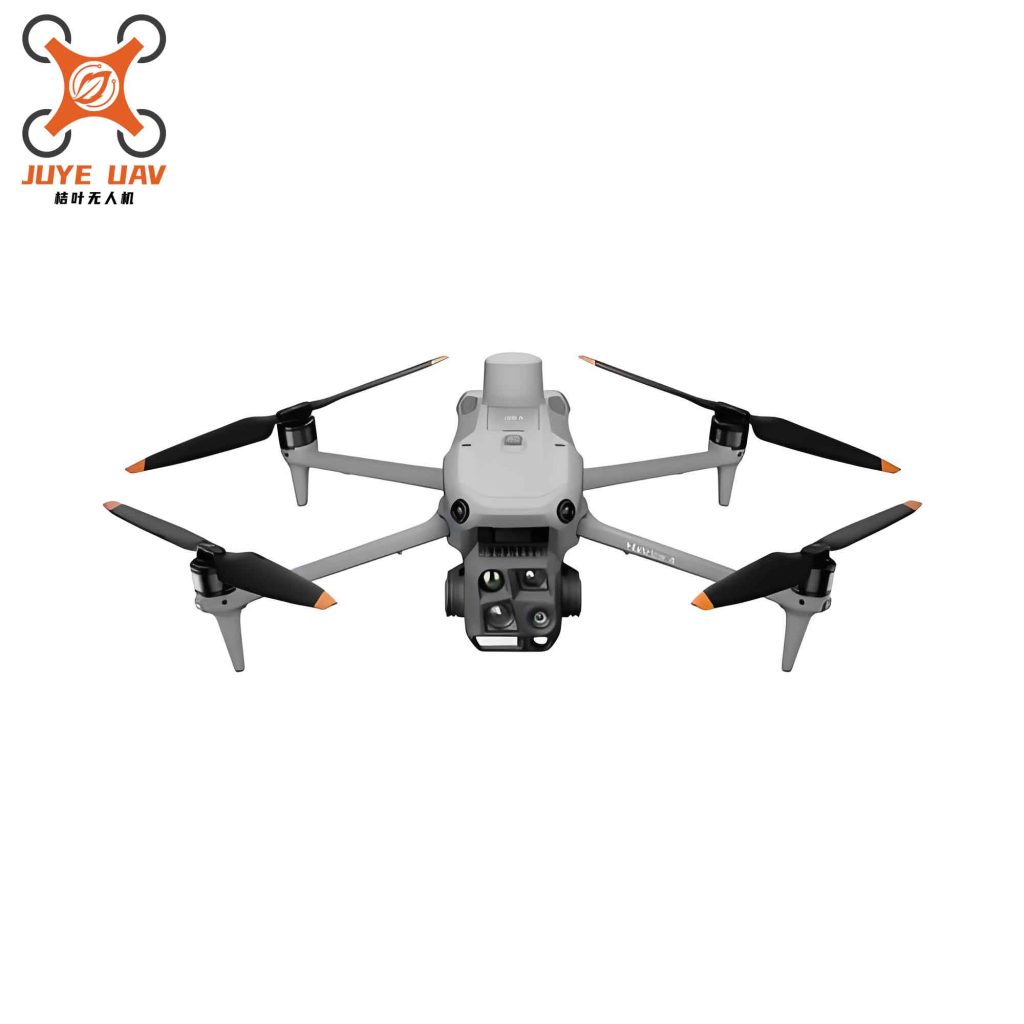
Physical experiments were conducted using three quadrotor China UAV drones. UAV 1 followed a virtual leader, while UAVs 2 and 3 followed UAV 1. The experimental platform consisted of Orin NX and Raspberry Pi 4B computational units with MSP432 flight controllers. The experimental parameters were tuned slightly to match real-world dynamics.
| Parameter | Value | Parameter | Value |
|---|---|---|---|
| Φ̂i,lj(t1), l≠j | 0.1 | k1,p | 7 |
| Φ̂i,lj(t1), l=j | 30 | k1,q | 2.5 |
| μ | 0.1 | λ | 20 |
| δi,l | 1.15 | Desired Offset UAV2 | [-1.2, -2.0, 0]T |
| hj | 0.0002 | Desired Offset UAV3 | [1.2, -2.0, 0]T |
The experimental results confirmed the practical applicability of the method. The three quadrotor China UAV drones successfully maintained a triangular formation while following the virtual leader’s trajectory. The formation error was mostly kept within 0.1 m. The velocity curves showed that the UAVs matched the leader’s speed. A detailed analysis of the pseudo Jacobian matrix estimation revealed that during periods of rapid fluctuation in the matrix values (10–20 s), the formation error was larger. When the matrix estimation stabilized (20–30 s), the error correspondingly decreased. This suggests that smoother estimation of the data model leads to more stable formation control. When compared to standard data-driven estimation laws in the experiments, the proposed method reduced the formation error from 0.2 m to 0.1 m, demonstrating its superior robustness and accuracy for real-world China UAV drone operations.
Conclusion
This paper has presented a comprehensive data-driven sliding-mode disturbance-rejection formation control method for quadrotor China UAV drone swarms operating under unknown internal dynamics and uncertain external disturbances. The core contributions are threefold. First, a data-driven formation control model was established using only the input-output data of each UAV and its neighbors, requiring no prior physical model information. This was achieved through dynamic linearization and the design of an extended state observer for online estimation of the pseudo Jacobian matrix and lumped disturbances. Second, a discrete-time integral sliding-mode controller was developed to achieve rapid, robust formation tracking and velocity consensus. The sliding surface and switching control law were designed to effectively compensate for the observer estimation errors and external disturbances. Third, a rigorous stability analysis was provided, deriving sufficient conditions for formation convergence based on the connectivity of the communication topology and the boundedness of disturbance variations. The computational complexity of the algorithm scales linearly with the number of UAVs, making it suitable for real-time onboard implementation on computationally limited China UAV drone platforms.
The effectiveness of the proposed approach was thoroughly validated through both Gazebo simulations and physical experiments. Under continuous wind fields and 7 m/s gusts, the China UAV drone swarm maintained formation errors below 0.1 m, outperforming traditional model-based formation control methods by 41% in error reduction and 40% in response time. The controller also demonstrated excellent adaptability to time-varying formation shapes and scalability to larger swarms. Compared to existing data-driven methods, the proposed technique showed smoother trajectory tracking and smaller overshoot due to the careful construction of the data model. The experimental results further confirmed the practical feasibility and superior disturbance-rejection capability of the proposed method for real-world China UAV drone operations. Future research will focus on extending this data-driven framework to multi-layer heterogeneous systems involving both UAVs and Unmanned Ground Vehicles (UGVs), optimizing computational efficiency for large-scale deployments, and further enhancing robustness in highly complex and dynamic environments.