
In this paper, I examine the institutional dilemmas faced by UAV drones logistics in the context of low-altitude airspace resource allocation. The core contradiction manifests as a structural disconnection between the traditional two-dimensional property rights framework and the three-dimensional dynamic utilization demands of UAV drones. The current legal system adheres to an administrative control model for airspace resources, which fails to recognize their status as objects of property rights or establish market-oriented allocation mechanisms. This results in a tripartite institutional paradox for operators: absence of rights source, insufficient exclusivity, and lack of continuous usufruct guarantees. To address these challenges, I propose the construction of a “spatiotemporal composite airspace usufructuary right” for UAV drones operations.
I argue that airspace resources possess the characteristics of controllability and exclusivity, satisfying the essential requirements for usufructuary objects. Through the extension of spatial stratification theory and innovations in dynamic registration systems, a spatiotemporal composite airspace usufructuary right can be constructed. This right employs three-dimensional geofencing technology to specify spatial boundaries and adopts time-division multiplexing mechanisms to reconcile conflicts between exclusivity and public accessibility, forming a rights acquisition model of “registration effectiveness + dynamic publicity” along with restrictive rules of “safety reservation + public interest priority.”
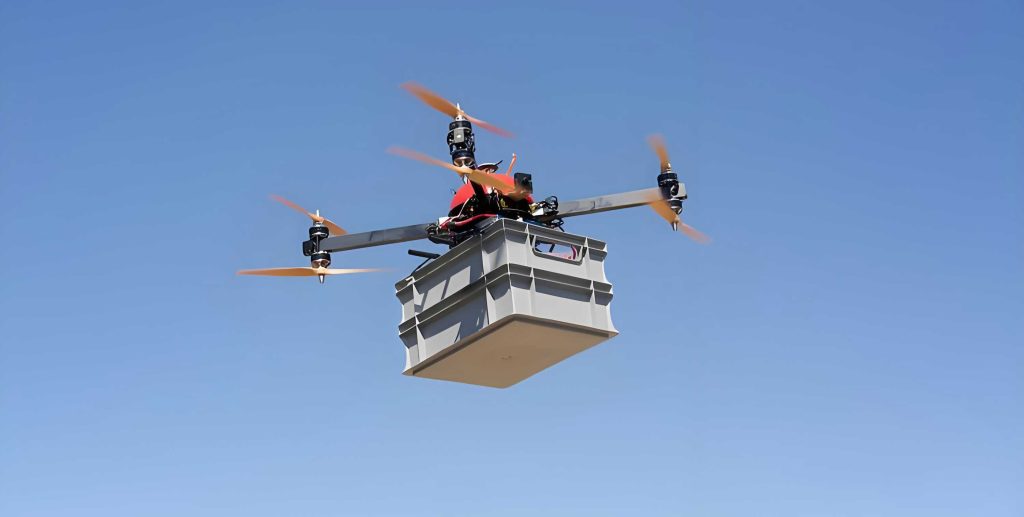
1. Institutional Dilemmas in UAV Drones Airspace Use
The scaled development of UAV drones logistics relies heavily on the effective allocation and utilization of low-altitude airspace resources. However, the current legal system adheres to a traditional two-dimensional property rights framework and an administrative control model. This leads to three key institutional paradoxes for UAV drones operators.
| Institutional Paradox | Description | Impact on UAV Drones |
|---|---|---|
| Absence of Rights Source | The Civil Code lacks provisions for independent airspace as a property right object. Airspace rights are entirely dependent on land surface ownership. | UAV drones operators have no legal basis to claim exclusive use of specific airspace layers. |
| Insufficient Exclusivity | Administrative permits create relative rights that cannot bind third parties. Multiple operators may receive overlapping permissions for the same airspace. | Operators face constant risk of right conflicts, leading to operational instability and increased coordination costs. |
| Lack of Continuous Usufruct Guarantees | Existing permits are temporary, task-specific, and subject to administrative discretion. There is no guarantee of renewal. | UAV drones logistics companies cannot make long-term investments in infrastructure or route networks. |
2. Theoretical Justification for Airspace Usufructuary Rights
2.1 Extending Spatial Stratification Theory
Spatial stratification theory provides the legal basis for a three-dimensional property rights system. The core idea is to break through the two-dimensional thinking pattern of land use and establish the independent status of space resources from land surface ownership. Although airspace is not a tangible object, it can be specified through geographic coordinates and registration, meeting the certainty requirement for property rights objects. This theory can be extended to the low-altitude domain for UAV drones by constructing a dynamic stratification system:
| Dimension | Stratification Method | Application to UAV Drones |
|---|---|---|
| Vertical Layer | Divide based on flight altitude intervals (e.g., 50-200 meters for logistics) | Defines the operational ceiling and floor for UAV drones routes. |
| Horizontal Layer | Define using GIS coordinates | Creates specific corridors or zones for UAV drones flight paths. |
| Temporal Layer | Set exclusive use periods | Allows different operators to share the same physical space at different times for UAV drones operations. |
By expanding the interpretation of Article 345 of the Civil Code, the logic of spatial stratification can be extended to airspace resources. This theoretical extension provides a solid foundation for the legal status of airspace usufructuary rights for UAV drones.
2.2 Adaptability of the Usufructuary Rights System
The core elements of the traditional usufructuary rights system, such as object specificity and exclusivity, share normative commonalities with airspace resource utilization. However, the dynamic spatial utilization characteristics of UAV drones logistics require breaking through the traditional assumption of static physical space control. The key adaptations are:
| Traditional Usufructuary Right Element | Adaptation for Airspace Usufructuary Right |
|---|---|
| Object Specificity | Static physical space → “Spatial coordinates + Time parameters” composite model |
| Exclusive Effect | Absolute exclusion of others → Limited exclusivity subject to public interest and safety constraints |
| Registration | Static registration of fixed boundaries → Dynamic registration with 3D geofencing technology |
| Stability | Long-term, unchanging rights → Rights with built-in flexibility for operational adjustments |
From the perspective of economic law, the market-oriented allocation of airspace resources must balance efficiency and public interest. This principle aligns with the Public Trust Doctrine, where the state holds resources in trust for the people. The boundaries for marketization must satisfy three constraints:
$$
\begin{aligned}
& \text{Security Constraint:} \quad \text{UAV drones operations must not compromise aviation safety, data security, etc.} \\
& \text{Fairness Constraint:} \quad \text{Non-discriminatory access mechanisms must be established.} \\
& \text{Efficiency Constraint:} \quad \text{Price and competition mechanisms should guide resources to high-efficiency users.}
\end{aligned}
$$
3. Institutional Construction: Legal Empowerment Path for Airspace Usufructuary Rights
3.1 Core Rights and Obligations
The core rights of the airspace usufructuary right for UAV drones include the exclusive right of use, the right to yield, and the limited right of disposition. These rights are accompanied by special obligations. The table below summarizes the normative content.
| Core Right / Obligation | Normative Content | Special Characteristics for UAV Drones |
|---|---|---|
| Exclusive Use Right | The right to exclude unauthorized interference within a defined spatiotemporal scope (vertical layer, horizontal coordinates, time period). | Defined by 3D geofencing; limited exclusivity subject to public interest priorities (e.g., emergency flights, passenger aviation). |
| Right to Yield | The right to obtain economic benefits from the airspace use (e.g., own logistics operations, subleasing time slots). | Dynamic and derivative income (e.g., time-sharing leasing, capacity trading), subject to public interest constraints. |
| Limited Right of Disposition | The right to transfer the usufructuary right or encumber it (e.g., mortgage) within legal limits. | Transfers require the transferee to meet operational qualifications; transfers must be registered. |
| Dynamic Avoidance Obligation | The obligation to implement a real-time response system for route adjustments to avoid conflicts and hazards. | Requires AI-driven algorithms for path finding; must maintain manual override capacity; reports must be filed. |
| Data Security Obligation | The obligation to manage flight data (trajectories, payload info) throughout its lifecycle, ensuring confidentiality and integrity. | Data must be classified and graded; stored within the country; transfers abroad require security risk assessments. |
3.2 Rights Acquisition and Termination Mechanisms
The acquisition of an airspace usufructuary right for UAV drones requires a reformed registration system. The traditional “registration takes effect” principle must be adapted to accommodate the dynamic nature of airspace. The core functional requirement can be expressed as a formula balancing efficiency and security.
$$
\begin{aligned}
& \text{Registration Effectiveness Principle (Adapted):} \\
& \text{Right Created} \equiv f(\text{Meet Safety Standards}, \text{Complete Initial Registration}) \\
& \text{Right Dynamically Exercised} \equiv f(\text{Operational Changes}, \text{Technical Record}, \text{Public Notice})
\end{aligned}
$$
This reform can be implemented through a dual-track system:
| Aspect of Right | Track 1: Substantial Establishment | Track 2: Operational Adjustment |
|---|---|---|
| Action | Initial Registration of core 3D coordinates and time parameters of the airspace for UAV drones. | Minor route adjustments (e.g., fine-tuning geofence coordinates due to weather or demand). |
| Legal Effect | Right is established and has erga omnes effect (registration take effect principle). | Adjustment becomes effective against third parties after real-time record and public disclosure (opposition principle). |
| Procedure | Strict, formal registration with the competent authority. | Technical verification and automated record through the smart, blockchain-based registration system. |
3.3 Compulsory Recall System
Despite the rights granted, the public nature of airspace requires a mechanism for compulsory termination. The compulsory recall of an airspace usufructuary right for UAV drones must be strictly limited to cases defined by law, such as for national security, emergency rescue, or major public infrastructure projects. The justification for compensation can be derived from the Coase Theorem, which suggests that clear property rights and low transaction costs are key to efficient resource allocation. When the state forcibly terminates a right for the public good, compensation is needed to internalize the cost and maintain allocative efficiency. The compensation standard must be more than simple market value, including the destruction of going concern value.
$$
\text{Total Compensation} = \text{Direct Losses} + \text{Foreseeable Future Profit Loss}
$$
Where,
$$
\begin{aligned}
& \text{Direct Losses} = \text{Capital investment in network infrastructure (routes, facilities)} \\
& \text{Future Profit Loss} = f(\text{Historical operational data}, \text{Market growth projections})
\end{aligned}
$$
4. Implementation Safeguards
4.1 Legislative Model: A Dual-Track Approach
The implementation of this new right requires a dual-track legislative approach. The first track involves expanding the interpretation of existing laws (the Property Rights Section of the Civil Code) to provide a civil law foundation. The second track involves enacting special legislation, such as an “Airspace Resource Use Management Act,” to detail the specific mechanisms. This act must be carefully coordinated with existing air traffic management laws. This creates a “property right + regulation” structure.
$$
\begin{aligned}
& \text{Legal Framework for UAV Drones} = \text{Civil Code (Property Rights)} \cup \text{Special Airspace Act} \\
& \text{Where,} \\
& \text{Civil Code provides foundation,} \\
& \text{Special Act provides specific rules (e.g., registration, enforcement, safety).}
\end{aligned}
$$
4.2 Regulatory System Reform
The regulatory system must be optimized to monitor dynamic rights. A multi-agency collaborative framework is necessary to manage the different risk dimensions of UAV drones operations. The table below outlines a possible division of responsibilities.
| Regulatory Domain | Lead Agency | Key Responsibilities for UAV Drones |
|---|---|---|
| Airspace Planning & Safety | Civil Aviation Authority | Define airspace layers, approve geofencing standards, monitor real-time flight activities, and coordinate priorities (e.g., emergency vs. commercial). |
| Equipment & Technology | Ministry of Industry & IT | Certify UAV drones airworthiness, manage spectrum allocation, and enforce data security compliance. |
| Geospatial Data | Natural Resources Ministry | Provide foundational GIS data and coordinate the 3D geographic reference system for airspace boundaries. |
| Public Security & Enforcement | Public Security Bureau | Handle emergency response, enforce law against unauthorized access to geofenced airspace, and maintain public order. |
5. Conclusion
In conclusion, the airspace utilization dilemma for UAV drones logistics is fundamentally a gap between the traditional property law framework and the demands of a new, three-dimensional, and dynamic form of space use. I have argued that the construction of an “airspace usufructuary right” is a necessary and feasible legal innovation to resolve this gap. This paper has provided a theoretical justification by extending spatial stratification theory, a practical institutional design featuring a spatiotemporal rights model with dynamic registration, and a framework for implementation through a dual-track legislative approach and optimized multi-agency regulation. The success of this new right depends on the deep integration of legal rules with technologies like 3D geofencing, AI for dynamic avoidance, and blockchain for transparent registration. This institutional innovation is not a rejection of the existing legal order but a necessary evolution to provide a stable, predictable, and efficient legal foundation for the burgeoning UAV drones economy, balancing the goals of market efficiency, private rights, and public safety.