
In our recent research, we have extensively utilized UAV drones equipped with multispectral sensors to monitor geomorphological landscapes, particularly in mining areas. The integration of UAV drones with multispectral imaging has revolutionized traditional monitoring methods by providing high spatial resolution, temporal flexibility, and multidimensional data acquisition. Our work focuses on demonstrating the effectiveness of UAV drones in detecting land cover changes, vegetation dynamics, and ecological restoration progress. In this article, we present a comprehensive overview of our methodology, including system composition, data acquisition parameters, processing workflows, and quantitative analysis of land use transitions over a one-year period in a typical mine rehabilitation site.
The core advantage of using UAV drones lies in their ability to capture data at centimetre-level resolution while covering large areas efficiently. Unlike satellite remote sensing, which suffers from cloud interference and fixed revisit cycles, UAV drones can be deployed on demand, ensuring timely and consistent monitoring. Moreover, the multispectral payloads carried by UAV drones allow us to compute various vegetation indices, such as NDVI, which are critical for assessing vegetation health and coverage. Throughout our study, we have repeatedly emphasized the role of UAV drones in providing reliable, cost-effective, and high-precision geomorphological data.
Technical Advantages of UAV Drones in Geomorphological Monitoring
Traditional methods for geomorphological monitoring, such as manual surveying and satellite remote sensing, have inherent limitations. Manual surveys using total stations or GPS-RTK are time-consuming, labour-intensive, and limited in spatial coverage. Satellite imagery, while offering synoptic views, often lacks the spatial resolution needed for detailed landscape analysis and is affected by atmospheric conditions. UAV drones overcome these challenges by offering:
- Wide coverage with high resolution: A single flight can cover hundreds of hectares with ground sampling distances (GSD) as fine as 2-5 cm, enabling detection of subtle terrain features.
- Multi-dimensional data: By carrying RGB, multispectral, thermal, or LiDAR sensors, UAV drones can simultaneously capture spectral reflectance, 3D point clouds, and surface temperatures.
- Multi-spectral analysis capability: With 4-10 discrete spectral bands, UAV drones provide the spectral richness necessary for accurate vegetation classification and stress detection.
- Real-time dynamic monitoring: UAV drones can be flown repeatedly at short intervals, allowing time-series analysis of dynamic processes such as erosion, vegetation succession, or mine rehabilitation.
These advantages make UAV drones an indispensable tool for modern geomorphological monitoring. In the following sections, we detail the technical principles and practical application of a UAV-based multispectral system used in our mine rehabilitation project.
Technical Principles and System Components
Principles of Multispectral Remote Sensing
The fundamental principle of multispectral remote sensing using UAV drones is the measurement of reflected or emitted electromagnetic radiation from the Earth’s surface across multiple wavelength bands. Different land cover types exhibit distinct spectral signatures, which can be captured by sensors mounted on UAV drones. For instance, healthy vegetation shows strong absorption in the red band (due to chlorophyll) and high reflectance in the near-infrared (NIR) band. This contrast forms the basis for calculating vegetation indices. The general process involves:
- Radiometric calibration to convert raw digital numbers to physical reflectance values.
- Geometric correction to eliminate lens distortion and platform motion errors.
- Atmospheric correction (if necessary) to remove scattering and absorption effects.
Mathematically, the reflectance at a given wavelength λ is expressed as:
$$ R_{λ} = \frac{L_{λ} – L_{p}}{E_{λ} \cdot \tau_{λ}} $$
where $L_{λ}$ is the at-sensor radiance, $L_{p}$ is the path radiance, $E_{λ}$ is the downwelling irradiance, and $\tau_{λ}$ is the atmospheric transmittance. For low-altitude UAV drones (< 500 m), the atmospheric effects are minimal, and often a simplified reflectance calibration using a reference panel suffices.
UAV Multispectral System Composition
Our system consists of three main components: the UAV platform, the multispectral sensor, and the data processing software.
| Component | Model/Type | Specifications |
|---|---|---|
| UAV Platform | Vertical Take-Off and Landing (VTOL) fixed-wing: SmartAlpha SF3300 | Wingspan: 3.3 m; Max payload: 1.5 kg; Endurance: 80 min; Cruise speed: 6.8 m/s |
| Multispectral Sensor | MS600 (6-channel) | Bands: 450 nm (Blue), 555 nm (Green), 660 nm (Red), 720 nm (Red-edge), 750 nm (NIR1), 840 nm (NIR2); Resolution: 1.2 MP per band; Radiometric calibration: built-in sunshine sensor |
| Flight Control & Data Logging | Autopilot with RTK GNSS | Positioning accuracy: 2.5 cm + 1 ppm; IMU: 200 Hz |
| Processing Software | DPGrid, Pix4Dmapper, ENVI | Orthomosaic generation, radiometric correction, vegetation index calculation, classification |
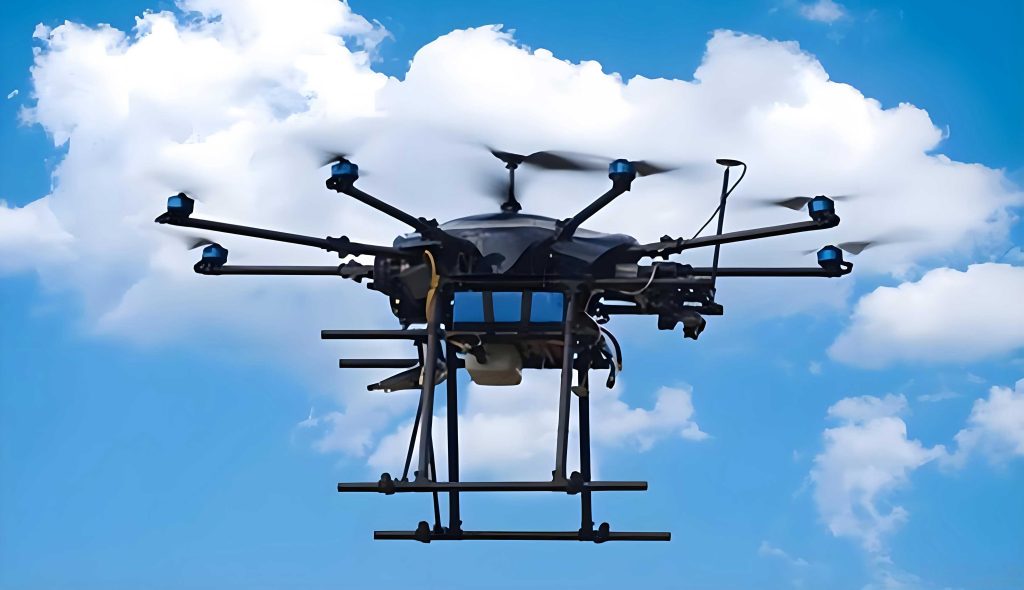
The VTOL fixed-wing platform combines the advantages of multi-rotor (vertical take-off and landing) and fixed-wing (high efficiency and long endurance) configurations. This design allows our UAV drones to operate in complex terrains, such as mountainous mining areas, without requiring runways. The MS600 sensor captures six spectral bands simultaneously, which is sufficient to compute a wide range of vegetation indices, including NDVI, NDRE, and SAVI.
Technical Workflow
Our typical workflow for geomorphological monitoring using UAV drones is illustrated in the following figure (link to image).
The process begins with field reconnaissance and flight planning. Based on the terrain and monitoring objectives, we design waypoints and camera settings to achieve the desired spatial resolution and overlap. After the UAV drones complete the autonomous flight, raw data are downloaded and pre-processed. Radiometric calibration is performed using the irradiance data recorded by the sunshine sensor. Then, structure-from-motion (SfM) algorithms are applied to generate orthophotos and digital surface models (DSM). Finally, we compute vegetation indices and perform land cover classification using supervised or rule-based methods.
Case Study: Mine Rehabilitation Monitoring
Study Area and Data Acquisition
Our study area is an active mine rehabilitation site covering approximately 7.04 km². The terrain is mostly flat with thick loess coverage, and the land use types include cropland, forest, grassland, water bodies, and barren land. We conducted two monitoring campaigns in 2022 and 2023 to evaluate vegetation recovery. The flight parameters are summarized in Table 2.
| Parameter | Value |
|---|---|
| UAV Platform | SmartAlpha SF3300 (VTOL fixed-wing) |
| Multispectral Sensor | MS600 (6 bands) |
| Location | Mine rehabilitation area, northwestern China |
| Forward Overlap | 80% |
| Side Overlap | 70% |
| Flight Speed | 6.8 m/s |
| Flight Altitude (AGL) | 430 m |
| Number of Flights | 1 per campaign |
| Flight Duration | ~80 min per campaign |
| Ground Sampling Distance (GSD) | 30 cm per pixel |
With these parameters, each single flight of UAV drones covered the entire study area with sub-meter resolution imagery. The high forward and side overlaps (80% and 70%) ensured robust image matching for DSM generation and minimized occlusions.
Data Processing and Vegetation Index Calculation
After acquisition, we processed the multispectral imagery using a combination of commercial and open-source software. First, we performed radiometric calibration using the MS600’s panel reference images. Then, we used the SfM algorithm in DPGrid (v5.3) to generate an orthomosaic and a DSM with a resolution of 0.3 m. The orthomosaic was projected to the China Geodetic Coordinate System 2000 (CGCS2000).
From the multispectral orthomosaic, we computed the Normalized Difference Vegetation Index (NDVI) using the red (660 nm) and NIR (840 nm) bands:
$$ \text{NDVI} = \frac{\rho_{\text{NIR}} – \rho_{\text{Red}}}{\rho_{\text{NIR}} + \rho_{\text{Red}}} $$
NDVI values range from -1 to 1, with higher values indicating denser and healthier vegetation. Based on the NDVI thresholds, we classified vegetation coverage into five categories, as shown in Table 3.
| NDVI Range | Coverage Class | Description |
|---|---|---|
| [-1.0, -0.5] | Severe non-vegetation | Bare soil, buildings, water |
| [-0.5, 0] | Non-vegetation | Surface with minimal vegetation |
| [0, 0.3] | Low vegetation coverage | Sparse vegetation, early growth |
| [0.3, 0.6] | Moderate vegetation coverage | Normal vegetation growth |
| [0.6, 1.0] | High vegetation coverage | Dense, vigorous vegetation |
In addition to NDVI, we also computed the Normalized Difference Red Edge Index (NDRE) for assessing chlorophyll content:
$$ \text{NDRE} = \frac{\rho_{\text{NIR}} – \rho_{\text{Red-edge}}}{\rho_{\text{NIR}} + \rho_{\text{Red-edge}}} $$
where $\rho_{\text{Red-edge}}$ corresponds to the 720 nm band. The NDRE index is less sensitive to background soil colour and is useful for early stress detection.
Land Cover Classification and Accuracy Assessment
Using the multispectral orthomosaic and NDVI layers, we performed object-oriented classification in eCognition software. The classification scheme consisted of nine land cover types: high-cover grassland, shrubland, dry cropland, bare land, built-up land, other forest land, reservoir/pond, forest land, and medium-cover grassland. We used a decision-tree classifier based on spectral thresholds, texture indices, and geometric features. To validate the classification, we randomly selected 64 ground truth points per year from high-resolution imagery and field surveys. The confusion matrices yielded overall accuracies of 91.9% (2022) and 90.6% (2023), with Kappa coefficients of 0.899 and 0.863, respectively. These high accuracies confirm the reliability of UAV drone-derived data for land cover mapping.
Land Use Change Analysis
We compared the classified maps of 2022 and 2023 to quantify land use transitions. Table 4 presents the area statistics for each land use type in both years.
| Land Use Type | 2022 Area (ha) | 2023 Area (ha) | Change (ha) | Change (%) |
|---|---|---|---|---|
| High-cover grassland | 427.98 | 434.48 | +6.50 | +1.52 |
| Shrubland | 35.58 | 18.46 | -17.12 | -48.12 |
| Dry cropland | 60.96 | 85.58 | +24.62 | +40.39 |
| Bare land | 24.30 | 26.31 | +2.01 | +8.27 |
| Built-up land | 19.65 | 19.86 | +0.21 | +1.07 |
| Other forest land | 68.12 | 69.72 | +1.60 | +2.35 |
| Reservoir/pond | 4.86 | 4.89 | +0.03 | +0.62 |
| Forest land | 17.76 | 17.47 | -0.29 | -1.63 |
| Medium-cover grassland | 44.37 | 27.16 | -17.21 | -38.79 |
| River channels | 0.35 | 0.00 | -0.35 | -100 |
| Total | 703.93 | 703.93 | — | — |
The results show that dry cropland expanded by 24.62 ha (40.4%), mainly due to the conversion from medium-cover grassland and bare land. High-cover grassland increased by 6.50 ha, partially from shrubland conversion. In contrast, shrubland and medium-cover grassland decreased significantly (48.1% and 38.8%, respectively), indicating a shift towards more herbaceous vegetation or agricultural use. These changes reflect ongoing rehabilitation activities, such as topsoil replacement and seeding.
To further understand the dynamics, we constructed a land use transfer matrix (Table 5). The matrix reveals the specific transitions between 2022 and 2023.
| 2022 \ 2023 | High grass | Shrub | Dry crop | Bare | Built-up | Other forest | Reservoir | Forest | Med grass | 2022 Total |
|---|---|---|---|---|---|---|---|---|---|---|
| High grass | 413.10 | 0 | 11.63 | 2.93 | 0.03 | 0.06 | 0 | 0 | 0.23 | 427.98 |
| Shrub | 12.94 | 18.46 | 0 | 0.28 | 0 | 3.24 | 0 | 0 | 0.66 | 35.58 |
| Dry crop | 0.40 | 0 | 58.36 | 0.39 | 0 | 0.53 | 0 | 0 | 1.28 | 60.96 |
| River | 0 | 0 | 0.35 | 0 | 0 | 0 | 0 | 0 | 0 | 0.35 |
| Bare | 0.40 | 0 | 5.38 | 17.75 | 0 | 0 | 0 | 0 | 0.77 | 24.30 |
| Built-up | 0 | 0 | 0 | 0 | 19.65 | 0 | 0 | 0 | 0 | 19.65 |
| Other forest | 1.58 | 0 | 0.29 | 0.36 | 0 | 65.89 | 0 | 0 | 0 | 68.12 |
| Reservoir | 0 | 0 | 0 | 0 | 0 | 0 | 4.86 | 0 | 0 | 4.86 |
| Forest | 0.05 | 0 | 0 | 0.24 | 0 | 0 | 0 | 17.47 | 0 | 17.76 |
| Med grass | 6.01 | 0 | 9.57 | 4.36 | 0.18 | 0 | 0.03 | 0 | 24.22 | 44.37 |
| 2023 Total | 434.48 | 18.46 | 85.58 | 26.31 | 19.86 | 69.72 | 4.89 | 17.47 | 27.16 | 703.93 |
Key transitions observed:
- From high-cover grassland: 11.63 ha became dry cropland, 2.93 ha became bare land.
- From shrubland: 12.94 ha became high-cover grassland, 3.24 ha became other forest.
- From medium-cover grassland: 9.57 ha to dry cropland, 4.36 ha to bare land, 6.01 ha to high-cover grassland.
These transitions are consistent with the rehabilitation strategy that involves converting sparse shrubland and degraded grassland into productive cropland or restored high-cover grassland. The net increase of dry cropland by 24.62 ha indicates successful reclamation of agricultural land for local communities.
Discussion and Future Directions
Our study demonstrates that UAV drones equipped with multispectral sensors are highly effective for monitoring geomorphological changes in mining areas. The high spatial resolution (30 cm) enables detection of small-scale features such as individual reclaimed patches, while the multi-temporal capability allows quantification of annual land cover transitions. Compared to satellite imagery, UAV drones reduce the time and cost of data acquisition, especially for areas smaller than 100 km².
One limitation is the dependency on weather conditions; strong winds or low clouds can disrupt flights. However, the VTOL design of our UAV drones mitigates some of these issues, as they can take off and land in confined spaces. Future advancements in AI-based autonomous navigation and real-time spectral analysis could further enhance the efficiency of UAV drones. For instance, onboard machine learning classification could provide immediate feedback on vegetation health, allowing adaptive flight planning.
We also identified an opportunity to incorporate thermal infrared sensors on UAV drones to monitor surface temperature, which is a proxy for soil moisture and evapotranspiration. Combining thermal, multispectral, and LiDAR data would provide a holistic view of the geomorphological and ecological status of rehabilitated landscapes. The development of compact, lightweight hyperspectral sensors for UAV drones is another promising direction, as they offer hundreds of spectral bands for detailed material identification.
Conclusion
In conclusion, we have successfully applied UAV remote sensing technology to monitor geomorphological landscape changes in a mine rehabilitation area. The use of UAV drones allowed us to acquire high-resolution multispectral data efficiently, compute vegetation indices such as NDVI and NDRE, and produce accurate land cover maps with over 90% overall accuracy. The change analysis between 2022 and 2023 revealed significant positive trends: the area of high-cover grassland and dry cropland increased, while degraded shrubland and medium-cover grassland decreased, indicating successful ecological restoration efforts. The land use transfer matrix provided detailed insights into the conversion pathways, confirming that most new cropland came from medium-cover grassland and bare land, while shrubland largely transitioned into high-cover grassland.
Our findings highlight the value of UAV drones as a reliable and cost-effective tool for environmental monitoring. With continuous improvements in sensor technology, flight endurance, and data processing algorithms, UAV drones will play an increasingly vital role in geomorphological and ecological studies. We recommend that future work focus on integrating multi-sensor payloads and developing automated change detection algorithms to further reduce manual interpretation efforts.