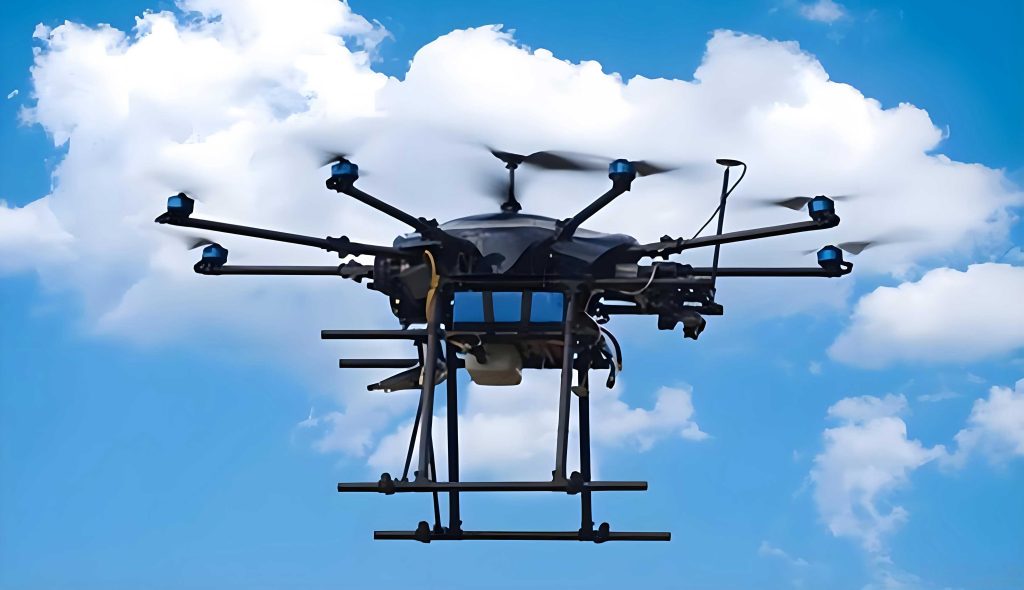
In recent years, the rapid development of UAV drones has enabled extensive applications in disaster monitoring, emergency rescue, and logistics distribution. However, path planning for UAV drones in complex mountainous terrain remains a challenging optimization problem due to severe terrain fluctuations, dense no‑fly zones, and stringent multi‑drone collision constraints. To address these challenges, we propose a Hybrid PID Search Algorithm (HPSA) that integrates a weighted elite guidance mechanism and genetic crossover operations into the standard PID Search Algorithm (PSA). The proposed method is applied to multi‑UAV collaborative path planning in mountainous areas, and its performance is validated through comprehensive numerical experiments and real‑world terrain simulations.
1. Problem Formulation for Multi-UAV Path Planning
We formulate the multi‑UAV path planning problem as a multi‑objective constrained optimization problem. Each UAV drone flies from a start point to a goal point through N waypoints. The path for the i-th UAV is represented as a sequence of waypoints in spherical coordinates: \( (r, \theta, \phi) \), where \( r \) is the step length, \( \theta \) is the climb angle, and \( \phi \) is the steering angle. The transformation from spherical to Cartesian coordinates is given by:
\[
\begin{aligned}
x_{i,n} &= x_{i,n-1} + r_{i,n} \sin\theta_{i,n} \cos\phi_{i,n} \\
y_{i,n} &= y_{i,n-1} + r_{i,n} \sin\theta_{i,n} \sin\phi_{i,n} \\
z_{i,n} &= z_{i,n-1} + r_{i,n} \cos\theta_{i,n}
\end{aligned}
\]
The total cost function combines five weighted components:
\[
\min f = \omega_1 f_1 + \omega_2 f_2 + \omega_3 f_3 + \omega_4 f_4 + \omega_5 f_5
\]
where the weights are normalized to satisfy \(\omega_1+\omega_2+\omega_3+\omega_4+\omega_5=1\). The individual cost terms are defined as:
- Path length cost (\(f_1\)): The Euclidean distance over all M UAV drones and N waypoints.
- Altitude cost (\(f_2\)): Deviation from the optimal altitude, with infinite penalty if outside the allowed range \([H_{\min}, H_{\max}]\).
- Obstacle avoidance cost (\(f_3\)): Penalty for approaching cylindrical obstacles; infinite if inside the threat radius.
- Smoothness cost (\(f_4\)): Sum of horizontal turning angles and vertical climb angle changes.
- Multi‑UAV safety distance cost (\(f_5\)): Penalty when the distance between any two UAV drones is less than a safety threshold \(d_s\) (set to 10 m); infinite if exactly equal.
The B‑spline curve of degree 3 is applied to the generated waypoints to produce a smooth and flyable trajectory, while retaining the geometric properties such as convexity and local controllability.
2. Proposed Hybrid PID Search Algorithm (HPSA)
The standard PID Search Algorithm (PSA) simulates the proportional‑integral‑derivative control process, using the deviation between each individual and the global best to update positions. However, PSA suffers from premature convergence and insufficient exploration in high‑dimensional complex problems. To overcome these limitations, we propose HPSA with two key enhancements:
2.1 Weighted Elite Guidance Mechanism
Instead of relying solely on the single best individual, we select the top k (here k=3) individuals and construct a composite guidance position based on their fitness values. The weights are computed as:
\[
\omega’_i = \frac{1}{F_i}, \quad \omega_i = \frac{\omega’_i}{\sum_{j=1}^k \omega’_j}
\]
\[
\bar{x} = \sum_{i=1}^k \omega_i x_i
\]
If the composite position yields a better fitness, it replaces the original best; otherwise, the best remains unchanged. This strategy provides more comprehensive search direction and prevents over‑dependence on a single candidate.
2.2 Genetic Crossover on Elite Individuals
We further integrate the crossover operation from genetic algorithms to enhance exploration. For two elite individuals \(x_i\) and \(x_j\), two new offspring are generated as:
\[
\begin{aligned}
x^{\text{new}}_{i,d} &= r_7 x_{i,d} + (1-r_5) x_{j,d} + c_1 (x_{i,d} – x_{j,d}) \\
x^{\text{new}}_{j,d} &= r_8 x_{j,d} + (1-r_6) x_{i,d} + c_2 (x_{j,d} – x_{i,d})
\end{aligned}
\]
where \(r_7, r_8\) are random numbers in \([0,1]\), and \(c_1, c_2\) are random numbers in \([-1,1]\). A greedy selection retains the best individuals among parents and offspring, thus preserving quality while injecting diversity.
The complete HPSA procedure follows the main loop of PSA but replaces the single‑best update with the elite guidance and adds crossover at the end of each iteration. The algorithm is outlined as Algorithm 1.
3. Numerical Experiments on CEC2017 Benchmark Functions
We first evaluate the optimization performance of HPSA on the CEC2017 test suite, which includes unimodal (F1, F3), multimodal (F4–F10), hybrid (F11–F20), and composition (F21–F30) functions. The problem dimension is set to 100, population size = 30, maximum iterations = 500, and each algorithm runs 30 independent times. The comparison includes PSO, GA, DBO, HHO, PSA, and the proposed HPSA. The results are summarized in Table 1, where the best values are highlighted in bold. The Wilcoxon rank‑sum test is employed to assess statistical significance (+, ≈, −).
Table 1: CEC2017 Results (dim=100)
| Function | Metric | PSO | GA | DBO | HHO | PSA | HPSA |
|---|---|---|---|---|---|---|---|
| F1 | Best | 1.77E+10 | 4.62E+11 | 2.70E+10 | 3.55E+10 | 1.88E+09 | 1.48E+08 |
| Mean | 4.21E+10 | 5.56E+11 | 1.05E+11 | 4.96E+10 | 4.84E+09 | 2.96E+08 | |
| Std | 1.90E+10 | 4.99E+10 | 7.79E+10 | 7.42E+09 | 2.24E+09 | 1.04E+08 | |
| F3 | Best | 3.71E+05 | 7.16E+05 | 3.58E+05 | 2.99E+05 | 5.14E+05 | 3.80E+05 |
| Mean | 5.98E+05 | 9.37E+05 | 6.84E+05 | 3.38E+05 | 7.54E+05 | 5.40E+05 | |
| Std | 1.09E+05 | 1.16E+05 | 2.97E+05 | 1.73E+04 | 1.68E+05 | 1.61E+05 | |
| F4 | Best | 2.61E+03 | 1.33E+05 | 3.34E+03 | 6.56E+03 | 1.31E+03 | 9.19E+02 |
| Mean | 6.14E+03 | 1.98E+05 | 1.76E+04 | 9.02E+03 | 1.62E+03 | 1.03E+03 | |
| Std | 3.72E+03 | 3.96E+04 | 1.65E+04 | 1.41E+03 | 2.37E+02 | 6.34E+01 | |
| F5 | Best | 1.15E+03 | 2.62E+03 | 1.35E+03 | 1.54E+03 | 1.26E+03 | 1.04E+03 |
| Mean | 1.29E+03 | 2.96E+03 | 1.68E+03 | 1.64E+03 | 1.46E+03 | 1.24E+03 | |
| Std | 9.07E+01 | 1.66E+02 | 2.13E+02 | 3.81E+01 | 9.66E+01 | 1.16E+02 | |
| F6 | Best | 6.47E+02 | 7.37E+02 | 6.64E+02 | 6.84E+02 | 6.52E+02 | 6.15E+02 |
| Mean | 6.57E+02 | 7.60E+02 | 6.82E+02 | 6.91E+02 | 6.65E+02 | 6.31E+02 | |
| Std | 6.27E+00 | 8.72E+00 | 1.28E+01 | 3.68E+00 | 6.57E+00 | 6.30E+00 | |
| F7 | Best | 1.80E+03 | 8.84E+03 | 2.39E+03 | 3.54E+03 | 2.72E+03 | 1.65E+03 |
| Mean | 2.14E+03 | 1.19E+04 | 2.91E+03 | 3.76E+03 | 3.25E+03 | 1.87E+03 | |
| Std | 2.18E+02 | 1.15E+03 | 1.90E+02 | 1.03E+02 | 2.70E+02 | 1.30E+02 | |
| F8 | Best | 1.42E+03 | 2.97E+03 | 1.83E+03 | 2.04E+03 | 1.50E+03 | 1.33E+03 |
| Mean | 1.62E+03 | 3.37E+03 | 2.19E+03 | 2.14E+03 | 1.80E+03 | 1.55E+03 | |
| Std | 1.02E+02 | 1.77E+02 | 1.99E+02 | 4.85E+01 | 1.18E+02 | 1.18E+02 | |
| F9 | Best | 1.88E+04 | 1.21E+05 | 3.56E+04 | 5.23E+04 | 2.74E+04 | 2.47E+04 |
| Mean | 4.88E+04 | 1.51E+05 | 7.56E+04 | 6.99E+04 | 4.09E+04 | 3.21E+04 | |
| Std | 2.37E+04 | 2.20E+04 | 1.40E+04 | 5.83E+03 | 6.34E+03 | 5.04E+03 | |
| F10 | Best | 1.53E+04 | 3.12E+04 | 1.98E+04 | 2.17E+04 | 1.40E+04 | 1.21E+04 |
| Mean | 2.04E+04 | 3.39E+04 | 2.81E+04 | 2.44E+04 | 1.80E+04 | 1.51E+04 | |
| Std | 2.07E+03 | 1.22E+03 | 4.55E+03 | 1.80E+03 | 1.76E+03 | 1.42E+03 | |
| F11 | Best | 3.84E+04 | 3.03E+05 | 1.34E+05 | 9.22E+04 | 2.54E+04 | 1.18E+04 |
| Mean | 7.96E+04 | 5.03E+05 | 2.31E+05 | 1.41E+05 | 6.78E+04 | 3.14E+04 | |
| Std | 2.57E+04 | 1.32E+05 | 6.82E+04 | 3.29E+04 | 2.44E+04 | 1.71E+04 | |
| F12 | Best | 1.45E+09 | 2.17E+11 | 1.90E+09 | 4.29E+09 | 1.89E+08 | 4.23E+07 |
| Mean | 1.52E+10 | 3.03E+11 | 7.21E+09 | 1.06E+10 | 5.72E+08 | 1.24E+08 | |
| Std | 1.05E+10 | 4.65E+10 | 2.32E+09 | 3.42E+09 | 2.77E+08 | 5.20E+07 | |
| F13 | Best | 1.23E+05 | 2.63E+10 | 3.26E+07 | 4.37E+07 | 4.86E+04 | 6.62E+03 |
| Mean | 1.70E+09 | 6.67E+10 | 2.75E+08 | 2.86E+08 | 2.18E+05 | 2.51E+04 | |
| Std | 1.70E+09 | 1.67E+10 | 2.19E+08 | 1.56E+08 | 3.36E+05 | 1.83E+04 | |
| F14 | Best | 7.67E+05 | 2.75E+07 | 7.09E+06 | 5.84E+06 | 1.25E+06 | 1.29E+06 |
| Mean | 7.33E+06 | 2.33E+08 | 1.82E+07 | 1.04E+07 | 4.86E+06 | 3.43E+06 | |
| Std | 4.37E+06 | 1.59E+08 | 1.38E+07 | 2.57E+06 | 2.30E+06 | 1.57E+06 | |
| F15 | Best | 3.10E+04 | 1.48E+10 | 1.16E+05 | 5.06E+06 | 1.53E+04 | 2.27E+03 |
| Mean | 6.76E+08 | 3.15E+10 | 5.63E+07 | 1.38E+07 | 3.42E+04 | 4.42E+03 | |
| Std | 8.61E+08 | 7.52E+09 | 6.13E+07 | 8.70E+06 | 1.64E+04 | 2.14E+03 | |
| F16 | Best | 6.01E+03 | 1.90E+04 | 6.16E+03 | 7.59E+03 | 5.11E+03 | 4.22E+03 |
| Mean | 7.28E+03 | 2.80E+04 | 9.47E+03 | 1.04E+04 | 6.66E+03 | 5.83E+03 | |
| Std | 9.24E+02 | 4.60E+03 | 1.56E+03 | 1.24E+03 | 8.46E+02 | 7.41E+02 | |
| F17 | Best | 4.92E+03 | 2.11E+05 | 7.64E+03 | 5.94E+03 | 4.77E+03 | 3.80E+03 |
| Mean | 7.51E+03 | 8.50E+06 | 9.11E+03 | 8.49E+03 | 5.92E+03 | 5.24E+03 | |
| Std | 3.98E+03 | 1.18E+07 | 1.01E+03 | 1.58E+03 | 6.96E+02 | 7.11E+02 | |
| F18 | Best | 1.13E+06 | 5.47E+07 | 4.62E+06 | 3.66E+06 | 1.29E+06 | 7.90E+05 |
| Mean | 7.51E+06 | 3.76E+08 | 2.70E+07 | 1.07E+07 | 5.93E+06 | 4.59E+06 | |
| Std | 3.86E+06 | 3.83E+08 | 1.62E+07 | 5.18E+06 | 2.78E+06 | 2.66E+06 | |
| F19 | Best | 7.40E+06 | 1.83E+10 | 1.87E+07 | 1.04E+07 | 5.58E+03 | 2.34E+03 |
| Mean | 5.87E+08 | 3.06E+10 | 1.25E+08 | 3.42E+07 | 8.03E+04 | 5.23E+03 | |
| Std | 7.68E+08 | 8.32E+09 | 1.42E+08 | 1.66E+07 | 7.65E+04 | 3.57E+03 | |
| F20 | Best | 4.59E+03 | 7.89E+03 | 5.75E+03 | 5.01E+03 | 4.70E+03 | 3.75E+03 |
| Mean | 5.75E+03 | 8.92E+03 | 7.21E+03 | 6.13E+03 | 5.63E+03 | 5.09E+03 | |
| Std | 5.32E+02 | 5.01E+02 | 6.02E+02 | 4.50E+02 | 5.50E+02 | 5.85E+02 | |
| F21 | Best | 3.10E+03 | 4.91E+03 | 3.67E+03 | 4.00E+03 | 3.12E+03 | 2.93E+03 |
| Mean | 3.41E+03 | 5.34E+03 | 4.00E+03 | 4.40E+03 | 3.34E+03 | 3.03E+03 | |
| Std | 1.48E+02 | 2.52E+02 | 1.72E+02 | 2.37E+02 | 1.34E+02 | 9.14E+01 | |
| F22 | Best | 1.88E+04 | 3.32E+04 | 2.33E+04 | 2.44E+04 | 1.82E+04 | 1.52E+04 |
| Mean | 2.22E+04 | 3.70E+04 | 3.05E+04 | 2.72E+04 | 2.06E+04 | 1.90E+04 | |
| Std | 2.04E+03 | 1.23E+03 | 3.99E+03 | 1.58E+03 | 1.39E+03 | 3.38E+03 | |
| F23 | Best | 4.37E+03 | 6.45E+03 | 4.33E+03 | 5.21E+03 | 3.47E+03 | 3.21E+03 |
| Mean | 4.84E+03 | 7.97E+03 | 4.80E+03 | 5.83E+03 | 3.92E+03 | 3.35E+03 | |
| Std | 3.15E+02 | 7.56E+02 | 2.47E+02 | 3.73E+02 | 1.77E+02 | 8.83E+01 | |
| F24 | Best | 5.48E+03 | 9.81E+03 | 5.50E+03 | 6.94E+03 | 4.16E+03 | 3.81E+03 |
| Mean | 6.51E+03 | 1.33E+04 | 6.14E+03 | 8.02E+03 | 4.57E+03 | 4.01E+03 | |
| Std | 5.25E+02 | 1.60E+03 | 4.39E+02 | 7.36E+02 | 2.34E+02 | 9.68E+01 | |
| F25 | Best | 4.18E+03 | 5.37E+04 | 4.76E+03 | 5.75E+03 | 3.92E+03 | 3.64E+03 |
| Mean | 5.73E+03 | 9.65E+04 | 8.76E+03 | 6.96E+03 | 4.41E+03 | 3.76E+03 | |
| Std | 1.09E+03 | 1.87E+04 | 6.60E+03 | 5.31E+02 | 3.62E+02 | 8.89E+01 | |
| F26 | Best | 1.77E+04 | 5.68E+04 | 2.01E+04 | 2.88E+04 | 1.57E+04 | 4.70E+03 |
| Mean | 2.29E+04 | 7.51E+04 | 2.71E+04 | 3.18E+04 | 2.06E+04 | 1.44E+04 | |
| Std | 3.41E+03 | 9.77E+03 | 3.99E+03 | 2.03E+03 | 2.41E+03 | 4.45E+03 | |
| F27 | Best | 3.82E+03 | 1.13E+04 | 3.86E+03 | 4.81E+03 | 3.63E+03 | 3.47E+03 |
| Mean | 4.48E+03 | 1.48E+04 | 4.76E+03 | 6.56E+03 | 3.96E+03 | 3.79E+03 | |
| Std | 5.15E+02 | 1.77E+03 | 4.77E+02 | 1.26E+03 | 1.71E+02 | 2.34E+02 | |
| F28 | Best | 4.60E+03 | 4.75E+04 | 7.83E+03 | 7.22E+03 | 3.92E+03 | 3.75E+03 |
| Mean | 1.04E+04 | 6.12E+04 | 2.13E+04 | 9.31E+03 | 5.26E+03 | 4.42E+03 | |
| Std | 3.25E+03 | 8.06E+03 | 7.29E+03 | 1.19E+03 | 8.25E+02 | 2.83E+03 | |
| F29 | Best | 7.23E+03 | 7.63E+04 | 8.54E+03 | 1.02E+04 | 6.54E+03 | 6.05E+03 |
| Mean | 8.87E+03 | 3.16E+06 | 1.15E+04 | 1.26E+04 | 8.03E+03 | 7.13E+03 | |
| Std | 1.35E+03 | 5.32E+06 | 2.18E+03 | 1.34E+03 | 6.87E+02 | 5.87E+02 | |
| F30 | Best | 2.34E+07 | 2.76E+10 | 8.36E+07 | 2.66E+08 | 7.85E+05 | 4.93E+04 |
| Mean | 1.81E+09 | 5.02E+10 | 2.71E+08 | 7.16E+08 | 4.41E+06 | 2.69E+05 | |
| Std | 1.72E+09 | 1.40E+10 | 1.49E+08 | 3.25E+08 | 3.35E+06 | 1.98E+05 | |
| Wilcoxon (HPSA vs.) | |||||||
| +/≈/− | 29/0/0 | 29/0/0 | 28/1/0 | 28/0/1 | 29/0/0 | — | |
From Table 1, HPSA achieves the best or second‑best results on the vast majority of functions. In particular, it obtains the smallest Best, Mean, and Std values on unimodal F1, multimodal F4–F10, hybrid F11–F20, and composition F21–F30, demonstrating superior convergence accuracy and stability. The Wilcoxon test indicates that HPSA significantly outperforms PSO, GA, and PSA on all 29 functions, and outperforms DBO and HHO on 28 functions, confirming the effectiveness of the proposed improvements. The convergence curves for selected functions (F1, F10, F20, F30) further illustrate that HPSA converges faster and escapes local optima more effectively than its counterparts.
4. Multi‑UAV Path Planning Simulations
We evaluate HPSA on two mountainous scenarios with increasing complexity. The digital elevation model (DEM) area is 1500 m × 1500 m × 400 m. The UAV drones fly at altitudes between 100 m and 200 m, with maximum turning and climb angles of 45°. Each path consists of 12 waypoints. The cost weights are set as \( \omega_1=5/18,\ \omega_2=1/18,\ \omega_3=1/18,\ \omega_4=10/18,\ \omega_5=1/18 \). The population is 500, maximum iterations 200, and each algorithm runs 30 times. All compared algorithms use the same spherical coordinate encoding and B‑spline smoothing.
4.1 Scenario 1 (4 obstacles)
The first scenario includes four cylindrical obstacles with a radius of 50 m. Table 2 summarizes the statistical results.
Table 2: Scenario 1 Results (4 obstacles, 4 UAV drones)
| Algorithm | Best | Mean | Std | Avg Distance (m) | Avg Altitude | Avg Turn (°) | Avg Safety |
|---|---|---|---|---|---|---|---|
| SPSO | 1014.55 | 1135.53 | 114.77 | 997.24 | 393.05 | 105.54 | 0.00 |
| GA | 1549.70 | 1773.86 | 175.10 | 1086.44 | 355.51 | 426.41 | 0.00 |
| DBO | 1063.50 | 1273.47 | 129.33 | 1081.10 | 390.36 | 142.05 | 0.00 |
| HHO | 1201.22 | 1562.63 | 384.34 | 986.67 | 266.92 | 165.46 | 2000.00 |
| PSA | 1046.86 | 1166.25 | 95.25 | 984.87 | 346.04 | 133.83 | 0.00 |
| HPSA | 996.27 | 1086.96 | 69.39 | 967.20 | 285.67 | 103.77 | 0.00 |
HPSA obtains the best Best (996.27), Mean (1086.96), and Std (69.39), with the shortest average distance and lowest turning cost. Except for HHO, all algorithms achieve zero safety cost. Compared to PSA, HPSA improves average convergence accuracy by 6.8% and reduces the standard deviation by 27.15%.
4.2 Scenario 2 (9 obstacles)
The second scenario increases the number of obstacles to nine, representing a more complex environment. The results are shown in Table 3.
Table 3: Scenario 2 Results (9 obstacles, 4 UAV drones)
| Algorithm | Best | Mean | Std | Avg Distance (m) | Avg Altitude | Avg Turn (°) | Avg Safety |
|---|---|---|---|---|---|---|---|
| SPSO | 1127.81 | 1357.17 | 151.57 | 1051.35 | 358.84 | 187.35 | 201.60 |
| GA | 1629.84 | 2009.69 | 302.08 | 1102.32 | 341.76 | 479.86 | 736.26 |
| DBO | 1282.62 | 1493.48 | 161.98 | 1266.61 | 437.99 | 169.20 | 0.00 |
| HHO | 1745.61 | 2195.27 | 578.79 | 1157.11 | 351.01 | 276.84 | 3534.93 |
| PSA | 1052.58 | 1297.44 | 143.54 | 1020.02 | 311.01 | 194.10 | 0.00 |
| HPSA | 1065.28 | 1203.14 | 98.28 | 1002.41 | 336.56 | 146.92 | 0.00 |
HPSA again achieves the smallest Mean (1203.14), Std (98.28), and turning cost (146.92°), and maintains zero safety cost. The average cost is 7.27% lower than PSA, and the standard deviation is reduced by 31.53%.
4.3 Scenario 2 with Six UAV Drones
We further increase the number of UAV drones to six in the same complex environment. Table 4 presents the comparative results.
Table 4: Scenario 2 Results (9 obstacles, 6 UAV drones)
| Algorithm | Best | Mean | Std | Avg Distance (m) | Avg Altitude | Avg Turn (°) | Avg Safety |
|---|---|---|---|---|---|---|---|
| SPSO | 2701.80 | 2903.82 | 207.48 | 1092.37 | 426.89 | 223.79 | 100.79 |
| GA | 4483.27 | 5389.91 | 707.59 | 1158.33 | 389.85 | 541.96 | 3670.34 |
| DBO | 2976.50 | 3087.65 | 92.67 | 1314.30 | 472.51 | 170.43 | 0.00 |
| HHO | 4515.89 | 6311.61 | 954.45 | 1137.15 | 251.97 | 106.97 | 10875.50 |
| PSA | 2602.81 | 3055.46 | 310.43 | 1054.19 | 383.52 | 266.93 | 333.33 |
| HPSA | 2475.68 | 2669.64 | 200.23 | 1050.14 | 387.59 | 192.57 | 0.00 |
Only HPSA and DBO achieve zero safety cost, but HPSA yields a significantly lower average total cost (2669.64 vs. 3087.65). Compared to PSA, HPSA improves average convergence accuracy by 12.63% and reduces the standard deviation by 35.50%.
5. Real‑World Terrain Validation
To further verify the applicability of HPSA in practical environments, we test the algorithm using a real digital elevation model (DEM) from Gasa Town, Xinping County, Yunnan Province. The terrain features steep mountains and deep valleys, with an altitude range of 400 m. Six UAV drones are deployed for a cooperative inspection mission. The comparative algorithms include SPSO, PSA, and HPSA. The results are summarized in Table 5.
Table 5: Real Terrain Results (6 UAV drones)
| Algorithm | Best | Mean | Std | Avg Distance (m) | Avg Altitude | Avg Turn (°) | Avg Safety |
|---|---|---|---|---|---|---|---|
| SPSO | 4289.09 | 5058.94 | 381.23 | 1824.59 | 1424.10 | 378.66 | 0.00 |
| PSA | 4598.76 | 5098.60 | 388.59 | 1667.02 | 1901.35 | 420.96 | 0.00 |
| HPSA | 4101.55 | 4575.20 | 233.34 | 1575.62 | 1433.15 | 365.18 | 0.00 |
HPSA obtains the smallest Best (4101.55), Mean (4575.20), and Std (233.34), with the lowest average flight distance and turning cost. The average convergence accuracy improves by 10.27% over PSA, and the standard deviation reduces by 39.95%. The convergence curves confirm that HPSA not only converges faster but also reaches a better final cost in real mountainous terrain.
6. Conclusion
In this work, we have proposed a Hybrid PID Search Algorithm (HPSA) for multi‑UAV path planning in complex mountainous environments. By incorporating a weighted elite guidance mechanism and genetic crossover operations, HPSA significantly enhances the global exploration capability and the ability to escape local optima compared to the standard PSA. Extensive numerical experiments on the CEC2017 benchmark functions demonstrate the superior optimization performance of HPSA in terms of convergence speed, accuracy, and stability. Furthermore, multi‑UAV path planning simulations in both synthetic and real‑world mountainous terrains show that HPSA consistently yields the smallest total cost, shortest flight distance, and minimal turning cost while maintaining zero collision risk. The proposed algorithm is robust and efficient, providing a reliable solution for cooperative path planning of UAV drones in challenging terrain conditions.