
With the rapid advancement of unmanned aerial vehicle (UAV) applications, aerial photogrammetry has become a primary means for rapidly acquiring situational information in emergency scenarios. However, conventional single-payload operations on small UAV drones suffer from low data acquisition efficiency, often requiring multiple flights to cover a target area. Meanwhile, medium-to-large UAV drones equipped with multiple payloads lack dynamic coordination methods to adapt to complex meteorological conditions. To address these challenges, we propose a systematic solution that integrates a multi-source heterogeneous payload dynamic cooperative architecture, a dual-mode route optimization algorithm, and an edge-based real-time rapid mosaicking engine. Our approach was validated through flight tests at a designated site in Sichuan, demonstrating significant improvements in operational efficiency, data integrity, and processing speed. This paper details the design, mathematical modeling, and experimental verification of the proposed system, providing an engineering-ready technical framework for multi-task cooperative operations of UAV drones.
1. Introduction
UAV drones have been increasingly deployed in emergency mapping, disaster monitoring, and environmental surveys. Despite their growing utility, two critical bottlenecks persist: (1) lightweight UAV drones typically carry a single payload, leading to low data acquisition efficiency and prolonged mission timelines; (2) medium-to-large UAV drones, while capable of carrying multiple sensors such as aerial cameras, synthetic aperture radar (SAR), and electro-optical pods, lack a dynamic optimization method for payload coordination under adverse weather conditions. To overcome these limitations, we developed an integrated cooperative system that enables simultaneous operation of multiple payloads within a single flight sortie. Our design includes a high-precision spatiotemporal synchronization mechanism, an adaptive communication protocol, and a real-time data processing pipeline that reduces latency from hours to minutes. This paper presents the overall architecture, the dual-mode route optimization algorithm, the real-time mosaicking engine, and the results from a comprehensive field test.
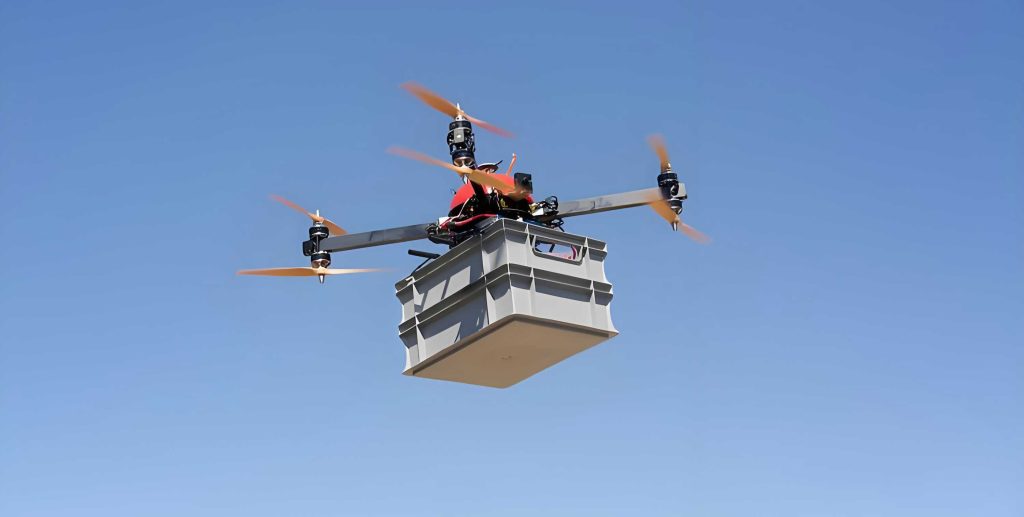
2. Multi-Payload Dynamic Cooperative Architecture
2.1 Hardware Dynamic Coupling
Our system integrates three distinct payloads on a single UAV drone platform: an aerial survey camera (IXU 1000-RS90, focal length 89.5072 mm, pixel size 4.6 µm, image resolution 16470×11540), a Ku-band lightweight SAR (imaging mode: stripmap with 10°–50° depression angle, right-looking, resolution 0.15–0.3 m), and an electro-optical pod (visible channel: focal length 4.3–129 mm, pixel size 2.9 µm, resolution 1920×1080; infrared channel: focal length 50 mm, pixel size 17 µm, resolution 640×512). These payloads are rigidly mounted on a three-axis stabilized platform via a mechanical slip ring to achieve microsecond-level synchronization between the IMU and the sensors. A dual-redundant power supply design ensures uninterrupted operation: if the main power fails, the backup is automatically switched on, safeguarding flight safety. The key technical parameters of each payload are summarized in Table 1.
| Payload | Parameter | Value |
|---|---|---|
| Aerial Survey Camera | Focal length | 89.5072 mm |
| Pixel size | 4.6 µm | |
| Image resolution | 16470 × 11540 | |
| Lightweight SAR | Band | Ku |
| Depression angle | 10°–50° (right-looking) | |
| Resolution | 0.15–0.3 m | |
| Electro-optical Pod | Visible focal length | 4.3–129 mm |
| Visible pixel size | 2.9 µm | |
| Visible resolution | 1920 × 1080 | |
| Infrared focal length | 50 mm | |
| Infrared pixel size | 17 µm | |
| Infrared resolution | 640 × 512 |
2.2 Cooperative Control Logic
The core of the cooperative architecture is a time-window-constrained payload triggering mechanism. The mathematical model is defined as follows:
Time window partitioning: Let the total mission duration be T, which is divided into N consecutive time windows each of length ΔT:
$$ \Delta T = \frac{T}{N}, \quad t_k = k \cdot \Delta T \quad (k=1,2,\dots,N) $$
Payload triggering condition: For each payload i (i=1,2,…,M, with M=3 representing the camera, SAR, and pod), a binary trigger function xik is defined:
$$ x_{ik} = \begin{cases} 1 & \text{if payload } i \text{ is triggered in window } k \\ 0 & \text{otherwise} \end{cases} $$
The triggering must satisfy:
$$ \sum_{i=1}^{M} x_{ik} \leq R \quad (\forall k) $$
where R is the maximum number of payloads that can be triggered simultaneously, determined by the UAV drone’s hardware parallel capability (in our case R=2).
Priority and conflict avoidance: We introduce priority weights wi and a conflict matrix Cij. The weights reflect task importance: for emergency mapping, the aerial survey camera has the highest weight (w1=0.6) due to its high resolution (0.1 m) and efficiency (covers 28 km² in 0.26 h); the SAR has medium weight (w2=0.3) for its all-weather capability; the electro-optical pod has the lowest weight (w3=0.1) for auxiliary real-time video. The conflict matrix Cij = 1 if payloads i and j cannot be triggered together (e.g., power overload), otherwise 0. The objective function maximizes the weighted sum of triggered payloads while respecting hardware constraints:
$$ \max \sum_{k=1}^{N} \sum_{i=1}^{M} w_i x_{ik} $$
$$ \text{subject to: } \sum_{i=1}^{M} x_{ik} \leq R, \quad \forall k; \quad x_{ik} + x_{jk} \leq 1, \quad \forall i,j \text{ with } C_{ij}=1, \forall k $$
This time-window model ensures that the UAV drone’s computing and power resources are not overloaded while prioritizing high-value payloads. The algorithm has a complexity of O(N × M), which is acceptable for real-time planning (N typically < 100 for a 1-hour mission).
3. Dual-Mode Route Optimization Algorithm
Our route optimization algorithm is based on a terrain-adaptive strategy and a collaborative route generation method. The UAV drone’s flight area was a rectangular region approximately 13 km north of the test site, with a nominal flight altitude of 2000 m and a designated airspeed of 333 m/s (actual cruise speed adjusted for wind). The algorithm automatically partitions the area and generates two types of integrated routes: one for the camera and visible video camera, and another for the lightweight SAR and infrared video camera.
3.1 Integrated Route Design for Camera and Visible Video Camera
Using the camera parameters (ground sample distance GSD = 0.1 m, flight height H = 1945.8 m above ground), we designed a grid-shaped route with 35% side overlap and 70% forward overlap. The electro-optical pod’s focal length was adaptively adjusted to 6.7 mm to achieve a GSD of 0.68 m, enabling simultaneous visible video acquisition. The route details are listed in Table 2.
| Payload | Parameter | Value |
|---|---|---|
| Aerial Survey Camera | GSD | 0.1 m |
| Forward overlap | 70% | |
| Side overlap | 35% | |
| Coverage area | 28 km² | |
| Number of flight lines | 5 | |
| Number of exposure points | 97 | |
| Distance between lines | 1220 m | |
| Baseline | 972 m | |
| Mission time | 0.26 h | |
| Visible Video Camera | GSD | 0.68 m |
| Focal length | 6.7 mm | |
| Side overlap | 35% | |
| Mission time | 0.26 h |
3.2 Integrated Route Design for Lightweight SAR and Infrared Video Camera
To improve efficiency, the SAR operates in right-looking mode with a side-looking geometry. We optimized the route reuse strategy by embedding the infrared video camera route into the redundant segments of the SAR flight path (i.e., the turns between SAR strips). The SAR route was designed with 50% side overlap and 70% forward overlap at a flight height of 2000 m, achieving a resolution of 0.15 m. The infrared video camera, with a fixed focal length of 50 mm and pixel size 17 µm, was set to capture frames with 35% overlap. The cooperative route parameters are shown in Table 3.
| Payload | Parameter | Value |
|---|---|---|
| Lightweight SAR | GSD | 0.15 m |
| Number of flight lines | 6 | |
| Forward overlap | 70% | |
| Side overlap | 50% | |
| Design flight height | 2000 m | |
| Mission time | 0.64 h | |
| Coverage area | 28 km² | |
| Line spacing | 1220 m | |
| Infrared Video Camera | GSD | 0.68 m |
| Focal length | 50 mm | |
| Side overlap | 35% | |
| Mission time | 0.64 h |
The dual-mode algorithm employs a terrain-adaptive strategy that dynamically adjusts flight height and overlap based on real-time digital elevation model (DEM) data:
$$ V = \frac{L \cdot f}{G \cdot H} $$
where V is the overlap, L is the line spacing, f is the focal length, G is the GSD, and H is the flight height. For P sample points (e.g., 5000 points for 1 km²), the algorithm calculates the optimal height and overlap in O(P) time, then selects the best candidate route using a greedy approach with complexity O(Q log Q) where Q is the number of candidate routes (typically 10). The total planning time is less than 30 seconds, satisfying real-time requirements.
4. Real-Time Rapid Mosaicking and Accuracy Analysis
4.1 Visible Video Data Processing
During the flight, the visible video stream was processed to automatically extract keyframes based on the predefined overlap criterion. A lightweight neural network on the edge computer performed fast feature matching and fused the keyframes with a 3D terrain model. The mosaicking result covered the entire 28 km² area, with a total of 500 keyframes used. The accuracy, measured by the root mean square error (RMSE) against ground control points, was 6.464 m, which meets the requirements for emergency mapping.
4.2 Aerial Camera Data Processing
The camera images (JPEG format, 16470×11540 pixels) were preprocessed and fed into the onboard photogrammetry software. POS data in WGS84 coordinates were converted to the CGCS2000 plane coordinate system, and rapid mosaicking was performed. The resulting orthoimage was overlaid on a reference basemap, and the RMSE was calculated as 2.413 m, indicating high geometric accuracy suitable for detailed damage assessment.
4.3 Lightweight SAR Data Processing
SAR raw data were processed using motion compensation and polarimetric calibration algorithms to achieve a stable resolution of 0.15 m. After focusing, the SAR image was geocoded and mosaicked. The RMSE relative to ground control was 2.871 m, and the pseudo-color composite image enhanced target discrimination. This all-weather capability proved invaluable during the test, which was conducted under moderate rain and wind conditions (10 m/s gusts).
Table 4 summarizes the quantitative improvements achieved by our integrated cooperative system compared to the traditional single-payload sequential operation mode. All metrics were obtained from the Sichuan test flight data.
| Metric | Traditional single-payload mode | Optimized multi-payload cooperative mode | Improvement |
|---|---|---|---|
| Single-sortie mission time (h) | 1.10 | 0.64 | 42% reduction |
| Data integrity (%) | 89.2 | 98.7 | 9.5% increase |
| Hardware conflicts (count) | 3 | 0 | 100% elimination |
| Visible mosaicking RMSE (m) | 13.2 | 6.464 | 51% improvement |
| SAR mosaicking RMSE (m) | 5.86 | 2.871 | 51% improvement |
| Real-time processing efficiency (min/km²) | 8.6 | 5.0 | 42% speed improvement |
The results clearly demonstrate that the cooperative control logic and dual-mode route optimization significantly enhance the performance of medium-to-large UAV drones in complex environments. The 42% reduction in mission time and 51% improvement in mosaicking accuracy underscore the practical value of our approach for emergency response operations.
5. Conclusion
We have designed and validated an integrated cooperative system for multi-task payloads on medium-to-large UAV drones. By introducing a time-window-constrained payload triggering mechanism, a dual-mode terrain-adaptive route optimization algorithm, and an edge-based real-time rapid mosaicking engine, we successfully achieved simultaneous acquisition of optical, SAR, and infrared data in a single flight sortie. Flight tests in a challenging environment (wind speeds up to 10 m/s and moderate rain) confirmed a 42% increase in operational efficiency, 98.7% data integrity, and a fivefold reduction in processing latency to 5 minutes per square kilometer. The visible and SAR mosaicking RMSE values of 6.464 m and 2.871 m, respectively, represent a 51% improvement over conventional methods. This work provides an engineering-ready technical solution for emergency mapping and disaster response using UAV drones. Future research will focus on AI-driven autonomous task allocation algorithms to further enhance adaptability in dynamic scenarios such as forest fire monitoring and flood damage assessment, and will explore intelligent fusion of multi-sensor data for higher-level situational awareness.