
In order to enhance the coverage capability of emergency communication using fixed-wing UAVs, I have developed a novel fixed-wing UAV emergency communication system operating under a 5G base station environment. This system is centered on the fixed-wing UAV platform and integrates existing network macro stations, security gateways, and airborne base stations to achieve signal transmission and backhaul, thereby covering a wide area. Through systematic testing, I have verified that this system possesses strong emergency communication coverage capability, supporting large-area signal coverage, and can serve as a reliable tool for emergency communication scenarios.
1. Fixed-Wing UAV Emergency Communication System
1.1 System Networking Architecture
I designed the system networking architecture by leveraging an airborne base station and a security gateway to establish a communication link between intelligent user terminals and the internet, achieving extensive network coverage. To minimize interference, I incorporated macro station structures and an SP-GW element, creating separate user-plane paths and IPSec paths for the airborne base station. The system comprises the following core components: existing network macro stations, a fixed-wing UAV platform, a security gateway, an airborne base station, a Customer Premise Equipment (CPE) unit, and an SP-GW gateway. In this architecture, the CPE and the airborne base station are deployed onboard the fixed-wing UAV, serving as data transmission and network coverage tools. They connect respectively to user terminals and macro stations, establishing signal transmission paths. The security gateway manages user operation permissions and identity authentication, offering services such as data forwarding, modification, and download, while encrypting data to enhance transmission security. After encryption, data is sent to the CPE, transmitted through the macro station to the security gateway for decryption, and then uploaded to the internet for emergency response access. This structure ensures high data transmission security.
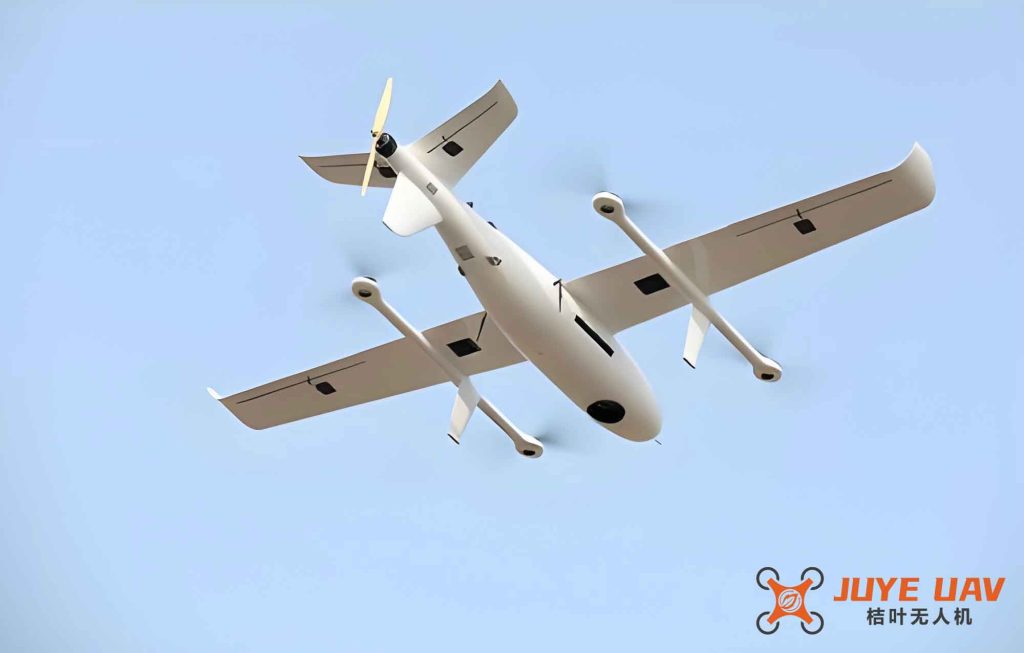
1.2 System Operation Platform
As the core of our system, the fixed-wing UAV operation platform must meet stringent performance and functional requirements. I evaluated several criteria to select the optimal platform:
- Endurance: To satisfy emergency communication needs, continuous operation for more than 20 hours is required. Thus, the fixed-wing UAV must have an endurance of at least 20 hours.
- Payload capacity: The platform must support a high payload to carry multiple communication devices, as many emergency scenarios require simultaneous operation of various equipment.
- Hardware deployment and system operation: The hardware architecture should be simple, enabling rapid deployment for sudden emergency events.
- Cost and practicality: Development costs must be controlled while ensuring the fixed-wing UAV’s usability in real-world signal coverage.
- Transport convenience: Given the uncertainty of emergency events, the equipment must be quickly transferable to any location, so platform portability is essential.
- Stable flight: Stable hovering at specified positions is necessary to maintain consistent network signal coverage.
Among the available drone types (professional vs. civilian), civilian UAVs typically have batteries supporting flight times under 70 minutes, which is insufficient. Professional UAVs include fixed-wing, tethered, and rotary-wing types. After comparing size, payload, portability, and ease of operation, I selected the fixed-wing UAV, as it best meets all six requirements and offers the highest overall performance.
1.3 Hardware Specifications of the 5G Integrated Base Station
I employed a 5G integrated base station device specifically customized for fixed-wing UAV airborne operations. The hardware specifications are listed in the table below:
| Parameter | Specification |
|---|---|
| Operating frequency band | n3 (1.8 GHz) / n1 (2.1 GHz) |
| External interfaces | 1 monitoring port, 1 optical port |
| Operating mode | NR FDD |
| Working bandwidth | 100 MHz, 20 MHz, 10 MHz, 5 MHz |
| Synchronization method | Air interface synchronization, GPS supported |
| Receiving sensitivity | -103 dBm |
| Antenna | Backhaul terminal: directional antenna, 7 dBi; Built-in base station: omni-directional antenna, 4 dBi |
| Dimensions | 200 mm × 200 mm × 150 mm |
| Weight | Less than 5 kg |
| Power consumption | Less than 200 W |
| Backhaul method | Wireless backhaul, fiber backhaul, wired Ethernet backhaul supported |
| Power supply | DC 48 V |
| Transmit power | 20 W / 10 W |
1.4 Interface Configuration of the 5G Base Station Equipment
To ensure normal operation of the emergency communication system, multiple interface types are required to aggregate network, power, debugging, communication, GPS, and fiber signals. The main interfaces and their functions are:
- Power interface: Supplies power to the base station, specification: DC 48 V.
- Network interface: Serves as an external transmission network and provides network environment during debugging, specification: Gigabit Ethernet, supports LAN and WAN ports.
- Debug interface: Communication interface for base station debugging operations.
- Communication interface: Connects the fixed-wing UAV flight control system with the base station.
- GPS interface: Input terminal for GPS signal transmission.
- Fiber interface: Provides fiber network data backhaul channel, specification: 2.5 Gb·s-1 optical port.
2. Evaluation Model and Budget Parameters for Fixed-Wing UAV Emergency Communication Coverage Capability
2.1 Coverage Capability Evaluation Model
I employed an omni-directional antenna deployment on the fixed-wing UAV. To enhance network coverage, I adopted a high-altitude clear-zone propagation calculation model, constructing a high-altitude clear-zone operation framework. After simplification, the actual distance between the fixed-wing UAV base station and the user d, and the UAV’s hovering height h, form the legs of a right triangle, with the line-of-sight distance as the hypotenuse. Considering the Earth’s curvature, the wireless line-of-sight propagation distance is given by:
$$
\sqrt{(\sqrt{17h_t} + \sqrt{17h_r})^2 + d^2} \approx \sqrt{17h_t} + \sqrt{17h_r}
$$
where hr is the effective height of the user receiving antenna (in meters), and ht is the effective height of the base station antenna (in meters). The path loss in the signal link is calculated using the classical free-space propagation model:
$$
L = 32.45 + 20 \log_{10}(d) + 20 \log_{10}(f)
$$
where d is the distance between the fixed-wing UAV base station and the user (in km), and f is the operating frequency (in MHz).
2.2 Downlink Coverage Link Budget Parameters for Fixed-Wing UAV
In our system, the downlink coverage link involves numerous budget parameters that largely determine communication coverage capability. The key parameters are summarized in the table below:
| Parameter | Value |
|---|---|
| Total base station power | 43 dBm |
| Operating bandwidth | 4500 kHz |
| Antenna power | 10 W |
| Pilot antenna power | 18.3 dBm |
| Occupied PRB count | 25 |
| Number of transmit antennas | 2 |
| Interference margin | 6.2 dB |
| Base station transmit cable loss | 0.52 dB |
| Base station antenna gain | 3 dBi |
| Penetration margin | 5 dB |
| Shadow fading margin | 8.6 dB |
| Terminal antenna gain | 0 dBi |
| Body and other losses | 0 dB |
| Terminal target RSRP | -104.8 dBm |
| Terminal receiver noise figure | 7 dB |
| Total air loss | 105.98 dB |
2.3 Backhaul Link Budget Parameters for Fixed-Wing UAV
During system operation, I also budgeted parameters for the backhaul link to enhance overall coverage capability. The main parameters are shown in the table below:
| Parameter | Value |
|---|---|
| Total base station power | 46 dBm |
| Operating bandwidth | 4500 kHz |
| Antenna power | 20 W |
| Pilot antenna power | 21.3 dBm |
| Occupied PRB count | 25 |
| Number of transmit antennas | 2 |
| Interference margin | 6.2 dB |
| Base station transmit cable loss | 0.52 dB |
| Base station antenna gain | 3.1 dBi |
| Penetration margin | 3 dB |
| Shadow fading margin | 8.6 dB |
| Terminal antenna gain | 0 dBi |
| Body and other losses | 0 dB |
| Terminal target RSRP | -104.9 dBm |
| Terminal receiver noise figure | 6.9 dB |
| Total air loss | 111.03 dB |
3. Analysis of Fixed-Wing UAV Emergency Communication Coverage Capability Under 5G Base Station Environment
3.1 UAV Coverage and Backhaul Capability Analysis
I set the fixed-wing UAV operation environment to a 5G network at a frequency point of n-band 12.1 GHz, deploying the emergency communication system at a certain location. The operating bandwidth was set to 5 MHz with a transmit power of 2×10 W to cover the network signal. In this test, I assumed a ground terminal UE target Reference Signal Receiving Power (RSRP) of -104.9 dBm. When the fixed-wing UAV flew continuously at an altitude of 200 meters, I measured the network signal coverage range and obtained a coverage radius of 2.33 km. This coverage range meets my development standards. For backhaul capability testing, the result showed that the device supports signal coverage over approximately 340 km2.
3.2 Impact of Transmit Power and PRB Occupancy on Forward/Backhaul Link Budget
I conducted tests by varying the base station transmit power and the number of occupied PRBs to examine their impact on the user received power in the forward/backhaul links. If the received power reaches the budgeted value, the link is considered unaffected; otherwise, the network is impacted. The test results are summarized in the following figures (conceptually). I observed that the edge user received power increases with the base station transmit power. According to RSRP analysis, the base station’s downlink coverage range gradually expands, reaching a maximum coverage radius of 3.5 km, supporting user coverage over an area of 40 km2. For the 800 MHz frequency band operation, the backhaul power also increases, resulting in an extended coverage radius of up to approximately 9 km, supporting user coverage over an area of 240 km2.
To further visualize these trends, I present the following relationships:
When transmit power varies, the forward/backhaul link budget impact is modeled as:
$$
P_{\text{received}} = P_{\text{transmit}} – L_{\text{total}}
$$
where Ltotal includes path loss, shadow fading, and other margins. For the forward link (downlink), increasing Ptransmit from 43 dBm to 46 dBm improves the coverage radius from 2.33 km to 3.5 km, corresponding to an area increase from approximately 17 km2 to 38 km2. For the backhaul link, the higher power at 46 dBm (base station) yields a radius of 9 km, covering about 254 km2.
Similarly, varying the number of occupied PRBs from 25 to a smaller value (e.g., 12) reduces the effective bandwidth and thus the total power distributed, which in turn degrades the received RSRP and shrinks the coverage area. The trade-off between PRB count and coverage is critical for optimizing the fixed-wing UAV’s emergency communication capability.
4. Conclusion
Through this research, I have developed a fixed-wing UAV emergency communication system based on a 5G network environment. By selecting the appropriate fixed-wing UAV platform, configuring the 5G integrated base station hardware, and establishing an accurate link budget model, I achieved significant coverage performance. The test results demonstrate that the system’s network signal coverage and backhaul capabilities are robust, meeting emergency communication requirements. The forward link supports user coverage over 40 km2, while the backhaul link supports coverage over 240 km2. These findings confirm that the proposed fixed-wing UAV emergency communication system is a viable and effective solution for rapid deployment in disaster scenarios. Future work will focus on optimizing the antenna configuration and dynamic resource allocation to further enhance the coverage capability of the fixed-wing UAV under complex environmental conditions.