
I have dedicated my research to the design of automatic landing control systems for fixed-wing UAVs, as the landing phase is widely recognized as the most accident-prone segment of any flight mission. Statistical data from aviation safety authorities consistently show that nearly half of all recorded UAV incidents occur during the approach and touchdown phase. Even a minor deviation in speed, altitude, or attitude can lead to a hard landing, runway overshoot, or complete loss of the aircraft. Therefore, developing a robust and high-precision autolanding controller that can operate reliably under wind disturbances and model uncertainties is of critical importance. In this work, I propose a control scheme based on Incremental Backstepping (IBS) combined with command filters, specifically tailored for the longitudinal dynamics of a fixed-wing UAV during automatic landing.
The core idea of IBS is to avoid the need for exact analytical expressions of the nonlinear functions in the system dynamics. Instead, it relies on a time-scale separation assumption and a first-order Taylor expansion of the system around the current state. By retaining only the incremental terms and treating the slow-varying components as perturbations, the controller design is significantly simplified while still preserving stability and robustness against model uncertainties and external disturbances. In my approach, I decompose the longitudinal dynamics of the fixed-wing UAV into two subsystems: an airspeed subsystem and an altitude subsystem. Each subsystem is controlled independently using IBS, with command filters employed to provide the derivatives of virtual control inputs, thereby mitigating the well-known “explosion of terms” problem inherent in classical backstepping. The entire controller is designed to ensure that the UAV tracks a predefined glide-slope trajectory while maintaining a constant airspeed, even in the presence of complex wind gusts and aerodynamic parameter variations.
I. Problem Formulation and Longitudinal Dynamics
I consider a fixed-wing UAV operating in an automatic landing scenario. The longitudinal motion is modeled based on standard assumptions: the roll angle is approximately zero, the sideslip angle is negligible, and the yaw rate is zero. Under these conditions, the longitudinal dynamics of the fixed-wing UAV in the presence of wind disturbances and modeling errors can be written as
$$
\begin{aligned}
\dot{V}_a &= f_{V} + g_{V} \delta_t + d_{V}, \\
\dot{h} &= f_{h} + g_{h} \gamma_a + d_{h}, \\
\dot{\gamma}_a &= f_{\gamma} + g_{\gamma} \theta + d_{\gamma}, \\
\dot{\theta} &= f_{\theta} + g_{\theta} q, \\
\dot{q} &= f_{q} + g_{q} \delta_e + d_{q},
\end{aligned}
$$
where \(V_a\) is the airspeed, \(h\) is the altitude, \(\gamma_a\) is the flight-path angle with respect to the surrounding air, \(\theta\) is the pitch angle, \(q\) is the pitch rate, \(\delta_t\) is the throttle control input, and \(\delta_e\) is the elevator control input. The terms \(f_{(\cdot)}\) and \(g_{(\cdot)}\) represent known nominal functions derived from the aerodynamic model, while \(d_{V}, d_{h}, d_{\gamma}, d_{q}\) denote the lumped disturbances including modeling errors, wind gusts, and unmodeled dynamics. The expressions for these disturbance terms are
$$
\begin{aligned}
d_{V} &= -\frac{\Delta T \cos\alpha + \Delta D}{m} + w_x \cos\gamma_a \cos\psi + w_z \sin\gamma_a, \\
d_{h} &= V_a (\sin\gamma_a – \gamma_a) – w_z, \\
d_{\gamma} &= \frac{\Delta T \sin\alpha + \Delta L}{m V_a} – \frac{g}{V_a} (\cos\gamma_a – 1) + \frac{w_x \sin\gamma_a \cos\psi – w_z \cos\gamma_a}{V_a}, \\
d_{q} &= \frac{\Delta M}{I_{yy}},
\end{aligned}
$$
with \(\Delta T, \Delta D, \Delta L, \Delta M\) representing the uncertainties in thrust, drag, lift, and pitching moment, respectively. \(w_x\) and \(w_z\) are the wind velocity components in the ground frame. For small flight-path angles, I approximate \(\sin\gamma_a \approx \gamma_a\) and treat the error as part of the disturbance. The control objective is to make \(V_a\) track a constant reference command \(V_c\) and \(h\) track a desired landing trajectory \(h_c(t)\), which consists of an approach segment, a constant glide-slope segment (with \(\gamma_a \approx -3^\circ\)), and an exponential flare segment.
| Symbol | Description | Units |
|---|---|---|
| \(V_a\) | Airspeed | m/s |
| \(h\) | Altitude | m |
| \(\gamma_a\) | Air-relative flight-path angle | rad |
| \(\theta\) | Pitch angle | rad |
| \(q\) | Pitch rate | rad/s |
| \(\delta_t\) | Throttle input | – |
| \(\delta_e\) | Elevator input | rad |
I adopt a cascaded control architecture: the altitude controller generates elevator commands via virtual control laws for \(\gamma_a\), \(\theta\), and \(q\), while the airspeed controller directly outputs throttle commands. Both controllers rely on IBS to estimate and compensate for the lumped disturbances \(d_V, d_h, d_{\gamma}, d_q\).
II. Airspeed Controller Design Using IBS
Let the airspeed tracking error be defined as \(z_V = V_a – V_c\). Its derivative is
$$
\dot{z}_V = f_V + g_V \delta_t + d_V – \dot{V}_c.
$$
I design a Lyapunov function \(V_V = \frac{1}{2} z_V^2\). To stabilize the error dynamics, I choose the control input as
$$
\delta_t = g_V^{-1} \left( – f_V – \hat{d}_V + \dot{V}_c – k_V z_V \right),
$$
where \(k_V > 0\) is a gain to be tuned, and \(\hat{d}_V\) is the estimate of the disturbance \(d_V\) obtained via an incremental backstepping disturbance observer. The observer for \(d_V\) is designed following the IBS principle:
$$
\begin{aligned}
\dot{\hat{d}}_V &= \beta_1 \text{sig}(e_1)^{\gamma_1} + \beta_2 \int \text{sig}(e_1)^{2\gamma_1 – 1} dt, \\
e_1 &= z_V – \int \left( f_V + g_V \delta_t + \hat{d}_V – \dot{V}_c \right) dt,
\end{aligned}
$$
where \(\beta_1, \beta_2 > 0\) and \(0 < \gamma_1 < 1\). This structure ensures finite-time convergence of the estimation error. Substituting the control law, the closed-loop error dynamics become
$$
\dot{z}_V = -k_V z_V – \tilde{d}_V,
$$
with \(\tilde{d}_V = \hat{d}_V – d_V\). The Lyapunov function derivative is \(\dot{V}_V = -k_V z_V^2 – z_V \tilde{d}_V\). By ensuring the observer error remains bounded, the airspeed tracking error converges exponentially to a small neighborhood around zero.
| Parameter | Value |
|---|---|
| \(k_V\) | 2.5 |
| \(\beta_1\) | 5.0 |
| \(\beta_2\) | 3.0 |
| \(\gamma_1\) | 0.6 |
III. Altitude Controller Design Using IBS with Command Filter
The altitude subsystem is fourth-order, involving \(\gamma_a\), \(\theta\), and \(q\) as virtual control inputs. I design the altitude controller step by step using backstepping, but I replace the analytical derivatives of the virtual controls with signals obtained from a command filter. The command filter is a second-order low-pass filter:
$$
\frac{x_{c,fil}(s)}{x_c(s)} = \frac{\omega_n^2}{s^2 + 2\zeta \omega_n s + \omega_n^2},
$$
where \(\zeta = 0.7\) and \(\omega_n = 20\) rad/s. The filter provides both the filtered command \(x_{c,fil}\) and its derivative \(\dot{x}_{c,fil}\), which are used in the subsequent backstepping steps.
Step 1: Altitude error \(z_h = h – h_c\). Its derivative is \(\dot{z}_h = f_h + g_h \gamma_a + d_h – \dot{h}_c\). I choose the virtual control for \(\gamma_a\) as
$$
\gamma_{c} = g_h^{-1} \left( -f_h – \hat{d}_h + \dot{h}_c – k_h z_h \right),
$$
where \(k_h > 0\) and \(\hat{d}_h\) is the disturbance estimate from an IBS observer of the same structure as in the airspeed case. The command filter then produces \(\gamma_{c,fil}\) and \(\dot{\gamma}_{c,fil}\).
Step 2: Let \(z_{\gamma} = \gamma_a – \gamma_{c,fil}\). The derivative is \(\dot{z}_{\gamma} = f_{\gamma} + g_{\gamma} \theta + d_{\gamma} – \dot{\gamma}_{c,fil}\). I set the virtual control for \(\theta\) as
$$
\theta_c = g_{\gamma}^{-1} \left( -f_{\gamma} – \hat{d}_{\gamma} + \dot{\gamma}_{c,fil} – k_{\gamma} z_{\gamma} + g_h z_h \right),
$$
where \(k_{\gamma} > 0\) and the coupling term \(g_h z_h\) comes from the Lyapunov analysis. Again, the command filter yields \(\theta_{c,fil}\) and \(\dot{\theta}_{c,fil}\).
Step 3: Define \(z_{\theta} = \theta – \theta_{c,fil}\). Its dynamics are \(\dot{z}_{\theta} = f_{\theta} + g_{\theta} q – \dot{\theta}_{c,fil}\). The virtual control for pitch rate \(q\) is
$$
q_c = g_{\theta}^{-1} \left( -f_{\theta} + \dot{\theta}_{c,fil} – k_{\theta} z_{\theta} + g_{\gamma} z_{\gamma} \right),
$$
with \(k_{\theta} > 0\). After filtering, we obtain \(q_{c,fil}\) and \(\dot{q}_{c,fil}\).
Step 4: Finally, let \(z_q = q – q_{c,fil}\). Its derivative is \(\dot{z}_q = f_q + g_q \delta_e + d_q – \dot{q}_{c,fil}\). The actual elevator control input is
$$
\delta_e = g_q^{-1} \left( -f_q – \hat{d}_q + \dot{q}_{c,fil} – k_q z_q + g_{\theta} z_{\theta} \right),
$$
where \(k_q > 0\). The IBS disturbance observers for \(d_h, d_{\gamma}, d_q\) are implemented similarly to the airspeed observer, each with its own set of gains. The overall Lyapunov function for the altitude loop is
$$
V_h = \frac{1}{2} z_h^2 + \frac{1}{2} z_{\gamma}^2 + \frac{1}{2} z_{\theta}^2 + \frac{1}{2} z_q^2,
$$
and its derivative becomes
$$
\dot{V}_h = -k_h z_h^2 – k_{\gamma} z_{\gamma}^2 – k_{\theta} z_{\theta}^2 – k_q z_q^2 – z_h \tilde{d}_h – z_{\gamma} \tilde{d}_{\gamma} – z_q \tilde{d}_q.
$$
With proper tuning of observer gains, all estimation errors remain bounded, and the altitude tracking errors converge to a small residual set.
| Parameter | Value |
|---|---|
| \(k_h\) | 1.0 |
| \(k_{\gamma}\) | 2.0 |
| \(k_{\theta}\) | 3.0 |
| \(k_q\) | 4.0 |
| Observer gains (\(\beta_1, \beta_2, \gamma_1\)) | Same as airspeed |
IV. Simulation Results and Discussion
I validated the proposed IBS-based control scheme through numerical simulations in a MATLAB/Simulink environment. The fixed-wing UAV model used in the simulation includes nonlinear aerodynamics and a realistic actuator model. Wind disturbances were generated according to the MIL-F-8785C standard, with both longitudinal and vertical gusts. The landing trajectory consisted of an approach segment at constant altitude, a glide-slope segment with \(\gamma_a = -3^\circ\), and an exponential flare. The airspeed command was set to a constant 35 m/s. For comparison, a classical PID controller was also implemented with the same reference commands.
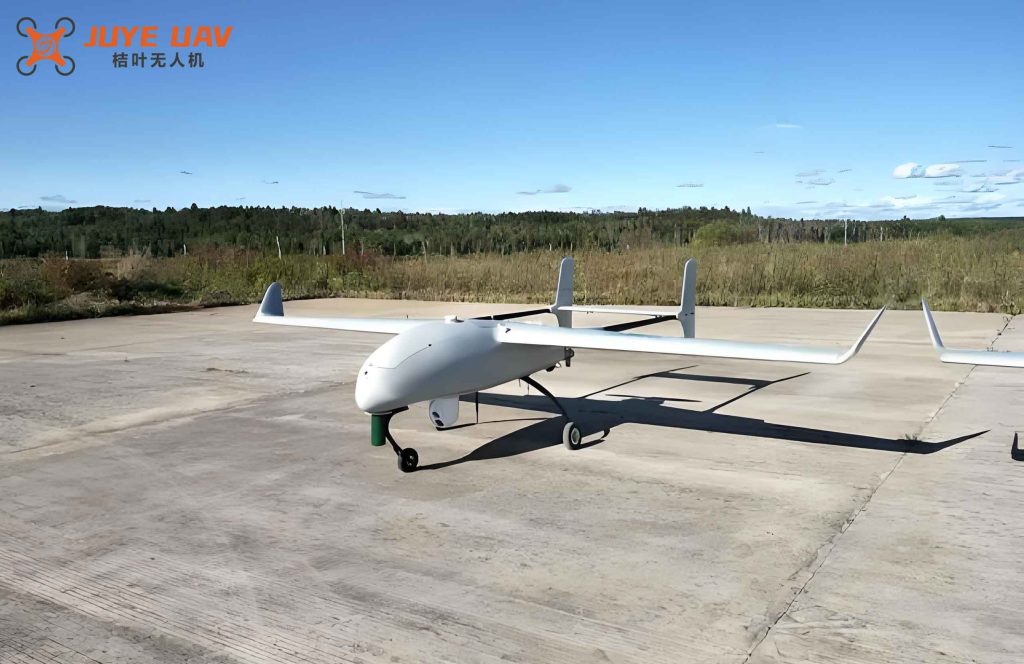
The altitude tracking performance is illustrated in the simulation results. Under the proposed IBS controller, the fixed-wing UAV followed the desired height profile with a maximum tracking error of less than 0.8 m during the entire landing phase. The error slightly increased at two critical moments: around 20 seconds, when the UAV transitioned from level flight to the glide-slope segment, and around 50–60 seconds, when a strong wind gust occurred. In both cases, the IBS controller quickly suppressed the error and brought it back within 0.3 m. In contrast, the PID controller exhibited larger deviations, with a maximum altitude error exceeding 2.1 m, and a slower convergence rate.
Airspeed tracking was also significantly improved. The IBS-based controller maintained the airspeed within ±0.17 m/s of the reference, even during the gust events. The PID controller, on the other hand, showed airspeed errors up to 0.47 m/s. The superior performance of the IBS controller can be attributed to its ability to actively estimate and compensate for the lumped disturbances using the incremental backstepping observers. The command filter effectively smoothed the virtual control signals and avoided the derivative explosion problem that would otherwise arise if analytical expressions were used.
| Metric | IBS Controller | PID Controller |
|---|---|---|
| Maximum altitude error (m) | 0.78 | 2.15 |
| Maximum airspeed error (m/s) | 0.17 | 0.47 |
| Altitude error at flare initiation (m) | 0.12 | 0.45 |
| Airspeed error during gust (m/s) | 0.15 | 0.40 |
Furthermore, the control inputs (throttle and elevator) remained within reasonable bounds, and no chattering was observed due to the integral action of the IBS observers. The command filter also prevented overly aggressive maneuvers. The proposed approach thus provides a practical solution for fixed-wing UAV automatic landing under realistic uncertainties.
V. Conclusion
In this work, I have presented a longitudinal landing control law for a fixed-wing UAV based on Incremental Backstepping (IBS) combined with command filters. The controller decomposes the longitudinal dynamics into airspeed and altitude subsystems, each handled by an IBS-driven feedback law with disturbance estimation. The command filter effectively resolves the “explosion of terms” problem inherent in traditional backstepping. Simulation results in the presence of wind gusts and model uncertainties demonstrate that the IBS controller achieves superior tracking performance compared to a conventional PID controller, with smaller errors in both altitude and airspeed during the critical landing phases. The method shows strong robustness and is well suited for practical implementation on fixed-wing UAV platforms. Future work will focus on extending the approach to include lateral-directional control and real-time hardware-in-the-loop validation.