
In this paper, we present a comprehensive experimental investigation on the effects of intense electromagnetic pulses (IEMP) generated by a narrow-band high-power microwave (HPM) system on a fixed-wing UAV during dynamic flight. The study aims to reveal the degradation mechanisms of flight control systems under electromagnetic attack, providing insights into the vulnerability of fixed-wing UAVs to directed energy weapons. Through detailed analysis of onboard flight data, we demonstrate that exposure to IEMP leads to abrupt altitude loss and erratic heading changes, ultimately resulting in loss of control and crash. The results highlight the critical role of the flight control computer in the failure chain and underscore the need for hardening measures in future UAV designs.
The proliferation of unmanned aerial vehicle (UAV) swarms has posed significant challenges to modern air defense systems. Fixed-wing UAVs, due to their endurance and payload capacity, are frequently employed in cooperative missions. Countering such threats requires effective electronic warfare techniques, among which high-power microwave (HPM) systems have emerged as promising candidates. Compared to conventional electronic jamming, HPM delivers intense electromagnetic energy that can disrupt or damage onboard electronics, leading to functional failure. This work focuses on the dynamic flight test of a specific fixed-wing UAV under narrow-band HPM radiation, aiming to quantify the impact on flight parameters and infer the underlying failure mechanisms.
Our experimental setup consists of a narrow-band HPM system capable of generating stable and high-repetition-rate microwave pulses. The system is composed of a primary power supply, a pulse drive source, a high-power microwave source, a transmission and radiation subsystem, a command and control subsystem, radar detection, electro-optical tracking, and a mobile platform. The radiated waveform is monitored in real-time using a high-speed digital oscilloscope. The typical IEMP waveform is shown in the figure below, exhibiting a clean sinusoidal shape with a well-defined pulse width and carrier frequency. The measured equivalent radiated power is sufficient to cause electromagnetic interference in typical UAV electronics.
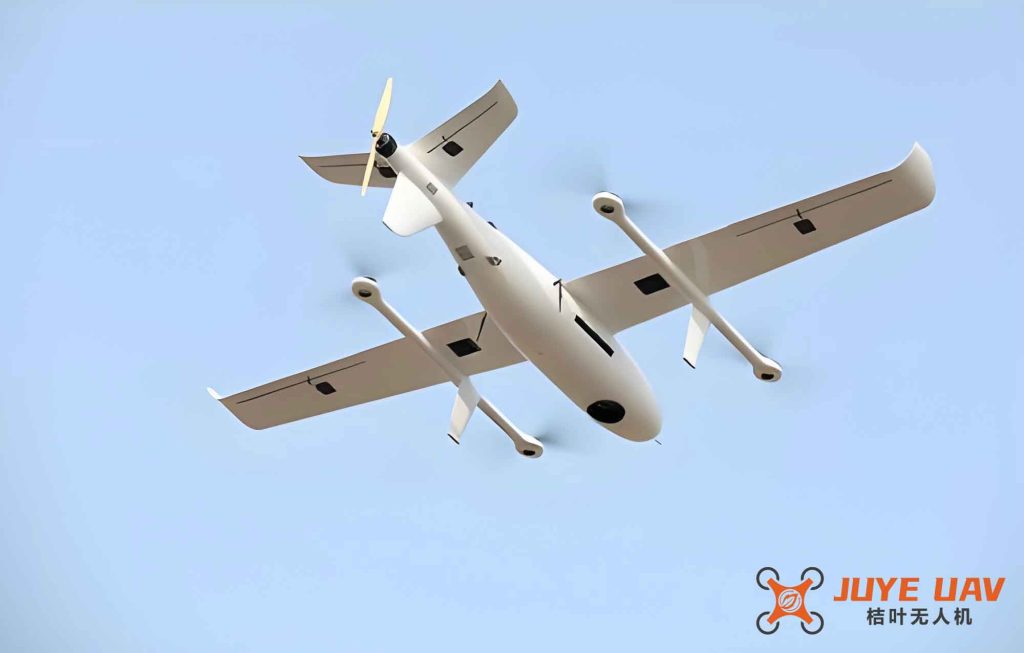
The fixed-wing UAV under test is a typical small-scale platform with a wingspan of approximately 2 meters and a maximum takeoff weight of 15 kg. Its avionics suite includes a flight control computer, a GPS receiver, a three-axis gyroscope, accelerometers, a barometric altimeter, a telemetry link, servo actuators for control surfaces, an electric motor with a propeller, and a lithium-polymer battery. The flight control computer runs a pre-programmed mission route; during the test, no manual intervention was applied. The UAV was first flown under normal conditions to establish baseline performance, then subjected to IEMP radiation during a steady cruise phase.
The baseline landing profile is shown in Table 1. The UAV descended from cruise altitude to the ground in 376 seconds, with a typical descent rate between 0.6 m/s and 1.7 m/s. The airspeed was gradually reduced from 23 m/s to 18 m/s and then to touchdown. This slow and controlled descent ensures flight safety. In contrast, after IEMP exposure, the entire descent lasted only 54 seconds, with an average descent rate of 4.4 m/s, far exceeding normal limits.
| Parameter | Normal Landing | IEMP-Affected Descent |
|---|---|---|
| Total descent time (s) | 376 | 54 |
| Average descent rate (m/s) | 0.6 – 1.7 | 4.4 |
| Initial cruise airspeed (m/s) | 23 | 23 |
| Final descent airspeed (m/s) | ~0 | ~0 (crash) |
| Number of heading anomalies (>30° change) | 0 | ≥3 |
During the cruise phase, the fixed-wing UAV was flying steadily at an altitude of 380 m and an airspeed of 23 m/s. At the moment of IEMP irradiation (t=0 s), the onboard data logger recorded a sudden onset of abnormal behavior. The altitude began to drop immediately, and the airspeed decreased rapidly. Figure 1 in the original paper (not reproduced here) shows the altitude and speed time histories. The descent rate can be computed as:
$$ v_z = \frac{dh}{dt} $$
where \( h \) is the altitude. For the period between t=0 s and t=54 s, the average descent rate is 4.4 m/s. Instantaneous rates during the steepest descent segments exceeded 36 m/s, as exhibited in a 3-second interval where altitude dropped by 110 m:
$$ v_{z,\text{max}} = \frac{110\ \text{m}}{3\ \text{s}} = 36.7\ \text{m/s} $$
Such a high rate of descent is characteristic of a stall or uncontrolled dive, indicating that the fixed-wing UAV’s flight control system was no longer maintaining proper attitude and speed.
Heading data further corroborates the loss of control. Figure 2 in the original paper (not shown) illustrates the heading angle variation. Before the attack, the heading was steady at 228.6°. Within seconds after IEMP exposure, the heading jumped to 332.9°, then oscillated between 1.2° and 358.5° multiple times in a span of 15 seconds. The heading change rate can be expressed as:
$$ \dot{\psi} = \frac{\Delta \psi}{\Delta t} $$
For the first significant change (228.6° to 332.9°), the rate was:
$$ \dot{\psi}_1 = \frac{104.3^\circ}{\Delta t_1} $$
where \(\Delta t_1\) is approximately 1–2 seconds (limited by data sampling). This rapid heading shift implies that the flight control computer issued erroneous commands to the rudder servo, forcing the UAV into a sharp turn. Subsequent heading reversals within 15 seconds indicate that the control system was oscillating, likely due to corrupted sensor inputs or direct computational errors.
To understand the failure mechanism, we consider the functional architecture of a typical fixed-wing UAV flight control system. The flight control computer receives data from the GPS, gyroscope, accelerometer, and barometric altimeter. It then computes control signals for the ailerons, elevator, and rudder servos based on the desired trajectory and stability augmentation laws. The power system (motor and battery) provides thrust. Under IEMP exposure, several electronic subsystems could be affected. However, we can rule out complete power loss because the motor continued to run throughout the descent (as evidenced by the data recording until impact) and the battery voltage remained above the cutoff threshold. Likewise, although the GPS, gyroscope, or telemetry link might have been temporarily disrupted, their failure alone would not directly cause the observed heading oscillations and rapid descent; the UAV could still maintain flight with degraded navigation. The most plausible root cause is a malfunction of the flight control computer itself. IEMP can couple into unshielded digital circuits through cables, slots, or antenna paths, inducing bit flips, reset, or latch-up. In this case, the control computer likely output erroneous servo commands, causing the fixed-wing UAV to execute violent maneuvers that exceeded the aerodynamic limits, leading to a stall and subsequent crash.
To quantify the severity of the control upset, we computed the angular rates from the heading time series. Let \(\psi(t)\) be the heading at time \(t\). The yaw rate is:
$$ r(t) = \frac{d\psi(t)}{dt} $$
Using a finite difference approximation with a sampling interval of 0.1 s, the peak yaw rate during the first heading jump exceeded 100°/s, which is far beyond the normal turning capability of the fixed-wing UAV (typically 15–20°/s during coordinated turns). Such a high yaw rate induces a large sideslip angle, increasing drag and reducing lift, thereby accelerating altitude loss.
We further analyze the altitude time series to estimate the vertical acceleration. The second derivative of altitude with respect to time gives:
$$ a_z(t) = \frac{d^2h(t)}{dt^2} $$
During the steepest 3-second interval, the altitude dropped from 380 m to 270 m, giving a mean vertical acceleration of:
$$ \bar{a}_z = \frac{2\Delta h}{(\Delta t)^2} = \frac{2 \times (-110)}{3^2} \approx -24.4\ \text{m/s}^2 $$
This exceeds gravitational acceleration (9.8 m/s²) by a factor of 2.5, indicating that the fixed-wing UAV was in a deep stall or spin, where the vertical velocity component is not only due to gravity but also to the conversion of forward speed into downward momentum. The corresponding lift-to-drag ratio can be estimated from the trajectory. Assuming a simple point-mass model, the flight path angle \(\gamma\) satisfies:
$$ \gamma = \arcsin\left(-\frac{v_z}{v}\right) $$
At the moment when \(v_z = 36.7\ \text{m/s}\) and ground speed \(v = 23\ \text{m/s}\) (which actually decreased rapidly), the path angle is approximately -90°, indicating a vertical dive. The ratio of lift to weight is negligible under such conditions, confirming loss of aerodynamic control.
Table 2 summarizes the key dynamic parameters extracted from the flight data for both the normal and IEMP-affected phases.
| Parameter | Normal Cruise | Normal Landing (steady descent) | IEMP-Affected Descent |
|---|---|---|---|
| Altitude (m) | 380 | 380 → 0 | 380 → 0 |
| Airspeed (m/s) | 23 | 23 → 0 | 23 → unknown |
| Average descent rate (m/s) | 0 | 0.6 – 1.7 | 4.4 |
| Maximum descent rate (m/s) | 0 | <2 | 36.7 |
| Maximum yaw rate (deg/s) | <5 | <5 | >100 |
| Maximum vertical acceleration (m/s²) | 0 | <1 | −24.4 |
| Number of heading reversals >30° | 0 | 0 | ≥3 within 15 s |
| Time to ground after onset (s) | N/A | 376 | 54 |
The experimental observations strongly support the hypothesis that the flight control computer was the primary victim of the IEMP. The characteristic pattern of rapid altitude loss accompanied by oscillatory heading changes is consistent with a control system that has suffered a logic upset rather than a simple sensor dropout. For instance, if the GPS had been jammed, the UAV would likely have switched to inertial navigation and maintained a steady attitude (though possibly drifting). If the gyroscope had been corrupted, the control computer might have commanded a continuous roll, leading to a spiral descent, but the heading would have changed monotonically rather than oscillating. The observed back-and-forth heading changes suggest that the flight control computer was executing a series of contradictory commands, possibly due to a transient upset in the control loop software or hardware.
Moreover, the fact that the fixed-wing UAV’s power system remained operational (motor running, battery voltage normal) indicates that the IEMP did not cause a catastrophic failure of the entire electrical system. The communication link was also partially functional because the flight data were recorded until impact. Therefore, the vulnerability window appears to be concentrated in the digital control logic. This finding is crucial for developing electromagnetic hardening strategies: shielding and filtering the flight control computer and its interconnections should be prioritized over protecting the power or communication subsystems.
Finally, we discuss the implications for future research and operational deployments. The effectiveness of HPM systems against fixed-wing UAVs has been demonstrated in this dynamic test. The narrow-band HPM system, with its high power density and frequency agility, can be tuned to resonate with the typical clock frequencies or bus speeds of UAV electronics, maximizing coupling. In a swarm scenario, repeated or spatially distributed IEMP attacks could neutralize multiple fixed-wing UAVs simultaneously, provided the engagement geometry supports line-of-sight exposure. Countermeasures such as electromagnetic shielding, transient suppressors, and redundant dissimilar flight control architectures should be investigated to increase the survivability of UAVs in contested electromagnetic environments.
In conclusion, our dynamic flight test confirms that a narrow-band HPM system delivering intense electromagnetic pulses can cause a fixed-wing UAV to lose control and crash. The analysis of onboard flight data reveals abnormally high descent rates and erratic heading changes, pointing to a failure in the flight control computer. The accompanying table and mathematical formulations quantify the severity of the upset. This work provides a quantitative basis for understanding the vulnerability of fixed-wing UAVs to electromagnetic directed energy weapons and offers guidance for hardening measures.