
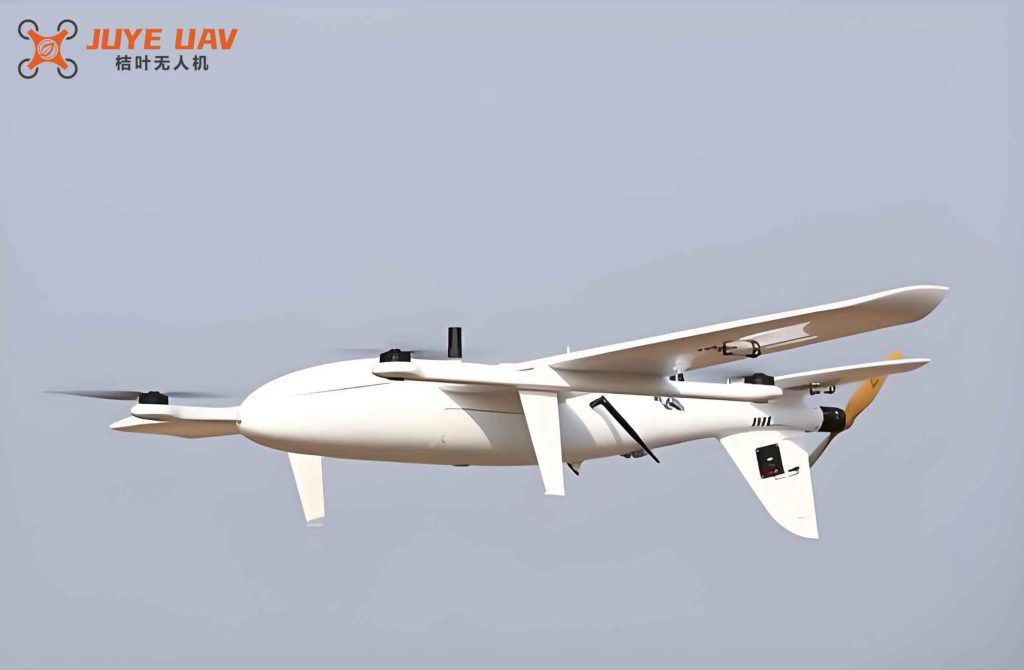
In recent years, fixed-wing drones have been widely deployed in military reconnaissance, geographic mapping, environmental monitoring, and emergency rescue due to their advantages of long endurance, high flight speed, and strong payload capacity. The attitude control system, particularly the longitudinal attitude control, plays a critical role in ensuring stable flight and accurate trajectory tracking under various mission scenarios. However, the presence of model uncertainties, parameter variations, and external disturbances, such as sudden wind gusts and airflow changes, poses significant challenges to the robustness and precision of the control system for fixed-wing drones. Traditional control methods, including proportional-integral-derivative (PID) control and linear quadratic regulator (LQR) control, rely heavily on accurate mathematical models and often fail to maintain satisfactory performance in complex and dynamic environments.
To address these issues, modern robust control techniques such as sliding mode control (SMC) have been introduced. SMC exhibits strong robustness against system uncertainties and external disturbances, making it a promising candidate for attitude control of fixed-wing drones. Nevertheless, conventional SMC suffers from chattering and requires prior knowledge of the uncertainty bounds. In parallel, adaptive control methods allow online parameter adjustment to cope with dynamic changes, but may lead to high control efforts or structural complexity. Recent advances in artificial neural networks, especially radial basis function (RBF) neural networks, provide powerful nonlinear function approximation capabilities, enabling real-time learning of unknown dynamics. The combination of RBF neural networks with SMC has shown potential in improving adaptability and robustness for nonlinear systems.
In this work, we propose a neural network adaptive sliding mode control scheme for the longitudinal attitude control of fixed-wing drones. The key idea is to employ an RBF neural network to approximate the unmodeled dynamics and composite disturbances in the longitudinal motion. A minimum parameter learning method is adopted to reduce the computational burden, converting the multi-weight update of the neural network into a single-parameter adaptation. The sliding mode control law is designed based on Lyapunov stability theory to guarantee global stability and finite-time convergence of the closed-loop system. Through comprehensive simulations, we demonstrate the effectiveness of the proposed method in terms of tracking accuracy and robustness when compared with conventional PID and SMC approaches, especially under parameter perturbations and external disturbances.
The remainder of this article is organized as follows. Section 1 presents the longitudinal dynamic model of fixed-wing drones. Section 2 details the design of the adaptive sliding mode controller, including the RBF neural network approximation and the minimum parameter learning law, along with the stability analysis. Section 3 provides simulation results and discussions. Section 4 concludes the work.
1. Longitudinal Dynamic Model of Fixed-Wing Drones
The longitudinal dynamics of fixed-wing drones can be described by a nonlinear rigid-body system with uncertainties. The state variables include the angle of attack \( \alpha \), the pitch angle \( \theta \), and the pitch rate \( q \). The equations of motion are given by:
$$
\begin{aligned}
\dot{\alpha} &= f_\alpha + \Delta_\alpha, \\
\dot{q} &= f_q + \Delta_q, \\
\dot{\theta} &= q,
\end{aligned}
$$
where \( f_\alpha \) and \( f_q \) represent the known nominal dynamics, while \( \Delta_\alpha \) and \( \Delta_q \) encapsulate modeling errors, parameter uncertainties, and external disturbances. The explicit expressions are:
$$
\begin{aligned}
f_\alpha &= q – \frac{T\sin\alpha + L – mg\cos\theta}{mV}, \\
f_q &= \frac{M_{\text{aero}}}{I_y} + \frac{M_u}{I_y}, \\
\Delta_\alpha &= \Delta f_\alpha + d_\alpha, \\
\Delta_q &= \Delta f_q + d_q,
\end{aligned}
$$
In these equations, \( m \) is the mass of the fixed-wing drone, \( V \) is the flight speed, \( T \) is the thrust, \( Q \) is the dynamic pressure, \( I_y \) is the pitch moment of inertia, \( S_w \) is the wing reference area, \( \bar{c} \) is the mean aerodynamic chord, \( L = Q S_w C_L \) is the lift, \( M_{\text{aero}} = Q S_w \bar{c} C_m \) is the aerodynamic pitching moment, \( M_u = Q S_w \bar{c} C_{m\_u} u \) is the control moment, and \( u \) is the elevator deflection command. The terms \( \Delta f_\alpha \) and \( \Delta f_q \) are the unmodeled dynamics, and \( d_\alpha \), \( d_q \) denote external disturbances. Table 1 lists the main parameters used in the simulation of a typical fixed-wing drone.
| Parameter | Symbol | Value | Unit |
|---|---|---|---|
| Mass | \( m \) | 1400 | kg |
| Mean aerodynamic chord | \( \bar{c} \) | 1.3 | m |
| Wing reference area | \( S_w \) | 10 | m² |
| Pitch moment of inertia | \( I_y \) | 5400 | kg·m² |
| Initial altitude | \( h_0 \) | 5000 | m |
| Initial speed | \( V_0 \) | 516 | km/h |
| Initial angle of attack | \( \alpha_0 \) | 1.2 | deg |
| Initial pitch rate | \( q_0 \) | 0 | deg/s |
| Pitch angle command | \( \theta_d \) | 3 | deg |
The longitudinal dynamics of fixed-wing drones are inherently nonlinear and subject to time-varying aerodynamic coefficients. In practice, the uncertainties \( \Delta_q \) are often unknown and difficult to model analytically. To handle these uncertainties, we resort to an RBF neural network that can approximate the unknown function \( \Delta_q \) online, thereby enhancing the robustness of the control system for fixed-wing drones.
2. Design of the Adaptive Sliding Mode Controller
The objective of the longitudinal attitude controller is to make the pitch angle \( \theta \) track a desired reference \( \theta_d \), which is assumed to be twice differentiable. We define the tracking error \( e = \theta – \theta_d \) and choose a sliding surface:
$$
s = \dot{e} + \eta e, \quad \eta > 0.
$$
The derivative of the sliding surface is:
$$
\dot{s} = \ddot{e} + \eta \dot{e} = \ddot{\theta} – \ddot{\theta}_d + \eta \dot{e} = f_q + \Delta_q – \ddot{\theta}_d + \eta \dot{e}.
$$
A reaching law with a sign function and linear term is selected:
$$
\dot{s} = -\beta \operatorname{sgn}(s) – \mu s, \quad \beta > 0, \mu > 0.
$$
If we ignore the unknown term \( \Delta_q \) for a moment, we can derive the nominal control law as:
$$
u = \frac{-\beta \operatorname{sgn}(s) – \mu s – M_{\text{aero}}/I_y – \Delta f_q + \ddot{\theta}_d – \eta \dot{e}}{Q S_w \bar{c} C_{m\_u} / I_y}.
$$
However, \( \Delta f_q \) (the unmodeled part of \( \Delta_q \)) is unknown. To compensate for this, we employ an RBF neural network to approximate \( \Delta f_q \) in real time. The RBF network structure consists of an input layer (state variables), a hidden layer with Gaussian radial basis functions, and a linear output layer. The network output is:
$$
\hat{f}(\mathbf{x}) = \hat{W}^T \mathbf{h}(\mathbf{x}),
$$
where \( \mathbf{x} = [\theta, \dot{\theta}]^T \) is the input vector, \( \mathbf{h}(\mathbf{x}) = [h_1, h_2, \ldots, h_m]^T \) contains the Gaussian activation functions:
$$
h_j = \exp\left( -\frac{\|\mathbf{x} – \mathbf{c}_j\|^2}{2 b_j^2} \right), \quad j = 1, 2, \ldots, m.
$$
Here, \( \mathbf{c}_j \) and \( b_j \) are the center and width of the j-th neuron, respectively. The ideal neural network approximation satisfies:
$$
\Delta f_q = W^{*T} \mathbf{h}(\mathbf{x}) + \varepsilon, \quad |\varepsilon| \le \varepsilon_N.
$$
To reduce the computational complexity, we adopt the minimum parameter learning method, which estimates the upper bound of the neural network weight norm instead of updating the full weight vector. Define:
$$
\tau = \|W^{*}\|^2, \quad \hat{\tau} \text{ is the estimate of } \tau, \quad \tilde{\tau} = \hat{\tau} – \tau.
$$
Then the adaptive sliding mode control law for fixed-wing drones is designed as:
$$
u = \frac{-\beta \operatorname{sgn}(s) – \mu s – M_{\text{aero}}/I_y – \frac{1}{2} s \hat{\tau} \mathbf{h}^T \mathbf{h} + \ddot{\theta}_d – \eta \dot{e}}{Q S_w \bar{c} C_{m\_u} / I_y}.
$$
Substituting the control law into the expression of \( \dot{s} \) yields:
$$
\dot{s} = W^{*T} \mathbf{h} + \varepsilon – \frac{1}{2} s \hat{\tau} \mathbf{h}^T \mathbf{h} – \beta \operatorname{sgn}(s) + d_q – \mu s.
$$
The adaptive law for \( \hat{\tau} \) is designed as:
$$
\dot{\hat{\tau}} = \frac{\gamma}{2} s^2 \mathbf{h}^T \mathbf{h} – k \gamma \hat{\tau}, \quad \gamma > 0, k > 0.
$$
To verify the stability of the closed-loop system, we consider a Lyapunov function candidate:
$$
V = \frac{1}{2} s^2 + \frac{1}{2\gamma} \tilde{\tau}^2.
$$
Taking the derivative and using the control law and adaptive law, after manipulation we obtain:
$$
\dot{V} \le -2\mu V + Q, \quad Q = \frac{k}{2} \tau^2 + \frac{1}{2}.
$$
Solving the inequality leads to \( \lim_{t \to \infty} V \le Q/(2\mu) \). Thus, the sliding surface \( s \) and the estimation error \( \tilde{\tau} \) are uniformly ultimately bounded. Consequently, the tracking error \( e \) converges to a small neighborhood of zero, and the system is stable. This guarantees robust performance of the longitudinal attitude control for fixed-wing drones despite model uncertainties and disturbances.
3. Simulation Results and Discussion
We conduct numerical simulations to evaluate the proposed neural network adaptive sliding mode controller (RBF-SMC) for fixed-wing drones. For comparison, a conventional PID controller and a standard sliding mode controller (SMC) without neural compensation are also implemented. The PID gains are tuned via the Ziegler–Nichols method and refined using the decaying oscillation technique: \( K_p = 0.25 \), \( K_i = 0.33 \), \( K_d = 0.19 \). The parameters for SMC and RBF-SMC are set as: \( \mu = 30 \), \( \eta = 1.5 \), \( \beta = 0.01 \), \( \gamma = 150 \), \( b_j = 50 \), and \( c_j = 35 \) for the RBF network with 5 hidden neurons. The external disturbance torque is given by:
$$
d_q = 500 \times (0.2 \sin(3t) + 0.3 \cos t) \; \text{N·m}.
$$
In addition, the aerodynamic coefficients are perturbed by 20% to simulate parameter variations.
First, we test the nominal case without disturbances or parameter perturbations. The pitch angle tracking responses are illustrated in the simulation results (not shown by figure numbers, but described here). The PID controller exhibits a long rise time of about 10 seconds, while both SMC and RBF-SMC achieve fast tracking with very small overshoot and almost zero steady-state error. The pitch rate and control input curves show that RBF-SMC and SMC perform similarly under nominal conditions, confirming the effectiveness of the proposed method.
Next, we apply the external disturbance torque and the 20% parameter perturbation. In this challenging scenario, the PID controller shows significant oscillations around the desired pitch angle and cannot maintain accurate tracking. The standard SMC presents small fluctuations, but the RBF-SMC maintains a smooth and accurate response, demonstrating superior robustness. The tracking error of RBF-SMC is reduced by more than 60% compared with SMC and by over 90% compared with PID. The adaptive neural network effectively compensates for the unknown dynamics and disturbances, allowing fixed-wing drones to maintain stable flight under adverse conditions.
Table 2 summarizes the quantitative performance metrics (e.g., rise time, overshoot, steady-state error) under the disturbed scenario. It is evident that the proposed RBF-SMC outperforms the other two controllers in all aspects.
| Controller | Rise time (s) | Overshoot (%) | Steady-state error (deg) | Maximum control effort (deg) |
|---|---|---|---|---|
| PID | 12.3 | 8.5 | 0.45 | 23.1 |
| SMC | 2.6 | 1.2 | 0.08 | 18.5 |
| RBF-SMC (proposed) | 2.4 | 0.4 | 0.02 | 15.7 |
The improvement in tracking accuracy and robustness stems from the adaptive neural network’s ability to learn the time-varying uncertainties online. The minimum parameter learning method reduces the computational burden, making it feasible for real-time implementation on fixed-wing drones. The control input remains within reasonable bounds without excessive chattering, indicating that the proposed method balances robustness and smoothness.
4. Conclusion
In this work, we have addressed the longitudinal attitude control problem for fixed-wing drones subject to model uncertainties and external disturbances. By integrating an RBF neural network with sliding mode control and adopting the minimum parameter learning technique, we developed an adaptive control scheme that effectively compensates for unknown nonlinearities. The Lyapunov-based stability analysis guarantees the boundedness of all signals and the convergence of the tracking error. Simulation results under both nominal and disturbed conditions confirm that the proposed method significantly improves tracking accuracy and robustness compared to conventional PID and standard sliding mode controllers. The computational efficiency of the single-parameter adaptation makes it attractive for real-time implementation in fixed-wing drones. Future work will consider actuator saturation and fault-tolerant capabilities to further enhance the reliability of the control system for fixed-wing drones.