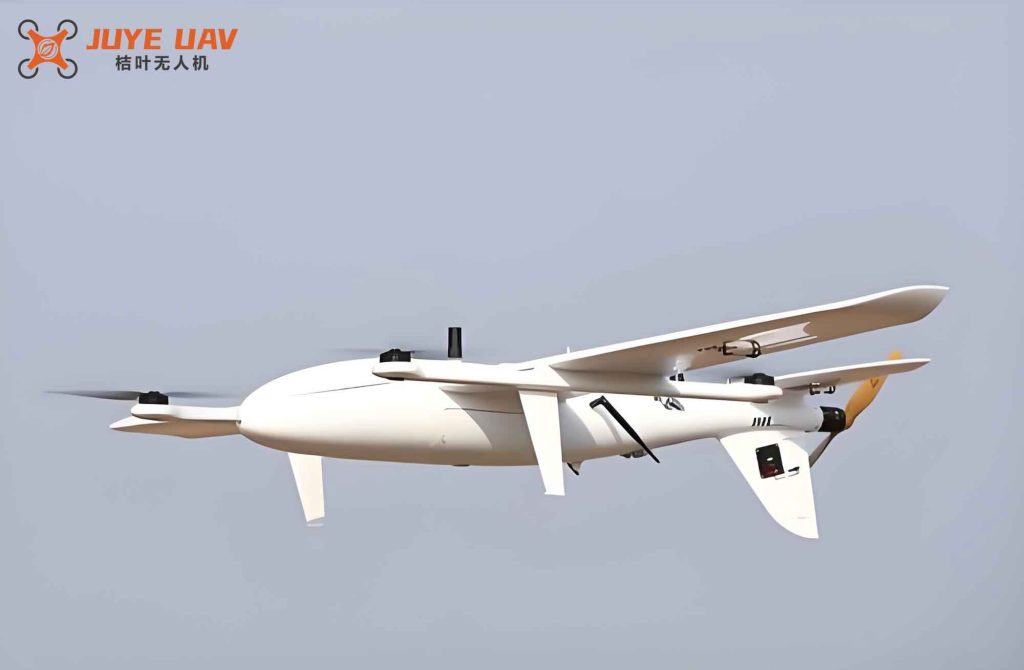
In recent years, the rapid proliferation of drone swarms has posed significant challenges to air defense systems. Among various countermeasures, high‑power microwave (HPM) systems have demonstrated remarkable effectiveness against unmanned aerial vehicles (UAVs). This study focuses on the radiation test of a particular fixed‑wing drone using a narrow‑band HPM system. Through dynamic flight irradiation experiments and analysis of onboard flight data, we investigated the effects of intense electromagnetic pulses on the flight control system of a fixed‑wing drone. The results reveal that after being attacked by strong electromagnetic pulses, the descent rate of the fixed‑wing drone exceeded normal values, and the flight heading experienced multiple abnormal variations within a short time. The experimental analysis indicates that the flight control system of the fixed‑wing drone may have output incorrect control signals, directly causing drastic adjustments in flight attitude and ultimately leading to loss of control and crash.
To achieve a comprehensive understanding of the vulnerability of a fixed‑wing drone to HPM threats, we designed and conducted a series of dynamic flight irradiation tests. This paper presents the experimental setup, methodology, and detailed analysis of the flight data. Our work provides valuable insights into the failure mechanisms of a fixed‑wing drone under intense electromagnetic pulse attack and supports the development of effective counter‑drone technologies.
Experimental System and Methodology
The narrow‑band HPM system employed in this study consists of several key subsystems, as listed in Table 1. The system generates high‑power microwave pulses and directs them toward the target fixed‑wing drone. The radiation antenna is precisely aimed using radar and electro‑optical tracking devices.
| Subsystem | Description |
|---|---|
| High‑Power Microwave Generator | Includes primary power supply, pulse driver, and HPM source |
| Transmission & Radiation Unit | Waveguides, antennas, and beam‑steering mechanisms |
| Command & Control | Centralized control for system operation and targeting |
| Radar Detection | Acquires target position and velocity of the fixed‑wing drone |
| Electro‑Optical Tracking | Provides visual tracking and aiming confirmation |
| Power Supply & Platform | Mounted on a mobile vehicle for field deployment |
During the tests, the HPM system was operated in far‑field conditions. A high‑speed digital oscilloscope monitored the radiated waveform in real time. The typical waveform, shown in Figure 1 (not displayed here), indicates a clean, narrow‑band signal with well‑defined pulse width and frequency. The equivalent radiated power was calculated using the following formula:
$$
P_{\text{equiv}} = \frac{4\pi R^2 \cdot S}{G}
$$
where \(P_{\text{equiv}}\) is the equivalent radiated power, \(R\) is the distance from the antenna to the fixed‑wing drone, \(S\) is the measured power density, and \(G\) is the antenna gain. The waveform analysis confirmed that the HPM source operated in a normal mode, delivering stable pulses.
The target fixed‑wing drone was equipped with a typical avionics suite: flight control system, satellite navigation module, gyroscope, accelerometer, barometric altimeter, communication link, servos, electric motor, power battery, and ground control station. The servos control the elevator, rudder, and ailerons based on commands from the flight control computer. The drone was programmed to follow a predetermined flight path. Before the irradiation tests, we conducted a normal flight (takeoff, cruise, and landing) to acquire baseline data. Subsequently, the HPM system was activated to attack the fixed‑wing drone during its autonomous cruise phase.
Experimental Results and Discussion
During the normal landing procedure, the fixed‑wing drone exhibited gradual descent and speed reduction. Figure 2 (not shown) records the altitude and speed profiles over time. The total landing duration was 376 seconds, with a descent rate between 0.6 m/s and 1.7 m/s. The cruise speed was approximately 23 m/s, and the landing speed decreased to 18 m/s before final touchdown. These baseline data confirm the smooth and controlled behavior of the fixed‑wing drone under normal conditions.
When the fixed‑wing drone was exposed to intense electromagnetic pulses from the narrow‑band HPM system, its flight behavior changed dramatically. The electro‑optical tracking system captured the moment of attack. Initially, the drone maintained a level wing attitude. After irradiation, the roll angle increased sharply, the altitude dropped rapidly, and the drone eventually crashed. Post‑crash inspection revealed severe structural damage, indicating a lethal effect of the HPM attack on the fixed‑wing drone.
| Parameter | Normal Landing | After HPM Attack |
|---|---|---|
| Total descent duration (s) | 376 | 54 |
| Average descent rate (m/s) | 0.6 – 1.7 | 4.4 |
| Cruise speed (m/s) | 23 | 23 (before attack) |
| Heading variations within 15 s | Negligible | 3 times (large changes) |
| Outcome | Safe landing | Crash (unrecoverable) |
Figure 3 (not displayed) plots the altitude and speed of the fixed‑wing drone during the attacked flight. After the pulse, the airspeed decreased while the altitude fell at an average rate of 4.4 m/s, more than double the normal descent rate. The entire descent from cruise altitude to ground lasted only 54 seconds, demonstrating a rapid, uncontrolled fall. This abnormal behavior suggests that the flight control system of the fixed‑wing drone malfunctioned.
Further analysis of the heading data (Figure 4, not shown) revealed severe instability. Before the HPM attack, the fixed‑wing drone maintained a steady heading of about 228.6°. Immediately after the pulse, the heading jumped to 332.9°, then changed to 6.7° after 21 seconds. Following a small adjustment, the heading shifted from 1.2° to 358.5°, and then back to 3.8° within 6 seconds. In total, three major heading reversals occurred within 15 seconds. Simultaneously, during the transition from 1.2° to 358.5°, the altitude dropped 110 meters in only 3 seconds. This combination of rapid heading oscillations and steep descent clearly indicates that the flight control system lost its ability to maintain stable attitude and trajectory.
The observed failures cannot be attributed solely to individual component malfunctions such as GPS receiver, gyroscope, or altimeter, because even if those sensors fail, the flight control computer should still be able to hold a stable attitude if it receives the correct commands. However, the erratic heading changes and high descent rate point directly to the flight control system outputting erroneous commands to the rudder and elevator servos. The power battery remained operational throughout the event, and the motor did not stop spinning, as the flight lasted several tens of seconds after the attack. Therefore, we conclude that the intense electromagnetic pulse disrupted the flight control computer of the fixed‑wing drone, causing it to generate incorrect control signals. The servos executed these faulty commands, resulting in violent maneuvers that led to a stall and crash.
The coupling path of the electromagnetic pulse into the flight control system of the fixed‑wing drone could be via the wiring harness, shield apertures, or directly into the electronic components. The narrow‑band HPM source used in our experiments radiated a strong electric field that induced currents and voltages in the internal circuits of the fixed‑wing drone. Even a temporary upset (bit‑flip or latch‑up) in the microcontroller can lead to erroneous calculations and output signals. Once the flight control algorithm received corrupted sensor data or executed a corrupted instruction, the closed‑loop control of the fixed‑wing drone degraded immediately. The resulting loss of pitch and yaw stability caused the drone to enter a dive and spiral.
To quantify the effect, we define the descent performance metric:
$$
\Gamma = \frac{\Delta h}{\Delta t}
$$
where \(\Delta h\) is the altitude change and \(\Delta t\) is the time interval. Under normal conditions, \(\Gamma_{\text{normal}} = 0.6 \,\text{m/s}\) to \(1.7 \,\text{m/s}\). Under attack, \(\Gamma_{\text{attack}} = 4.4 \,\text{m/s}\). The ratio is:
$$
\frac{\Gamma_{\text{attack}}}{\Gamma_{\text{normal}}} \approx 2.6 \text{ to } 7.3
$$
This significant increase indicates a total loss of controlled flight. Furthermore, the heading deviation can be characterized by the cumulative angular change:
$$
\Theta = \sum_{i=1}^{n} |\theta_i – \theta_{i-1}|
$$
Within the first 15 seconds after the pulse, \(\Theta \approx 360^\circ\) (three full reversals), whereas during normal cruise, \(\Theta\) is typically less than \(5^\circ\) over the same duration.
Conclusion
In this work, we performed a dynamic flight irradiation test on a fixed‑wing drone using a narrow‑band high‑power microwave system. Analysis of the onboard flight data reveals that after being exposed to intense electromagnetic pulses, the fixed‑wing drone exhibited abnormal descent rates and multiple rapid heading changes, far exceeding normal values. The evidence strongly suggests that the flight control system of the fixed‑wing drone output erroneous commands, driving the servos to execute extreme maneuvers that led to a catastrophic loss of control and crash. These findings underscore the vulnerability of the flight control electronics in a fixed‑wing drone to HPM threats and highlight the importance of hardening such systems for military and civilian applications. Future work will explore the specific susceptibility thresholds of different flight control architectures and develop protection techniques to enhance the survivability of a fixed‑wing drone in electromagnetic environments.