
In our study, we focused on the aerodynamic layout selection for a long-endurance hydrogen-powered hybrid fixed-wing drone. The increasing demand for clean energy in aviation led us to explore the potential of hydrogen as a primary energy source. Our research aimed to evaluate the aerodynamic performance of a specific conceptual design through numerical simulation, providing data support for layout optimization and modification. We analyzed the aerodynamic characteristics at 11 angles of attack ranging from -6° to 14° and compared results from two turbulence models. The lift-drag performance curves were obtained, and flow details such as velocity field, streamlines, pressure contours, and pressure coefficient distributions were examined using the SST k-ω model. Our findings indicate that this fixed-wing drone achieves a maximum lift-to-drag ratio of 14.5 at an angle of attack of 4°, with a stall angle of 8°, confirming that the design meets basic requirements. The detailed flow field analysis provides valuable insights for further aerodynamic refinement of this fixed-wing drone.
Introduction
The rapid development of unmanned aerial vehicles (UAVs) has revolutionized many industries, from surveillance to logistics. Traditional fossil fuel-powered drones face environmental and endurance limitations. Hydrogen energy, with its high energy density and zero emissions, offers a promising alternative for long-endurance missions. Hydrogen-powered fixed-wing drones are particularly attractive for applications requiring extended flight times, such as environmental monitoring and communication relay. However, the aerodynamic design of such fixed-wing drones must be carefully optimized to maximize efficiency. Our team at the Aerospace Research Institute undertook the task of evaluating a preliminary layout design for a hydrogen-powered fixed-wing drone. The primary goal was to assess whether the aerodynamic configuration could meet the required performance specifications, including a maximum takeoff weight of 800 kg, a cruising speed of 100 km/h, a flight altitude of at least 1000 m, and an endurance of over 10 hours. We employed computational fluid dynamics (CFD) to simulate the flow field around the fixed-wing drone and analyze its aerodynamic characteristics. The results serve as a foundation for subsequent design iterations and wind tunnel validations.
Geometric Layout and Parameters
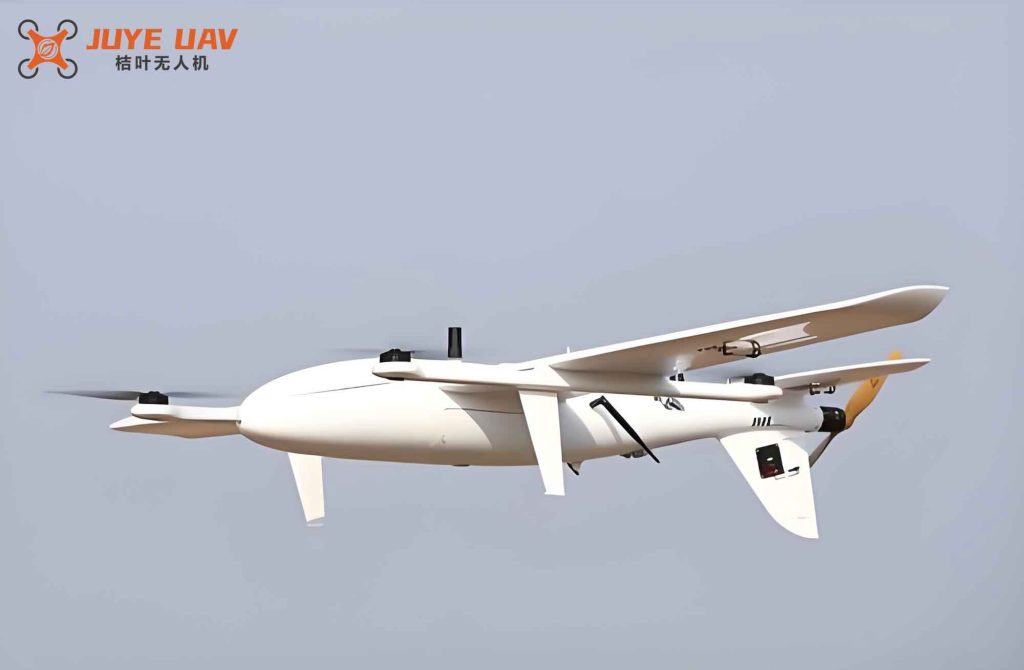
The fixed-wing drone we investigated adopts a conventional layout with a high aspect ratio wing using the Clark Y airfoil. The horizontal tail is mounted on top of the vertical tail to minimize interference from the wing wake. A ventral fin is added to improve lateral-directional stability. The tail surfaces are positioned far from the center of gravity to provide sufficient stability and control. The three-dimensional model of the fixed-wing drone is shown in the conceptual design. The main geometric parameters are summarized in Table 1. In this initial aerodynamic study, we excluded the landing gear and propulsion system to simplify the analysis.
| Parameter | Value |
|---|---|
| Overall length (m) | 7.500 |
| Overall height (m) | 0.750 |
| Wing area (m²) | 3.750 |
| Wingspan (m) | 9.900 |
| Aspect ratio | 25.670 |
| Mean aerodynamic chord (m) | 0.385 |
The fixed-wing drone features a large wing aspect ratio to maximize lift-to-drag ratio during cruise, which is critical for hydrogen-powered long-endurance missions. The Clark Y airfoil was chosen for its favorable low-speed characteristics. The wing-body junction design required careful attention to reduce interference drag.
Numerical Simulation Methodology
We built the geometry of the fixed-wing drone using CATIA and performed geometric cleanup with SCDM. The computational domain was meshed using Workbench Meshing with unstructured grids. To save computational resources, we utilized a half-model due to symmetry. The domain extended 35 m upstream (approximately 5 times the fuselage length) and 70 m downstream (about 10 times the fuselage length), with lateral and vertical extents of 35 m. We refined the grid near the fuselage, wing leading edges, and areas of interest. Boundary layer resolution was ensured with a first-layer height of 0.01 mm to achieve y+ ≤ 1, suitable for low-Reynolds number turbulence models. The total mesh count was approximately 4.2 million cells. Figure 2 illustrates the grid distribution around the fuselage.
We set the freestream conditions to simulate flight at 1 km altitude: static pressure 0.91×10⁵ Pa, static temperature 275 K, and Mach number 0.1 (corresponding to the cruising speed of ~100 km/h). The sideslip angle was 0°. We selected 11 angles of attack from -6° to 14°. The flow medium was ideal gas. The body surface was treated as a no-slip wall, the far-field boundary as pressure far-field, and the symmetry plane as a symmetry boundary. We employed two turbulence models: the Spalart-Allmaras (SA) model, widely used in external aerodynamics, and the SST k-ω model, known for its capability to predict large separated flows. The governing equations are given below.
The Spalart-Allmaras transport equation is:
$$ \rho \frac{D\tilde{\nu}}{Dt} = G_\nu + \frac{1}{\sigma_{\tilde{\nu}}} \left[ \frac{\partial}{\partial X_j} \left( (\mu + \rho \tilde{\nu}) \frac{\partial \tilde{\nu}}{\partial X_j} \right) \right] + C_{b2} \rho \left( \frac{\partial \tilde{\nu}}{\partial X_j} \right)^2 – Y_\nu $$
where $Y_\nu$ is the destruction term, $\sigma_{\tilde{\nu}}$ and $C_{b2}$ are constants, $\nu$ is molecular kinematic viscosity, and $G_\nu$ is the production term.
The SST k-ω model equations are:
$$ \frac{\partial}{\partial t} (\rho k) + \frac{\partial}{\partial x_i} (\rho k u_i) = \frac{\partial}{\partial x_j} \left( \Gamma_k \frac{\partial k}{\partial x_j} \right) + G_k – Y_k + S_k $$
$$ \frac{\partial}{\partial t} (\rho \omega) + \frac{\partial}{\partial x_i} (\rho \omega u_i) = \frac{\partial}{\partial x_j} \left( \Gamma_\omega \frac{\partial \omega}{\partial x_j} \right) + G_\omega – Y_\omega + S_\omega $$
Here $G_k$ is the production of turbulent kinetic energy due to mean velocity gradients, $G_\omega$ is the production of $\omega$, $\Gamma_k$ and $\Gamma_\omega$ denote effective diffusivities, $Y_k$ and $Y_\omega$ represent dissipation of $k$ and $\omega$, and $S_k$, $S_\omega$ are user-defined source terms.
Results and Discussion
Lift and Drag Characteristics
We computed the lift coefficient $C_L$, drag coefficient $C_d$, and lift-to-drag ratio $K$ for the fixed-wing drone at various angles of attack. Figure 3 shows the variation of $C_L$ and $C_d$ with $\alpha$, comparing the two turbulence models. For $\alpha < 4^\circ$, both models yield similar results, indicating good accuracy at small angles. However, at higher angles, the SST k-ω model predicts lower lift and higher drag than the SA model, consistent with its better capability to capture flow separation. Therefore, we discuss only SST k-ω results hereafter. At Mach 0.1, the fixed-wing drone stalls at $\alpha = 8^\circ$ with a maximum lift coefficient $C_{L,max} = 1.47$. The lift-to-drag ratio reaches a maximum of $K_{max} = 14.5$ at $\alpha = 4^\circ$ (Figure 4). These results demonstrate that the aerodynamic layout of this fixed-wing drone achieves high efficiency, meeting the preliminary design targets.
| Angle of Attack $\alpha$ (°) | $C_L$ | $C_d$ | $K = C_L / C_d$ |
|---|---|---|---|
| 0 | 0.35 | 0.025 | 14.0 |
| 4 | 0.72 | 0.050 | 14.5 |
| 8 | 1.47 | 0.190 | 7.7 |
| 12 | 1.30 | 0.270 | 4.8 |
Flow Field and Streamline Patterns
We examined the surface streamlines on the fixed-wing drone at $\alpha = 0^\circ$. The streamlines show deflection near the wing-body junction, forming a saddle point, which indicates flow separation and transition. This feature confirms that our simulation captured detailed flow physics. At higher angles of attack, the separation becomes more pronounced. Figure 6 and Figure 7 compare external streamlines at $\alpha = 0^\circ$ and $12^\circ$. At $12^\circ$, large-scale separation appears on the wing upper surface, especially near the root. Cross-sectional views at the mid-wing (Figure 8) show attached flow at $0^\circ$ and separated flow with a saddle point at $12^\circ$.
Mach Number and Pressure Distribution
The Mach number contour on the fuselage surface (Figure 9) at $\alpha = 0^\circ$ shows attached flow, while at $12^\circ$, early separation is evident, with spanwise wavy separation lines. The pressure coefficient contours on the upper and lower surfaces (Figures 10 and 11) illustrate the same trend. At low angles, the upper surface suction is smooth; at high angles, the pressure distribution indicates separation onset.
We further extracted pressure coefficient distributions at five spanwise stations (Figure 12). At $\alpha = 0^\circ$ and $2^\circ$, all curves are smooth, indicating attached flow. At $\alpha = 8^\circ$ and $10^\circ$, the upper surface pressure curves show kinks near the trailing edge, revealing separation. Interestingly, the tip station (station 5) maintains a smooth pressure curve even at high angles, due to the beneficial effect of the wingtip vortex, which delays separation locally. However, the tip vortex also increases induced drag.
Wake Vortex Structure
Figure 13 depicts the wake vortex pattern at $\alpha = 0^\circ$. Strong wingtip vortices are observed, along with vortices from the horizontal tail tips and the fuselage aft body. These vortices contribute to drag and should be mitigated in future design iterations. For instance, adding wingtip devices or streamlining the fuselage could reduce vortex drag and improve overall efficiency of this fixed-wing drone.
Conclusion
We conducted a comprehensive numerical evaluation of the aerodynamic layout for a hydrogen-powered fixed-wing drone. The main findings are:
- Both SA and SST k-ω turbulence models perform well at small angles of attack, but SST k-ω is superior for predicting large separation at high angles.
- The fixed-wing drone achieves a maximum lift coefficient of 1.47, a peak lift-to-drag ratio of 14.5 at $\alpha = 4^\circ$, and stalls at $\alpha = 8^\circ$, satisfying the design requirements.
- At high angles of attack, the wing upper surface experiences flow separation, transitioning from laminar to turbulent boundary layer, evidenced by sudden changes in Mach number and pressure distributions.
- Wing-body junction flow separation and vortex structures at wingtips and tail tips increase drag, indicating areas for further optimization.
These results provide a solid foundation for the subsequent refinement of this fixed-wing drone’s aerodynamic layout. Future work will focus on wingtip modifications, fuselage streamlining, and junction optimization, followed by wind tunnel testing.
In summary, our assessment confirms that the conceptual layout of this hydrogen-powered fixed-wing drone possesses satisfactory aerodynamic performance, and the detailed flow field data guide us towards a more efficient design. We believe that with continued optimization, this fixed-wing drone will excel in long-endurance missions, contributing to the advancement of green aviation.