
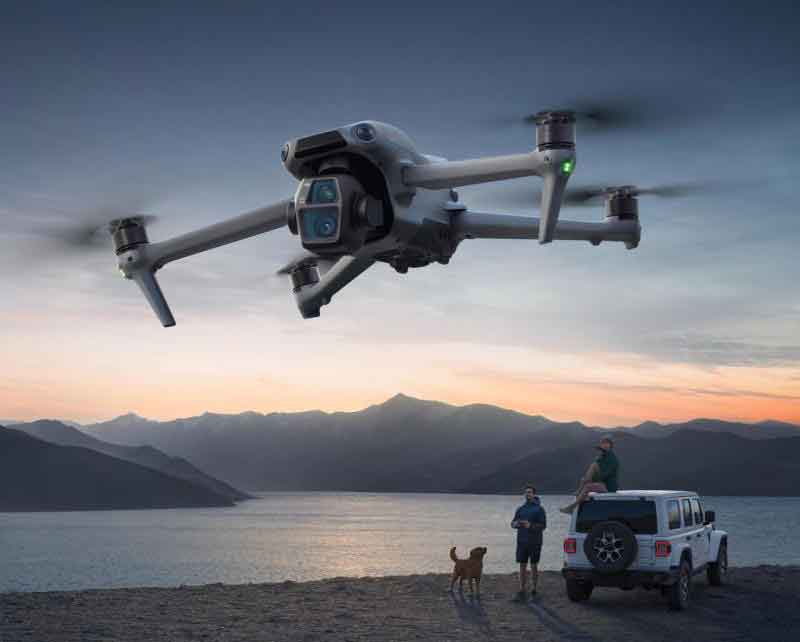
As a researcher deeply engaged in the field of drone technology, I have observed a significant paradigm shift in the operational landscape of unmanned aerial vehicles. The rapid expansion of the low-altitude economy, driven by applications ranging from urban logistics and aerial photography to infrastructure inspection and disaster response, has pushed drone technology into environments far more complex than the open skies for which they were originally designed. My work focuses on understanding the profound challenges posed by the low-altitude aerodynamic environment, which is characterized by complex flow fields, diverse interference sources, and significant coupling effects. This environment critically impacts the aerodynamic performance and flight safety of drones. In my review, I systematically explore three typical scenarios: complex wind fields, spatially constrained environments, and multi-drone environments.
1. The Low-Altitude Complex Wind Field and Its Aerodynamic Impact on Drone Technology
The low-altitude wind field, constrained by the Earth’s surface, presents formidable challenges to modern drone technology. I have found that this environment is defined by strong spatial and temporal heterogeneity, high shear, and intense non-stationary turbulence. The genesis of this complex flow lies within the Atmospheric Boundary Layer (ABL), which extends from the ground up to approximately 1.5 km. Within this layer, mechanical turbulence from friction with rough surfaces like buildings and vegetation combines with thermal turbulence from solar heating to create a highly dynamic environment. In urban settings, this interaction intensifies, leading to phenomena like the “urban canyon” effect and “street canyon” flows, which dramatically alter local wind patterns.
To understand and model these complex environments for the advancement of drone technology, we rely on several key methods. The modeling of the wind field itself requires high-fidelity approaches, as traditional weather models lack the necessary resolution. My analysis of the literature shows a clear progression from Reynolds-averaged Navier-Stokes (RANS) simulations, which are computationally efficient but fail to capture transient features like gusts, to more advanced techniques like Large Eddy Simulation (LES). LES offers superior accuracy in simulating the unsteady, three-dimensional nature of urban wind fields. More recent efforts focus on multi-scale coupling, linking macro-scale weather models with micro-scale CFD models to provide realistic boundary conditions for high-resolution simulations of specific urban areas.
The methods for studying how these wind fields affect drone technology can be broadly categorized into numerical simulation and experimental approaches.
1.1 Summary of Numerical and Experimental Methods for Complex Wind Fields
| Category | Method | Key Characteristics | Advantages / Disadvantages for Drone Technology |
|---|---|---|---|
| Numerical Simulation | RANS (Reynolds-averaged Navier-Stokes) | Solves time-averaged equations; uses turbulence models like k-ε. | Advantages: Low computational cost; suitable for large-scale engineering prediction. Disadvantages: Cannot capture instantaneous turbulent features; poor accuracy in separated flow regions. |
| LES (Large Eddy Simulation) | Directly computes large-scale eddies; models small-scale eddies. | Advantages: High accuracy for unsteady, separated flows and gust simulation; captures transient effects. Disadvantages: Very high computational cost; requires fine meshes. | |
| ML-CFD Hybrid (e.g., GAN, CNN, GNN) | Uses machine learning to replace or accelerate CFD solvers. | Advantages: Enables real-time or near-real-time flow field prediction; reduces computational cost dramatically. Disadvantages: Requires large training datasets; may struggle with generalization to new geometries or flow conditions. | |
| Experimental | Wind Tunnel (Active/Passive) | Simulates ABL using devices like spires, roughness elements, or active grids. | Advantages: Provides high-fidelity, real-world physics; indispensable for validation. Disadvantages: High cost; limited by wind tunnel size; passive methods lack flexibility in reproducing transient gust patterns. |
| Fan Array Wind Generator (FAWG or Wind Wall) | Uses a matrix of independently controlled fans to generate arbitrary, time-varying flow fields. | Advantages: Highly flexible; can reproduce complex, non-stationary wind fields including gusts and shear; good repeatability. Disadvantages: Requires sophisticated control systems; flow field characterization is complex. |
My synthesis of the research reveals that the impact of these complex wind fields on drone technology is profound. The unsteady loads from turbulence and gusts directly affect the propeller and rotor performance. For instance, studies have shown that rotor thrust can fluctuate significantly when a drone enters the wake region of a building. The entire drone’s flight dynamics and stability are compromised, particularly for smaller, lighter drones which are more susceptible to wind disturbances. This presents a critical challenge for the control systems of modern drone technology.
2. Spatially Constrained Environments and Their Aerodynamic Impact on Drone Technology
In my review of the challenges facing modern drone technology, I find that the spatial constraints of the low-altitude environment represent a critical area of concern. Drones are increasingly required to operate in close proximity to walls, ceilings, and the ground—a necessity for tasks like bridge inspection, building maintenance, and indoor navigation. The aerodynamic interference from these surfaces, analogous to the well-known ground effect for helicopters, drastically alters the performance of propellers and the stability of the drone.
The classification of these wall effects is a key focus of my work. I categorize them into three primary types: ground effect, ceiling effect, and sidewall effect. When a drone flies close to the ground, its downwash is compressed, leading to increased thrust and reduced power consumption. However, this effect becomes highly non-uniform near obstacles, causing instability. Conversely, when flying near a ceiling, the downwash is blocked, leading to thrust instability and a dangerous “suction” effect that can pull the drone into the ceiling. The sidewall effect creates an asymmetric thrust distribution, inducing roll and yaw disturbances that complicate control. The complexity escalates with “complex wall effects,” which include inclined surfaces, finite-size walls, and multi-wall coupling, such as flying into a corner.
2.1 Summary of Wall Effect Research and Models
| Type of Wall Effect | Primary Impact on Drone Technology | Key Modeling Approach / Result |
|---|---|---|
| Ground Effect | Increased thrust, reduced power consumption; potential for instability from non-uniform flow. | Cheeseman and Bennett model for lift change: $\frac{T}{T_\infty} = 1 – \frac{\sigma R^2}{16 z^2}$, where $T$ is thrust in ground effect, $T_\infty$ is out-of-ground-effect thrust, $R$ is rotor radius, $z$ is height, and $\sigma$ is a factor. More advanced models incorporate non-uniform inflow and fountain flows. |
| Ceiling Effect | Increased thrust (suction); significant power reduction; high instability and control delay. | Extended Cheeseman-type models: $\frac{T}{T_\infty} = 1 + \frac{\sigma R^2}{16 z^2}$ (adapted for ceiling). Numerical simulations show severe thrust fluctuations at very small distances ($z < 0.4R$). Kocer et al. used a force-estimation-based nonlinear MPC for active control. |
| Sidewall Effect | Asymmetric thrust distribution; induces roll and yaw moments; modest lift loss. | Momentum theory-based models estimate side force. Ding et al. developed a model to estimate distance to wall from thrust measurements, enabling reactive navigation. Asymmetry increases with proximity: Lift reduction can be approximated as a function of the lateral distance to the wall. |
| Complex Wall Effect (Inclined / Corner) | Non-linear coupling of forces; flow recirculation; significant performance degradation. | Numerical (CFD) and experimental studies show corner effects create a “fountain flow” that further reduces thrust. For inclined ceilings, studies find that the effect can be stronger at certain angles. Models require angle-dependent corrections to classical formulas. |
My research synthesis shows that while significant progress has been made in modeling single, ideal wall effects, the more realistic multi-wall and complex geometry scenarios remain poorly understood. The coupling of ground and sidewall effects, for instance, creates a highly non-linear flow field that cannot be predicted by simply summing individual effects. These gaps represent a critical frontier for drone technology, particularly for autonomous navigation in cluttered urban environments. The development of robust, real-time capable aerodynamic models is essential for flight control systems to ensure safe operation in these confined spaces.
Furthermore, some drone technology applications seek to exploit these effects. Perching drones use the ceiling effect for energy-efficient long-duration hovering, and wall-climbing robots use propeller thrust to adhere to vertical surfaces. This dual nature—where an effect can be a hazard or an advantage—highlights the need for a deep, mechanistic understanding of these phenomena.
3. Multi-Drone Environment and Inter-Drone Aerodynamic Interference
The final key area of my review addresses the challenges inherent in multi-drone operations. As drone technology matures, the vision of dense, coordinated swarms of drones performing complex tasks like search-and-rescue or last-mile delivery is becoming a reality. However, this vision is heavily dependent on solving the problem of inter-drone aerodynamic interference. When multiple drones fly in close proximity, the wake, downwash, and tip vortices of one drone directly influence the aerodynamic performance and flight stability of its neighbors. This creates a complex, unsteady, and non-linear coupled flow field.
I categorize these scenarios into two main types: cooperative formation flight and non-formation multi-drone flight. In cooperative formation flight, such as a V-formation, the trailing drone can benefit from the upwash generated by the leading drone’s wingtip vortices, leading to improved lift-to-drag ratio. However, this benefit is highly sensitive to the relative position. A slight deviation can place the trailing drone in the highly turbulent core of the wake, leading to severe control issues. For multi-rotor drones, the interaction of downwashes is the dominant factor. The downstream or lower rotors experience a significant reduction in thrust and efficiency as they ingest the turbulent, low-momentum wake from upstream rotors. This leads to a drop in total thrust and introduces complex pitching and rolling moments that must be counteracted by the flight controller.
3.1 Aerodynamic Interference in Multi-Drone Scenarios
| Scenario | Primary Interference Mechanism | Key Parameters and Effects for Drone Technology |
|---|---|---|
| Cooperative Formation Flight (Fixed-wing) | Interaction with upstream wingtip vortices (upwash/downwash). | Parameters: Lateral and longitudinal spacing, angle of attack. Effects: Potential for significant drag reduction (up to 30%) in optimal upwash region; risk of large roll moments and control loss if entering wake core. |
| Cooperative Formation Flight (Multi-rotor) | Ingestion of upstream rotor downwash and wake. | Parameters: Vertical and horizontal separation, advance ratio (forward speed). Effects: Significant thrust reduction on downstream rotors; increased power consumption for constant thrust; introduction of pitch and roll moments. The effect is strongest at low forward speeds. |
| Non-Formation / Heterogeneous Flight (e.g., Mother-Daughter) | Interaction of a small drone’s rotors with the complex wake and induced flow of a larger drone’s rotors and body. | Parameters: Relative position (distance, azimuth), thrust levels of both drones. Effects: Highly localized and variable interference. The small daughter drone can experience sudden, large changes in thrust and severe control upsets. Research has defined safe flight corridors based on the interference pattern, showing that the interference is highly dependent on the relative position within the mother drone’s wake. |
My review highlights that non-formation flight, such as the mother-daughter drone system, presents an even more challenging problem. In this scenario, a small daughter drone is attempting to dock with or launch from a much larger mother drone. It must fly through the mother drone’s complex, highly turbulent rotor wake. The interference is not simply a reduction in thrust but a highly variable and asymmetric disturbance that depends critically on the daughter drone’s instantaneous position within the mother’s flow field. Modeling this interference is crucial for developing safe and robust control algorithms for these complex heterogeneous drone systems. Advanced techniques, such as the two-dimensional quasi-steady momentum source method, are being explored to capture these interactions with good accuracy at a manageable computational cost, a key enabler for future drone technology applications.
4. Core Issues, Challenges, and Future Outlook
From my comprehensive review of the literature, I have identified several core issues and key challenges that the field of low-altitude drone aerodynamics must address to enable the next generation of drone technology. First, there is a critical need for accurate, efficient, and real-time capable aerodynamic models that can account for the strong non-linear coupling between wind fields, wall effects, and inter-drone interference. The current state-of-the-art often relies on high-fidelity simulations like LES or full CFD, which are far too slow for onboard, real-time control. The development of reduced-order models, potentially leveraging physics-informed machine learning, is a paramount challenge for drone technology.
Second, there is a significant gap in our understanding of multi-scale and multi-physics coupling. The effect of a gust of wind on a drone flying next to a building in the presence of another drone is not just the sum of individual effects. We need a fundamental understanding of how these phenomena interact and compound. This requires a concerted effort combining high-resolution field measurements, sophisticated wind tunnel experiments that can replicate these complex scenarios, and advanced numerical simulation.
Finally, for applied drone technology, the ultimate challenge is integration and validation. The aerodynamic models we develop must be robust enough to handle real-world variability and be seamlessly integrated into flight control systems. There is a pressing need for more flight testing in complex, realistic low-altitude environments to validate these models and control strategies. The long-term vision for drone technology—a world of safe, efficient, and autonomous low-altitude operations—depends on our ability to master these complex aerodynamic challenges. Future research must focus on creating a holistic, system-level understanding of the low-altitude aerodynamic environment, enabling drones not just to survive, but to thrive and exploit these conditions for enhanced performance and safety.
The research trajectory I see emphasizes the fusion of physics-based modeling with data-driven methods. The application of machine learning, from deep neural networks for wind field prediction to reinforcement learning for control in interference-heavy environments, offers a powerful pathway to address the high-dimensional, non-linear complexities of low-altitude flight. Moving forward, the development of an integrated aerodynamic framework for drone technology that accounts for the wind, the walls, and the swarm will be the foundational scientific pillar upon which the future of the low-altitude economy is built.