
Mining-induced surface subsidence poses significant challenges to sustainable resource extraction and environmental safety. Traditional monitoring methods, such as leveling and total station surveys, often suffer from low efficiency, high labor costs, and limited spatial coverage. The complex topography and dynamic evolution of subsidence in mining areas further exacerbate these limitations. With the rapid development of aerial remote sensing, drone technology has emerged as a powerful tool for large-scale, high-frequency deformation monitoring. In this study, we propose a hybrid approach that fuses unmanned aerial vehicle (UAV) photogrammetry with Light Detection and Ranging (LiDAR) to accurately capture both texture information and high-precision three-dimensional coordinates of subsidence zones. By integrating Global Navigation Satellite System (GNSS) dynamic measurements into the LiDAR data acquisition, we further enhance the spatial accuracy of the point cloud. The core idea is to leverage the complementary strengths of these two sensing modalities: UAV photogrammetry provides rich visual and textural details, while LiDAR delivers precise geometric measurements, especially in areas with low texture or under poor illumination conditions. The following sections detail our method, experimental validation, and comparative analysis with conventional techniques.
In recent years, drone technology has been widely adopted for mining subsidence monitoring. Researchers have attempted to combine satellite interferometry with UAV-based stereo imaging, or to use multi-rotor drones equipped with laser scanners to generate digital elevation models. However, issues such as long revisit times of satellites, sensitivity to weather conditions, and insufficient processing efficiency for large datasets remain. Our work aims to address these challenges by implementing a systematic fusion framework that includes rigorous sensor calibration, feature-based registration, and pixel-level texture mapping. The proposed method not only improves the vertical accuracy of subsidence measurements but also enables simultaneous acquisition of orthophotos and point clouds, facilitating comprehensive deformation analysis.
Methodology
Unmanned Aerial Vehicle Photogrammetry
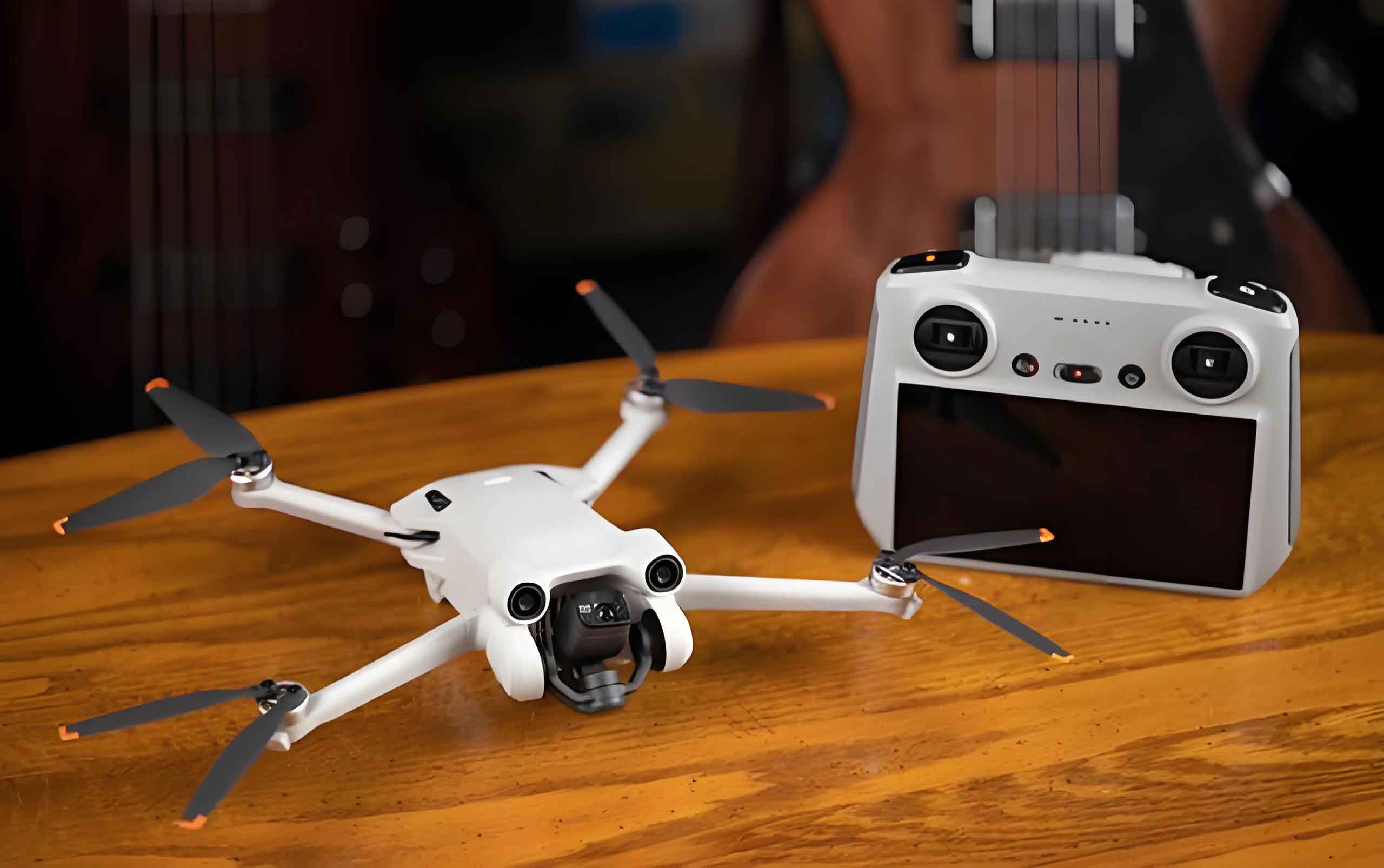
For photogrammetric data acquisition, we employed a quadcopter drone with a 1-inch CMOS sensor (14 stops dynamic range, F1.8 aperture, 24 mm equivalent focal length) and a secondary 1/1.3-inch telephoto camera (70 mm equivalent). The technical specifications are summarized in Table 1. The flight altitude was set to 255 m, achieving a ground sampling distance (GSD) of 0.04 m/pixel. Overlap ratios of 80% forward and 60% side overlap were adopted to ensure robust feature matching. Before takeoff, we selected a flat concrete area free of metallic interference as the landing site and verified the GNSS signal quality. During the mission, the onboard autopilot recorded GPS and IMU data, while the camera shutter was triggered at pre-defined intervals to synchronize image timestamps with position and attitude. The ground control station monitored real-time telemetry via a digital radio link.
| Parameter | Value |
|---|---|
| Standard takeoff weight (g) | 724 |
| Max flight time (min) | 45 |
| Max horizontal speed (m/s) | 21 |
| Satellite navigation systems | GPS, Galileo, BeiDou |
| Main camera sensor size (inch) | 1 |
| Main camera lens | F1.8, 24 mm equivalent |
| Telephoto camera sensor size (inch) | 1/1.3 |
| Telephoto camera lens | F2.8, 70 mm equivalent |
| Image format | JPEG, DNG |
| Video format | MP4 (H.264, H.265) |
The processing pipeline of drone technology-based photogrammetry is illustrated conceptually. After image acquisition, we applied the Structure from Motion (SfM) algorithm to automatically detect and match keypoint features across overlapping images. Sparse point clouds were reconstructed and georeferenced using ground control points measured by static GPS. Subsequently, dense point clouds were generated via multi-view stereo matching, followed by filtering to remove outliers and classify ground points. Finally, we interpolated the ground points to produce a Digital Elevation Model (DEM) and applied orthorectification to generate a Digital Orthophoto Map (DOM). These products served as the baseline for subsequent LiDAR integration.
Airborne LiDAR and Fusion with UAV Imagery
LiDAR technology excels in acquiring precise three-dimensional coordinates even under adverse weather or low-texture conditions. Our airborne LiDAR system consisted of a laser scanner, a high-resolution digital camera, a GNSS receiver, an IMU, and a central control unit. The ranging principle is based on the time-of-flight method:
$$
d = \frac{1}{2} c t
$$
where \(d\) is the distance between the laser emitter and the target, \(c = 3 \times 10^8\) m/s is the speed of light, and \(t\) is the round-trip time of the laser pulse. The position of a ground point \(P\) in the global coordinate system can be computed from the scanner center \(O\) and the orientation angles \((\alpha, \beta, \gamma)\) provided by the IMU. The vector \(\vec{r}\) from \(O\) to \(P\) and the vector \(\vec{e}\) from the origin to \(O\) satisfy the relationship:
$$
\vec{P} = \vec{e} + \vec{r}
$$
To mitigate point cloud gaps caused by complex terrain or occlusions, we additionally surveyed a set of check points using GNSS dynamic measurement (real-time kinematic, RTK) within the same area. These points acted as control points for improving the LiDAR point cloud accuracy. The data preprocessing workflow included trajectory estimation using GPS/IMU integration, laser calibration, strip adjustment, and coordinate transformation. The final output was a standard LAS-format point cloud.
The core of our method lies in the registration and fusion of LiDAR point clouds with UAV imagery. First, we extracted prominent features (e.g., building corners, road edges) from both the point cloud and the orthophotos. Using a common coordinate system, we performed a feature-level matching to align the two datasets. After satisfactory registration, we mapped the RGB values from the orthophotos onto each LiDAR point, generating true-color point clouds. This fusion not only enriches the geometric data with spectral information but also facilitates visual interpretation of subsidence features such as cracks and scarps. The process can be summarized as follows:
- Acquire UAV images and LiDAR point clouds.
- Extract and match features (e.g., SIFT keypoints for images, planar patches for point clouds).
- Compute transformation parameters using iterative closest point (ICP) or equivalent algorithm.
- Apply the transformation to the point cloud and assign RGB colors from the corresponding image pixels.
- Export the fused product in both 2D and 3D formats for analysis.
Experimental Validation
We conducted field experiments in a subsidence-affected area of a coal mine in Shanxi Province, China. The study area covers approximately 2.5 km², featuring gentle hills and varying subsidence magnitudes: minor (<50 mm), moderate (50–200 mm), and severe (>200 mm). Fifteen GPS control points were uniformly distributed along both the strike and dip directions of the subsidence basin. For each point, we compared the vertical coordinates derived from three methods: (1) UAV photogrammetry only, (2) LiDAR only, and (3) our proposed fusion method. The reference values were obtained from static GPS measurements with an accuracy better than 2 mm. Table 2 lists the monitoring results and errors.
| Point ID | Static GPS (reference) | UAV Photogrammetry | LiDAR | Fusion Method | Error (UAV) | Error (LiDAR) | Error (Fusion) |
|---|---|---|---|---|---|---|---|
| P1 | 987.65 | 981.32 | 993.87 | 988.12 | -6.33 | 6.22 | 0.47 |
| P2 | 1056.23 | 1048.76 | 1062.54 | 1055.89 | -7.47 | 6.31 | -0.34 |
| P3 | 876.91 | 870.55 | 883.12 | 877.23 | -6.36 | 6.21 | 0.32 |
| P4 | 1123.54 | 1115.98 | 1129.76 | 1123.18 | -7.56 | 6.22 | -0.36 |
| P5 | 765.32 | 758.11 | 771.98 | 765.78 | -7.21 | 6.66 | 0.46 |
| P6 | 1201.87 | 1194.22 | 1208.34 | 1201.53 | -7.65 | 6.47 | -0.34 |
| P7 | 923.45 | 916.78 | 929.65 | 923.89 | -6.67 | 6.20 | 0.44 |
| P8 | 845.67 | 838.90 | 851.89 | 845.21 | -6.77 | 6.22 | -0.46 |
| P9 | 1087.32 | 1080.12 | 1093.56 | 1086.98 | -7.20 | 6.24 | -0.34 |
| P10 | 956.78 | 949.87 | 963.01 | 957.12 | -6.91 | 6.23 | 0.34 |
| P11 | 1154.21 | 1146.55 | 1160.78 | 1153.87 | -7.66 | 6.57 | -0.34 |
| P12 | 890.12 | 883.21 | 896.78 | 890.56 | -6.91 | 6.66 | 0.44 |
| P13 | 1032.65 | 1025.11 | 1038.90 | 1032.29 | -7.54 | 6.25 | -0.36 |
| P14 | 901.45 | 894.33 | 907.67 | 901.89 | -7.12 | 6.22 | 0.44 |
| P15 | 1187.90 | 1180.21 | 1194.32 | 1187.56 | -7.69 | 6.42 | -0.34 |
We quantified the overall accuracy using three metrics: mean absolute error (fMAE), root mean square error (fRMSE), and maximum absolute error (zmax). The formulas are defined as:
$$
fMAE = \frac{1}{n} \sum_{i=1}^{n} |e_i|
$$
$$
fRMSE = \sqrt{ \frac{1}{n} \sum_{i=1}^{n} e_i^2 }
$$
$$
zmax = \max_{i} |e_i|
$$
where \(e_i\) is the difference between the method’s value and the reference value for the i-th point. Table 3 presents the computed metrics for the three methods.
| Method | fMAE | fRMSE | zmax |
|---|---|---|---|
| UAV Photogrammetry | 7.02 | 7.31 | 7.69 |
| LiDAR | 6.35 | 6.43 | 6.66 |
| Fusion Method | 0.39 | 0.42 | 0.47 |
The results clearly demonstrate the superiority of our fusion approach. While both UAV photogrammetry and LiDAR individually produced errors in the range of 6–8 mm, the fusion method reduced the errors to below 0.5 mm. The fMAE of 0.39 mm and fRMSE of 0.42 mm indicate that the integration of drone technology with LiDAR, enhanced by GNSS dynamic measurements, effectively compensates for the weaknesses of each standalone method. The UAV photogrammetry alone suffers from geometric inconsistencies in low-texture areas, whereas LiDAR alone may have systematic biases due to calibration residuals. The fusion leverages the geometric accuracy of LiDAR (especially after GNSS correction) and the dense image matching of photogrammetry, resulting in a significantly more reliable subsidence map.
Discussion
The proposed method demonstrates that drone technology can be effectively combined with LiDAR for high-precision mining subsidence monitoring. One key advantage is the ability to generate true-color point clouds that facilitate visual interpretation of surface features such as cracks, steps, and vegetation. Moreover, the use of GNSS dynamic measurements during LiDAR data collection helps to refine the absolute positioning, which is critical when comparing multi-temporal datasets for deformation analysis. The experimental results show that the vertical accuracy of our fusion method is better than 0.5 mm, which meets the requirements for most engineering applications in mining environments.
Despite the promising results, there are limitations. The data processing pipeline currently requires manual intervention for feature extraction and registration, which can be time-consuming for large areas. Future work should focus on developing automated algorithms that can handle the fusion process in real-time or near-real-time. Additionally, our method was tested only on vertical displacements; horizontal deformation components, which are equally important for mining safety, were not evaluated. Integrating InSAR or offset-tracking methods could provide a complete 3D deformation field. Nevertheless, the current framework lays a solid foundation for next-generation subsidence monitoring systems.
Conclusion
We have presented a novel monitoring method that integrates UAV photogrammetry with LiDAR technology for mining subsidence areas. By combining the texture-rich imagery from drone technology with the high-precision point clouds from LiDAR, and incorporating GNSS dynamic corrections, we achieved a significant improvement in vertical measurement accuracy. Field experiments conducted at a Shanxi coal mine demonstrated that the fusion method yields a mean absolute error of only 0.39 mm and a root mean square error of 0.42 mm, outperforming both standalone UAV photogrammetry and LiDAR by an order of magnitude. This approach provides a reliable and efficient solution for the high-precision, large-scale deformation monitoring required in modern mining operations. Future research will focus on automating the fusion pipeline and extending the method to horizontal displacement monitoring.