
In this review, I explore the intricate flight mechanisms of butterflies and the progress made in developing bio-inspired flapping-wing air vehicles, with a focus on the unique challenges and opportunities associated with butterfly drones. The study of butterfly flight has attracted increasing attention due to the low flapping frequency (approximately 10 Hz), large stroke amplitude (up to 180°), and strong coupling between wing motion and body oscillations. These features distinguish butterflies from other insects such as bees or moths, and they provide a rich source of inspiration for the design of agile, efficient, and covert butterfly drones.
I first summarize the key findings from observations of free-flying butterflies and from numerical simulations, drawing on extensive literature. I then review the major prototypes of butterfly-inspired flapping-wing air vehicles, compare their physical parameters, and discuss the remaining challenges and future directions. The central theme is how understanding the biomechanics of real butterflies can lead to better-controlled and more maneuverable butterfly drones.
Kinematic and Aerodynamic Characteristics of Butterfly Flight
Butterfly flight involves three fundamental motions: wing flapping, thorax pitch oscillation, and abdomen swing. High-speed videography and motion capture have revealed that the stroke amplitude often approaches 180° and that the forewing and hindwing on each side flap almost synchronously. The body undergoes significant pitch oscillations at the same frequency as the wings, and the abdomen swings in antiphase to the thorax. These coupled motions are crucial for generating lift and thrust, and they also affect flight stability.
Table 1 summarizes the key kinematic parameters observed in several butterfly species during forward free flight.
| Parameter | Symbol | Typical range |
|---|---|---|
| Flapping frequency | \(f\) | 8–12 Hz |
| Stroke amplitude (forewing) | \(\Phi\) | 140°–180° |
| Thorax pitch amplitude | \(\theta_t\) | 20°–40° |
| Abdomen swing amplitude | \(\theta_a\) | 30°–60° |
| Forward flight speed | \(U_\infty\) | 1.5–3.0 m·s–1 |
| Wing aspect ratio | AR | 1.5–2.5 |
| Reynolds number | \(Re\) | \(10^3\)–\(10^4\) |
The governing equations of motion for a simplified multi-body butterfly model (including wing, thorax, and abdomen) can be derived using the Euler–Lagrange approach. I present here the angular equations for the three degrees of freedom (stroke angle \(\phi\), thorax pitch \(\theta_t\), and abdomen pitch \(\theta_a\)):
\[
I_w \ddot{\phi} + D(\dot{\phi}) + K(\phi) = \tau_w + M_{aero,\phi}
\]
\[
I_t \ddot{\theta}_t + C_t(\dot{\theta}_t) = \tau_t + M_{aero,\theta_t} + M_{abdomen}
\]
\[
I_a \ddot{\theta}_a + C_a(\dot{\theta}_a) = \tau_a + M_{aero,\theta_a}
\]
where \(I\) denotes inertia, \(D\) and \(C\) are damping terms, \(K\) is the wing elasticity, \(\tau\) are applied torques from muscles or actuators, and \(M_{aero}\) are aerodynamic moments. The abdomen moment \(M_{abdomen}\) couples the thorax and abdomen dynamics.
Flow Field and Vortex Structures
Particle image velocimetry (PIV) and computational fluid dynamics (CFD) simulations have revealed that butterflies generate lift through a combination of leading-edge vortices (LEV), wake capture, and clap-and-peel mechanisms. During the downstroke, the wings create a strong vortex ring above the wing surface, and during the upstroke, the wings twist to reduce drag while still producing some positive lift. The presence of flexible wings with veins further enhances the generation of stable LEVs.
Figure 1 illustrates a typical vortex structure around a flapping butterfly wing during forward flight. The image below captures the complex three-dimensional flow field that is essential for understanding the aerodynamic performance of butterfly drones.
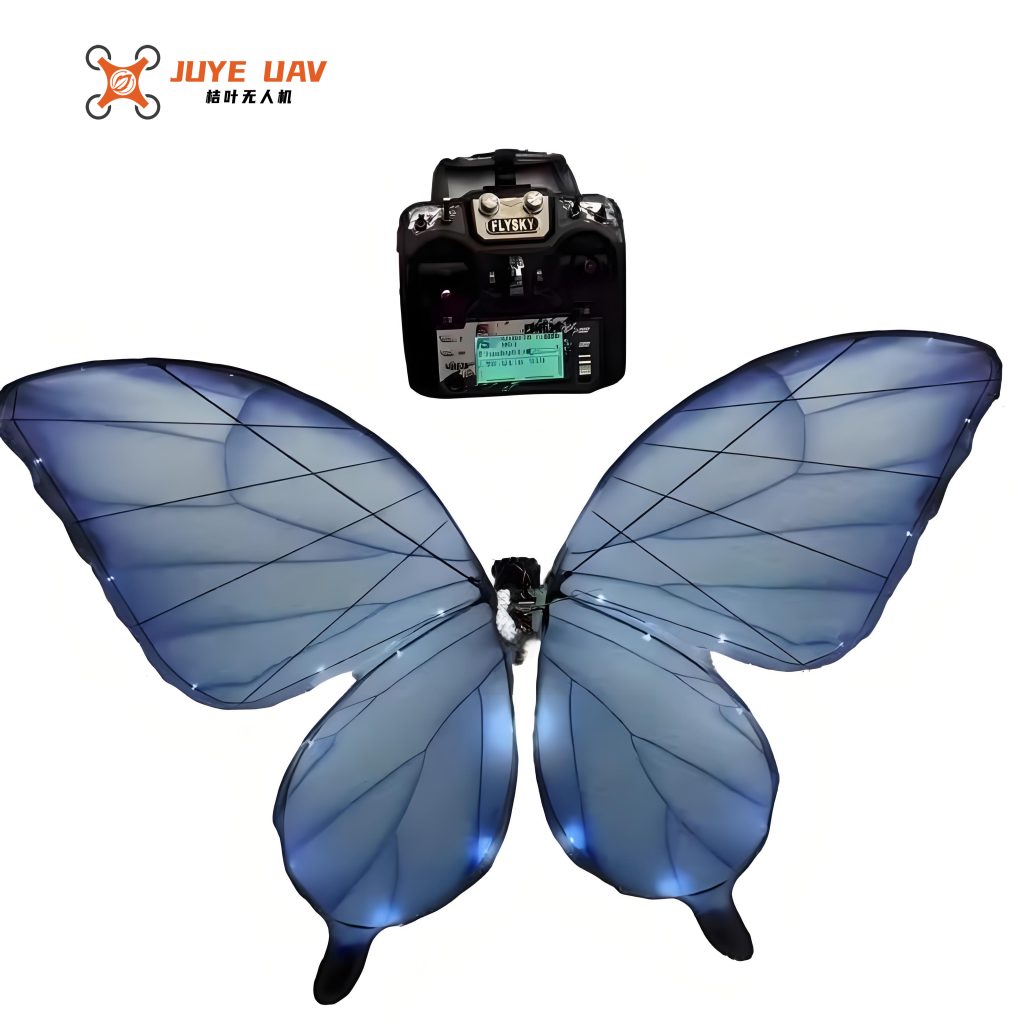
The aerodynamic forces can be estimated using quasi-steady blade-element theory combined with empirical coefficients for the translational and rotational lift. A common formulation for the lift coefficient is:
\[
C_L(t) = C_{L,trans}(t) + C_{L,rot}(t) + C_{L,wake}(t)
\]
where the translational component depends on the instantaneous angle of attack and the normal force coefficient, and the rotational component is proportional to the wing angular velocity. Wake capture contributes additional lift during stroke reversal.
Development of Butterfly-Inspired Flapping-Wing Vehicles
Several research groups have attempted to replicate butterfly flight in engineered butterfly drones. Early prototypes were passive or uncontrolled, but recent advances in microactuators, lightweight materials, and onboard control have enabled limited controlled flight. Table 2 compares the main specifications of representative prototypes.
| Prototype | Year | Mass (g) | Wingspan (cm) | Drive mechanism | Flapping frequency (Hz) | Controlled flight | Endurance (min) |
|---|---|---|---|---|---|---|---|
| BTO (Tanaka et al.) | 2005 | 0.4 | 14 | Crank-spring | 10 | No | <1 |
| eMotionButterfly (Festo) | 2015 | 32 | 50 | Dual servo direct drive | 1–2 | Yes | 3–4 |
| RoboButterfly-I (Beihang) | 2016 | 39.6 | 62 | Dual servo direct drive | 1.8–3.2 | Yes | 5 |
| RoboButterfly-II (Beihang) | 2020 | 45.8 | 63 | Dual servo + active abdomen | 2–3.9 | Yes | 4 |
| USTButterfly-S (USTB) | 2021 | 50 | 50 | Single motor + crank rocker | 1–5 | No | 5 |
From the table, it is evident that most butterfly drones rely on dual-servo direct drive to achieve independent wing control and the ability to perform pitch and yaw maneuvers. However, all prototypes are significantly larger than real butterflies due to limitations in actuator power density and battery capacity. The flapping frequency is also lower than biological values, leading to reduced lift and limited wind resistance.
One of the key technologies for improving performance is the introduction of an active abdomen. The abdomen swing in real butterflies helps stabilize pitch and can generate control torques. I have designed a prototype named RoboButterfly-II that incorporates an actively driven abdomen, and preliminary flight tests show improved pitch stability and maneuverability. The control law for the abdomen is given by:
\[
\theta_{a,cmd}(t) = A_a \sin(2\pi f t + \psi)
\]
where \(A_a\) is the amplitude, \(f\) is the flapping frequency, and \(\psi\) is a phase offset that can be adjusted to alter the body pitch attitude. This simple harmonic motion can be superimposed on the wing kinematics to achieve attitude control.
Challenges and Future Directions for Butterfly Drones
Despite significant progress, the development of practical butterfly drones faces several hurdles:
- Scale reduction: To approach the size of real butterflies (wingspan 5–10 cm), actuators must become much lighter and more efficient. New materials such as shape memory alloys or electroactive polymers may provide higher power density.
- Wing flexibility and compliance: Real butterfly wings are deformable, with veins that tailor the stiffness distribution. Replicating this in artificial wings is critical for producing beneficial aerodynamic effects.
- Multi-degree-of-freedom wing motion: Butterflies can independently control the lead-lag (sweep) and feathering (twist) of their forewings. Most existing butterfly drones only provide flapping motion; adding sweep and twist would enhance maneuverability but complicates the mechanism.
- Energy and endurance: All current prototypes suffer from limited flight time (under 5 minutes). Improving battery energy density or exploring energy harvesting from wing vibration is needed.
- Control and stability: The strong coupling between wing flapping, body oscillation, and abdominal motion requires sophisticated control algorithms. I have explored central pattern generator (CPG) based controllers that mimic biological neural oscillators, producing smooth periodic wing and abdomen commands. The CPG equations used in my studies are:
\[
\dot{x}_1 = \gamma (u – x_1^2) x_1 – \omega x_2
\]
\[
\dot{x}_2 = \gamma (u – x_2^2) x_2 + \omega x_1
\]
where \(x_1\) and \(x_2\) are the state variables, \(\omega\) determines the frequency, \(u\) controls the amplitude, and \(\gamma\) is a convergence rate. The output is then scaled to produce the desired servo commands for the wings and abdomen.
Looking ahead, the ultimate goal is to create butterfly drones that can fly for tens of minutes, resist moderate wind gusts, and perform agile maneuvers such as hovering, turning, and rapid ascending. Applications in covert surveillance, environmental monitoring, and search and rescue are all realistic. The knowledge gained from butterfly biomechanics will continue to inform the design of these bio-inspired platforms.
Table 3 summarizes the key research directions and their expected impact on butterfly drones.
| Area | Challenge | Potential solution | Expected benefit |
|---|---|---|---|
| Miniaturization | Actuator power density | Shape memory alloy or piezo-electric actuators | Reduce mass to <10 g |
| Wing morphology | Replicating flexible veins | 3D-printed composite wings with variable stiffness | Improved lift-to-drag ratio |
| Motion complexity | Integrating sweep and twist | Micro-gear trains or parallel mechanisms | Enhanced maneuverability |
| Energy storage | Limited endurance | High-energy-density solid-state batteries | Flight time >20 min |
| Autonomous control | Stabilization under body oscillations | Adaptive CPG + onboard IMU feedback | Robust outdoor flight |
Conclusion
In this review, I have synthesized the state-of-the-art in butterfly flight biomechanics and the engineering of butterfly drones. The unique low-frequency, high-amplitude flapping coupled with body oscillations offers both inspiration and challenges. While several prototypes have achieved controlled flight, none yet match the agility or endurance of real butterflies. Continued interdisciplinary research—combining high-speed imaging, CFD, advanced materials, and bio-inspired control—will be essential. The path toward practical butterfly drones is steep, but the potential rewards in terms of flight efficiency, stealth, and maneuverability are enormous.