
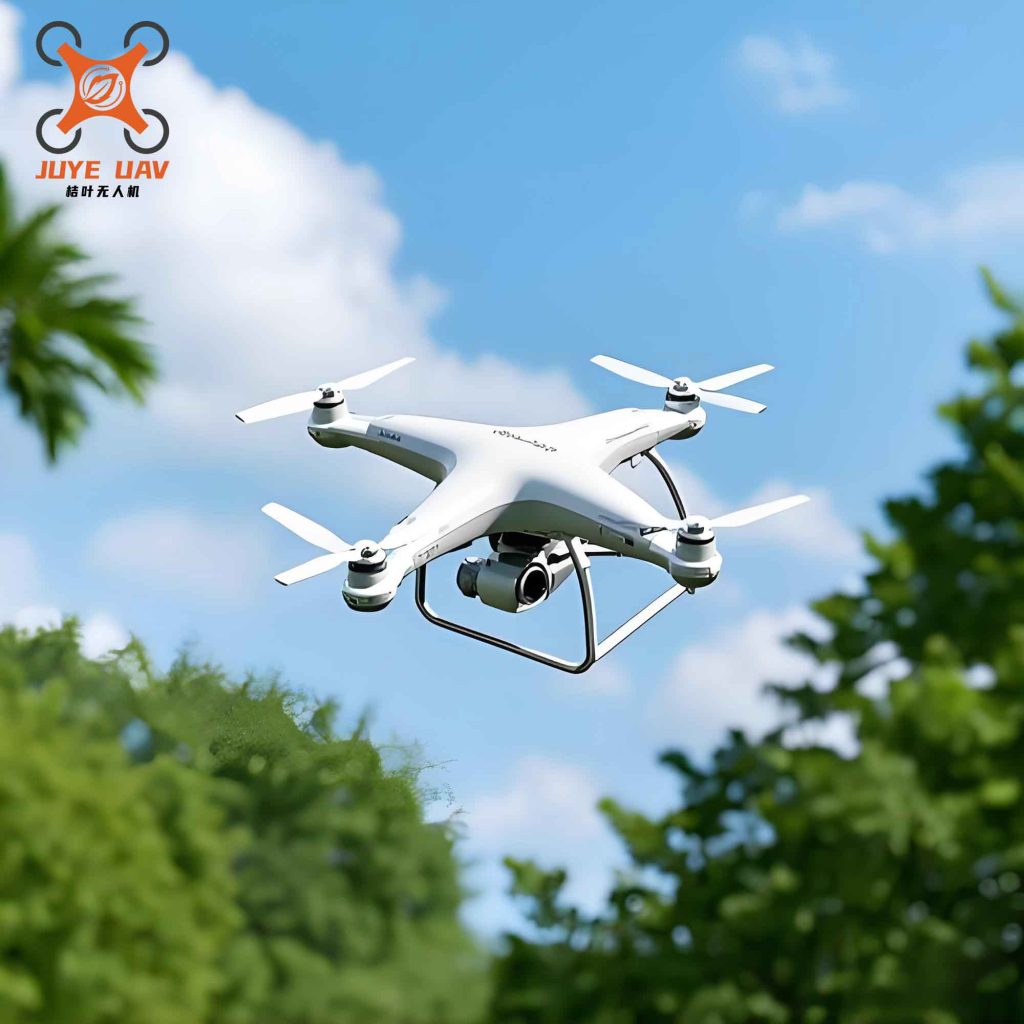
As the technology of unmanned aerial vehicles (UAVs) continues to mature, vehicle detection in aerial imagery captured by China UAV platforms has become a critical research frontier in intelligent transportation monitoring, autonomous driving, and public safety. The unique advantages of China UAVs—such as high flexibility, low cost, and wide-area coverage—enable efficient data acquisition for traffic flow analysis, emergency response, and smart city management. In recent years, deep learning-based methods have revolutionized this field, shifting from handcrafted feature extractors to end-to-end trainable neural networks that automatically learn hierarchical representations. Despite significant progress, challenges persist: small object detection in high-altitude images, severe occlusion in dense traffic, complex background interference due to variable illumination and weather, and the need for lightweight models deployable on resource-constrained UAV platforms. This article provides a comprehensive overview of the state-of-the-art deep learning methods for vehicle detection in China UAV aerial images, highlighting key technological breakthroughs, benchmarking datasets, evaluation metrics, and future research directions.
The evolution of vehicle detection in China UAV aerial images can be divided into three distinct phases. The early stage relied on traditional image processing techniques such as Histogram of Oriented Gradients (HOG) and Scale-Invariant Feature Transform (SIFT), combined with sliding windows and classifiers like Support Vector Machines (SVM). These methods achieved acceptable results in static, simple scenes (e.g., parking lot counting) but suffered from poor generalization under varying viewpoints, illumination, and small target scales. The second phase began with the adoption of convolutional neural networks (CNNs), notably Faster R-CNN, YOLO, and SSD. These deep learning models introduced automatic feature extraction and end-to-end prediction, significantly improving detection accuracy. However, the two-stage detectors (e.g., Faster R-CNN) offered high precision at the cost of speed, while single-stage detectors (e.g., YOLO) prioritized real-time performance but struggled with small objects and occlusions. The third and current phase is characterized by extensive innovation: Transformer architectures fuse with CNNs for global feature modeling, lightweight networks like MobileNet and PrFu-YOLO enable edge deployment, multi-modal fusion integrates RGB and infrared data, and anchor-free detectors simplify geometric adaptation. Moreover, training paradigms such as self-supervised learning and neural architecture search (NAS) are being explored to overcome data scarcity and model optimization challenges.
| Phase | Period | Core Methods | Strengths | Limitations |
|---|---|---|---|---|
| Traditional Methods | Before 2015 | HOG+SVM, SIFT, Viola-Jones | Simple, interpretable for limited scenes | Sensitive to scale, illumination; poor generalization |
| Deep Learning Preliminary | 2015–2019 | Faster R-CNN, YOLOv3, SSD | Automatic feature extraction; improved accuracy | High computational cost; limited small target handling |
| Optimization & Integration | 2020–present | Transformer+CNN, YOLOv8/11, multi-modal fusion, anchor-free, lightweight | High precision, real-time, robust to complex environments, deployable on edge | Data dependency, extreme conditions still challenging |
The core technical advancements in China UAV vehicle detection can be categorized into three problem domains: small target detection, complex background adaptation, and model lightweighting with real-time optimization. For small target detection, the main challenge is the loss of discriminative features due to downsampling in deep networks. Methods include adding dedicated small-object detection layers, super-resolution pre-processing, and exploiting multi-scale feature pyramids. For instance, the Joint-SRVDNet integrates super-resolution reconstruction with detection to enhance low-resolution vehicles, while an improved YOLOX with an additional detection head and deformable attention modules achieves an 8.4% mAP improvement on the VisDrone dataset. Dense target occlusion and overlap are addressed by residual learning-based instance segmentation networks and multi-task frameworks that jointly predict vehicle attributes and boundaries. The multimodal collaboration network (MuDet) fuses RGB and height maps, achieving 95.07% AP@0.5 on challenging datasets. Multi-scale adaptability is tackled through feature pyramid networks (FPN), bidirectional FPN, and K-means++ anchor clustering. Representative work includes an improved YOLOv2 with multi-layer fusion that reaches 94.78% mAP on BIT-Vehicle, and an LD-CNNs model with generative adversarial network (GAN) data augmentation achieving 86.9% mAP on Munich dataset.
| Reference | Method | Key Contribution | Dataset | Performance |
|---|---|---|---|---|
| [21] | Improved YOLOv5 + DAC + Focal-EIoU | Added small target detection layer, deformable attention C3 | VisDrone2019 | mAP +8.4% |
| [22] | Joint-SRVDNet | Joint super-resolution and detection network | VEDAI, DOTA | mAP +3.54%, F1 +2% |
| [28] | Multi-task residual FCN | Vehicle instance segmentation, separates touching vehicles | ISPRS, IEEE GRSS DFC2015 | Performance +7.31% |
| [30] | Coupled region-based CNN | Simultaneous vehicle proposal and attribute learning | Munich vehicle dataset | Recall 77.02%, F1=0.82 |
| [40] | Improved YOLOX + ASFF + CA | Adaptive spatial feature fusion and coordinate attention | CQSkyEyeX | Detection accuracy 84.58% |
| [42] | Improved YOLOv2 + K-means++ | Multi-layer fusion and anchor clustering | BIT-Vehicle | mAP 94.78% |
| [46] | Synergistic fusion YOLO | Multi-scale aggregation with small computational cost | VisDrone, Drone-Vehicle | mAP@0.5 +5.5% |
| [49] | LD-CNNs + MC-GAN | Lightweight network with generative data augmentation | Munich, self-built | mAP 86.9%, F1=0.875 |
To cope with dynamic background interference, illumination changes, and geometric distortions, researchers have proposed various attention mechanisms and multi-modal fusion strategies. The Scene Context Attention-based Fusion Network (SCAF-Net) enhances detection by incorporating scene context, achieving 91.2% AP on DLR 3K. The dual-pooling attention module (DPAM) strengthens local vehicle features, reaching mAP values exceeding 95% on UAV re-identification datasets. An improved YOLOv8-OBB with large selective kernel attention (LSKAM) reduces computational cost to 26.9 GFLOPs while maintaining 73.7% mAP. For lighting and weather robustness, the ReDT-Det network integrates Retinex-guided enhancement with Transformer detection, improving small target accuracy by 3.6% on a self-built night dataset. Multi-modal fusion using RGB and infrared data (e.g., UA-CMDet, MGMF, AFFCM) has shown substantial improvements: DroneVehicle dataset experiments report up to 80.24% mAP with Mamba-based fusion. Perspective distortion is addressed by projection-patch attack analysis and orientation-adaptive dynamic convolution (OASA), which extracts orientation-invariant features and achieves 7.1% mAP gain on the VRAI dataset.
| Reference | Method | Key Innovation | Dataset | Performance |
|---|---|---|---|---|
| [62] | SCAF-Net | Scene context attention fusion | DLR 3K | AP@0.5 = 91.2% |
| [64] | Dual-pooling attention module (DPAM) | Channel + spatial pooling attention for local features | VeRi-UAV | mAP > 95% |
| [66] | PDPA-PAN (Pyramid Dual Pooling Attention PAN) | High-altitude dataset LH-UAV-Vehicle, dual attention | LH-UAV-Vehicle | mAP50 = 85.43% |
| [67] | UA-CMDet (Uncertainty-Aware Cross-Modality) | RGB-IR fusion with uncertainty estimation | DroneVehicle | mAP +16.10% (RGB) / +4.86% (IR) |
| [70] | Improved YOLOv8-OBB + LSKAM | Large selective kernel attention, lightweight neck | DroneVehicle | mAP 73.7%, 26.9 GFLOPs |
| [72] | ReDT-Det (Retinex-guided Differential Transformer) | Nighttime enhancement + Transformer detection | NightDrone-Mix | Small target AP +3.6% |
| [77] | MGMF (Mask Guided Mamba Fusion) | Mask regularization + state-space fusion for RGB-IR | DroneVehicle | mAP 80.24% |
| [78] | AFFCM (Adaptive Multimodal Feature Fusion + Cross-Modal Index) | RGB-TIR fusion with cross-modal indexing | DroneVehicle | mAP +14.44% (RGB) / +5.02% (TIR) |
| [81] | OASA (Orientation Adaptive & Salience Attentive) | Orientation-adaptive dynamic convolution + Trans-Attn | VRAI (largest UAV vehicle Re-ID) | mAP +7.1% |
Model lightweighting and real-time optimization are essential for deploying deep networks on China UAV platforms where computational resources and power are strictly limited. Two primary strategies have been adopted: model compression/pruning and lightweight network architecture design. Pruning techniques remove redundant weights and channels without significant accuracy loss. For example, the DenseLightNet reduces floating-point operations dramatically while achieving 67 FPS detection speed. Quantized Tiny-YOLOv3 runs on edge devices with a mAP of 0.8581 and 0.77 F1 score, suitable for military vehicle detection in real time. Lightweight networks employ depthwise separable convolutions (MobileNet), shuffling operations (ShuffleNet), and efficient modules like GhostConv. Improved YOLOv5 with GhostConv and DenseBlock boosts mAP by 4.6% on infrared vehicle data. The PrFu-YOLO based on YOLOv8 achieves a 10.05% mAP improvement while being more compact. Cross-stage partial fusion and dual-layer routing attention (CSP-BLRAN) reduce parameters by 22.9% with accuracy gains over YOLO11n. Multi-task learning frameworks like MultEYE simultaneously handle detection, tracking, and speed estimation, achieving 91.4% faster speed than prior SOTA.
| Reference | Method | Key Techniques | Performance | Dataset |
|---|---|---|---|---|
| [87] | Improved YOLOv3 + SPP | Spatial pyramid pooling, multi-scale convolution pyramid | mAP +4.5% | Self-built aerial dataset |
| [88] | Quantized Tiny-YOLOv3 | Weight quantization for edge device | mAP=0.8581, F1=0.77 | Self-built military dataset |
| [89] | Improved YOLOv5 + DenseBlock + GhostConv | Dense connections, ghost convolution, channel attention | mAP=73.1% (+4.6%) | Infrared vehicle dataset |
| [90] | DenseLightNet | Lightweight design with reduced FLOPs | AP=0.88, 67 FPS | Cityscapes + Pascal VOC |
| [92] | Improved YOLOv11 (FAE_V11s) | BiFormer attention + MobileNetV3 backbone | mAP@0.5 +13.29% | UA-DETRAC + self-built |
| [94] | RFAConv + CSP-BLRAN + MS-FPN + GWDLoss | Receptive-field attention, dual-layer routing, multi-layer selective fusion | Params -22.9%, mAP@50-95 +4.5% | VisDrone, Vehicle |
| [95] | YOLOv5-R (GhostNetV2 + CA) | Lightweight modules for speed and accuracy | Accuracy and speed improved, 99.7 FPS | Roboflow car dataset |
| [96] | OSD-YOLOv10 | Online convolutional re-param (OCRConv), dual small target layer | Params -40.7%, mAP +1.3% | VisDrone-DET2019, UAVDT |
| [108] | MultEYE (Multi-task) | Detection + tracking + speed estimation on edge | 91.4% faster than SOTA | Self-built |
Public datasets play a crucial role in benchmarking and advancing vehicle detection techniques for China UAVs. Key datasets include VisDrone (over 2.6 million object annotations across multiple Chinese cities), UAVDT (80,000 frames with weather and occlusion attributes), VEDAI (multi-spectral images with small vehicles), DOTA (large-scale with oriented bounding boxes), CARPK (parking lot vehicle counting), and UAV123 (tracking sequences). Table 5 summarizes the characteristics of these datasets. In addition, many researchers construct self-built datasets tailored to specific scenarios, such as high-altitude (LH-UAV-Vehicle), nighttime (NightDrone-Mix), dense occlusion (multi-modal MuDet), and military vehicle detection (Armed_vehicle). These self-collected datasets often incorporate local geographic features and extreme conditions, filling gaps left by public benchmarks and enhancing model generalization in real-world China UAV operations.
| Dataset | Perspective | Platform | Altitude (m) | Image Count | Annotation Count | Image Size (pixels) |
|---|---|---|---|---|---|---|
| VisDrone2019 | Various | China UAV | 10–150 | 10,209 | 2.5M | 2000×1500 |
| UAVDT | Front, side, top | China UAV | 10–70 | 80,000 | 840K | 1080×540 |
| VEDAI | Top | Satellite/China UAV | – | ~1,200 | ~12.5K | 512×512 / 1024×1024 |
| DOTA | Top | Various sensors | – | 2,806 | 188K | 800×800 to 4000×4000 |
| CARPK | Top | China UAV | ~40 | 1,448 | 89K | – |
| UAV123 | Various | China UAV | 5–25 | 123 videos | – | 1280×720 to 3840×2160 |
| DroneVehicle | Various | China UAV & IR | – | ~20,000 | ~200K | – |
Evaluation metrics for vehicle detection in China UAV aerial images include Precision, Recall, F1-score, mean Average Precision (mAP), Intersection over Union (IoU), False Positive Rate (FPR), False Negative Rate (FNR), and Frame Per Second (FPS) for real-time assessment. The mathematical formulations are:
$$ \text{Precision} = \frac{TP}{TP+FP} $$
$$ \text{Recall} = \frac{TP}{TP+FN} $$
$$ F1 = 2 \times \frac{\text{Precision} \times \text{Recall}}{\text{Precision} + \text{Recall}} $$
$$ \text{mAP} = \frac{1}{N} \sum_{i=1}^{N} AP_i $$
$$ \text{IoU} = \frac{|B_{gt} \cap B_{pred}|}{|B_{gt} \cup B_{pred}|} $$
$$ \text{FPR} = \frac{FP}{FP+TN} $$
$$ \text{FNR} = \frac{FN}{TP+FN} $$
Comprehensive performance comparisons across different algorithm families are provided in Tables 6, 7, and 8, which cover small object detection models, complex background adaptation models, and lightweight/real-time models. These tables highlight the trade-offs between accuracy, speed, and computational cost, guiding the selection of suitable methods for various China UAV deployment scenarios.
| Category | Example Work | Key Principle | Strengths | Limitations | Applicable Scenarios |
|---|---|---|---|---|---|
| YOLO-series improved | Improved YOLOX [40] | Added detection layer, anchor optimization, attention | Fast, accurate | FNR high in extreme occlusion | Real-time traffic monitoring |
| Feature enhancement + super-resolution | Joint-SRVDNet [22] | Integrates SR with detection | High accuracy for low-resolution | Computationally heavy | High-precision tasks |
| Data augmentation | Krump & Stütz [53] | Optimized synthetic data generation | Improves sample imbalance | Relies on synthetic quality | Scarce data scenarios |
| Category | Example Work | Key Principle | Strengths | Limitations | Applicable Scenarios |
|---|---|---|---|---|---|
| Attention mechanism | SCAF-Net [62], DPAM [64] | Scene context/spatial-channel attention | Suppress background, enhance target | High complexity | Dynamic backgrounds |
| Multi-modal fusion | UA-CMDet [67], MGMF [77] | RGB+IR/TIR integration | Robust to illumination/weather | Requires dual sensors | Night, fog, adverse weather |
| Lightweight anti-interference | Improved YOLOv8-OBB [70], Drone-TOOD [74] | Lightweight backbone + task decomposition | Balance accuracy and speed | Small object detection weaker | Resource-limited monitoring |
| Category | Example Work | Key Principle | Strengths | Limitations | Applicable Scenarios |
|---|---|---|---|---|---|
| YOLO lightweight variants | Fine-tuned YOLOv5 [98], FAE_V11s [92] | Network simplification, GhostConv, MobileNet backbone | Fast, low parameters | Reduced small-target accuracy | Real-time UAV monitoring |
| Compression & quantization | Quantized Tiny-YOLOv3 [88], DenseLightNet [90] | Weight pruning, FP32→INT8 | Small model size, fast inference | Accuracy loss after compression | Edge devices, low-power UAVs |
| Multi-task lightweight | PrFu-YOLO [99], MultEYE [108] | Shared backbone for detection+tracking+speed | Resource efficient, multi-function | Task interference possible | Integrated traffic analysis |
Despite the remarkable progress, several challenges remain that demand future research efforts. First, the detection accuracy of extremely small vehicles (e.g., 10×10 pixels) in high-altitude China UAV images is still unsatisfactory due to severe feature dilution. Future work should explore self-supervised representation learning and generative data augmentation to improve small-object feature retention. Second, complex environments involving rain, fog, low illumination, and dynamic motion call for more robust domain adaptation techniques and advanced multi-modal fusion frameworks that integrate not only visible and infrared but also LiDAR and radar data. Third, model lightweighting must be advanced further to achieve a Pareto frontier between accuracy and computational cost. Adaptive neural architecture search (NAS) and knowledge distillation can help automate the design of efficient architectures tailored to specific China UAV hardware. Fourth, cross-domain generalization remains an open problem—models trained in one city often fail in another due to differences in vehicle types, road layouts, and lighting. Unsupervised domain adaptation (UDA) and meta-learning are promising directions to mitigate these gaps. Fifth, the privacy and security of China UAV data need attention; federated learning could be employed to train models across distributed edge nodes without sharing raw images. Finally, the collaboration of multiple China UAVs (swarm detection) can provide broader coverage and higher redundancy, but coordination and fusion of multi-view detection results introduce new algorithmic challenges. By addressing these issues, vehicle detection in China UAV aerial images will not only achieve higher accuracy and reliability but also enable transformative applications in smart transportation, disaster response, and autonomous systems.