
In 2021, China officially incorporated the low-altitude economy into its national planning through the National Comprehensive Three-Dimensional Transportation Network Planning Outline, marking a pivotal step for the sector. Subsequently, the low-altitude economy was featured in the Chinese government work reports for both 2024 and 2025, and the 15th Five-Year Plan further emphasized accelerating the development of strategic emerging industries such as the low-altitude economy. By 2025, China drone registrations surged by 98.5% year-on-year, and the cumulative flight hours of drones increased by 15.4%. In Shenzhen, the “low-altitude economy and aerospace” sector achieved a 350.61 billion yuan output in 2025, with a growth rate of 31%, the highest among 20 strategic industries. These statistics underscore the rapid expansion of China drone operations, which now span logistics, agriculture, inspection, and public services. However, this explosive growth also brings severe challenges: illegal flights, airspace conflicts, and privacy intrusions have escalated, exposing the limitations of current supervision. Remote identification technology, acting as a “digital license plate” and “real-time beacon” for each drone, is fundamental to enabling safe and efficient low-altitude airspace management. It transforms the regulatory paradigm from passive response to proactive monitoring and intelligent scheduling. In this paper, we systematically examine remote identification from policy, standards, technology, and application perspectives, with a special focus on the evolving landscape of China drone regulation.
1. Global Policies, Regulations, and Standards for Remote Identification
1.1 United States
The United States has been a pioneer in low-altitude airspace management. Through the Federal Aviation Administration (FAA), it established a comprehensive regulatory framework. In 2020, the FAA introduced 14 CFR Part 89, mandating remote identification for all drones requiring registration (except those under 0.55 lb used solely for recreation). The regulation defines three compliance methods: (a) standard remote ID drones that broadcast via Wi-Fi or Bluetooth, (b) drones equipped with a remote ID broadcast module, and (c) operation within an FAA-recognized identification area. The required broadcast data includes drone ID, location, altitude, velocity, control station location, emergency status, and timestamp. The FAA mandates that the broadcast must be compatible with personal wireless devices and prohibits the use of ADS-B or network-based methods as the primary remote ID means (with exceptions for authorized flights under air traffic control). Trade associations like ASTM have developed standards (ASTM F3411-22a and ASTM F3586-22) to specify message formats, transmission protocols, and compliance methodologies. The UTM (Unmanned Aircraft System Traffic Management) concept, led by NASA and the FAA, envisions a distributed network where Third-Party Service Providers handle conflict resolution and flight planning, relying on remote identification as a key data source.
| Parameter | Requirement under 14 CFR Part 89 |
|---|---|
| Applicable drones | All drones requiring registration (except <0.55 lb recreational) |
| Broadcasting technology | Wi-Fi or Bluetooth (mandatory) |
| Data content | Drone ID, position, altitude, velocity, control station position, emergency status, timestamp |
| Update interval | Not explicitly stated; typically ≤1 second per industry practice |
| Prohibited methods | ADS-B, ADS-R, ATC transponder, network-only (unless authorized) |
| Compliance standards | ASTM F3411-22a, ASTM F3586-22 |
1.2 Europe
The European Union, under the coordination of EASA (European Union Aviation Safety Agency), has adopted a risk-based framework through Delegated Regulation (EU) 2019/945 and Implementing Regulation (EU) 2019/947. These categorize drones into Open, Specific, and Certified categories. For Open category drones (classes C1, C2, C3 above 250 g with certain conditions), direct remote identification is required. The regulation mandates that drones broadcast a unique registration number, physical serial number, geographic position, altitude, heading, ground speed, and the control station’s location or take-off point. The European standard ASD-STAN prEN 4709-002 provides the technical implementation details for direct remote identification, specifying the message format, transmission frequency, and the use of open, documented protocols to ensure interoperability. Europe’s U-space concept (supported by SESAR) outlines a stepwise evolution (U1 to U4) towards fully integrated air traffic management for drones, with remote identification as a foundational service at level U1.
While both the US and Europe rely on broadcast-based remote ID, China drone policy has taken a distinctive dual-path approach, mandating both broadcast and network-based remote identification simultaneously.
1.3 3GPP Standardization Progress
As a global leader in telecommunications standards, 3GPP has been incorporating drone communication requirements since Release 15. In Release 17, TS 22.125 defined requirements for UAS (Unmanned Aircraft System) support, including remote identification via 3GPP systems. Release 18 (TS 23.256) specified the architecture for NR (New Radio) to support broadcast remote identification via PC5 (A2X) and multicast-broadcast services (MBS). These standards enable drones to broadcast remote ID messages in compliance with regional regulations (e.g., ASTM or prEN 4709-002) while using 3GPP network functions for enhanced coverage and reliability. In Release 19, TR 22.843 further studies potential enhancements for UAV communications, focusing on security and scalability. The 3GPP framework is critical for network-based remote identification, which is particularly emphasized in China drone standardization.
1.4 China’s Domestic Standards and Regulations
China has established a comprehensive legal and technical foundation for drone remote identification. The core regulation is the Interim Regulations on the Flight Management of Unmanned Aerial Vehicles (effective January 1, 2024), which categorizes drones into micro, light, small, medium, and large classes. It mandates real-name registration, a unique product identification code, and the capability to transmit identification information. The mandatory national standard GB 42590-2023, effective June 2024, specifies 17 safety requirements including remote identification, electronic fences, and emergency handling. In 2025, three landmark standards were released:
- GB 46750-2025 “Specification for Operation Identification of Civil Unmanned Aerial Vehicle Systems” (effective May 1, 2026): This specifies the information content, format, and performance requirements for both broadcast and network remote identification. It mandates that the update interval shall not exceed 1 second, and drones must perform self-checks before takeoff. It explicitly prohibits the use of ADS-B for remote ID.
- GB 46761-2025 “Requirements for Real-Name Registration and Activation of Civil Unmanned Aerial Vehicles”: This defines the process for mandatory registration and activation, requiring owner identity, product name, model, and unique product identification code.
- GB 46860-2025 “Unique Product Identification Code for Civil Unmanned Aerial Vehicles”: This specifies a 20-character encoding scheme for unique product identification codes, distinguishing between manufacturer-built and self-assembled drones. The code must be transmitted via both network (to a supervisory platform) and broadcast (radio interval ≤1 s).
The China drone remote identification framework uniquely requires simultaneous broadcast and network capabilities. The broadcast mode uses Wi-Fi or Bluetooth, while the network mode relies on cellular networks (4G/5G) or satellite communication. This dual approach ensures resilience: broadcast works in areas with limited infrastructure, while network enables wide-area, bidirectional data transmission for real-time monitoring and integration with UTM systems. The China Communications Standards Association (CCSA) is also developing industry standards for 5G drone communication modules, emphasizing one-machine-one-code reporting.
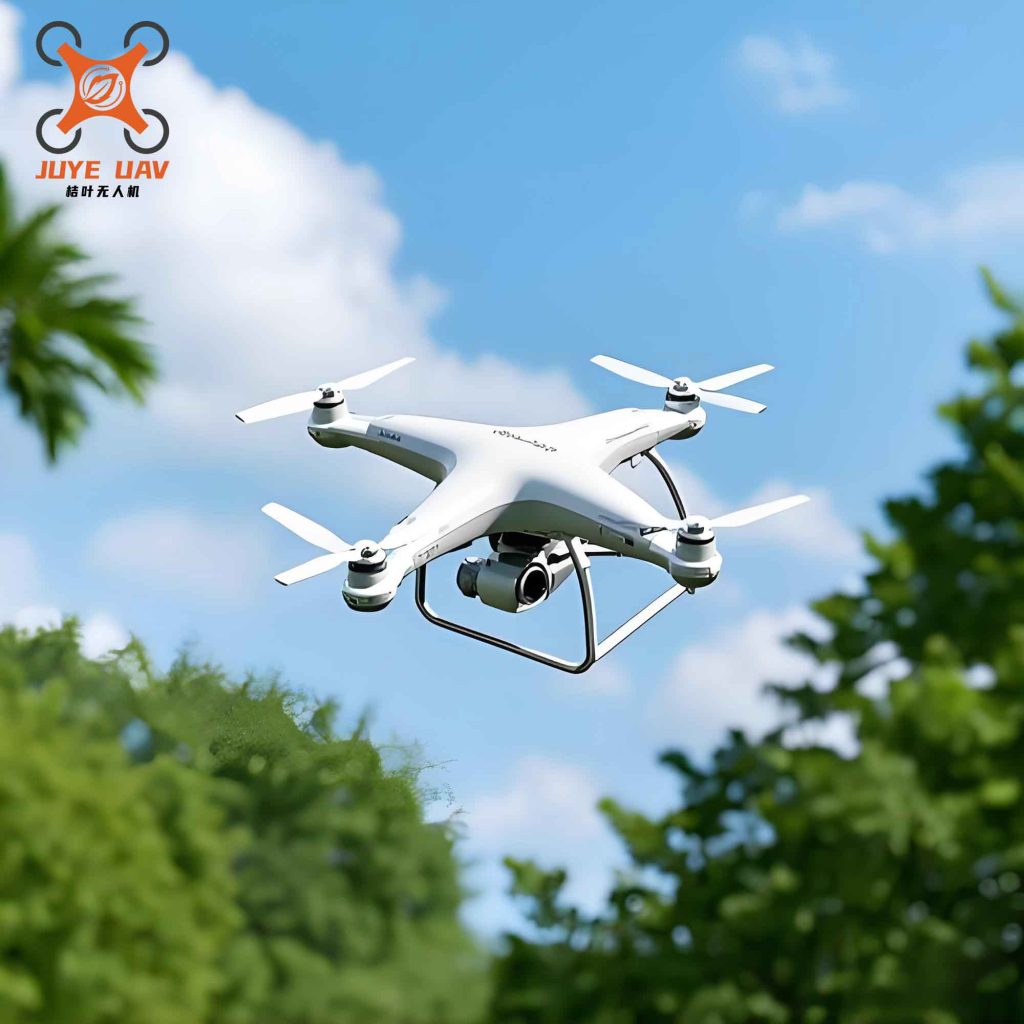
The above figure illustrates the rapid adoption of China drone technology across various sectors. The recent standardization efforts reflect the nation’s commitment to building a safe and efficient low-altitude ecosystem.
2. Drone Identification Technologies
2.1 Information Requirements for Remote Identification
According to GB 46750-2025, the remote identification data packet must include data type, version, length, a data identifier byte (or bytes), and the content items. The data identifier field uses the first 7 bits to indicate whether each corresponding item is transmitted (1 = yes, 0 = no), and bit 8 serves as an extension flag. Mandatory data items include the unique product identification code (20 characters), real-name registration marker, drone classification, control station location, drone location, track angle, ground speed, altitude, operation status, coordinate system type, horizontal/vertical/speed accuracy, and timestamp. Optional items include the category of operation, relative height, vertical speed, and pressure altitude. The update interval must be ≤1 second.
2.2 Broadcast-Based Remote Identification
Broadcast-based remote identification (also called direct remote ID) operates as a one-way transmission: the drone periodically transmits messages via Wi-Fi or Bluetooth, and any compatible receiver within range can decode the information. The standard (GB 46750-2025) requires that a single broadcast receiver system must be capable of simultaneously resolving at least 50 targets, with a processing delay ≤50 ms. Traditional Wi-Fi coverage is limited to ~300 m, while Bluetooth 5.x can reach ~1 km in ideal conditions. Broadcast is simple, low-cost, and effective in areas without cellular coverage, but it suffers from limited range and vulnerability to interference and eavesdropping.
2.3 Network-Based Remote Identification
Network-based remote identification leverages two-way communication links such as 4G/5G, satellite, or wired networks. The drone actively sends its identification data to a designated supervisory platform or service supplier. The processing delay for the receiver system must be ≤1 second. This approach offers wide-area coverage (subject to network availability), enables integration with UTM systems, and supports bi-directional commands (e.g., airspace updates, emergency notifications). However, it is dependent on network continuity; in the event of a communication failure (e.g., coverage gaps or congestion), the drone must cache the failed data and retransmit once the link is restored. GB 46750-2025 mandates this caching and retransmission feature.
The system architecture for network-based identification in China typically involves a mobile communication network (4G/5G) as the backbone. The supervision flow includes: drone registration and module binding, real-time airspace information push, pre-flight authorization, continuous status reporting, and post-flight data upload. The supervisory platform uses base station positioning and data analysis to detect anomalies and enforce geo-fencing. This closed-loop system is a hallmark of China drone regulation.
| Feature | Broadcast Remote ID | Network Remote ID |
|---|---|---|
| Communication | Unidirectional (Wi-Fi/Bluetooth) | Bidirectional (Cellular/Satellite) |
| Coverage | Typical ≤1 km (Bluetooth), ≤300 m (Wi-Fi) | Up to tens of km (depends on network) |
| Receiver | Any compatible device within range | Designated supervisory platform |
| Latency requirement (processing) | ≤50 ms | ≤1 s |
| Simultaneous targets | ≥50 | All within service area |
| Vulnerability | Eavesdropping, spoofing, interference | Network outages, data interception |
| Offline functionality | Works without infrastructure | Requires continuous connection |
2.4 Non-Cooperative Identification Technologies
Non-cooperative identification (also called passive detection) is essential for detecting drones that are not broadcasting their identity (e.g., “black flights” or malicious actors). These technologies rely on physical signatures. The main approaches are:
$$
\text{Overall performance} = \frac{\alpha_1 \cdot \text{Optical} + \alpha_2 \cdot \text{Acoustic} + \alpha_3 \cdot \text{Radar} + \alpha_4 \cdot \text{RF}}{\text{fusion\_complexity}}
$$
where \(\alpha_i\) are weighting factors determined by the operational environment.
- Optical/Infrared Identification: Uses visible light or thermal cameras to capture visual features (shape, color, heat signature). Convolutional neural networks (CNNs) like YOLO or two-stage detectors are employed. Advantages: high spatial resolution, intuitive. Disadvantages: affected by weather and lighting.
- Acoustic Identification: Microphone arrays capture the unique sound signatures of drone motors and propellers. Mel-frequency cepstral coefficients (MFCC) combined with machine learning (SVM, K-NN) are used. Advantages: low cost, passive, works day/night. Disadvantages: sensitive to background noise, limited range.
- Radar Identification: Exploits micro-Doppler effects from rotating blades and radar cross-section (RCS) patterns. The received signal follows a polynomial phase-sinusoidal frequency modulation (PPS-SFM) model. Fractional Fourier transform and machine learning extract features. Advantages: long range, all-weather. Disadvantages: difficulties with low-slow small targets, multipath in urban areas.
- RF Identification: Captures the drone’s communication signals (control link or video transmission). Radio frequency fingerprinting or deep learning on raw I/Q data identifies the drone type or even individual device. Advantages: high specificity, passive. Disadvantages: requires the drone to be actively transmitting.
- Fusion Identification: Combines multiple sensor modalities (e.g., optical + radar + RF) to enhance accuracy and robustness. Data-level, feature-level, or decision-level fusion is applied. The fusion model typically uses deep learning to exploit complementarity. This is the most promising approach for comprehensive low-altitude surveillance.
Table below summarizes the key comparison between cooperative and non-cooperative identification technologies.
| Technology | Type | Principle | Advantages | Disadvantages |
|---|---|---|---|---|
| Broadcast Remote ID | Cooperative | Wi-Fi/Bluetooth one-way broadcast | Simple, low cost, no infrastructure | Short range, vulnerable to spoofing |
| Network Remote ID | Cooperative | Cellular/satellite two-way | Wide coverage, data traceability | Requires network, risk of outage |
| Optical Identification | Non-cooperative | Visible/IR imaging + CNN | High resolution, intuitive | Weather/light dependent |
| Acoustic Identification | Non-cooperative | Microphone array + MFCC | Low cost, passive, day/night | Noise sensitive, short range |
| Radar Identification | Non-cooperative | Micro-Doppler + RCS analysis | Long range, all-weather | Difficult for slow small targets, multipath |
| RF Identification | Non-cooperative | RF fingerprinting / DL | High specificity, passive | Only when drone transmits |
| Fusion Identification | Both | Multi-sensor deep fusion | Enhanced accuracy and robustness | High complexity, computational cost |
3. Typical Application Scenarios of Remote Identification
Remote identification is not merely a regulatory requirement; it is an enabler for practical drone operations. In China drone deployments, the technology has proven critical across multiple domains.
3.1 Logistics and Express Delivery
Companies like SF Express and Meituan have launched drone delivery routes in cities such as Wuxi and in Dubai. For these operations, remote identification ensures that each drone’s identity, position, and status are continuously broadcast and monitored by the traffic management system, preventing collisions and enabling coordinated batch operations. The 1-second update interval is essential for safe multi-drone operations in urban corridors.
3.2 Urban Governance and Patrol
Shenzhen Public Security deploys 149 drone patrol routes, accumulating over 20,000 flight hours for traffic management and crime prevention. Remote identification allows command centers to verify flight legitimacy in real time, distinguishing compliant drones from potential “black flights.” The technology also supports dynamic geo-fencing and automated alerts.
3.3 Emergency Rescue and Disaster Response
During the massive floods in Beijing’s Mentougou district, the Ministry of Industry and Information Technology dispatched Zhongxing (ZTE) tethered drones to provide 5G coverage over 80 km² for 6 hours. Remote identification facilitated coordination among multiple rescue teams, preventing airspace conflicts and ensuring that communication-relay drones were identifiable and prioritized.
3.4 Precision Agriculture
In Ninghe District, Tianjin, over 40 agricultural drones perform spraying tasks, covering 40,000–50,000 mu per day. Remote identification enables the fleet manager to track each drone’s location, battery status, and progress, ensuring optimal coverage and preventing overlaps or gaps. The network-based identification also logs historical data for compliance and optimization.
3.5 Cultural Tourism and Entertainment
Drone light shows in many Chinese cities (e.g., Shenzhen, Xi’an) involve hundreds of synchronized drones. Remote identification provides real-time swarm identity, allowing the control system to detect any drone that deviates from its assigned position and trigger emergency landing or correction. The broadcast mode is also used by spectators’ apps to identify show drones (subject to privacy filters).
4. Key Challenges and Open Issues
Despite the significant progress, the deployment of remote identification, especially within the China drone ecosystem, faces several critical challenges.
4.1 Information Security and Cyber Attacks
Both broadcast and network remote ID are vulnerable to attacks. Broadcast signals can be easily spoofed using software-defined radios, allowing an attacker to inject fake drone identities or false position data. Network links may be subjected to jamming, man-in-the-middle attacks, or denial-of-service. The current standards (GB 46750-2025) require caching and retransmission but do not mandate encryption or digital signatures, leaving a gap. There is an urgent need for lightweight authentication protocols, possibly leveraging timestamp, nonce, and asymmetric cryptography tailored for resource-constrained drones:
$$
\text{Message} = \{\text{ID}, P_{\text{drone}}, H_{\text{drone}}, t, \text{Signature}(SK_{\text{drone}}, \text{plaintext})\}
$$
where \(SK_{\text{drone}}\) is a private key embedded during manufacturing. However, key management and revocation remain complex.
4.2 Privacy Protection
The continuous disclosure of drone identity and precise location raises privacy concerns for operators. For example, broadcasting the remote control station’s location can reveal the pilot’s home or workplace. In China drone regulations, the unique product identification code is public within broadcast range, but only authorized enforcement agencies can link it to the owner. However, any receiver can track the drone’s flight path, potentially inferring the operator’s routine. Network-based identification aggregates sensitive data on supervisory platforms, posing a risk of data leakage or misuse. Privacy-enhancing techniques like differential privacy or location obfuscation are being explored but must balance with the need for accurate monitoring.
4.3 Real-Time Performance and Reliability in Complex Environments
The mandated update interval of ≤1 second is challenging under high-speed flight or dense urban canyons. Broadcast signals suffer from multipath interference and attenuation, while network-based identification depends on cellular handover success rates. In scenarios such as fast-moving logistics drones or swarms, the effective update rate may degrade. System designers must ensure:
$$
\text{End-to-end latency} = T_{\text{acquisition}} + T_{\text{processing}} + T_{\text{transmission}} + T_{\text{decode}} \leq 1 \, \text{s}
$$
For broadcast, the processing must be ≤50 ms. For network, the total must be ≤1 s, which is tight when considering 5G radio access delays and core network processing. Furthermore, the system must handle network outages gracefully. The caching and automatic retransmission requirement is a good start, but the cache size and timeout thresholds need careful specification.
4.4 Non-Cooperative Target Identification
Cooperative remote ID only works for drones that are properly equipped and willing to broadcast. Malicious drones can disable remote ID or spoof it. Non-cooperative technologies (radar, optical, acoustic, RF) must fill the gap, but they each have limitations. Fusion of multiple sensors is the most promising path, but it introduces complexity in data synchronization, calibration, and cost. For China drone airspace management, a tiered approach is envisioned: cooperative ID provides baseline situational awareness, while networked sensors (e.g., 5G-A integrated sensing and communication) add non-cooperative detection. The fusion algorithm must fuse heterogeneous data:
$$
P(\text{threat}) = f(\text{Radar\_track}, \text{Optical\_class}, \text{RF\_fingerprint}, \ldots)
$$
using Bayesian inference or deep learning.
4.5 Fragmentation of Standards
Global fragmentation of remote ID standards creates barriers for China drone exports and international operations. While ASTM (US) and prEN 4709-002 (Europe) are broadcast-only, China’s GB 46750-2025 requires both broadcast and network. The message format, payload data, and frequency bands differ. A drone compliant with one region may not be compliant in another without firmware modifications. International coordination through ICAO, 3GPP, or global standardization bodies is necessary. In the meantime, China drone manufacturers must design multi-standard capable modules, increasing cost and complexity.
5. Conclusion
Remote identification technology is the cornerstone of integrating civilian drones into the national airspace system. Our study has traced the landscape from policy to application, highlighting the distinct approach of China drone regulation, which mandates both broadcast and network-based identification. The Chinese standards (GB 46750-2025, GB 46761-2025, GB 46860-2025) provide a rigorous framework, but challenges in cybersecurity, privacy, real-time performance, non-cooperative detection, and standard harmonization remain open. Future research should focus on fusing cooperative and non-cooperative technologies, developing lightweight authentication mechanisms, and advancing testing and certification methodologies to support the sustainable growth of the low-altitude economy. As China drone operations continue to expand exponentially, a robust, secure, and globally interoperable remote identification system will be essential for unlocking the full potential of the low-altitude economic ecosystem.