
Delivery drones (UAVs) are transforming logistics operations, yet their ground impact risks during failures or collisions require rigorous quantification. We present a comprehensive risk assessment framework addressing these hazards through probabilistic modeling and consequence analysis.
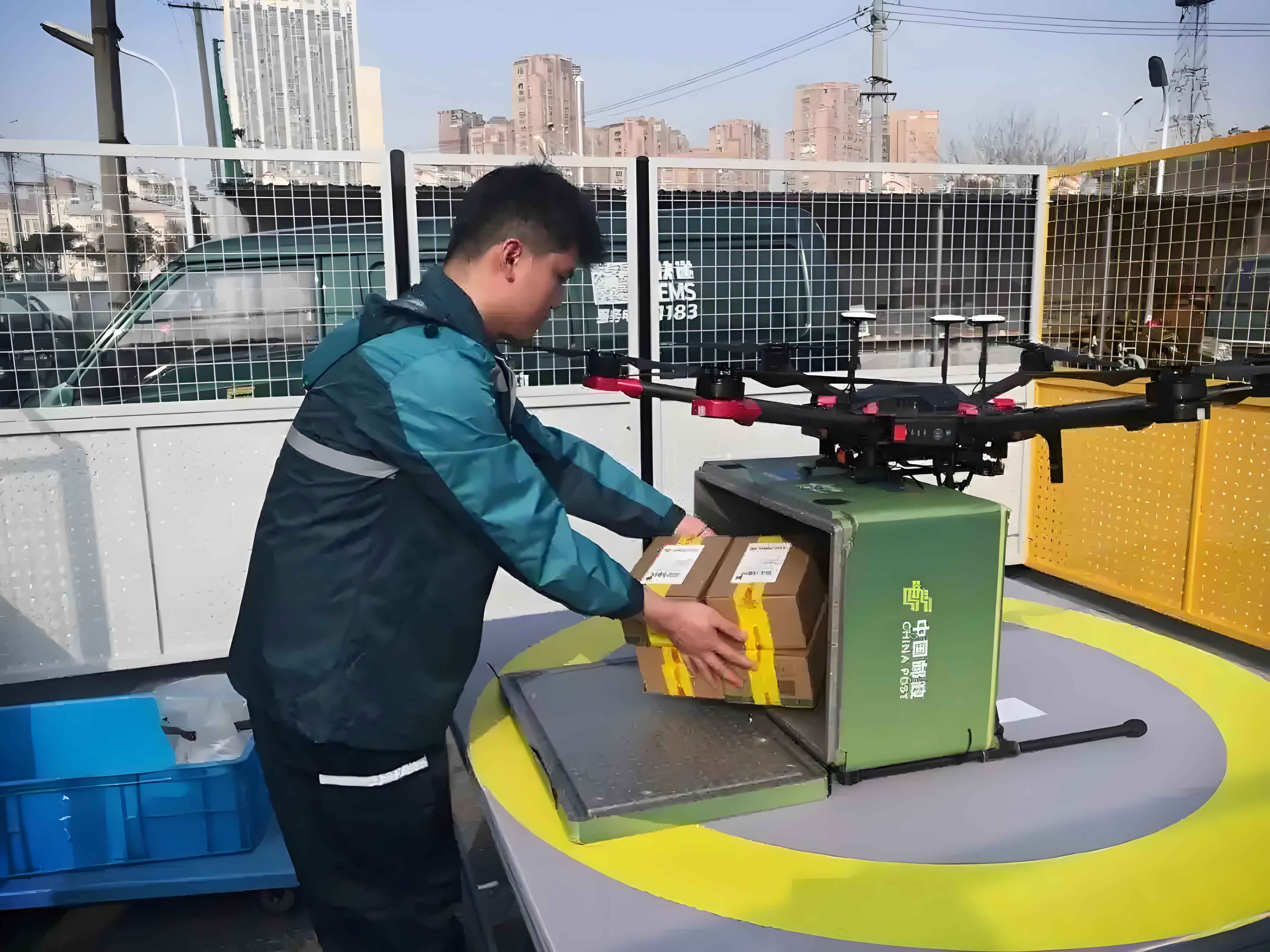
Failure-Induced Ground Impact Models
Fatality Estimation
Ground fatalities from delivery UAV crashes are calculated as:
$$N = P_k \rho A p_f$$
Where \(P_k\) = in-flight failure probability, \(\rho\) = population density (people/m²), \(A\) = impact area (m²), and \(p_f\) = fatality rate determined by impact energy \(E\):
$$p_f = \frac{1 – \lambda}{1 – 2\lambda} + \left( \frac{\alpha}{\beta} \right) \left( \frac{E}{P_s} \right)^3$$
With \(P_s\) = sheltering coefficient, \(\alpha\) = 1000 kJ (50% fatality energy at \(P_s=6\)), \(\beta\) = 34 J (injury threshold), and \(\lambda = \min\left[1, \left( \frac{\beta}{E} \right)^{3P_s}\right]\).
Vertical Descent Impact
During takeoff/landing failures, delivery drones exhibit vertical descent. Impact area \(A_1\) combines UAV and human radii plus 10% buffer:
$$A_1 = \pi (r_u + r_p)^2 \times 1.1$$
Impact velocity derives from solving Newtonian dynamics with drag:
$$m \frac{dv}{dt} = mg – kv^2 \quad (k = \frac{1}{2} c \rho_{\text{air}} s)$$
Terminal energy \(E = \frac{1}{2}mv^2\) is computed via velocity solution.
Gliding Descent Impact
Mid-flight failures cause gliding descents. Impact area \(A_2\) incorporates horizontal displacement \(d\):
$$A_2 = \left[ 2d r_u + \pi (r_u + r_p)^2 \right] \times 1.1$$
Where \(d = X_2 – X_1\) (horizontal displacement from altitude \(h\) to average human height \(h_0\)).
Economic Loss Calculation
Total loss \(M\) combines direct (\(Q_1\)) and indirect (\(Q_2\)) costs:
$$M = Q_1 + Q_2$$
Direct costs include UAV damage (Table 1) and cargo compensation. Indirect costs cover incident response:
$$Q_2 = \frac{G n m_1 T_1}{365 \times 8} + \frac{G n m_2 T_2}{365 \times 8}$$
Where \(G\) = GDP per capita, \(n\) = incidents, \(m_{1,2}\) = personnel counts, \(T_{1,2}\) = response hours.
| Damage Level | Impact Energy Threshold (kJ) | Value Loss Rate (%) |
|---|---|---|
| Minor | 0.75 | 20 |
| Moderate | 1.50 | 40 |
| Severe | 3.00 | 80 |
| Total Loss | 3.75 | 100 |
Collision-Induced Ground Impact Models
Eccentric Impact Dynamics
For delivery UAV mid-air collisions, momentum conservation governs:
$$m_1(v_{1xh} – v_{1xq}) = P_X$$
$$m_1(v_{1yh} – v_{1yq}) = P_Y$$
Angular momentum conservation:
$$m_1 k_1^2 (\omega_{1h} – \omega_{1q}) = P_X b_1 – P_Y a_1$$
$$m_2 k_2^2 (\omega_{2h} – \omega_{2q}) = P_Y a_2 – P_X b_2$$
Energy loss \(E_{\text{loss}}\) uses restitution coefficient \(e=0.78\):
$$E_{\text{loss}} = e \left( \frac{1}{2} m_1 v_{1xq}^2 + \frac{1}{2} m_1 v_{1yq}^2 + \frac{1}{2} m_2 v_{2xq}^2 + \frac{1}{2} m_2 v_{2yq}^2 \right)$$
Post-Collision Impact Zone
Collision impact area \(A_p\) is annular:
$$A_p = \left[ \pi (X + r_u + r_p)^2 – \pi X’^2 \right] \times 1.1$$
Where \(X = \max(X_1, X_2)\) and \(X’ = \min(X’_1, X’_2)\) for two delivery drones.
Three-Dimensional Risk Assessment Matrix
We integrate accident probability (\(P\)), fatalities (\(N\)), and losses (\(M\)) into a 3D risk matrix (Fig. 1). Dimensions are normalized:
$$x_{\text{norm}} = \frac{x – x_{\min}}{x_{\max} – x_{\min}}$$
Risk levels are classified using Tables 2-4:
| Likelihood | Probability Range (%) | Risk Level |
|---|---|---|
| Low Probability | 0-20 | 1 |
| Possible | 21-50 | 2 |
| Probable | 51-70 | 3 |
| Frequent | 71-100 | 4 |
| Severity | Fatalities per 10M Flights | Risk Level |
|---|---|---|
| Minor | < 3 | 1 |
| Moderate | 3-10 | 2 |
| Significant | 10-30 | 3 |
| Major | >30 | 4 |
| Economic Impact | Loss Range (USD) | Risk Level |
|---|---|---|
| Minor | < 2,000 | 1 |
| Moderate | 2,000-8,000 | 2 |
| Significant | 8,000-30,000 | 3 |
| Major | >30,000 | 4 |
Case Study: Urban Operation Scenario
A delivery UAV route (Fig. 2) was analyzed with parameters: mass=15kg, \(r_u\)=0.834m, cruise speed=13m/s, altitude=100m. Population densities and sheltering factors varied across zones (Table 5).
| Zone | Sheltering \(P_s\) | Avg. Fatalities (per flight-hour) | Economic Loss (USD) | Risk Level |
|---|---|---|---|---|
| Zone 1 | 50 | 5.77×10⁻¹⁰ | 13,794 | Low |
| Zone 2 | 44 | 3.33×10⁻⁸ | 20,394 | Moderate |
| Zone 3 | 3 | 5.07×10⁻⁷ | 27,044 | Moderate |
| Zone 4 (Collision) | 35 | 1.23×10⁻⁶ | 67,410 | High |
| Zone 5 | 65 | 5.64×10⁻⁸ | 7,195 | Low |
| Zone 6 | 55 | 5.42×10⁻⁹ | 13,794 | Low |
Conclusions
Our models demonstrate that delivery drone ground risks remain below 10⁻⁶ fatalities/flight-hour in most zones. Elevated risks occur in low-sheltering areas (Zone 3) and collision-prone zones (Zone 4), primarily due to larger impact areas and higher energy transfer. The 3D risk matrix effectively differentiates hazard levels, enabling targeted safety interventions for delivery UAV operations. Future work should incorporate real-time weather dynamics and fleet management interactions to enhance model fidelity.