
In the field of deep geological disposal for high-level radioactive waste (HLW), the integrity of the host rock is paramount. As the primary natural barrier within the multi-barrier system, the host rock must ensure isolation for timescales exceeding ten thousand years. A critical factor influencing this long-term safety is the presence of structural fractures. These discontinuities can compromise the mechanical stability of the repository, significantly alter the hydraulic conductivity of the rock mass, and potentially act as fast pathways for radionuclide migration towards the biosphere. Therefore, accurate characterization of structural fractures—including their orientation, density, trace length, and spatial distribution—is fundamental for site selection, characterization, and safety assessment of a geological repository. This underscores the vital need for robust and efficient methods to identify and quantify fracture parameters.
Traditional field-based methods for fracture mapping, involving compasses, tape measures, and manual scanline surveys, are time-consuming, labor-intensive, and often limited by accessibility and safety concerns in rugged or hazardous terrain. Furthermore, they provide inherently discontinuous and localized data, making it challenging to extrapolate properties across large rock exposures. In recent years, remote sensing technologies, particularly those utilizing unmanned aerial vehicles, have emerged as powerful tools for geological mapping. The agility, relatively low cost, and ability to capture high-resolution imagery from optimal vantage points make unmanned drone systems exceptionally suitable for surveying extensive rock outcrops. When coupled with advanced photogrammetric processing based on Structure-from-Motion algorithms, these systems enable the rapid construction of detailed, georeferenced three-dimensional digital outcrop models. These models serve as permanent, high-fidelity digital records from which fracture parameters can be extracted systematically and over a much larger area than is feasible manually.
This study focuses on developing and validating a workflow for extracting structural fracture parameters using unmanned drone photogrammetry. The research was conducted at the surface exposure near an underground research facility, characterized by well-exposed granite bedrock—a typical host rock candidate. Our objectives are threefold: (1) to detail a replicable methodology from unmanned drone flight planning to 3D model generation and fracture interpretation, (2) to quantitatively compare the fracture parameters (orientation and trace length) derived from the 3D model with those obtained from traditional manual measurements, and (3) to analyze the sources of discrepancy and discuss the influencing factors and limitations of the technique. This work aims to demonstrate that unmanned drone photogrammetry offers a reliable, efficient, and accurate alternative for fracture characterization in bedrock-dominated landscapes, providing valuable data for geotechnical and hydrogeological assessments in fields like HLW disposal.
Methodology
Overall Technical Workflow
The methodological framework adopted in this study comprises three sequential phases: data acquisition, 3D model reconstruction, and model-based interpretation. The workflow is designed to be systematic and reproducible.
Phase 1: Unmanned Drone Image Acquisition. This initial phase involves pre-flight planning and execution. A detailed analysis of the study area is conducted to define the survey boundaries and identify any potential flight hazards. The flight plan is designed to ensure adequate image overlap (typically >70% frontlap and >60% sidelap) and coverage of the target outcrop. The unmanned drone is then deployed to automatically capture a series of high-resolution, geotagged images.
Phase 2: 3D Reality-Based Model Reconstruction. The acquired images are processed using specialized photogrammetric software. The core algorithm, Structure-from-Motion, automatically identifies matching features across multiple overlapping images, solves for camera positions and orientations, and generates a sparse point cloud. This is followed by a Multi-View Stereo process, which performs dense image matching to produce a high-density point cloud model. This model can be further processed to generate a textured mesh, a digital elevation model, and an orthomosaic.
Phase 3: Fracture Identification and Parameter Extraction. The dense point cloud or the textured mesh model is imported into 3D analysis software. Structural fractures are manually identified based on their linear traces on the model surface. For each identified fracture, a best-fit plane is digitally constructed by picking multiple points along its visible trace. The software then calculates the geometric parameters of this plane, including its dip direction, dip angle, and the 3D coordinates of its center. The trace length is measured directly along the 3D model surface.
This integrated workflow is summarized in Table 1.
| Phase | Key Activities | Primary Tools/Outputs |
|---|---|---|
| 1. Acquisition | Site reconnaissance, Flight planning, Image capture | Unmanned drone, Flight control software, Geotagged images |
| 2. Reconstruction | Image alignment, Sparse & dense cloud generation, Mesh/texture creation | SfM-MVS software (e.g., Agisoft Metashape), Dense 3D point cloud, Textured mesh |
| 3. Interpretation | Fracture trace identification, Plane fitting, Parameter calculation | 3D analysis software (e.g., Sirovision), Fracture orientation, Trace length |
Unmanned Drone System and Image Acquisition
The aerial survey was conducted using a commercial quadcopter-type unmanned drone. This platform was selected for its stability, ease of deployment, and integrated high-resolution camera with a global navigation satellite system receiver. The key specifications of the unmanned drone system are listed in Table 2.
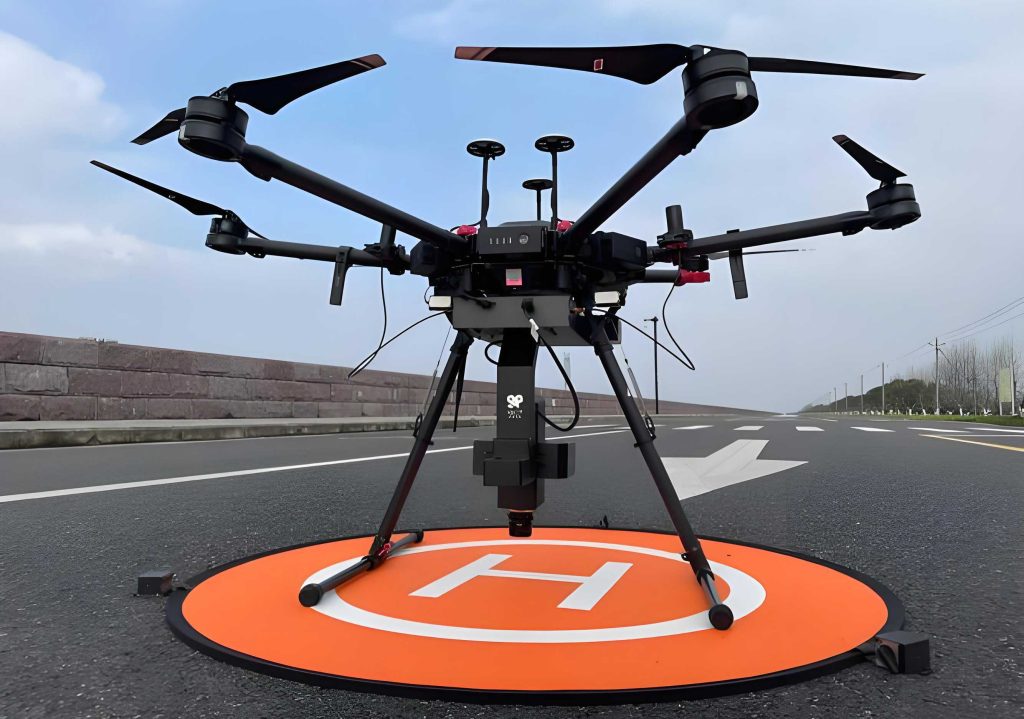
The flight was planned with a constant above-ground altitude of 40 meters, resulting in a ground sampling distance of approximately 3-5 cm per pixel. A nadir (vertical) camera orientation was maintained, and a double-grid flight path was executed to ensure comprehensive coverage and high overlap. No ground control points were deployed for this survey, as the primary objective was the relative accuracy of fracture geometry within the model, and the integrated GNSS provided sufficient georeferencing for the scale of analysis. A total of 459 images were captured over the target outcrop.
| Parameter | Specification |
|---|---|
| Platform Type | Multi-rotor (Quadcopter) |
| Sensor | 20 MP RGB Camera |
| Focal Length | 20 mm (equivalent) |
| Positioning | Integrated GNSS (GPS/GLONASS) |
| Flight Altitude | 40 m AGL |
| Ground Sampling Distance | ~3-5 cm/pixel |
Image Processing and 3D Reconstruction Principles
The core of the 3D reconstruction lies in the Structure-from-Motion (SfM) and Multi-View Stereo (MVS) pipeline. The SfM process begins by detecting scale-invariant feature transform keypoints in each image. Corresponding keypoints across multiple images are matched, establishing a network of tie points. From these matches, the internal camera calibration parameters (focal length, principal point, distortion) and the external camera poses (position and orientation in 3D space) are estimated via bundle adjustment, minimizing the reprojection error. This results in a sparse 3D point cloud of the matched features.
The mathematical foundation of the camera projection for a point $\mathbf{X} = (X, Y, Z)^T$ in world coordinates to image coordinates $\mathbf{x} = (u, v)^T$ is given by:
$$
\mathbf{x} = \mathbf{K} [\mathbf{R} | \mathbf{t}] \mathbf{X}
$$
where $\mathbf{K}$ is the camera intrinsic matrix, $\mathbf{R}$ is the rotation matrix, and $\mathbf{t}$ is the translation vector. The bundle adjustment solves for these parameters by minimizing the sum of squared reprojection errors over all points $i$ and cameras $j$:
$$
\min_{\mathbf{K}_j, \mathbf{R}_j, \mathbf{t}_j, \mathbf{X}_i} \sum_{j} \sum_{i} || \mathbf{x}_{ij} – \text{proj}(\mathbf{K}_j, \mathbf{R}_j, \mathbf{t}_j, \mathbf{X}_i) ||^2
$$
Following SfM, the MVS algorithm performs dense correspondence matching for every pixel in overlapping image pairs, using the known camera geometry as a constraint. This generates the final high-density point cloud, where the 3D coordinate $\mathbf{P}$ for a surface point is derived by finding the intersection of back-projected rays from multiple cameras, effectively solving for depth. The density of this cloud is crucial for accurately representing fracture geometry. The final model contained over 100 million points, with an average density exceeding 2,900 points per square meter.
Fracture Parameter Extraction from the 3D Model
The dense point cloud model was exported and imported into specialized 3D geological analysis software for interpretation. The process for extracting individual fracture parameters is as follows:
- Trace Identification: The model is visually inspected in 3D. Linear discontinuities contrasting with the intact rock surface are identified as potential fracture traces.
- Plane Fitting: For each trace, the “Add Plane” tool is activated. A minimum of three (typically more for accuracy) points are manually picked along the visible trace on the 3D model surface. These points should ideally sample the fracture trace where the fracture plane intersects the topography.
- Parameter Calculation: The software uses a least-squares algorithm to compute the best-fit plane through the selected points. The orientation of this plane is output as dip direction ($\alpha_d$) and dip angle ($\beta$). The trace length ($L$) is calculated as the cumulative 3D distance between sequential pick points along the traced path. The 3D coordinates of the plane’s center are also recorded.
The equation for the best-fit plane is of the form $ax + by + cz + d = 0$, derived by minimizing the sum of squared perpendicular distances from the picked points to the plane. The dip direction and dip angle are then calculated from the plane’s normal vector $\mathbf{n} = (a, b, c)$.
Validation via Traditional Field Measurement
To validate the unmanned drone-derived data, a ground-truthing campaign was conducted concurrently. Within the same area covered by the unmanned drone survey, 58 prominent fractures were selected and measured using traditional geological field techniques. A geological compass was used to measure the dip direction and dip angle directly on the fracture plane where accessible. A measuring tape was used to record the visible trace length along the ground surface. This dataset serves as the benchmark for assessing the accuracy of the photogrammetric method.
Study Area
The study was conducted in a pre-selected area for HLW disposal investigation, characterized by an arid desert climate with sparse vegetation, leading to excellent bedrock exposure—an ideal environment for photogrammetric surveys. The local geology is dominated by Mesozoic granitic rocks, including monzogranite and granodiorite. The terrain consists of low hills and ridges. Tectonically, the area is intersected by several regional fault zones. The outcrop chosen for this study is situated near a prominent NNE-trending fault zone, which has imparted a strong fracture network to the surrounding granitic rock mass. The primary fracture sets observed are steeply dipping, with dominant orientations aligning with the regional structural trends.
Results
High-Resolution 3D Dense Point Cloud Model
The processing of the 459 images produced a high-resolution, georeferenced 3D model. The model covers an area of approximately 200 m by 180 m. The alignment accuracy was set to the highest setting, resulting in over 110,000 tie points and a final dense cloud exceeding 100 million points. The quality of the model allowed for clear discrimination of individual fractures, boulders, and subtle topographic features on the rock surface. A preliminary accuracy assessment was performed using physical targets of known dimensions placed within the scene prior to the unmanned drone flight. The comparison between model-measured and actual dimensions of these targets is shown in Table 3, confirming sub-centimeter to centimeter-level accuracy for relative measurements, which is sufficient for fracture orientation analysis.
| Target Feature | Field Measurement | Model Measurement | Error |
|---|---|---|---|
| Target Height | 0.825 m | 0.839 m | +0.014 m |
| Scale Bar 1 Length | 1.20 m | 1.19 m | -0.01 m |
| Scale Bar 2 Length | 1.20 m | 1.17 m | -0.03 m |
Fracture Parameter Acquisition and Comparison
Fifty-eight fractures were interpreted from the 3D model, corresponding one-to-one with the fractures measured in the field. The acquired parameters (dip direction, dip angle, and trace length) from both methods were compiled. A subset of the comparative data is presented in Table 4, illustrating the general agreement and specific discrepancies.
The overall orientation patterns were consistent. Both datasets revealed two predominant fracture sets: a NNE-striking, steeply SE-dipping set and a sub-EW striking, steeply S-dipping set. The similarity in orientation patterns validates the unmanned drone method’s ability to capture regional structural trends.
| Fracture ID | Manual Measurement | Unmanned Drone Model Interpretation | Absolute Difference | ||
|---|---|---|---|---|---|
| Dip Dir./Dip (°) | Dip Dir./Dip (°) | Trace Length (m) | Δ Dip Dir. (°) | Δ Dip (°) | |
| F01 | 290 / 86 | 286 / 87 | 3.10 | 4.4 | 1.0 |
| F15 | 102 / 78 | 103 / 80 | 4.20 | 1.0 | 2.0 |
| F32 | 108 / 89 | 106 / 85 | 7.90 | 2.0 | 4.0 |
| F42 | 112 / 89 | 105 / 80 | 28.60 | 7.0 | 9.0 |
| F75 | 171 / 63 | 167 / 62 | 31.62 | 4.0 | 1.0 |
A statistical summary of the discrepancies across all 58 fractures is provided in Table 5. The average error in dip direction is relatively small. However, the average error in dip angle is more significant, with a clear tendency for the model-derived dip angles to be shallower than the field-measured ones.
| Parameter | Average Absolute Error | Maximum Absolute Error | Trend |
|---|---|---|---|
| Dip Direction | 5.0° | 18.0° | Random |
| Dip Angle | 8.2° | 29.3° | Model dips are generally shallower |
Analysis of Error Sources and Influencing Factors
To understand the systematic error in dip angle, the data was analyzed by grouping fractures based on their trace length ($L$). The average orientation errors for each group were calculated, revealing a strong correlation (Table 6, Figure 1).
| Trace Length Group (m) | Number of Fractures | Avg. Δ Dip Direction (°) | Avg. Δ Dip Angle (°) |
|---|---|---|---|
| $L \leq 5$ | 17 | 5.1 | 11.9 |
| $5 < L \leq 10$ | 16 | 3.8 | 8.7 |
| $10 < L \leq 15$ | 12 | 5.8 | 7.5 |
| $L > 15$ | 13 | 5.1 | 5.5 |
The analysis demonstrates a clear trend: the discrepancy in dip angle decreases significantly as the fracture trace length increases. The average dip angle error for fractures shorter than 5 m is more than double that for fractures longer than 15 m. This can be explained by the plane-fitting process within the 3D model. For long, continuous traces, the software can fit a plane through multiple points that effectively sample the true 3D orientation of the fracture surface intersecting the topography. For short traces, the limited number of pick points may not adequately constrain the plane, especially if the trace coincides with a subtle topographic feature or if the fracture surface itself is not well exposed. In such cases, the fitted plane can be influenced by the local micro-topography of the weathered rock surface rather than the true fracture plane, leading to a shallower apparent dip.
Furthermore, surface weathering in the arid environment plays a role. Fracture surfaces can be rounded or covered by weathering rinds, obscuring the sharp planar discontinuity. When picking points along such a weathered trace, the derived plane may represent a weathered surface tangent rather than the fresh fracture plane measured in the field with a compass. This effect is more pronounced for shorter traces and contributes to the observed dip angle bias.
The relationship between trace length ($L$) and dip angle error ($\Delta\beta$) can be empirically described by a negative power-law or exponential decay function, such as:
$$
\Delta\beta \approx k \cdot L^{-n}
$$
where $k$ and $n$ are positive constants determined from the data. This highlights the importance of trace length as a key indicator of measurement reliability when using the unmanned drone photogrammetry method.
Conclusion
This study successfully demonstrates and validates a comprehensive workflow for extracting structural fracture parameters using unmanned drone photogrammetry in a granite bedrock environment. The high-resolution 3D models generated from unmanned drone imagery provide an unprecedented level of detail for mapping fracture networks over large areas efficiently and safely. The key findings are:
- The unmanned drone-based method accurately reproduces the dominant fracture orientation patterns observed in the field, with an average dip direction error of approximately 5°.
- The accuracy of extracted dip angles is highly dependent on fracture trace length. For fractures with trace lengths exceeding 15 meters, the average dip angle error is within an acceptable range of about 5.5°. For shorter traces (<5 m), the error increases significantly, primarily due to limitations in constraining the 3D plane from limited exposure and interference from surface weathering features.
- The integration of unmanned drone photogrammetry with SfM-MVS processing and 3D geological interpretation software presents a powerful tool for quantitative fracture characterization. It offers significant advantages over traditional methods in terms of speed, coverage, accessibility, and the creation of a permanent, auditable digital record.
For practical application, we recommend prioritizing the interpretation of longer fracture traces within the 3D models to maximize data accuracy. The unmanned drone photogrammetry technique is particularly well-suited for preliminary site characterization, extensive fracture network mapping, and monitoring changes in rock exposures where repeat surveys are needed. This methodology provides a robust and efficient approach for supporting geotechnical and hydrogeological assessments in challenging fields like high-level radioactive waste disposal, where understanding the fracture network is critical to ensuring long-term safety.