
The global energy transition is accelerating, with photovoltaic (PV) power generation serving as a mainstay of clean energy, witnessing continuous and rapid growth in installed capacity. Large-scale PV power plants are widespread, making their safe and stable operation paramount. PV modules, the core power generation units, are exposed long-term to outdoor environments and are prone to various defects such as hot spots, micro-cracks, breakage, and diode failures. These defects not only lead to significant declines in power generation efficiency but also pose major safety hazards like fire risks. Traditional manual inspection methods are inefficient, labor-intensive, heavily reliant on inspector experience, and suffer from high rates of missed and false detection, failing to meet the high-precision, full-coverage maintenance needs of modern, large-scale PV power plants.
Unmanned drone technology, with its unique mobility and efficient data acquisition capabilities, has brought revolutionary breakthroughs to inspection work. However, simply deploying drones for inspections still presents challenges. Faced with massive PV fields ranging from megawatt to gigawatt scales, the key bottlenecks for enhancing the intelligence of plant operation and maintenance, reducing costs, and increasing efficiency are how to systematically and intelligently plan inspection tasks and achieve precise, automatic defect identification within vast amounts of image data. Therefore, researching component defect identification technology based on intelligent zoned inspection by unmanned drones aims to build a complete automated diagnostic system, which holds significant engineering application value and urgent practical demand for ensuring the efficient and reliable operation of PV power plants throughout their lifecycle.
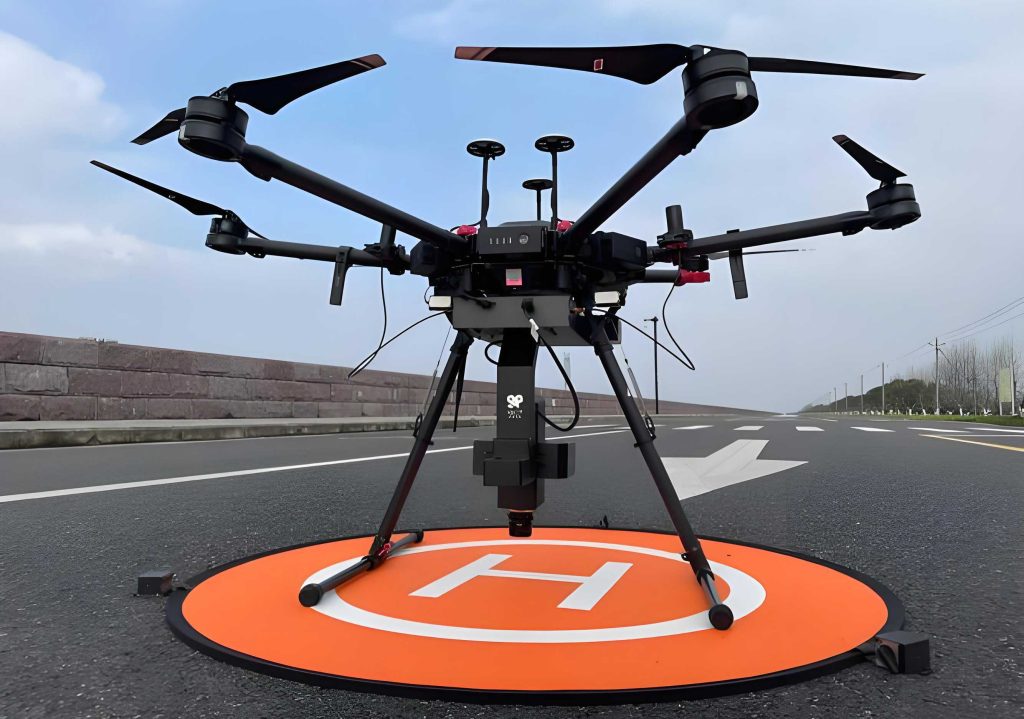
To achieve efficient and precise unmanned drone inspection of PV fields, the image acquisition process requires systematic planning. First, based on the actual layout of the field, module types, and terrain, the area is scientifically divided into multiple contiguous inspection sub-zones. An optimal ground-following automated flight path is planned for each zone, ensuring the drone maintains a constant distance and optimal shooting angle relative to the module surface. During the flight, the high-definition visible-light and infrared thermal imaging cameras carried by the unmanned drone perform comprehensive, gap-free vertical nadir data acquisition of the PV modules according to a preset plan with constant overlap and resolution. Visible-light images, thermal anomaly data, and positioning information are stored in real-time and synchronized. The imaging principle is as follows.
The low-altitude capture result by the unmanned drone is the image $I(x,y)$, expressed as:
$$ I(x,y) = \beta \cdot \gamma \cdot \cos(\theta) \cdot K \cdot H \cdot I_0(x’, y’) $$
where $(x, y)$ represents the captured position information of the inspection target; $(x’, y’)$ is the actual position information of the target; $\beta$ is the imaging coefficient; $\gamma$ is the resolution; $\theta$ is the imaging angle, i.e., the angle between the shooting drone and the target; $H$ is the flight altitude of the unmanned drone; and the parameter $K$ is the scaling ratio between the captured image and the actual surveyed area.
Feature extraction from PV module images is a critical step. We utilize the multi-layer convolutional and pooling operations of a Convolutional Neural Network (CNN) to extract feature maps, capable of capturing spatial structures and texture information within the images. CNNs build hierarchical feature extraction structures by simulating biological visual mechanisms. The core principle lies in using convolutional kernels to perform sliding-window local perception on the input image, progressively extracting abstract features from low-level edges/textures to high-level semantics through multi-layer convolution operations: initial convolutional layers capture low-order features like module surface edges and color patches; intermediate layers combine these basic features to form local structural patterns (e.g., cell grid lines); deep layers fuse global contextual information to characterize complex defect features (e.g., hot spot morphology, crack direction). Pooling operations interspersed within compress feature dimensions, enhance translation invariance, and reduce overfitting. Ultimately, through this end-to-end hierarchical learning mechanism, raw pixels are mapped into highly discriminative feature vectors, providing robust feature representations for subsequent defect classification and localization.
After each convolutional layer operation in a CNN, a non-linear activation function (ReLU) is typically applied to increase the model’s non-linear capability. Let the input to the $i$-th convolutional operation be $Q_i(a,b)$ (the PV module image at the $i$-th scale), and the output be the feature map for that scale. The expression is:
$$ S_i(a,b) = \Gamma \left[ \sum_{m=1}^{M} \sum_{n=1}^{N} Q_i(a-m, b-n) \cdot J_i(m,n) + \xi_i \right] $$
where $S_i(a,b)$ is the output feature map for the $i$-th scale/layer; $J_i(m,n)$ is the convolutional kernel for the $i$-th layer; $\Gamma[\cdot]$ is the non-linear activation function; $\xi_i$ is the bias term for the $i$-th convolutional operation; and $M \times N$ is the size of the input PV module image.
Based on the component-level deep features extracted by the CNN, a Graph Neural Network (GNN) constructs the entire PV field as a topological graph structure. Here, each PV module (or a logical segment) serves as a graph node, with node attributes encoded by the feature vectors extracted by the CNN. Edges between nodes are defined based on physical connection relationships, electrical series paths, or spatial proximity. Assuming PV modules are divided into multiple inspection segments, each segment is abstracted as a node, and adjacent segments are mapped as edge relationships, constructing an undirected weighted graph $G$, represented as:
$$ G = (R, T, U) $$
where $R$ is the node set (collection of PV module inspection segments); $T$ is the edge set (collection of connections between adjacent segments); and $U$ is the adjacency matrix representing the association strength between nodes.
Using the undirected weighted graph $G$, a node feature matrix is established, where each row corresponds to the feature vector of an inspection segment:
$$ C = \begin{bmatrix} f_{11} & f_{12} & \cdots & f_{1z} \\ f_{21} & f_{22} & \cdots & f_{2z} \\ \vdots & \vdots & \ddots & \vdots \\ f_{v1} & f_{v2} & \cdots & f_{vz} \end{bmatrix} $$
where $C$ is the node feature matrix; $z$ is the number of columns (feature dimensions); and $v$ is the number of rows (nodes/segments).
Node features are then mapped to the category space $\psi$ through a fully connected layer:
$$ \psi = \text{ReLU}(C \cdot W + E) $$
where $W$ is the weight matrix of the classification layer and $E$ is the bias term.
The probability that node $I$ (each inspection segment of the PV module) belongs to defect category $O$ is calculated using the Softmax function:
$$ P_{IO} = \frac{\exp(\psi_{IO})}{\sum_{k=1}^{K} \exp(\psi_{Ik})} $$
where $P_{IO}$ is the probability distribution. The category corresponding to the maximum $P_{IO}$ value is taken as the final defect identification result for the PV module segment.
To validate the effectiveness of the proposed method for intelligent zoned inspection by unmanned drones and component defect identification in PV power plants, a method test was conducted using a large mountainous PV power station in Southwest China as the test environment. The key parameters of the experimental setup are summarized below.
| Parameter Category | Description / Value |
|---|---|
| Site Overview | Total Capacity: 100 MWp; Area: ~2.5 km²; Module Count: >400,000; Primary Type: Monocrystalline Silicon; Topography: Mountainous with significant slopes. |
| Site Layout & Zoning | Arrays arranged E-W in rows, N-S in columns; Divided into 15 independent inspection sub-zones; Each zone contains ~80-120 strings; Strings consist of 22 series-connected modules. |
| Unmanned Drone System | Platform: DJI Matrice 30T; Visible Camera: 20 MP; IR Thermal Camera: 640×512 res., sensitivity ≤0.05°C. |
| Flight & Acquisition Parameters | Altitude: 10-15m; Speed: 4 m/s; Overlap: 80% (front), 70% (side); Gimbal Angle: ~-90° (vertical to module). |
| Defect Validation Basis | Combination of artificially implanted and naturally occurring defects: Hot Spots (ΔT≥10°C), Micro-cracks (length≥15cm), Glass Breakage (area≥5cm²), Soiling (coverage≥30%), Vegetation Shading. |
The experimental results for feature extraction from images captured during the unmanned drone’s zoned inspection in two selected local areas are presented. These visualizations demonstrate the CNN’s ability to highlight potential defect regions and extract meaningful features from the raw visible-light and thermal data.
The performance of the proposed feature extraction method was evaluated using the Q-correlation coefficient, comparing it against two other methods from the literature (denoted as Ref [3] and Ref [4]). The Q-correlation measures the linear correlation between the true features $X$ of a PV module and the extracted features $Y$, ranging from -1 to 1. A Q > 0.8 indicates high correlation, Q < 0.3 indicates low correlation, and values in between suggest moderate correlation. The formula is:
$$ Q = \frac{\text{Cov}(X,Y)}{\sqrt{\text{Var}[X] \cdot \text{Var}[Y]}} $$
where $\text{Cov}(X,Y)$ is the covariance between $X$ and $Y$, and $\text{Var}[X]$, $\text{Var}[Y]$ are their respective variances.
The Q-correlation coefficients obtained by the three methods over the experimental duration are summarized in the following table, highlighting the consistency and superiority of the proposed approach.
| Time Interval | Proposed Method (Q) | Ref [3] Method (Q) | Ref [4] Method (Q) |
|---|---|---|---|
| Initial Phase | 0.98 | 0.85 | 0.78 |
| Early-Mid Phase | 0.99 | 0.79 | 0.72 |
| Mid Phase | 0.97 | 0.82 | 0.65 |
| Mid-Late Phase | 0.99 | 0.76 | 0.70 |
| Final Phase | 0.98 | 0.81 | 0.68 |
| Average | 0.982 | 0.806 | 0.706 |
According to the results, the Q-correlation coefficient of the proposed method remained consistently close to 1.0 throughout the experimental period, significantly higher than the 0.8 threshold. This indicates a very high linear correlation between the true features $X$ and the extracted features $Y$. In contrast, the Q-correlation coefficients for the Ref [3] and Ref [4] methods were lower, with averages around 0.81 and 0.71, respectively, and some values dipping close to or below 0.8. This shows that the correlation degree between true and extracted features under these methods was not as effective as with the proposed method. It is evident that the proposed method, leveraging the hierarchical feature learning of CNN on images acquired by the unmanned drone, can more effectively maintain a high linear correlation with the true features during PV module image feature extraction.
To further verify the performance of the overall defect identification pipeline, the F1 score was used as an indicator to measure the consistency between the defect identification results from the intelligent zoned unmanned drone inspection and the actual ground truth. The F1 score is the harmonic mean of precision and recall, providing a balanced measure of a model’s accuracy for the identification task itself. The comparison across multiple experimental runs is shown below.
| Experimental Run # | Proposed Method (F1) | Ref [3] Method (F1) | Ref [4] Method (F1) |
|---|---|---|---|
| 1 | 0.96 | 0.82 | 0.75 |
| 2 | 0.95 | 0.85 | 0.78 |
| 3 | 0.97 | 0.79 | 0.72 |
| 4 | 0.96 | 0.83 | 0.74 |
| 5 | 0.98 | 0.80 | 0.70 |
| 6 | 0.95 | 0.86 | 0.77 |
| 7 | 0.97 | 0.81 | 0.73 |
| 8 | 0.96 | 0.84 | 0.76 |
| 9 | 0.98 | 0.78 | 0.71 |
| 10 | 0.95 | 0.82 | 0.75 |
| Average | 0.963 | 0.820 | 0.741 |
The results demonstrate a clear advantage for the proposed method in the PV component defect identification experiments conducted under unmanned drone zoned inspection. Across all experimental runs, the F1 score for the proposed method remained consistently high with relatively small fluctuations, with most values near or above 0.95. This indicates that the method achieved an excellent balance between precision and recall when identifying component defects. In comparison, the F1 scores for the Ref [3] and Ref [4] methods were significantly lower, showed greater variability, and exhibited considerable gaps from the proposed method at multiple points. This suggests that the performance of these two methods on the defect identification task was less stable and had poorer consistency with the actual results. In summary, by building upon effective CNN-based feature extraction from PV module images and enhancing it with GNN-based contextual analysis of the field topology, the proposed method significantly improves the F1 score, better ensuring the alignment of identification results with ground truth. This conclusively validates the effectiveness of the integrated unmanned drone inspection and deep learning pipeline for accurate PV component defect identification.
This research, by integrating intelligent unmanned drone inspection, convolutional neural networks, and graph neural networks, proposes and validates an intelligent defect identification method for PV field components in complex outdoor environments. The method first constructs a high-quality dataset through a zoned inspection strategy and multimodal image acquisition by unmanned aerial vehicles. It then utilizes CNNs to deeply extract microscopic defect features from component images, followed by GNNs modeling the field’s topology to achieve a leap from individual feature analysis to system-level associative diagnosis. Experimental results prove that this method excels in both feature extraction reliability (Q-coefficient near 1.0) and defect identification consistency (stable, high F1 scores), significantly enhancing the detection capability and identification accuracy for subtle defects in complex environments.
This study not only provides an effective technical solution to practical challenges in PV power plant operation and maintenance but also achieves a tight integration of theoretical research and engineering application. The findings hold important practical value and broad significance for enhancing the intelligent operation and maintenance level of new energy power plants, reducing power generation losses and maintenance costs, and ensuring the safe and stable operation of the power grid. The role of the unmanned drone as the primary data acquisition platform is fundamental to this integrated system’s success, enabling the systematic, large-scale collection of the high-resolution visible and thermal data upon which the subsequent advanced analytics depend.