
With rapid societal development, contactless delivery has emerged as a critical paradigm. Delivery drones (UAVs) excel in this domain by overcoming limitations of ground transportation, particularly in remote areas where traditional logistics face efficiency challenges. These aerial systems create new opportunities for smart logistics through their flexibility, speed, and independence from terrestrial networks. Trajectory planning constitutes the core operational framework for delivery drones, directly impacting safety, efficiency, and cost-effectiveness in urban logistics systems. Current research exhibits limitations including slow convergence, inadequate obstacle avoidance, and insufficient handling of 3D dynamic environments.
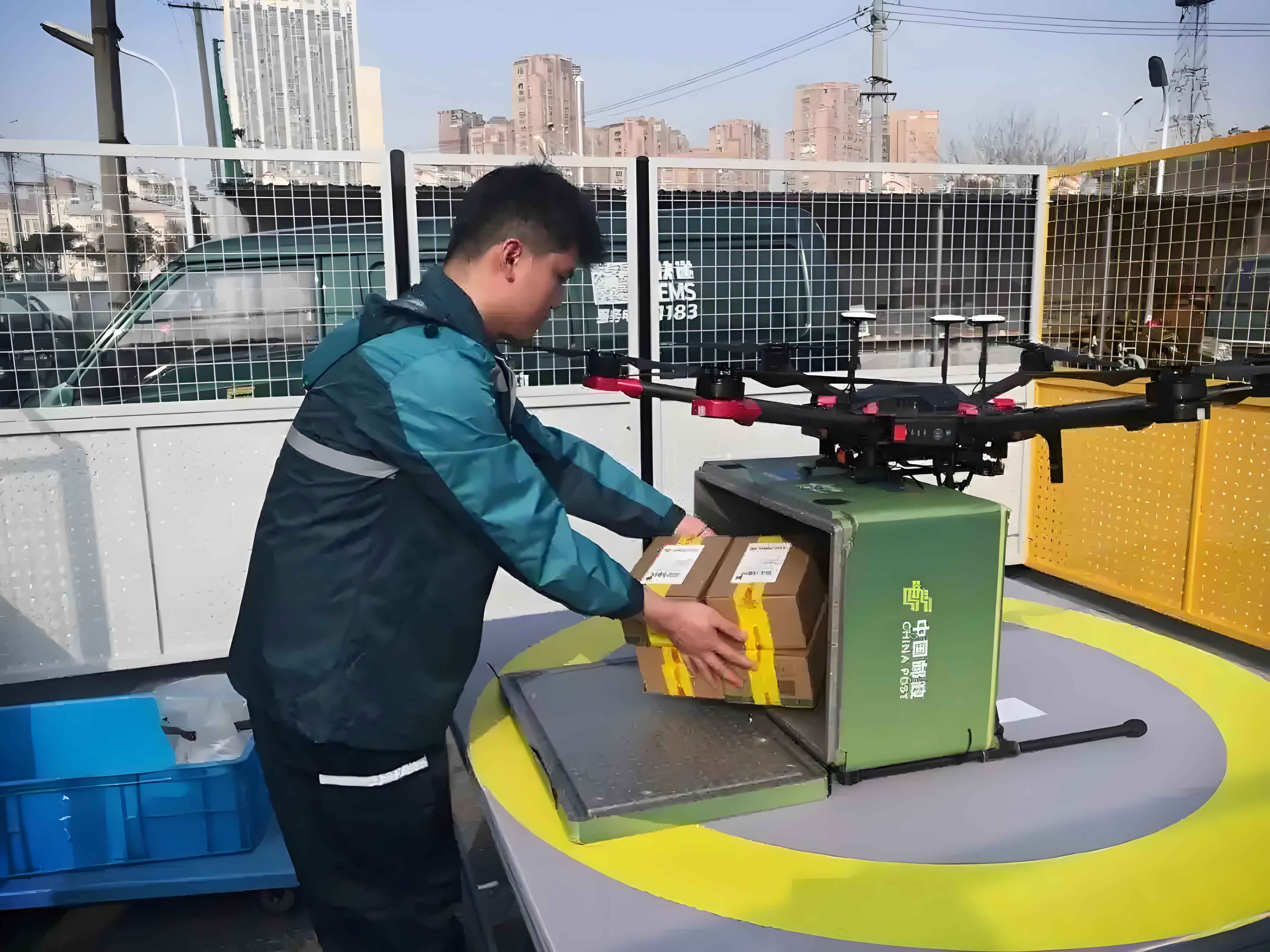
Existing approaches include RAMANA M V’s RRT-based static obstacle avoidance and LUO’s K-means/SA hybrid method for multi-drone coordination. XU Hongfei implemented A* and potential field algorithms for 3D trajectory planning but omitted takeoff/landing phases. While ZHAO Qibing applied grid-based ant colony algorithms to 2D pathfinding, these neglect flight dynamics. Our work addresses these gaps through a multi-objective optimization framework enhanced by algorithmic hybridization.
Model Formulation
For delivery UAV operations across demand nodes, we define a 3D airspace grid with dimensions $x \times y \times z$. Flyable zones are traversable grids while obstacles and no-fly zones are non-traversable, modeled as:
$$ \begin{cases}
\text{Flyable: } G(i,j,k) = 0 \\
\text{Non-traversable: } G(i,j,k) = 1
\end{cases} $$
The trajectory optimization minimizes a weighted objective function combining temporal, economic, and risk factors:
$$ \min \, C = \omega_1 T + \omega_2 C_r + \omega_3 C_p $$
where $\omega_1 + \omega_2 + \omega_3 = 1$. Components include:
Temporal cost:
$$ T = \sum_i \sum_j S_{ij}/V_d + \sum_d D_d $$
Risk cost:
$$ C_r = \frac{1}{2} \sum_{i=1}^n \left[ R(P_{i}) + R(P_{i-1}) \right] \cdot d_{i,i-1} $$
Economic cost:
$$ C_p = \sum_{j \in J} x_j C_f + \sum_{i \in I} \sum_{j \in J} y_{ij} d_{ij} (\lambda_{ij} + \mu_{ij}) $$
Operational constraints for delivery drones include:
| Constraint Type | Mathematical Formulation |
|---|---|
| Payload Capacity | $L_w y_{ij} \leq L_c \quad \forall i \in I, \, \forall j \in J$ |
| Flight Range | $D_d / N_d \leq V_d$ |
| Altitude Limits | $H_{min} < H < H_{max}$ |
| Energy Consumption | $E \leq E_{max}$ |
| No-fly Zones | $Z_{area} = \begin{cases} 0 & \text{restricted} \\ 1 & \text{permitted} \end{cases}$ |
Algorithm Design
Algorithmic Foundations
Standard Ant Colony Optimization (ACO) simulates pheromone deposition where ant $k$ moves from node $i$ to $j$ with probability:
$$ P_{ij}^k = \frac{[\tau_{ij}]^\alpha [\eta_{ij}]^\beta}{\sum_{l \in N_i^k} [\tau_{il}]^\alpha [\eta_{il}]^\beta} $$
Beetle Antennae Search (BAS) emulates olfactory sensing where a beetle at position $X^t$ updates its location based on antennae stimuli:
$$ \begin{aligned}
X_r &= X^t + l \cdot \vec{d} \\
X_l &= X^t – l \cdot \vec{d} \\
X^{t+1} &= X^t + \delta^t \cdot \vec{d} \cdot \text{sign}(f(X_r) – f(X_l))
\end{aligned} $$
Enhanced ACO-BAS Hybrid
Three critical improvements overcome traditional ACO limitations for delivery UAV trajectory planning:
1. Adaptive Pheromone Initialization: Initialize pheromones $\tau_{ij}$ within $[\tau_{min}, \tau_{max}]$ to prevent premature convergence. Implement pheromone bounds via:
$$ \tau_{ij} = \begin{cases}
\tau_{max} & \text{if } \tau_{ij} > \tau_{max} \\
\tau_{min} & \text{if } \tau_{ij} < \tau_{min}
\end{cases} $$
2. Directional Heuristic Function: Incorporate start ($b$) and end ($e$) nodes into heuristic calculations:
$$ \eta_{ij} = \frac{L(i)}{d_{ij}^2 + L_{je}} $$
where $L(i)$ is path length from origin to $i$, and $L_{je}$ is Euclidean distance from $j$ to destination.
3. Precision-Enhanced Search: Post-iteration, rank paths $L_1 \leq L_2 \leq \cdots \leq L_n$. Apply weighted pheromone updates:
$$ \Delta \tau_{ij}^n = \sum_{k=1}^{\omega-1} (\omega – k) \Delta \tau_{ij}^k + \begin{cases}
Q/L_{bs} & \text{if } (i,j) \in \text{best path} \\
0 & \text{otherwise}
\end{cases} $$
The integrated algorithm follows this computational framework:
- Initialize environment grid and ACO parameters
- While iteration ≤ max_iterations:
- Construct paths using enhanced transition probabilities
- Apply BAS for local refinement of top 20% solutions
- Update pheromones with elitist strategy
- Apply pheromone bounds
- Output optimal delivery UAV trajectory
Computational Experiments
We implemented simulations in MATLAB within a $21\times21\times21$ grid. Delivery UAVs navigated from start point (1,10,8) to destination (21,8,10) with parameters calibrated to commercial logistics drones:
| Delivery UAV Parameter | Value |
|---|---|
| Unit Usage Cost ($) | 60 |
| Cost per km ($/km) | 115 |
| Cruise Speed (km/h) | 86 |
| Max Altitude (m) | 2000 |
| Payload Capacity (kg) | 150 |
| Algorithm Parameter | Value |
|---|---|
| Ant Population | 20 |
| Evaporation Rate ($\rho$) | 0.5 |
| Pheromone Weight ($\alpha$) | 1.1 |
| Heuristic Weight ($\beta$) | 7 |
| Iterations | 600 |
Comparative results demonstrate the enhanced algorithm’s superiority for delivery UAV operations:
| Performance Metric | Standard ACO | Enhanced ACO-BAS |
|---|---|---|
| Computation Time (s) | 0.5954 | 0.1502 |
| Optimal Path Length (km) | 113.8298 | 91.0956 |
| Convergence Iterations | 387 | 153 |
| Obstacle Clearance (m) | 12.3 ± 4.1 | 18.7 ± 2.3 |
The enhanced algorithm achieved a 74.8% reduction in computation time and 20.0% shorter trajectories. Spatial analysis confirms superior obstacle avoidance with consistent safety margins exceeding 18 meters during delivery UAV navigation. Convergence acceleration stems from directional heuristics and BAS refinement, while adaptive pheromone management prevents local optima entrapment.
Conclusion
This research establishes an optimized trajectory planning framework for delivery drones through ACO-BAS hybridization. Our triple enhancement strategy—adaptive pheromone bounding, directional heuristics, and precision-ranked updates—addresses critical limitations in conventional approaches. Validated in complex 3D environments, the algorithm reduces computation time by 74.8% and path length by 20.0% while ensuring safe obstacle clearance. The methodology enables efficient, economical, and reliable delivery UAV operations across urban and remote logistics networks, advancing contactless distribution systems.