
Traditional policing models face significant challenges in resource allocation, monitoring efficiency, and data security when addressing complex crime patterns. To overcome these limitations, we developed a police drone platform integrating AI vision algorithms with private cloud technology. This solution enables rapid deployment to challenging terrains and crowd gatherings, with AI providing real-time analysis of aerial footage. Our hyper-converged private cloud ensures encrypted data lifecycle management, addressing critical security concerns inherent in law enforcement operations.
System Requirements Analysis
The police UAV platform comprises five interconnected modules that share data for operational synergy. Equipment Management maintains detailed inventories of drone specifications and statuses, feeding real-time operational data to Command & Dispatch. The Command module utilizes geospatial visualization and remote control capabilities, dynamically adjusting missions based on AI Analytics outputs. Flight Records comprehensively log all operational parameters for maintenance planning and AI model optimization. AI Analytics processes visual data through specialized algorithms during missions, while Drone Hangar Management monitors charging statuses and maintenance needs through integrated sensors.
| Module | Shared Data | Receiving Modules | Operational Impact |
|---|---|---|---|
| Equipment Management | UAV specs, real-time status | Command & Dispatch | Resource allocation for missions |
| Command & Dispatch | Flight paths, AI analysis | Flight Records, AI Analytics | Dynamic mission adjustment |
| Flight Records | Historical performance data | Equipment Management, AI | Predictive maintenance |
| AI Analytics | Object detection results | Command & Dispatch | Real-time decision support |
| Hangar Management | Charging status, maintenance alerts | Equipment Management | Operational readiness |
System Architecture
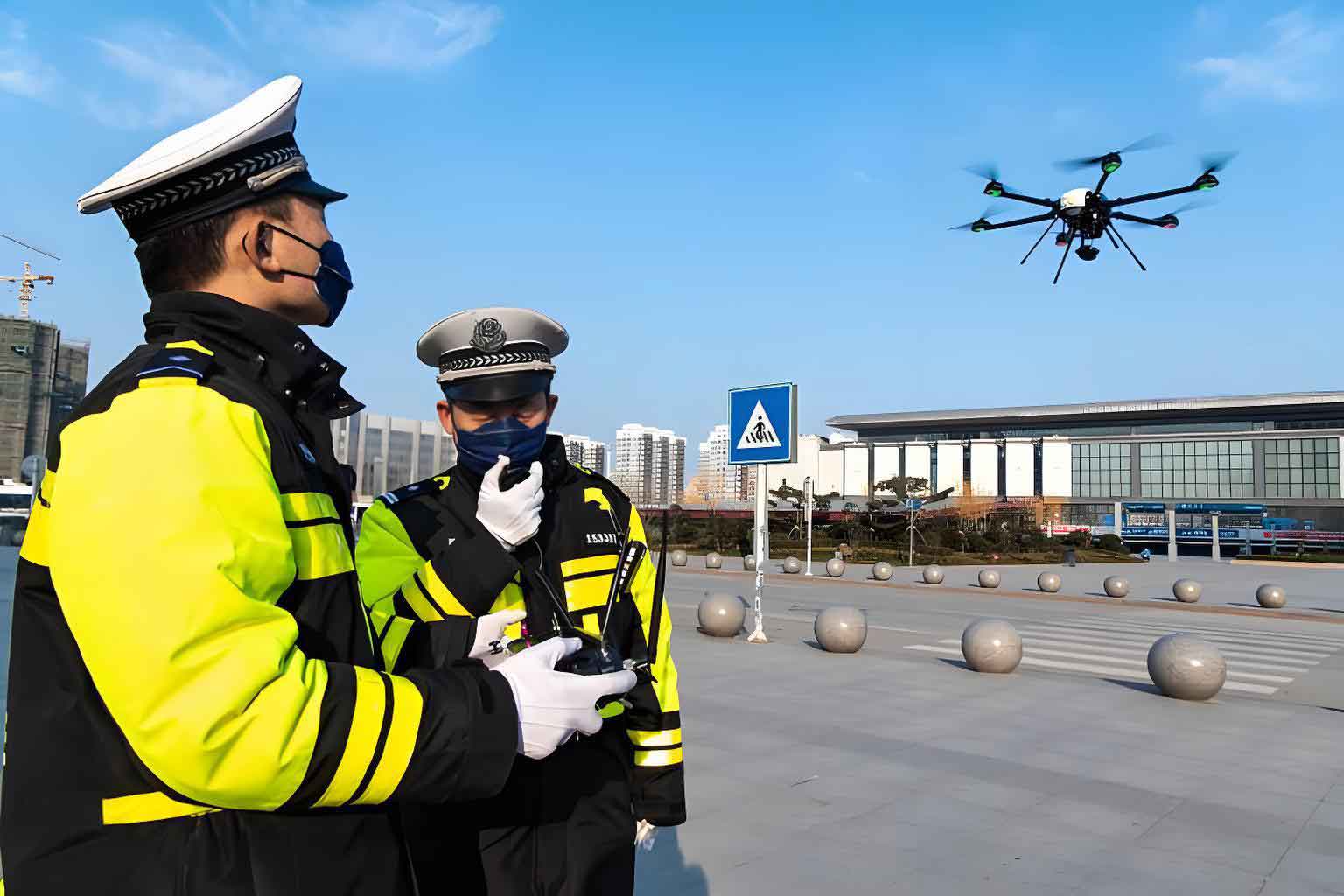
Our three-tier architecture adheres to stringent security standards while enabling comprehensive aerial monitoring. The Perception Layer integrates police UAVs equipped with multispectral cameras, 5G customized networks for low-latency transmission, and mobile control interfaces. The Data Layer employs geospatial databases for navigation precision, encrypted flight repositories, and specialized AI model libraries for object recognition. The Application Layer delivers tactical capabilities through real-time situational awareness, automated target identification, and coordinated response management.
| Architecture Layer | Components | Functionality |
|---|---|---|
| Perception Layer | Police drones, 5G networks, mobile controllers | Aerial data acquisition and control |
| Data Layer | Geospatial databases, encrypted storage, AI libraries | Secure information management |
| Application Layer | Tactical dashboards, automated analysis, command systems | Operational decision support |
Development Technology Stack
Frontend & Backend Infrastructure
The frontend utilizes Vue3 with Element Plus components for real-time geospatial visualization of police UAV positions and flight trajectories. Spring Boot powers backend operations, with Spring MVC processing HTTP requests through controller mappings. When receiving flight commands, the system executes control sequences through:
$$Command_{execute} = \mu \cdot \sum_{i=1}^{n} \frac{\partial ControlSignal}{\partial t_i} + \epsilon_{security}$$
Where \(\mu\) represents command validation parameters and \(\epsilon_{security}\) denotes encrypted transmission factors.
AI Vision Framework
Our computer vision system employs YOLOv11 with Transformer backbones for small object detection, trained on the VisDrone2021 dataset. The model achieves high-precision identification of vehicles, license plates, and traffic patterns through enhanced feature pyramid networks:
$$Precision = \frac{1}{N} \sum_{i=1}^{N} \left( \alpha \cdot \text{IoU}_{pred}^{truth} + \beta \cdot \text{Confidence}_{model} \right) \times 100\%$$
Where \(\alpha\) and \(\beta\) are weighting factors optimized for police drone operational altitudes.
Database Implementation
MySQL manages critical operational data with dual backup strategies ensuring data integrity. Key tables include:
| Table | Key Fields | Operational Purpose |
|---|---|---|
| UAV Equipment | UAV_ID, Controller_ID, Status_Code | Resource tracking and allocation |
| Flight Records | Route_Coordinates, Timestamps, Payload_Data | Mission analysis and replay |
| AI Models | Model_ID, Version, Detection_Type | Algorithm deployment management |
| Hangar Systems | Charging_Status, Maintenance_Logs | Operational readiness assurance |
Algorithm Integration Workflow
The operational workflow begins with police drone equipment verification, proceeding through command decisions with optional AI integration. When activated, computer vision algorithms process aerial imagery through parallel computational threads:
$$Detection_{confidence} = \sigma \left( \sum_{k=0}^{K} w_k \cdot f_k(\text{image}_{ROI}) + b \right)$$
Where \(\sigma\) represents the activation function, \(w_k\) denotes layer weights, and \(f_k\) indicates feature extraction operations at different scales. This enables real-time identification of vehicles, license plates, and traffic anomalies during police UAV surveillance missions.
System Testing Methodology
Testing Environment
The evaluation infrastructure featured a hyper-converged private cloud with three servers (2×32-core CPUs, 512GB RAM, 80TB storage). AI processing utilized NVIDIA A100 GPUs with 40GB VRAM. Six virtual machines hosted platform components with dedicated resources:
| Virtual Machine | vCPU | Memory | Function |
|---|---|---|---|
| Database Server | 16 | 32GB | Operational data management |
| AI Processing | 32 | 128GB | Computer vision computation |
| Streaming Server | 16 | 32GB | Video transmission |
Network configuration established 500Mbps dedicated channels with <20ms latency between police drones and command systems.
Performance Validation
Functional testing demonstrated 100% success in equipment management and flight operations. AI algorithms achieved remarkable accuracy in practical scenarios:
| Test Scenario | Algorithm | Samples | Accuracy |
|---|---|---|---|
| Traffic enforcement | Illegal parking detection | 187 vehicles | 97.3% |
| Road monitoring | Congestion analysis | 10 peak periods | 100% |
| Surveillance | License plate recognition | 854 vehicles | 95.2% |
Concurrent user tests confirmed operational stability under typical loads. The platform maintained <2s response times with 100 simultaneous users but experienced degradation beyond this threshold.
Operational Advantages and Future Applications
Our police UAV platform demonstrates exceptional performance in operational environments, successfully integrating flight control systems with AI analytics. The solution significantly enhances policing efficiency through:
- Rapid response deployment to inaccessible areas
- Automated detection of traffic violations and security threats
- Secure data management through encrypted private cloud infrastructure
- Coordinated resource management across multiple drone units
Future development will expand AI capabilities for crowd behavior analysis, forensic documentation, and predictive crime mapping. The platform’s modular architecture permits seamless integration of emerging sensors and algorithms, positioning police drones as central components in smart city security ecosystems. As computer vision and edge computing advance, police UAV platforms will increasingly transform urban safety management through comprehensive aerial monitoring networks.