
As I delve into the captivating world of formation drone light shows, I am constantly amazed by the intricate dance of unmanned aerial vehicles (UAVs) across the night sky. These spectacular displays, where hundreds of drones move in harmony to create luminous patterns, represent a pinnacle of coordinated control. The challenge lies not just in creating static shapes but in enabling dynamic, resilient, and autonomous formations that can adapt to complex environments. Inspired by the natural elegance of biological flocks, particularly pigeon flocks, I explore how their behavior mechanisms can revolutionize the design of formation drone light shows. This article delves into a bio-inspired control framework that leverages hierarchical structures and leadership models from pigeon flocks to achieve stunning and reliable aerial performances.
The essence of a formation drone light show is the seamless coordination of multiple drones to form and transition between visual patterns. Unlike traditional robotic systems, these shows require real-time adaptation, fault tolerance, and energy efficiency—all while maintaining aesthetic precision. Drawing parallels between drone swarms and animal groups, I find that pigeon flocks exhibit remarkable collective behaviors, such as context-dependent hierarchies and emergent leadership, which are ideal for mimicking in formation drone light shows. By studying these natural systems, I aim to develop control strategies that ensure drones can autonomously arrange into desired formations, such as geometric shapes or dynamic sequences, much like a flock of pigeons soaring in unison.
In pigeon flocks, individuals follow a strict hierarchical order, where each bird is influenced by specific leaders rather than a single central command. This decentralized approach enhances robustness, as the loss of one leader doesn’t collapse the entire formation. For formation drone light shows, this translates to a scalable and resilient architecture where drones can maintain patterns even if some units fail. I model this hierarchy using directed graphs, where each drone (or pigeon) is represented as a node, and edges denote leadership influences. Let me define a directed graph $$ \hat{D} = (\hat{V}, \hat{E}) $$, where $$ \hat{V} = \{v_1, v_2, \dots, v_n\} $$ represents the set of drones in a formation drone light show, and $$ \hat{E} = \{e_1, e_2, \dots, e_m\} $$ represents the leadership edges from higher-ranking to lower-ranking drones. The set of leaders for drone i is denoted as $$ N_i $$, which includes drones that directly influence its movement. For example, in a formation drone light show designed to mimic a “V” shape, the lead drone (v1) influences the first follower (v2), which in turn influences others, creating a cascade of control. This hierarchical network ensures that each drone in the formation drone light show has a clear role, reducing communication overhead and enhancing performance.
To quantify the leadership influences, I employ an artificial potential field method, which defines attractive and repulsive forces between drones. This approach is crucial for formation drone light shows, as it maintains safe distances while promoting cohesion. The potential function between drone i and its leader j is given by:
$$ P_{ij}(\| \mathbf{X}_{ij} \|) = \ln \| \mathbf{X}_{ij} \|^2 + \frac{d_{ij}^2}{\| \mathbf{X}_{ij} \|^2} $$
where $$ \mathbf{X}_{ij} = \mathbf{X}_i – \mathbf{X}_j $$ is the relative position vector, and $$ d_{ij} $$ is the desired separation distance for the formation drone light show. This function ensures that drones attract each other to form patterns but repel to avoid collisions—a key safety feature in crowded formation drone light show performances. The control input for each drone is derived from this potential, along with velocity alignment terms. For horizontal control in a formation drone light show, I define:
$$ u_{i,1-2} = \left( -K_p \sum_{j \in N_i} \nabla_{\| \mathbf{X}_{ij,1-2} \|} P_{ij} – K_v \sum_{j \in N_i} (\mathbf{v}_{i,1-2} – \mathbf{v}_{j,1-2}) – m_i (\mathbf{v}_{i,1-2} – \mathbf{v}_{1,1-2}) \right) \cdot w_1 + k_i \mathbf{v}_{i,1-2} $$
and for vertical control:
$$ u_{i,3} = \left( -K_h (\mathbf{X}_{i,3} – \mathbf{X}_{j,3}) – K_v \sum_{j \in N_i} (\mathbf{v}_{i,3} – \mathbf{v}_{j,3}) – m_i (\mathbf{v}_{i,3} – \mathbf{v}_{1,3}) \right) \cdot w_2 + k_i \mathbf{v}_{i,3} $$
Here, $$ K_p $$, $$ K_v $$, and $$ K_h $$ are gain factors tuned for the formation drone light show, $$ w_1 $$ and $$ w_2 $$ are scaling factors, and $$ m_i $$ is the drone mass. These equations drive the drones toward their target positions in the formation drone light show while synchronizing their velocities, ensuring smooth transitions that are vital for captivating audiences.
The drone dynamics are simplified for formation drone light show applications, focusing on key control inputs: speed, heading, and altitude. Each drone follows a 6-state model:
$$ \begin{aligned}
\dot{x}_i &= V_i \cos \psi_i, \\
\dot{y}_i &= V_i \sin \psi_i, \\
\dot{h}_i &= \lambda_i, \\
\dot{V}_i &= \frac{1}{\tau_v} (V_{i,c} – V_i), \\
\dot{\psi}_i &= \frac{1}{\tau_{\psi}} (\psi_{i,c} – \psi_i), \\
\dot{\lambda}_i &= -\frac{1}{\tau_{\lambda}} \lambda + \frac{1}{\tau_h} (h_{i,c} – h_i),
\end{aligned} $$
where $$ (x_i, y_i, h_i) $$ is the position, $$ V_i $$ is speed, $$ \psi_i $$ is heading, and $$ \lambda_i $$ is vertical rate. The control inputs $$ V_{i,c} $$, $$ \psi_{i,c} $$, and $$ h_{i,c} $$ are computed from the bio-inspired controller to orchestrate the formation drone light show. Practical constraints, such as speed limits and turn rates, are enforced to ensure safety and feasibility in real-world formation drone light show performances.
To implement this in a formation drone light show, I design an autonomous formation controller that integrates the pigeon-inspired model. The controller consists of two main parts: a behavior mechanism core (based on the hierarchical model) and auxiliary modules for control conversion and state transformation. This allows drones to interpret high-level formation commands—like “form a star shape” or “spiral dynamically”—into precise movements. The control flow for each drone in the formation drone light show is as follows: it receives state information from its leaders, computes desired control inputs using the potential field equations, converts these to actuator commands, and updates its position. This process repeats in real-time, enabling the formation drone light show to adapt to changes, such as wind gusts or failed drones, much like a pigeon flock adjusts its flight path.
In simulation, I test this approach for a formation drone light show involving multiple drones. The parameters are tuned to achieve stable formations, such as a “V” shape or a rotating circle. Below is a table summarizing key parameters for a typical formation drone light show setup:
| Parameter | Description | Value |
|---|---|---|
| $$ K_p $$ | Potential field gain | 170 |
| $$ K_v $$ | Velocity alignment gain | 1 |
| $$ K_h $$ | Height feedback gain | 5 |
| $$ d_{ij} $$ (for “V” shape) | Desired distance between drones | 10 m (varies by pair) |
| $$ \tau_v $$ | Speed time constant | 3 s |
| $$ \tau_{\psi} $$ | Heading time constant | 0.75 s |
These values ensure that the formation drone light show maintains cohesion without oscillations. Another table outlines the hierarchical structure for a 5-drone formation drone light show, illustrating the leadership network:
| Drone ID | Rank in Formation Drone Light Show | Leaders ($$ N_i $$) |
|---|---|---|
| 1 | Lead drone | None |
| 2 | First follower | 1 |
| 3 | Second follower | 1, 2 |
| 4 | Third follower | 1, 2, 3 |
| 5 | Third follower | 1, 2, 3 |
This hierarchy enables the formation drone light show to self-organize into complex patterns. During simulations, drones start from random positions and converge into the desired formation within seconds, showcasing the controller’s effectiveness for formation drone light show applications. The performance metric $$ Q $$, defined as the sum of position and velocity errors across the formation, decreases over time, indicating stable formation keeping even under dynamic conditions like sudden turns or altitude changes—a common requirement in formation drone light shows to create dramatic effects.
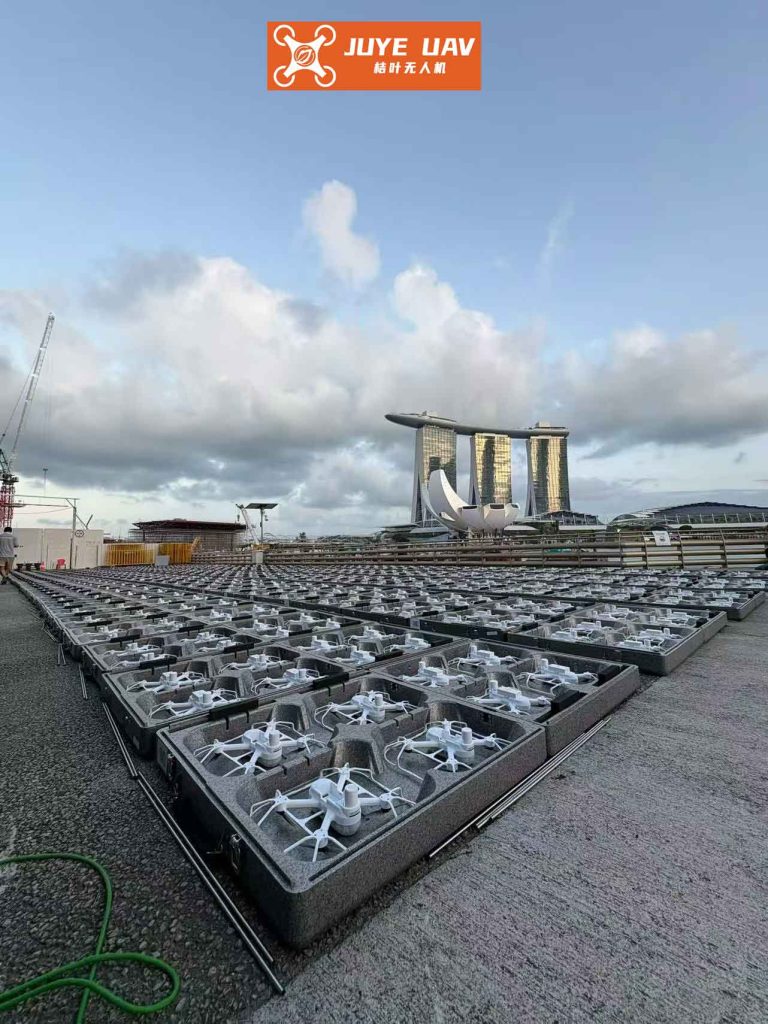
Visualizing a formation drone light show, as seen in the image above, highlights the beauty of coordinated flight. The drones, equipped with LED lights, form luminous patterns against the night sky, driven by the bio-inspired controller. This approach not only enhances reliability but also allows for creative flexibility—choreographers can design intricate sequences by simply adjusting the desired distances $$ d_{ij} $$ and hierarchy $$ N_i $$. For instance, to transition from a “V” shape to a circle in a formation drone light show, the controller smoothly recomputes potentials and velocities, ensuring minimal disruption. This adaptability is crucial for large-scale formation drone light shows, where hundreds of drones must synchronize perfectly to captivate audiences.
Moreover, the use of artificial potential fields in formation drone light shows provides inherent collision avoidance. As drones approach each other, the repulsive term in the potential function increases, nudging them apart without explicit programming. This safety feature is paramount in crowded formation drone light show performances, where drones fly in close proximity to create dense light patterns. The velocity alignment terms further ensure that drones move in unison, eliminating jerky motions that could mar the visual appeal of a formation drone light show.
In practice, implementing this for a formation drone light show involves integrating the controller with real-time communication systems. Drones exchange state information (position and velocity) with their leaders via wireless links, mimicking the visual and social cues in pigeon flocks. The hierarchical structure reduces bandwidth requirements, as each drone only needs data from a few neighbors rather than the entire swarm—a scalability advantage for massive formation drone light shows with thousands of units. Additionally, the decentralized nature means that if a drone malfunctions, others can reconfigure the formation drone light show autonomously, ensuring the show goes on seamlessly.
To further optimize formation drone light shows, I incorporate energy-efficient maneuvers. By minimizing control efforts through the gain tuning, drones conserve battery life, extending performance duration—a key consideration for commercial formation drone light show companies. The dynamics model includes constraints like maximum speed $$ V_{\text{max}} = 5 \, \text{m/s} $$ and turn rate limits to prevent unrealistic motions. These practical aspects ensure that the bio-inspired controller is not just theoretically sound but also viable for real-world formation drone light show deployments.
In conclusion, the fusion of pigeon flock behavior with advanced control theory offers a robust framework for formation drone light shows. This bio-inspired approach addresses core challenges: autonomous formation keeping, dynamic adaptation, and scalability. By modeling hierarchies with directed graphs and leadership with potential fields, drones in a formation drone light show can achieve mesmerizing choreographies that rival natural flocks. As I continue to refine this technology, the potential for formation drone light shows expands—from entertainment spectacles to applications in search-and-rescue or environmental monitoring, where coordinated drone swarms are essential. The future of formation drone light shows lies in embracing nature’s wisdom, creating harmonious aerial ballets that inspire and awe audiences worldwide.