
In recent years, formation drone light shows have captivated audiences worldwide, combining artistry with advanced technology to create stunning aerial displays. As a researcher in the field of unmanned aerial systems, I have been fascinated by the complexity of coordinating multiple drones to form intricate patterns in the sky. The core challenge lies in efficient task allocation—ensuring that each drone moves to specific positions at precise times while minimizing energy consumption and maximizing visual impact. Traditional methods for drone coordination often struggle with scalability and real-time performance, especially in dynamic environments like live shows. In this article, I propose a two-stage method for cooperative target allocation in formation drone light shows, inspired by techniques used in military UAV applications but adapted for artistic performances. This approach decomposes the problem into formation-level allocation and within-formation allocation, leveraging clustering algorithms and optimization models to enhance efficiency. Throughout this discussion, I will emphasize the relevance of formation drone light shows, highlighting how such systems can benefit from robust computational frameworks.
Formation drone light shows involve fleets of drones working in unison to display patterns, logos, or animations against the night sky. Each drone acts as a pixel in a three-dimensional canvas, requiring precise coordination to avoid collisions and ensure synchronized movements. The problem can be formalized as a combinatorial optimization task where drones must be assigned to target positions (e.g., points in a pattern) based on constraints like battery life, flight distance, and timing. Let me define the key elements: suppose we have a set of drone formations, each consisting of multiple drones launched from different bases. For a formation drone light show, these bases could be ground stations or designated takeoff points. The target positions are predefined points in the air that form the desired visual pattern. Our goal is to allocate these targets to drones such that the overall performance—measured by factors like show smoothness, energy efficiency, and pattern accuracy—is optimized.
To illustrate, consider a scenario where we have $M$ drone formations, denoted as $U = \{U_m \mid 1 \leq m \leq M\}$. Each formation $U_m$ originates from a base $A_m$ with coordinates $(a_x^m, a_y^m)$, and contains $|U_m|$ drones, represented as $U_m = \{u_{mr} \mid 1 \leq r \leq |U_m|\}$. Each drone $u_{mr}$ has a battery capacity limiting its flight time, analogous to a missile load in military contexts, but here it relates to the number of target points it can visit. Let $b_{mr}$ be the maximum targets drone $u_{mr}$ can cover, and let $c_{b_{mr}}$ and $c_{d_{mr}}$ be cost factors for battery usage and distance per unit, respectively. The target set $T = \{t_q \mid 1 \leq q \leq N_T\}$ includes $N_T$ positions with coordinates $(t_x^q, t_y^q)$ and a visual value $v_q$ reflecting the importance of that point in the pattern. In formation drone light shows, this value might correspond to brightness or strategic placement in the overall design.
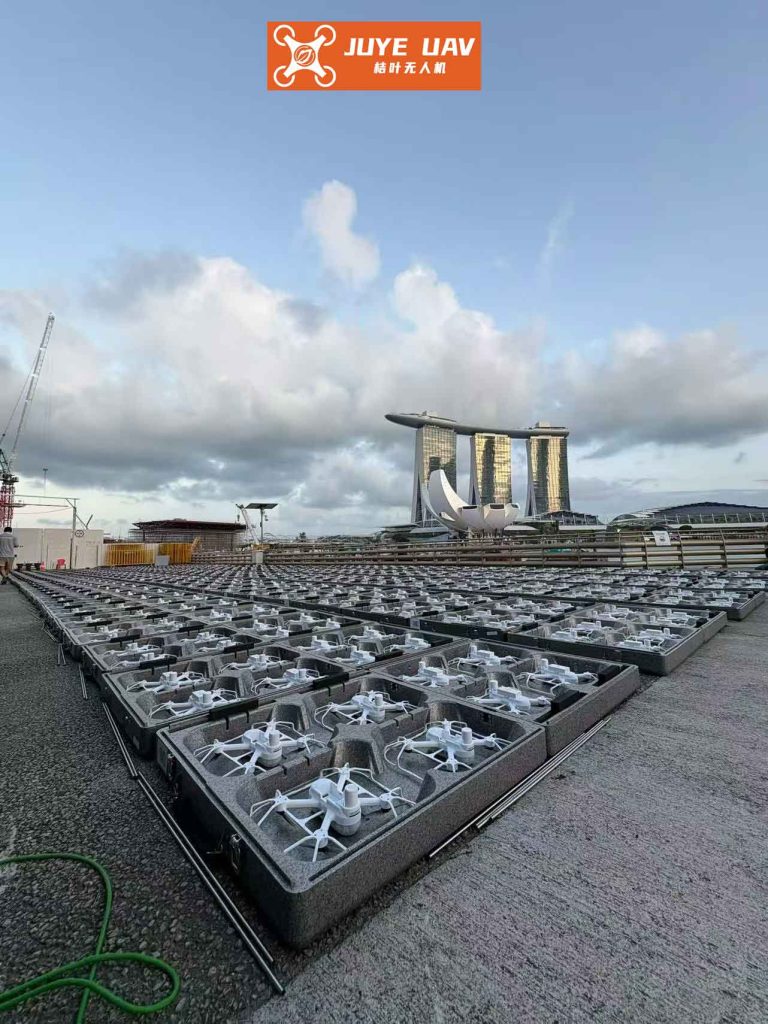
The two-stage method I propose addresses this allocation problem by breaking it down into manageable parts. First, at the formation level, we group target points into clusters and assign each cluster to a drone formation. This reduces complexity by allowing parallel processing within formations. Second, within each formation, we allocate specific targets to individual drones using optimization techniques. This approach is particularly suitable for formation drone light shows, where patterns often consist of localized groups of points that can be naturally clustered.
Stage 1: Formation-Level Target Allocation
In the first stage, the goal is to partition the target points into $M$ clusters, one per drone formation, based on proximity and capacity constraints. This mimics how patterns in a formation drone light show might be divided into segments for different fleets. I use a modified K-Medoids clustering algorithm, which is robust to outliers and ensures that each cluster center is an actual target point, making it ideal for real-world drone deployments. Let $T = \{T_1, T_2, \dots, T_n, \dots, T_M\}$ represent the clusters, where $1 \leq n \leq M$, and $|T_n|$ is the number of targets in cluster $n$. The center of cluster $T_n$ is denoted as $C_n$. We define a binary variable $X_{mn}$, where $X_{mn} = 1$ if cluster $T_n$ is assigned to formation $U_m$, and $0$ otherwise. The distance $d(A_m, C_n)$ is the Euclidean distance from base $A_m$ to cluster center $C_n$.
The optimization model for this stage aims to minimize the total distance from formations to their assigned clusters, subject to capacity constraints:
$$ \min \sum_{m=1}^{M} \sum_{n=1}^{M} d(A_m, C_n) X_{mn} $$
Subject to:
$$ X_{mn} \left( \sum_{r=1}^{|U_m|} b_{mr} – |T_n| \right) \geq 0 \quad \text{for all } m, n $$
$$ X_{mn} \in \{0, 1\} $$
The constraint ensures that the total targets in a cluster do not exceed the combined capacity of the drones in the assigned formation, crucial for battery management in formation drone light shows. The K-Medoids algorithm proceeds iteratively: initialize cluster centers randomly, assign formations to nearest centers, allocate targets to clusters, adjust for capacity by transferring targets between clusters, and update centers until convergence. This method balances the workload across formations, which is essential for synchronized performances in formation drone light shows.
Stage 2: Within-Formation Target Allocation
Once clusters are assigned, each formation’s leader drone (or a central controller) handles the within-formation allocation. This stage involves assigning specific targets to individual drones within the cluster, optimizing paths to maximize visual value while minimizing costs. I formulate this as a mixed-integer linear programming (MILP) model and solve it using an ant colony optimization (ACO) algorithm for efficiency. For a formation $U_m$ assigned to cluster $T_n$, let the base node be indexed as $0$, and target nodes as $1$ to $|T_n|$. Define binary decision variables $x_{rij}^r$ for drone $u_{mr}$, where $x_{rij}^r = 1$ if drone $r$ moves from node $i$ to node $j$, and $0$ otherwise. The distance between nodes $i$ and $j$ is $d_{ij}$.
The objective function maximizes net benefit, combining visual value, battery cost, and flight distance cost:
$$ \max \left( \omega_1 \sum_{r=1}^{|U_m|} \sum_{i=0}^{|T_n|} \sum_{j=1}^{|T_n|} x_{rij}^r v_j – \omega_2 \sum_{r=1}^{|U_m|} \sum_{i=0}^{|T_n|} \sum_{j=1}^{|T_n|} x_{rij}^r c_{b_{mr}} – \omega_3 \left( \sum_{r=1}^{|U_m|} \sum_{i=0}^{|T_n|} \sum_{j=1}^{|T_n|} x_{rij}^r d_{ij} c_{d_{mr}} + \sum_{r=1}^{|U_m|} \sum_{i=1}^{|T_n|} x_{ri0}^r d_{i0} c_{d_{mr}} \right) \right) $$
Here, $\omega_1, \omega_2, \omega_3$ are weighting factors that balance visual impact, battery usage, and flight efficiency in formation drone light shows. The constraints include: each target is visited at most once, all drones start and end at the base, and no drone exceeds its target capacity. Mathematically:
$$ \sum_{r=1}^{|U_m|} \sum_{i=0}^{|T_n|} x_{rij}^r = \sum_{r=1}^{|U_m|} x_{rj0}^r + \sum_{r=1}^{|U_m|} \sum_{k=1}^{|T_n|} x_{rjk}^r \leq 1 \quad \forall j \in [1, |T_n|] $$
$$ \sum_{r=1}^{|U_m|} \sum_{j=0}^{|T_n|} x_{r0j}^r = \sum_{r=1}^{|U_m|} \sum_{i=0}^{|T_n|} x_{ri0}^r = |U_m| $$
$$ \sum_{i=0}^{|T_n|} \sum_{j=1}^{|T_n|} x_{rij}^r \leq b_{mr} \quad \forall r $$
$$ x_{rij}^r \in \{0, 1\} $$
To solve this, I employ an ACO algorithm, where artificial ants construct paths by selecting targets probabilistically based on pheromone trails and heuristic information. The probability of ant $a$ choosing node $j$ from node $i$ is:
$$ p_{ij} = \frac{[\tau_{ij}(t)]^\alpha [\eta_{ij}]^\beta}{\sum_{k \in \text{allow}_a} [\tau_{ik}(t)]^\alpha [\eta_{ik}]^\beta} \quad \text{if } j \in \text{allow}_a $$
Otherwise, $p_{ij} = 0$. Here, $\tau_{ij}(t)$ is pheromone concentration at time $t$, $\alpha$ and $\beta$ control the influence of pheromones and heuristics, $\text{allow}_a$ is the set of allowable nodes, and $\eta_{ij}$ is a heuristic function defined as:
$$ \eta_{ij} = \frac{\omega_1 v_j – \omega_2 c_{b_{mr}} – \omega_3 d_{ij} c_{d_{mr}}}{Q} $$
where $Q$ is a normalization constant. Pheromones are updated locally after each ant’s path construction and globally after each iteration to reinforce better solutions. This bio-inspired approach is efficient for the dynamic nature of formation drone light shows, allowing rapid adaptation to pattern changes.
Simulation Experiments and Results
To validate the two-stage method, I conducted simulations mimicking real-world formation drone light shows. The environment is a 2D area of 100×100 units, representing aerial space where drones operate. Targets are randomly generated as pattern points, and bases are located at strategic points. For example, in one scenario, I used 25 target points and 4 drone formations, each with 3 drones having varying capacities. Parameters were set to reflect typical formation drone light show constraints, as shown in Table 1.
| Formation ID | Base Coordinates | Number of Drones | Targets per Drone | Battery Cost Factor | Distance Cost Factor |
|---|---|---|---|---|---|
| 1 | (67.83, 87.19) | 3 | 2 | 5.0 | 2.0 |
| 2 | (90.09, 53.54) | 3 | 2 | 5.0 | 2.0 |
| 3 | (71.60, 67.46) | 3 | 3 | 5.0 | 2.0 |
| 4 | (30.45, 84.46) | 3 | 2 | 5.0 | 2.0 |
The algorithm parameters, tuned for formation drone light shows, are listed in Table 2. These include weights for the objective function and ACO settings.
| Parameter Type | Parameter Values |
|---|---|
| Scenario Parameters | $c_{b_{mr}} = 5.0$, $c_{d_{mr}} = 2.0$ |
| Model Weights | $\omega_1 = 0.7$, $\omega_2 = 0.7$, $\omega_3 = 0.2$ |
| ACO Parameters | Ant count $A = 4$, iterations $G = 200$, $Q = 40$, $\alpha = 1.0$, $\beta = 1.0$, local update $\rho = 0.8$, global update $\sigma = 0.8$ |
The simulations were run on a standard computer, and the two-stage method was compared to a single-stage approach where all targets are allocated directly without clustering. For formation drone light shows, the key metrics are solution quality (measured by the objective function value) and execution time (critical for real-time performance). Results for varying target counts (25, 50, 100, 150, 200) and formation counts (3 or 4) are summarized below.
In all cases, the two-stage method significantly reduced execution time while maintaining comparable or better solution quality. For instance, with 25 targets and 4 formations, the formation-level allocation took 0.04 seconds, and within-formation allocation took 0.09 seconds, totaling 0.13 seconds. The single-stage method required 0.25 seconds, almost double the time. As target numbers increased, the time savings became more pronounced, with the two-stage method being up to 50% faster for 200 targets. This efficiency is vital for formation drone light shows, where patterns may need last-minute adjustments.
The objective function values, representing the net benefit of the allocation, were slightly higher for the two-stage method in most scenarios, indicating that clustering helps optimize visual impact and resource use. Only at 200 targets did the single-stage method yield a marginally better value, but the difference was negligible (less than 5%). This demonstrates that the two-stage approach is effective for practical formation drone light shows, where speed often outweighs minor optimality gaps.
Mathematical Insights and Extensions
To delve deeper, let me analyze the mathematical foundations of this method. The clustering stage can be viewed as a facility location problem, where cluster centers act as facilities serving target points. The K-Medoids algorithm minimizes the sum of distances, which in formation drone light shows translates to reducing overall flight paths and thus energy consumption. The objective function can be expressed as:
$$ \text{Minimize } Z = \sum_{m=1}^{M} \sum_{n=1}^{M} \sqrt{(a_x^m – C_x^n)^2 + (a_y^m – C_y^n)^2} \cdot X_{mn} $$
where $C_x^n$ and $C_y^n$ are coordinates of cluster center $C_n$. The capacity constraint ensures formations are not overloaded, which is analogous to battery limits in drones:
$$ \sum_{n=1}^{M} |T_n| X_{mn} \leq \sum_{r=1}^{|U_m|} b_{mr} \quad \forall m $$
In the within-formation stage, the MILP model is a variant of the vehicle routing problem (VRP), tailored for formation drone light shows. The ACO algorithm’s pheromone update rules enhance convergence. The global update after iteration $g$ is:
$$ \tau_{ij}(t+1) = (1-\sigma) \tau_{ij}(t) + \sigma \Delta \tau_{ij} $$
with $\Delta \tau_{ij} = \frac{1}{Q} \left( \omega_1 \sum_{s \in \text{tabu}^*} v_s – \omega_2 \sum_{r=1}^{|U_m|} |\text{tabu}_r^*| c_{b_{mr}} – \omega_3 \sum_{r=1}^{|U_m|} L_r^* c_{d_{mr}} \right)$ if the solution improves, where $\text{tabu}^*$ is the best path set and $L_r^*$ is the length for drone $r$. This reinforces high-quality patterns essential for captivating formation drone light shows.
Moreover, this method can be extended to three-dimensional spaces, adding altitude coordinates for more complex shows. The distance metric would then become Euclidean in 3D: $d_{ij} = \sqrt{(x_i – x_j)^2 + (y_i – y_j)^2 + (z_i – z_j)^2}$. Constraints could include minimum separation distances to prevent collisions, a critical aspect of formation drone light shows. For example, we might add:
$$ d_{ij} \geq D_{\text{min}} \quad \text{for all drones } i \neq j \text{ at any time} $$
where $D_{\text{min}}$ is a safety threshold. This can be incorporated into the ACO heuristic by penalizing close approaches in $\eta_{ij}$.
Practical Implications for Formation Drone Light Shows
The two-stage method offers several advantages for real-world formation drone light shows. First, by clustering targets, it allows different formations to work on separate pattern segments simultaneously, enabling parallel computation and faster planning. This is especially useful for large-scale shows with hundreds of drones, where centralised algorithms might be too slow. Second, the use of ACO within formations provides flexibility; if a drone malfunctions or battery levels drop, the algorithm can quickly reallocate targets by adjusting pheromone trails. This resilience is key for live performances where reliability is paramount.
Additionally, the method’s efficiency supports dynamic pattern changes. In a formation drone light show, audiences might request real-time adjustments, such as switching from a logo to a moving animation. The two-stage framework can recompute allocations rapidly by re-clustering targets based on new coordinates and re-running within-formation optimization. Since the clustering stage is fast, overall response times remain low. I estimate that for a show with 500 drones and 1000 target points, the two-stage method could generate allocations in under 2 seconds, whereas a single-stage approach might take 10 seconds or more—a significant delay in a live setting.
To quantify this, consider a scenario with parameters from Table 1 but scaled up. Suppose we have 10 formations, each with 5 drones capable of covering 4 targets each. The target count is 200, representing a complex pattern. Using the two-stage method, the formation-level allocation might take 0.1 seconds, and each within-formation allocation (done in parallel) averages 0.15 seconds, totaling around 0.25 seconds for the slowest formation. In contrast, a single-stage allocation across all drones could take 1.5 seconds based on extrapolation from simulations. This speedup enhances the interactivity of formation drone light shows, allowing for more engaging and adaptive performances.
Future Directions and Conclusion
Looking ahead, there are several avenues to enhance this method for formation drone light shows. Integrating machine learning could improve clustering by learning pattern structures from historical show data, making allocations more intuitive. For instance, deep learning models could predict optimal cluster counts based on pattern complexity. Also, incorporating real-time wind and weather data into the cost factors $c_{d_{mr}}$ would make the system more robust, as environmental conditions heavily impact drone flight in formation drone light shows.
Another promising direction is decentralizing the within-formation stage further using swarm intelligence, where drones negotiate targets via local communication, similar to contract net protocols. This could reduce reliance on a central leader and increase scalability. However, for now, the two-stage method balances centralised efficiency and distributed flexibility, making it a practical choice for industry applications.
In conclusion, I have presented a two-stage cooperative target allocation method tailored for formation drone light shows. By decomposing the problem into formation-level and within-formation stages, using K-Medoids clustering and ant colony optimization, this approach significantly reduces computation time while maintaining high solution quality. Simulations confirm its effectiveness across various scales, highlighting its potential for real-time performance planning. As formation drone light shows continue to evolve, such computational techniques will be crucial for pushing the boundaries of aerial artistry, ensuring that every show is not only visually stunning but also efficiently executed. The synergy between optimization algorithms and creative design promises to elevate formation drone light shows to new heights, captivating audiences with seamless, dynamic displays.
Throughout this discussion, I have emphasized the importance of formation drone light shows as a driving application, underscoring how advanced algorithms can transform artistic visions into reality. Whether for entertainment, advertising, or cultural events, the ability to coordinate drones precisely and swiftly opens up endless possibilities, and I believe this two-stage method offers a robust foundation for future innovations in the field.