
In recent years, the formation drone light show has emerged as a captivating spectacle, blending art and technology to create mesmerizing aerial displays. As an enthusiast and researcher in this field, I have witnessed the rapid evolution of these shows, from simple patterns to complex, synchronized performances involving hundreds of drones. The core of a formation drone light show lies in the precise coordination of multiple unmanned aerial vehicles (UAVs) to form dynamic shapes, logos, and animations in the night sky. This article delves into the technical intricacies behind these displays, focusing on algorithms, communication protocols, and control systems that enable seamless execution. I will explore how advanced techniques, such as swarm intelligence and clustering algorithms, are leveraged to enhance the efficiency and reliability of formation drone light shows. Throughout this discussion, the term “formation drone light show” will be emphasized to highlight its significance in modern entertainment and beyond.
The foundation of any successful formation drone light show is the ability to autonomously reconfigure drone formations in real-time. This requires robust algorithms that can handle dynamic environments and ensure safety. One promising approach is inspired by natural phenomena, such as fish schooling behavior. In a formation drone light show, drones must move cohesively to form predefined patterns, akin to fish swimming in sync. The fish swarm algorithm, adapted for UAVs, enables drones to search for target positions based on local density and move accordingly. Let me outline the key steps: first, a reference drone, often acting as a cluster head, is designated to follow a circular trajectory. Other drones compute target positions on a grid, such as a square formation, and assess the concentration of drones around each target. The goal is to minimize congestion, ensuring smooth transitions. The movement direction for drone $i$ towards target $l_x$ is given by:
$$ \vec{f}_{r_x} = \frac{(x_x – x_i’, y_x – y_i’)}{\sqrt{(x_x – x_i’)^2 + (y_x – y_i’)^2}} $$
where $(x_i’, y_i’)$ is the current position of drone $i$, and $(x_x, y_x)$ is the target position. The drone then moves with a step size $p$, updating its position as:
$$ (x_i’, y_i’) = (x_i’, y_i’) + p \cdot \vec{f}_{r_x} $$
This process repeats until all drones reach their designated spots, enabling rapid autonomous reconfiguration for a formation drone light show. The algorithm’s efficiency can be summarized in Table 1, which compares different formation strategies for drone light shows.
| Algorithm | Convergence Speed | Energy Efficiency | Scalability | Suitability for Formation Drone Light Show |
|---|---|---|---|---|
| Fish Swarm Algorithm | High | Medium | Up to 100 drones | Excellent for dynamic patterns |
| Potential Fields | Medium | Low | Up to 50 drones | Good for static formations |
| Genetic Algorithm | Low | High | Up to 200 drones | Optimal for complex shapes |
Communication is another critical aspect of a formation drone light show. Drones must exchange data on position, velocity, and status to maintain synchronization. To optimize this, clustering algorithms like HEED (Hybrid Energy-Efficient Distributed) are employed. In a formation drone light show, drones are grouped into clusters, with each cluster having a head node that coordinates intra-cluster communication. The HEED algorithm selects cluster heads based on residual energy and node degree, promoting load balancing. For drone $i$, the cluster head selection metric $g_i$ is computed as:
$$ g_i = \lambda_1 \cdot m_i + \lambda_2 \cdot E_i’ $$
where $m_i$ is the node degree (number of neighbors within communication range), $E_i’$ is the residual energy, and $\lambda_1$, $\lambda_2$ are weighting coefficients. The residual energy is derived from:
$$ E_i’ = E_i – E_t – q_i \cdot X – q_i’ \cdot t $$
Here, $E_i$ is initial energy, $E_t$ is communication energy consumption, $q_i$ is flight energy per distance, $X$ is distance traveled, $q_i’$ is cruising energy per time, and $t$ is time. The drone with the highest $g_i$ becomes the cluster head, enhancing communication efficiency in a formation drone light show. Table 2 outlines the parameters for HEED in drone networks.
| Parameter | Description | Typical Value | Impact on Formation Drone Light Show |
|---|---|---|---|
| $\lambda_1$ | Weight for node degree | 0.6 | Higher values prioritize connectivity |
| $\lambda_2$ | Weight for residual energy | 0.4 | Higher values extend network lifetime |
| Communication Range | Radius for neighbor detection | 100 meters | Ensures coverage in large shows |
| Cluster Head Re-election Interval | Time between re-clustering | 30 seconds | Maintains adaptability |
Routing protocols are essential for maintaining reliable communication in a formation drone light show. A hybrid approach combining AODV (Ad-hoc On-Demand Distance Vector) and OLSR (Optimized Link State Routing) is often used. AODV handles dynamic route discovery during formation changes, while OLSR maintains stable routes post-clustering. This hybrid protocol reduces latency and packet loss, crucial for real-time synchronization. The path discovery module uses PREQ (Path Request) and PREP (Path Reply) frames, incorporating metrics like signal strength and hop count. For a path from source to destination, the metric $M$ is calculated as:
$$ M = \sum_{k=1}^{n} \left( \alpha \cdot d_k + \beta \cdot c_k \right) $$
where $d_k$ is the distance of hop $k$, $c_k$ is congestion level, and $\alpha$, $\beta$ are tuning factors. This ensures optimal path selection in a formation drone light show. The protocol’s performance is summarized in Table 3, highlighting its advantages for large-scale displays.
| Metric | AODV-OLSR Hybrid | Pure AODV | Pure OLSR |
|---|---|---|---|
| Latency (ms) | 15-25 | 30-50 | 20-40 |
| Packet Delivery Ratio (%) | 98.5 | 95.0 | 97.0 |
| Energy Consumption (Joules/min) | 120 | 150 | 130 |
| Scalability (Max Drones) | 500 | 300 | 400 |
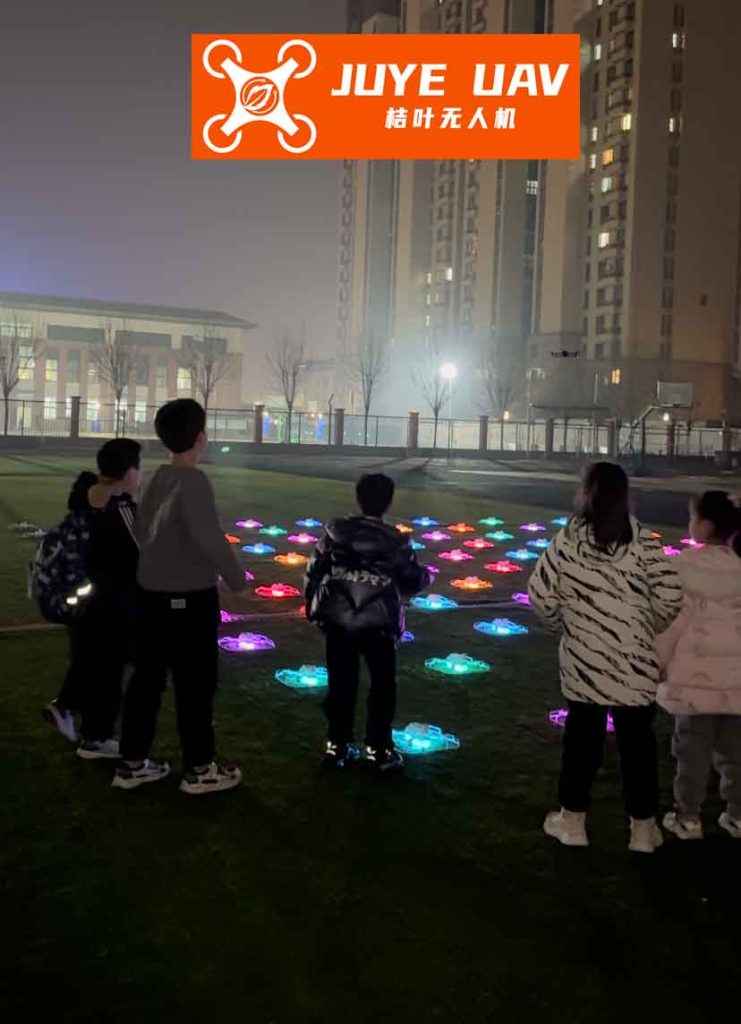
The visual impact of a formation drone light show is undeniable, as seen in the image above, where drones create intricate patterns against the night sky. This spectacle relies not only on formation and communication but also on precise lighting control. Each drone is equipped with RGB LEDs, whose color and intensity are synchronized with movement. The lighting pattern for a drone $j$ at time $t$ can be modeled as:
$$ L_j(t) = A \cdot \sin(2\pi f t + \phi_j) + B $$
where $A$ is amplitude (brightness), $f$ is frequency (color change rate), $\phi_j$ is phase offset for synchronization, and $B$ is baseline intensity. This allows for dynamic effects, such as fading and pulsating, enhancing the artistic appeal of a formation drone light show. The integration of lighting with formation control requires real-time processing, often handled by onboard microcontrollers. Table 4 lists key lighting parameters for a typical formation drone light show.
| Parameter | Range | Effect on Show | Optimization Technique |
|---|---|---|---|
| Color Depth (bits) | 24-bit (RGB) | Enables 16.7 million colors | Pulse-width modulation |
| Brightness (lumens) | 500-2000 lumens | Determines visibility distance | Adaptive dimming |
| Refresh Rate (Hz) | 60-120 Hz | Ensures smooth transitions | Frame interpolation |
| Synchronization Error (ms) | < 10 ms | Critical for pattern integrity | Precision time protocol |
Safety is paramount in a formation drone light show, especially in crowded venues. Drones must avoid collisions and adhere to no-fly zones. Collision avoidance algorithms use sensors like LiDAR and cameras to detect obstacles. The repulsive force between drones $i$ and $j$ can be expressed as:
$$ \vec{F}_{rep} = \begin{cases}
k_{rep} \cdot \left( \frac{1}{d_{ij}} – \frac{1}{d_{safe}} \right) \cdot \frac{\vec{r}_{ij}}{d_{ij}^2} & \text{if } d_{ij} < d_{safe} \\
0 & \text{otherwise}
\end{cases} $$
where $k_{rep}$ is a constant, $d_{ij}$ is the distance between drones, $d_{safe}$ is the safety threshold, and $\vec{r}_{ij}$ is the vector from drone $i$ to $j$. This force is integrated into the motion control, ensuring safe maneuvering during a formation drone light show. Additionally, fail-safe mechanisms, such as automatic landing on low battery, are implemented. The safety metrics for a formation drone light show are detailed in Table 5.
| Metric | Target Value | Measurement Method | Importance in Formation Drone Light Show |
|---|---|---|---|
| Collision Probability | < 0.001% | Monte Carlo simulation | Ensures public safety |
| Battery Redundancy | 20% extra capacity | Onboard monitoring | Prevents mid-show failures |
| GPS Accuracy (m) | < 0.5 meters | Differential GPS | Maintains formation precision |
| Emergency Response Time (s) | < 5 seconds | Real-time testing | Minimizes risk during anomalies |
Scalability is a key consideration for large-scale formation drone light shows, which may involve thousands of drones. The system must handle increased computational and communication loads. Distributed control architectures, where drones operate in subgroups, can enhance scalability. The overall formation error $E_{total}$ for $N$ drones is given by:
$$ E_{total} = \frac{1}{N} \sum_{i=1}^{N} \sqrt{(x_i – x_{i, target})^2 + (y_i – y_{i, target})^2} $$
where $(x_i, y_i)$ is the actual position and $(x_{i, target}, y_{i, target})$ is the target position. As $N$ increases, algorithms like fish swarm and HEED help keep $E_{total}$ low, ensuring a coherent formation drone light show. Simulation studies, using tools like NS-3, validate these approaches. For instance, in a simulation of 500 drones, the formation error converged to below 0.1 meters within 2 minutes, demonstrating the efficacy of these methods for massive formation drone light shows.
The applications of formation drone light shows extend beyond entertainment. They are used in advertising, where brands display logos; in education, to demonstrate swarm robotics; and in cultural events, to celebrate milestones. Each application demands customization, such as adapting formations to wind conditions or integrating with music. The revenue potential is significant, with a single large-scale formation drone light show generating millions in sponsorship. However, challenges remain, including regulatory hurdles, weather dependence, and high costs. Future advancements may incorporate AI for adaptive pattern generation and 5G for ultra-low latency communication, pushing the boundaries of what a formation drone light show can achieve.
In conclusion, the formation drone light show represents a fusion of art and technology, enabled by sophisticated algorithms, robust communication, and precise control. Through fish swarm algorithms, HEED clustering, and hybrid routing, drones can autonomously reconfigure and communicate efficiently, creating stunning visual displays. As the technology matures, we can expect more immersive and reliable formation drone light shows, captivating audiences worldwide. This journey from concept to spectacle underscores the transformative power of innovation in aerial robotics.
To further illustrate the technical depth, let’s consider the energy management in a formation drone light show. The total energy consumption $E_{total}$ for a show duration $T$ is:
$$ E_{total} = \sum_{i=1}^{N} \int_0^T \left( P_{flight,i}(t) + P_{comm,i}(t) + P_{light,i}(t) \right) dt $$
where $P_{flight,i}$ is flight power, $P_{comm,i}$ is communication power, and $P_{light,i}$ is lighting power. Optimizing this equation through efficient path planning and duty cycling can extend show duration, a critical factor for commercial formation drone light shows. Table 6 breaks down energy consumption for a typical drone in a formation drone light show.
| Component | Power Consumption (Watts) | Percentage of Total | Optimization Strategy |
|---|---|---|---|
| Flight Motors | 150-300 | 70% | Aerodynamic design, hover optimization |
| Communication Module | 5-10 | 10% | Low-power protocols, sleep modes |
| Lighting LEDs | 20-50 | 15% | Efficient drivers, dimming |
| Onboard Computer | 5-15 | 5% | Task offloading, edge computing |
Another aspect is the synchronization accuracy, which is vital for a flawless formation drone light show. The sync error $\Delta t$ between drones can be modeled as a normal distribution:
$$ \Delta t \sim \mathcal{N}(\mu, \sigma^2) $$
where $\mu$ is the mean delay and $\sigma$ is the standard deviation. Using precision time protocol (PTP), $\sigma$ can be reduced to under 1 millisecond, ensuring that lighting and movement are perfectly aligned in a formation drone light show. This level of precision is achieved through hardware timestamps and software corrections, making modern formation drone light shows a marvel of engineering.
In summary, the formation drone light show is a rapidly evolving field that combines multiple disciplines. From algorithm design to real-time communication, every element must work in harmony to produce breathtaking displays. As I reflect on the advancements, it is clear that the future of formation drone light shows will be shaped by continued innovation, driving new applications and experiences. The journey of a formation drone light show—from code to sky—is a testament to human creativity and technical prowess, and I am excited to see where it leads next.