
When I witness a formation drone light show, where hundreds of luminescent points dance in perfect unison, painting three-dimensional shapes against the night canvas, I am not just seeing an artistic spectacle. I am observing a profound demonstration of coordinated autonomy—a microcosm of the complex technological symphony required for the next generation of aerial systems. While the immediate goal is aesthetic, the underlying principles of command, control, communication, and cooperation (C4) are direct analogues to more critical applications, from logistics swarms to the collaborative missions between manned and unmanned aircraft that are defining future aerospace strategy. The mesmerizing patterns of a formation drone light show are, in essence, a visible and accessible proof-of-concept for distributed intelligence and real-time orchestration.
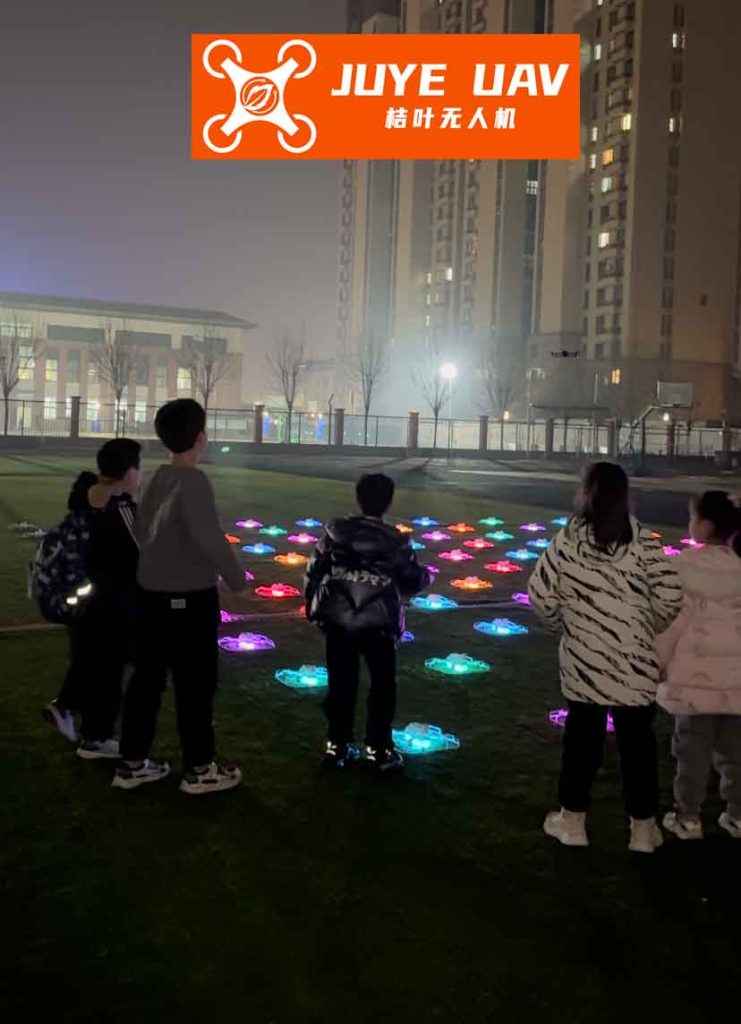
The transition from a single drone to a coordinated fleet represents a quantum leap in complexity. In a formation drone light show, each unit is an agent with localized sensing, processing, and actuation capabilities. Their collective behavior emerges from a carefully designed hierarchical control architecture. Similarly, in advanced military and industrial contexts, the paradigm is shifting from standalone platforms to integrated teams where intelligent assets collaborate. The core challenge remains consistent: how to efficiently translate a high-level mission objective (“display a rotating globe,” “suppress enemy air defenses,” “map a disaster zone”) into safe, efficient, and dynamically adaptable actions for each member of the group. The precision demanded by a flawless formation drone light show underscores the precision required in these life-critical systems.
Architectural Foundations: How the Flock is Organized
The efficacy of any multi-agent system, be it for a formation drone light show or a tactical mission, hinges on its organizational architecture. This defines the logical and physical relationships governing command, control, and information flow. Three primary models dominate, each with trade-offs between robustness, scalability, and central control.
1. Centralized Architecture: This is the simplest model, analogous to a single conductor leading an orchestra. One central controller (e.g., a powerful ground station or a lead aircraft) receives all data, makes all decisions (trajectory, timing, payload), and disseminates explicit commands to every other agent. In a formation drone light show, this might be a single computer calculating all flight paths offline.
$$ \text{Central Node: } C(t) = \arg \min_{u_1,…,u_N} J(x_1,…,x_N, u_1,…,u_N, t) $$
Where \(C(t)\) is the central command at time \(t\), \(u_i\) are the control inputs for drone \(i\), \(x_i\) are their states, and \(J\) is a global cost function (e.g., for smooth motion and collision avoidance). While simple and guaranteeing global optimality in planning, this architecture presents a single point of failure. Loss of the central node or its communication links cripples the entire system. It also requires immense bandwidth and processing power as the swarm size grows, making it impractical for large-scale, dynamic formations.
2. Distributed Architecture: Here, the “conductor” disappears. All agents are peers, endowed with equal authority and sophisticated onboard intelligence. They negotiate and coordinate through local communication to achieve a common goal, much like a flock of starlings. Decision-making is decentralized.
$$ \text{Local Decision for agent } i: u_i(t) = f_i(x_i, \hat{x}_{j \in \mathcal{N}_i}, M) $$
Here, \(u_i(t)\) depends on the agent’s own state \(x_i\), the estimated states \(\hat{x}\) of its neighbors \(j\) in communication range \(\mathcal{N}_i\), and the mission objective \(M\). This architecture is highly robust and scalable; the loss of any single agent is inconsequential to the group’s overall capability. However, it demands very high levels of autonomy and reliable local communication from each platform. Reaching a globally optimal solution through local bargaining can be computationally challenging and slow, a critical factor when designing a complex, time-sensitive formation drone light show sequence.
3. Hybrid or Hierarchical Architecture: This is the most prevalent and promising model for complex operations, combining the strengths of the previous two. It features a layered structure, creating a balance between centralized oversight and distributed execution. This model is perfectly suited for managing a large-scale formation drone light show or a mixed team of manned and unmanned assets.
The hierarchical model typically consists of three tiers:
| Tier | Role | Analogy in Formation Drone Light Show | Key Functions |
|---|---|---|---|
| Mission / Fleet Layer | Strategic Commander | Show Designer & Producer | Defines overall show narrative, splits it into major acts (e.g., “logo reveal,” “kinetic sculpture”). Allocates groups of drones to each act. |
| Group / Squadron Layer | Tactic Commander | Choreographer & Conductor | For its assigned act, decomposes the act into specific patterns and transitions. Coordinates timing and handoffs between subgroups. A “lead drone” or sub-station may act as this layer’s node. |
| Platform / Agent Layer | Individual Performer | Individual Dancer | Executes its assigned trajectory with precision. Handles local collision avoidance, monitors battery, and reports status. Makes micro-adjustments based on local sensor data (e.g., wind gust). |
The mathematical formulation becomes layered. The Mission Layer solves a high-level allocation problem, perhaps using a task assignment model. For assigning \(K\) groups to \(S\) show segments, one might model it as a generalized assignment problem:
$$ \text{Maximize: } \sum_{k=1}^{K}\sum_{s=1}^{S} p_{ks} x_{ks} $$
$$ \text{Subject to: } \sum_{s=1}^{S} x_{ks} \leq 1 \ \forall k, \quad \sum_{k=1}^{K} r_{k} x_{ks} \leq R_s \ \forall s, \quad x_{ks} \in \{0,1\} $$
Where \(p_{ks}\) is the “performance” score of group \(k\) doing segment \(s\), \(r_k\) is the resource (e.g., drone count) of group \(k\), \(R_s\) is the resource capacity of segment \(s\), and \(x_{ks}\) is the binary assignment variable.
The Group Layer then performs cooperative path planning for its assigned drones. A common approach is to use potential field methods combined with consensus algorithms:
$$ \vec{F}_{total,i} = \vec{F}_{goal,i} + \sum_{j \neq i} \vec{F}_{repel,ij} + \vec{F}_{formation,i} $$
Where for drone \(i\), \(\vec{F}_{goal}\) attracts it to its target waypoint, \(\vec{F}_{repel}\) repels it from neighbors to avoid collisions, and \(\vec{F}_{formation}\) is a corrective force to maintain the desired geometric shape relative to the group’s centroid. The parameters of \(\vec{F}_{formation}\) are tuned to create the mesmerizing, fluid shapes seen in a world-class formation drone light show.
This hybrid structure is remarkably flexible. It allows a human operator (or a high-level AI) to interact naturally at the mission layer, issuing intuitive commands like “reconfigure from a sphere to a wave,” while the lower layers handle the immense real-time calculation and coordination required to execute that command safely. The same architecture enables a single manned aircraft pilot to command a squadron of drones, with the AI handling the minute-by-minute flight details.
Core Enabling Technologies: The Pillars of Precision
The flawless execution of a formation drone light show, or any coordinated aerial mission, rests on several intertwined technological pillars. Advances in these areas directly translate to more ambitious, reliable, and intelligent swarm behaviors.
1. Dynamic Task Planning and Allocation
This is the “choreography” problem. Given a mission objective and a set of agents with potentially different capabilities, how do we optimally assign tasks and plan their execution sequence? For a formation drone light show, the task is a time-sequenced set of positions and colors. In military contexts, tasks include reconnaissance, strike, electronic warfare, and assessment.
The problem is often framed as a Multi-Agent Task Allocation (MATA) or a Vehicle Routing Problem (VRP) with multiple constraints (fuel, timing, precedence). Market-based approaches, inspired by auction theory, are highly effective distributed solutions. Each task is “auctioned,” and agents bid based on their cost to perform it:
$$ \text{Bid}_i(T_j) = \alpha \cdot \text{FuelCost}_i(T_j) + \beta \cdot \text{TimeCost}_i(T_j) + \gamma \cdot \text{CapabilityScore}_i(T_j) $$
The agent with the best (lowest) bid wins the task. This process repeats dynamically, allowing the swarm to reallocate tasks if an agent fails or a new priority emerges. For the fluid motions of a formation drone light show, the “tasks” are waypoints in a spatiotemporal curve, and allocation must ensure smooth, collision-free transitions for hundreds of agents simultaneously.
Trajectory generation itself is a complex optimization. Algorithms like Rapidly-exploring Random Trees (RRT*) or model predictive control (MPC) are used to generate kinematically feasible paths. The MPC formulation for a single drone in the formation can be:
$$ \min_{u_{t|t},…,u_{t+H|t}} \sum_{k=t}^{t+H} \left( \| \hat{x}_{k|t} – x^{ref}_{k} \|^2_Q + \| u_{k|t} \|^2_R \right) $$
$$ \text{s.t. } \hat{x}_{k+1|t} = f(\hat{x}_{k|t}, u_{k|t}), \quad \hat{x}_{t|t} = x(t), \quad u_{min} \leq u_{k|t} \leq u_{max} $$
Where \(H\) is the prediction horizon, \(x^{ref}\) is the reference trajectory (the choreography), and \(Q, R\) are weighting matrices. This is solved in a receding horizon fashion to adapt to disturbances.
2. Robust and Intelligent Communication Networks
The nervous system of the swarm is its communication data link. A formation drone light show operating over a city, or a UAV team in contested airspace, faces significant challenges: latency, bandwidth limits, interference, and dynamic network topology as drones move.
Modern systems use mesh network protocols where each drone acts as a node, capable of relaying messages. This creates redundant pathways, enhancing robustness. Key technologies include:
- TDMA (Time Division Multiple Access): Drones communicate in assigned time slots, minimizing packet collisions. Essential for high-density formations.
- Cognitive Radio: Drones can dynamically switch frequencies to avoid jamming or interference, a capability moving from military to premium commercial formation drone light show systems.
- Data Compression & Selective Sharing: Not all data needs to be shared with all agents. Protocols define what state information (position, velocity, health) is broadcast locally and what high-level commands or updates are relayed from the leader.
| Communication Type | Data Example | Critical Requirement | Typical Technology |
|---|---|---|---|
| Command & Control (C2) | “Begin Sequence Alpha,” “Abort Show” | Ultra-High Reliability, Low Latency | Dedicated UHF/VHF, Secure LoRa |
| Cooperative Awareness (CA) | GPS Position, Velocity, Heading | High Update Rate (>10 Hz), Local Range | Wi-Fi Mesh (IEEE 802.11s), LTE/5G Sidelink |
| Payload/Sensor Data | Live Video Feed, Health Telemetry | High Bandwidth, Can Tolerate Some Delay | Wi-Fi 6/6E, RF Video Transmission |
The network must be self-healing. If a key relay drone in a formation drone light show fails, the protocol should automatically re-route data within milliseconds to maintain the synchronization link to the rest of the subgroup.
3. Localization and Navigation Resilience
GPS is the foundation for outdoor positioning, but it is vulnerable to spoofing, jamming, and urban canyon effects. A sophisticated formation drone light show or mission-critical swarm cannot rely on it exclusively. Redundant and relative navigation systems are crucial.
- Relative Localization: Drones use onboard sensors (vision, UWB, infrared) to measure their position relative to neighbors. This allows the swarm to maintain its shape even if absolute GPS is lost. A common method is range-based consensus:
$$ \dot{p}_i = -\sum_{j \in \mathcal{N}_i} ( \|p_i – p_j\| – d_{ij} ) \frac{(p_i – p_j)}{\|p_i – p_j\|} $$
Where \(p_i\) is the position of drone \(i\), and \(d_{ij}\) is the desired distance to neighbor \(j\). This control law drives the swarm to the desired geometric configuration. - Inertial Navigation Systems (INS) aided by Computer Vision: Onboard IMUs provide short-term, high-frequency motion data. Visual odometry or recognition of known ground markers corrects the drift over time, enabling an indoor or GPS-denied formation drone light show.
4. Human-Swarm Interaction (HSI) and AI Decision Support
As swarms grow larger and more autonomous, the human operator’s role evolves from a manual pilot to a supervisor and mission commander. The interface must translate human intent into swarm-understandable commands and present swarm status in an intuitively comprehensible way. For a formation drone light show designer, this is a graphical tool to draw paths and shapes. For a military commander, it’s a tactical display showing objectives, constraints, and AI-recommended courses of action.
Key HSI concepts include:
- Sliding Autonomy: The human can intervene at any level—taking manual control of a single drone, adjusting the parameters of an automated routine (e.g., “fly tighter formation”), or approving/rejecting high-level plans proposed by the AI.
- Explainable AI (XAI): The system must be able to justify its recommendations. If the formation drone light show AI suggests canceling a sequence due to high winds, it should present the risk data (e.g., predicted position error > 0.5m). This builds crucial trust.
- Bi-Directional Natural Language Interfaces: Future systems may allow a commander to speak commands (“Have two drones investigate the building on the left”) and receive spoken status updates (“Investigation complete, no targets found”).
The Mathematical Backbone: From Art to Assurance
The beauty of a formation drone light show is governed by rigorous mathematics. Ensuring that N agents don’t collide while converging to a dynamic shape is a problem in distributed control theory and graph theory. The swarm’s communication topology can be represented as a graph \(G=(V,E)\), where vertices \(V\) are drones and edges \(E\) are communication links. The stability and performance of consensus algorithms depend on the algebraic connectivity \(\lambda_2\) of this graph (the second smallest eigenvalue of its Laplacian matrix \(L\)).
$$ L = D – A $$
where \(D\) is the degree matrix and \(A\) is the adjacency matrix. A larger \(\lambda_2\) implies a more connected and faster-communicating network, leading to quicker convergence of the formation.
The overall swarm dynamics can be modeled as a coupled system:
$$ \dot{\mathbf{x}} = (I_N \otimes F) \mathbf{x} + (L \otimes G) \mathbf{x} $$
where \(\mathbf{x}\) is the stacked state vector of all N drones, \(F\) models individual dynamics, \(G\) is the coupling gain, and \(\otimes\) denotes the Kronecker product. Control theory provides tools to design \(G\) such that the system is stable and achieves the desired cooperative behavior, whether it’s a rotating logo in a formation drone light show or a surveillance perimeter.
Future Trajectories: Beyond the Light Show
The technologies refined for breathtaking formation drone light shows are the building blocks for the future. We are moving towards:
- Heterogeneous Swarms: Teams comprising different drone types—some with cameras, some with speakers, some with delivery hooks—working together seamlessly. The next-generation formation drone light show might integrate aerial projection drones with emitter drones.
- Increased Autonomy with Guaranteed Safety: Using formal methods and reachability analysis to provide mathematical guarantees that a swarm will never violate safety constraints (e.g., “no drone enters a keep-out zone”). This is vital for public acceptance and operational certification.
- Swarm vs. Swarm Engagements: The logical extension of cooperation is competition. Future scenarios may involve defensive swarms intercepting hostile ones, requiring advanced game-theoretic strategies for a formation drone light show of a wholly different nature.
- Biologically-Inspired Algorithms: Further research into ant colony optimization, particle swarm optimization, and flocking behaviors will yield more resilient and adaptable decentralized control laws.
In conclusion, the shimmering, intelligent artwork of a modern formation drone light show is far more than entertainment. It is a highly visible testament to our growing mastery over distributed autonomous systems. Every perfectly timed maneuver, every fluid morphing shape, is a solved equation in coordination, a packet of data successfully shared, a node in a resilient network. The lessons learned in orchestrating these aerial ballets directly accelerate the development of systems that will deliver goods, save lives in search and rescue, explore other planets, and defend nations. The synchronized sky, first painted with light for our wonder, is becoming a canvas for our most advanced collaborative intelligence.