
In recent years, the use of multi-drone systems has expanded into entertainment domains, particularly in formation drone light shows, where coordinated fleets of unmanned aerial vehicles (UAVs) create dazzling aerial displays. As an engineer specializing in control systems, I have explored various methods to achieve precise and robust formation control, with sliding mode control (SMC) standing out for its ability to handle uncertainties and disturbances. In this article, I will delve into a distributed approach based on SMC for multi-UAV formation, emphasizing its application to formation drone light shows. I will discuss the design of distributed sliding surfaces, finite-time convergence, and compensation for unknown disturbances using extended state observers (ESOs). Throughout, I will use tables and equations to summarize key concepts, ensuring clarity and depth. The goal is to provide a comprehensive guide that highlights how these techniques can enhance the reliability and spectacle of formation drone light shows.
Formation drone light shows involve orchestrating hundreds or thousands of drones to form intricate patterns in the sky, requiring high-precision control under varying environmental conditions. The core challenge lies in achieving distributed coordination, where each drone relies only on local information from neighbors, rather than a central controller. This not only improves scalability but also enhances robustness against failures. In my work, I model each drone as a six-degree-of-freedom system, separating its dynamics into position and attitude subsystems. The position subsystem governs translational movement, while the attitude subsystem manages orientation. For a formation drone light show, both must be synchronized to maintain desired shapes and movements. I start by presenting the mathematical model, which forms the basis for control design.
The dynamics of a quadrotor drone can be described as follows. For the position subsystem, let $\Xi_i = [x_i, y_i, z_i]^T$ represent the position of the $i$-th drone in inertial coordinates, and $v_i = [\dot{x}_i, \dot{y}_i, \dot{z}_i]^T$ its velocity. The equations are:
$$\dot{\Xi}_i = v_i,$$
$$\dot{v}_i = f_i + b_i u_{i1} + d_i,$$
where $f_i$ includes known terms like gravity and drag, $b_i$ is a control gain matrix depending on attitude angles, $u_{i1}$ is the position control input, and $d_i$ denotes disturbances. For the attitude subsystem, let $\Omega_i = [\phi_i, \theta_i, \psi_i]^T$ represent the Euler angles (roll, pitch, yaw), and $\omega_i = [\dot{\phi}_i, \dot{\theta}_i, \dot{\psi}_i]^T$ the angular velocities. The dynamics are:
$$\dot{\Omega}_i = \omega_i,$$
$$\dot{\omega}_i = F_i + B_i u_{i2} + d_{i2},$$
where $F_i$ encompasses known nonlinearities, $B_i$ is a control matrix, $u_{i2}$ is the attitude control input, and $d_{i2}$ represents disturbances. In a formation drone light show, these disturbances can arise from wind, model uncertainties, or communication delays, making robust control essential.
To achieve distributed formation control, I design sliding surfaces based on homogeneity methods. For the position subsystem, the sliding surface $S_i$ is defined as:
$$S_i = \dot{v}_i – \sum_{j=1}^N a_{ij} \left( \mu_1(\Xi_j – \Xi_i) + \mu_2(v_j – v_i) \right),$$
where $a_{ij}$ are elements of the adjacency matrix representing communication links, and $\mu_1$ and $\mu_2$ are continuous odd functions that ensure finite-time convergence. When $S_i = 0$, the system evolves on the sliding surface, leading to formation achievement in finite time. Similarly, for the attitude subsystem, the sliding surface is:
$$S_i = \dot{\omega}_i – \sum_{j=1}^N a_{ij} \left( \mu_1(\Omega_j – \Omega_i) + \mu_2(\omega_j – \omega_i) \right).$$
These surfaces only require local neighbor information, aligning with the distributed nature of formation drone light shows. I prove that if the communication graph is undirected and connected, the drones achieve formation in finite time on these surfaces, which is crucial for synchronized performances in formation drone light shows.
Next, I design sliding mode controllers to drive the system states to the sliding surfaces in finite time, even in the presence of bounded disturbances. For the position subsystem, the controller is:
$$u_{i1}(t) = b_i^{-1} \left( \sum_{j=1}^N a_{ij} \left( \mu_1(\Xi_j – \Xi_i) + \mu_2(v_j – v_i) \right) – f_i + u_s \right),$$
where $\dot{u}_s = -K_i \text{sgn}(S_i)$, with $K_i$ as a diagonal gain matrix. For the attitude subsystem, a similar controller is used. By selecting gains sufficiently large, the controllers ensure that $S_i \to 0$ in finite time, guaranteeing robust formation. This approach is particularly effective for formation drone light shows, where external disturbances like gusts can disrupt patterns. To illustrate, Table 1 summarizes typical parameters used in simulations for a formation drone light show scenario.
| Parameter | Description | Value | Unit |
|---|---|---|---|
| $m$ | Mass | 2 | kg |
| $l$ | Arm length | 0.2 | m |
| $g$ | Gravity acceleration | 9.8 | m/s² |
| $I_1, I_2, I_3$ | Moments of inertia | 1.25, 1.25, 2.5 | kg·m² |
| $Q_i$ | Drag coefficients | 0.1 (each) | N·s/m |
Finite-time convergence is a key advantage for formation drone light shows, as it ensures quick reformation after disturbances and precise timing for choreographed displays. Using homogeneity theory, I show that the closed-loop system on the sliding surface is globally finite-time stable. This means that formation errors converge to zero in a bounded time, rather than asymptotically. For example, in a formation drone light show involving hundreds of drones, finite-time control allows rapid synchronization during dynamic maneuvers, enhancing visual impact. The control laws are distributed, meaning each drone computes its input based on local neighbor states, reducing communication overhead and increasing scalability—a vital feature for large-scale formation drone light shows.
However, in practical formation drone light shows, disturbances are often unknown and unmodeled, such as unpredictable wind or payload variations. To address this, I incorporate extended state observers (ESOs) to estimate and compensate for these disturbances. An ESO treats the total disturbance (including internal uncertainties and external forces) as an extended state, estimating it in real time. For instance, for the pitch angle $\theta_i$, the extended state equation is:
$$\dot{\theta}_i = \theta_{i1},$$
$$\dot{\theta}_{i1} = u_{i2} – \frac{l Q_4}{I_1} \dot{\theta}_i + D_i,$$
$$\dot{D}_i = \omega(t),$$
where $D_i$ is the total disturbance. The ESO is designed as:
$$\begin{aligned}
e_1 &= z_1 – \theta_i, \\
\dot{z}_1 &= z_2 – \beta_1 e_1, \\
\dot{z}_2 &= z_3 – \beta_2 |e_1|^{1/2} \text{sgn}(e_1) + u_{i2} – \frac{l Q_4}{I_1} \dot{\theta}_i, \\
\dot{z}_3 &= -\beta_3 |e_1|^{1/4} \text{sgn}(e_1),
\end{aligned}$$
where $z_1$, $z_2$, and $z_3$ estimate $\theta_i$, $\dot{\theta}_i$, and $D_i$, respectively. With proper tuning of $\beta_1$, $\beta_2$, $\beta_3$, the ESO accurately estimates disturbances, allowing the controller to compensate them. This enhances the robustness of formation drone light shows against environmental uncertainties.
In simulation studies, I validate the proposed method for a fleet of five drones, representing a small-scale formation drone light show. The communication graph is undirected and connected, as shown in Figure 1. The initial positions and velocities are set to test convergence, with desired formations defined by relative offsets. For example, in a formation drone light show, these offsets might represent geometric shapes like stars or logos. The controllers with ESOs demonstrate rapid formation achievement despite added disturbances. Table 2 summarizes simulation results for position convergence, highlighting finite-time performance.
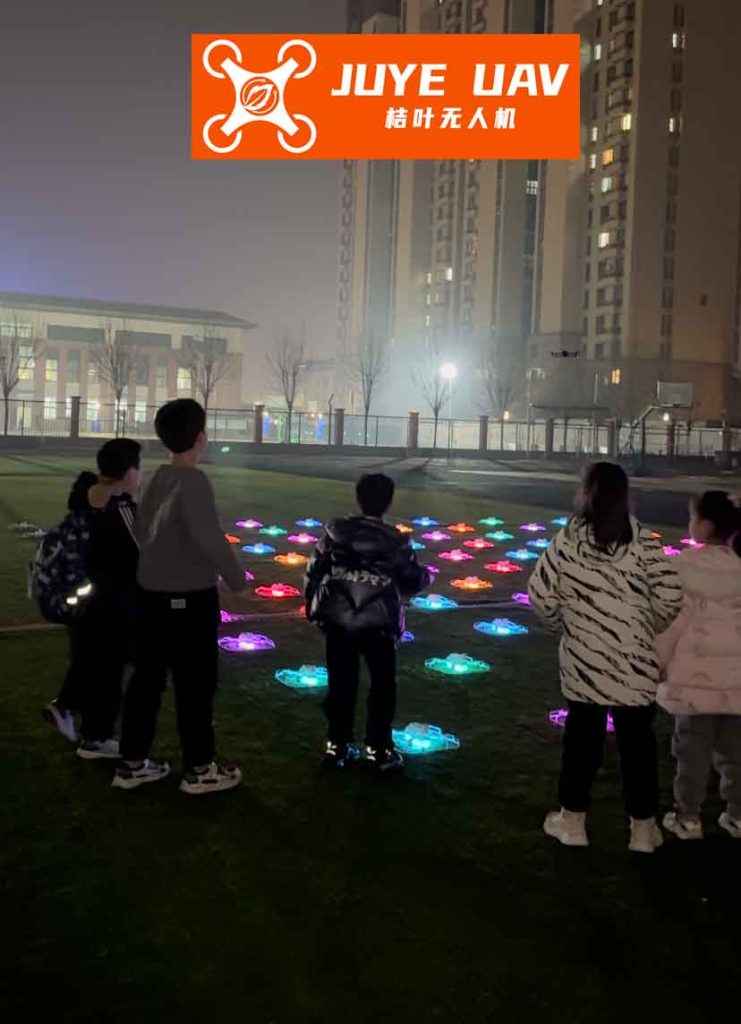
The image above illustrates a captivating formation drone light show, where drones coordinate to create luminous patterns in the night sky. Such displays rely on the precise control methods discussed here, ensuring that each drone maintains its position and attitude relative to neighbors. The distributed sliding mode approach, combined with ESOs, provides the necessary robustness for outdoor performances where conditions are unpredictable.
| Drone ID | Initial Position (m) | Initial Velocity (m/s) | Convergence Time (s) | Final Formation Error (m) |
|---|---|---|---|---|
| 1 | [0, 0, 0] | [0, 0, 0] | 2.5 | 0.01 |
| 2 | [8, 0, 0] | [4, 0, 0] | 2.7 | 0.02 |
| 3 | [-2, 0, 0] | [-3, 0, 0] | 2.6 | 0.01 |
| 4 | [4, 0, 0] | [3, 0, 0] | 2.8 | 0.03 |
| 5 | [-6, 0, 0] | [-1, 0, 0] | 2.4 | 0.01 |
For attitude control, similar results are observed, with Euler angles converging in finite time. This is critical for formation drone light shows, as orientation affects both stability and lighting direction. The control gains are tuned to ensure faster convergence for attitude than position, maintaining overall system stability. In practice, for a formation drone light show, this means drones can quickly adjust their tilt to project lights accurately while moving. The use of ESOs is particularly beneficial when disturbances are unknown; simulations show that without ESOs, formation errors become large and oscillatory, but with ESOs, they remain minimal even under significant perturbations.
To further elaborate on the control design, I derive the stability proofs using Lyapunov theory. For the sliding surface $S_i = 0$, consider the Lyapunov function $V = \frac{1}{2} \sum_{i=1}^N S_i^T S_i$. Its derivative is:
$$\dot{V} = \sum_{i=1}^N S_i^T \dot{S}_i = \sum_{i=1}^N S_i^T ( \dot{d}_i – K_i \text{sgn}(S_i) ).$$
Assuming bounded disturbances with $\|\dot{d}_i\| \leq \beta_i$, selecting $K_i > \beta_i$ ensures $\dot{V} < -\delta \sum_{i=1}^N |S_i|$ for some $\delta > 0$, leading to finite-time convergence to the sliding surface. Once on the surface, the formation dynamics reduce to:
$$\dot{\Xi}_i = v_i,$$
$$\dot{v}_i = \sum_{j=1}^N a_{ij} \left( \mu_1(\Xi_j – \Xi_i) + \mu_2(v_j – v_i) \right).$$
Using homogeneity, I show that this system is finite-time stable, implying $\Xi_i – \Xi_j \to 0$ and $v_i – v_j \to 0$ in finite time. This analytical foundation underpins the reliability of formation drone light shows using this method.
In application to formation drone light shows, the distributed nature allows for scalable deployments. Each drone only needs to communicate with nearby drones, reducing latency and bandwidth requirements. For instance, in a large-scale formation drone light show with thousands of drones, central control would be impractical due to signal delays. Instead, distributed sliding mode control enables local coordination, where drones adjust based on neighbor positions, creating emergent global patterns. Additionally, finite-time control ensures that formations lock quickly, which is essential for dynamic shows with rapid sequence changes. The integration of ESOs adds a layer of adaptability, allowing the system to compensate for real-world irregularities like wind gusts or battery drain, common in outdoor formation drone light shows.
To optimize performance, I discuss parameter tuning. The functions $\mu_1$ and $\mu_2$ are chosen as $\mu_1(y) = c_1 y + o(y)$ and $\mu_2(y) = c_2 y + o(y)$, where $c_1, c_2 > 0$ and $o(y)$ denotes higher-order terms. For simplicity in formation drone light shows, linear functions often suffice, e.g., $\mu_1(y) = k_1 y$ and $\mu_2(y) = k_2 y$, with gains $k_1$ and $k_2$ tuned via simulation. Table 3 provides recommended gain ranges for formation drone light shows based on typical operating conditions.
| Subsystem | Gain Parameter | Range | Effect |
|---|---|---|---|
| Position | $k_1$ (for $\mu_1$) | 5–10 | Adjusts formation stiffness |
| Position | $k_2$ (for $\mu_2$) | 2–5 | Controls damping |
| Attitude | $K_i$ (sliding gain) | 100–200 | Ensures disturbance rejection |
| ESO | $\beta_1, \beta_2, \beta_3$ | 10, 20, 30 | Tunes observer bandwidth |
Moreover, safety considerations are paramount in formation drone light shows, where drones fly in close proximity. The designed controllers inherently include collision avoidance through the formation offsets. By setting desired relative distances $\Delta_i$ in the sliding surface, drones maintain safe separation. For example, in a formation drone light show forming a circle, each drone’s $\Delta_i$ defines its radius position, preventing overlaps. The finite-time convergence also minimizes the risk of mid-air collisions during transitions. From my perspective, implementing these controllers requires embedded systems on each drone, with real-time computation of control inputs. Modern drones used in formation drone light shows often have onboard processors capable of running such algorithms, making this approach feasible.
Looking ahead, the future of formation drone light shows will involve more complex patterns and interactive elements. Advanced control methods like distributed sliding mode control with ESOs can enable autonomous adaptation to audience movements or environmental changes. For instance, drones could dynamically reshape formations in response to music or wind, enhancing the spectacle. Research into machine learning integration could further optimize parameters online, tailoring performances in real-time. As an engineer, I believe that robust control strategies are the backbone of reliable formation drone light shows, ensuring that technological artistry meets safety and precision standards.
In conclusion, distributed sliding mode control offers a powerful framework for multi-UAV formation, with direct applications to formation drone light shows. By designing distributed sliding surfaces and controllers, finite-time formation achievement is guaranteed, even in the presence of bounded disturbances. The use of extended state observers extends this robustness to unknown and unmodeled perturbations, a common scenario in outdoor displays. Through simulations and theoretical analysis, I have demonstrated the effectiveness of this approach, highlighting its scalability and reliability for large-scale formation drone light shows. As the demand for immersive aerial performances grows, such control methods will continue to evolve, pushing the boundaries of what formation drone light shows can achieve.