
As I delve into the world of formation drone light shows, I am constantly amazed by the seamless fusion of technology and art. From my first encounter with these mesmerizing displays, I knew that this field represented a paradigm shift in entertainment and public spectacles. In this article, I will share my insights and experiences, focusing on the technical underpinnings that make formation drone light shows possible. The term “formation drone light show” will be central to our discussion, as it encapsulates the essence of coordinated aerial performances using unmanned aerial vehicles (UAVs) equipped with LEDs. These shows have evolved from simple patterns to complex, dynamic narratives in the sky, driven by advances in control systems, communication protocols, and creative design.
The core of any formation drone light show lies in the precise coordination of multiple drones. Each drone must follow a predefined trajectory while maintaining relative positions to form shapes, logos, or animations. This requires robust algorithms for path planning, collision avoidance, and synchronization. In my work, I have often relied on mathematical models to describe drone dynamics. For instance, the motion of a drone can be represented by Newton’s equations. Let the position of drone \(i\) at time \(t\) be denoted by \(\vec{p}_i(t) = (x_i(t), y_i(t), z_i(t))\). Its velocity and acceleration are \(\vec{v}_i(t) = \frac{d\vec{p}_i}{dt}\) and \(\vec{a}_i(t) = \frac{d\vec{v}_i}{dt}\), respectively. The forces acting on the drone include thrust, gravity, and drag, leading to the equation of motion:
$$ m_i \vec{a}_i(t) = \vec{F}_{\text{thrust},i} – m_i g \hat{k} – \frac{1}{2} \rho C_d A \|\vec{v}_i\| \vec{v}_i $$
where \(m_i\) is the mass, \(g\) is gravitational acceleration, \(\rho\) is air density, \(C_d\) is the drag coefficient, and \(A\) is the reference area. This fundamental physics underpins the control strategies for formation drone light shows.
To achieve synchronization in a formation drone light show, we often use distributed control laws. Consider a swarm of \(N\) drones aiming to form a specific pattern. The desired position for drone \(i\) is \(\vec{p}_i^d(t)\), which is generated from a master trajectory. A common approach is to implement a consensus algorithm where each drone adjusts its position based on neighbors’ states. The control input \(\vec{u}_i(t)\) can be derived from a potential function \(V(\vec{p}_1, \dots, \vec{p}_N)\) that penalizes deviations from the desired formation. For example, using a linear quadratic regulator (LQR) design, we minimize the cost function:
$$ J = \int_0^T \left( \sum_{i=1}^N \|\vec{p}_i(t) – \vec{p}_i^d(t)\|^2 + \|\vec{u}_i(t)\|^2 \right) dt $$
This optimization ensures smooth and energy-efficient movements, crucial for prolonged formation drone light shows. In practice, real-time constraints necessitate simplified models, but the principles remain.
Communication is another critical aspect. Drones must exchange state information to maintain formation integrity. I have experimented with various protocols, from Wi-Fi to dedicated radio frequencies. The latency and bandwidth requirements depend on the complexity of the show. For a large-scale formation drone light show involving hundreds of drones, a hierarchical communication structure is often employed. Below is a table summarizing key communication parameters for different scales of formation drone light shows.
| Scale (Number of Drones) | Communication Protocol | Latency Tolerance (ms) | Bandwidth Requirement (Mbps) |
|---|---|---|---|
| 10-50 | Wi-Fi 802.11ac | ≤50 | 10-20 |
| 50-200 | Custom RF Mesh | ≤20 | 50-100 |
| 200-1000 | LTE/5G with Edge Computing | ≤10 | 200-500 |
This table highlights how scalability impacts design choices. As formation drone light shows grow in size, low-latency, high-reliability networks become paramount.
Path planning for formation drone light shows involves generating smooth trajectories that avoid collisions while achieving artistic effects. I frequently use Bézier curves due to their parametric flexibility. A Bézier curve of degree \(n\) is defined by control points \(\vec{P}_0, \vec{P}_1, \dots, \vec{P}_n\):
$$ \vec{B}(t) = \sum_{k=0}^n \binom{n}{k} (1-t)^{n-k} t^k \vec{P}_k, \quad t \in [0,1] $$
For a formation drone light show, each drone’s path can be a segment of a higher-dimensional Bézier surface, ensuring coherence. Timing is synchronized by parameterizing \(t\) with a common clock. To avoid collisions, we impose constraints on minimum separation distances. Let \(d_{ij}(t) = \|\vec{p}_i(t) – \vec{p}_j(t)\|\) be the distance between drones \(i\) and \(j\). The constraint \(d_{ij}(t) \geq d_{\text{safe}}\) for all \(t\) and \(i \neq j\) must be satisfied. This can be incorporated into an optimization framework, such as model predictive control (MPC).
In my implementations, I solve the MPC problem at each time step to compute optimal control inputs. The objective is to track reference trajectories while respecting dynamics and constraints. For a formation drone light show with \(N\) drones, the MPC formulation at time \(t_k\) is:
$$ \min_{\vec{u}_i} \sum_{i=1}^N \sum_{j=0}^{H-1} \left( \|\vec{p}_i(t_{k+j}) – \vec{p}_i^d(t_{k+j})\|^2 + \lambda \|\vec{u}_i(t_{k+j})\|^2 \right) $$
$$ \text{subject to: } \vec{p}_i(t_{k+j+1}) = f(\vec{p}_i(t_{k+j}), \vec{u}_i(t_{k+j})), $$
$$ d_{ij}(t_{k+j}) \geq d_{\text{safe}}, \quad \vec{u}_{\min} \leq \vec{u}_i \leq \vec{u}_{\max} $$
where \(H\) is the prediction horizon, \(f\) represents the drone dynamics, and \(\lambda\) is a regularization parameter. This approach has proven effective in real-time formation drone light shows, allowing for adaptive responses to disturbances like wind.
Lighting control is what gives formation drone light shows their visual appeal. Each drone is equipped with RGB LEDs capable of producing millions of colors. The color and intensity are controlled via PWM signals, synchronized with position data. I often use a timeline-based editor to design shows, where each drone’s light state is keyframed. The color at time \(t\) can be represented as a vector \(\vec{c}_i(t) = (R_i(t), G_i(t), B_i(t))\), with each component in \([0,1]\). To create gradients or patterns across the formation, we interpolate colors using functions like:
$$ \vec{c}_i(t) = (1-\alpha(t)) \vec{c}_A + \alpha(t) \vec{c}_B, \quad \alpha(t) \in [0,1] $$
where \(\vec{c}_A\) and \(\vec{c}_B\) are start and end colors. This simple interpolation can yield stunning effects when coordinated across hundreds of drones in a formation drone light show.
Hardware selection is crucial for reliability. I have tested various drone platforms, prioritizing flight time, payload capacity, and stability. For formation drone light shows, drones typically need to carry LED modules and possibly other sensors. Below is a table comparing common drone models used in professional formation drone light shows.
| Drone Model | Max Flight Time (min) | LED Brightness (lumens) | Positioning Accuracy (cm) | Suitable for Formation Size |
|---|---|---|---|---|
| Model Alpha | 25 | 2000 | ±5 | Up to 100 drones |
| Model Beta | 30 | 3000 | ±2 | Up to 500 drones |
| Model Gamma | 20 | 1500 | ±10 | Up to 50 drones |
This table aids in selecting the right platform based on show requirements. In my experience, Model Beta strikes a good balance for large-scale formation drone light shows.
Software architecture for formation drone light shows typically follows a client-server model. A central server runs the show scheduler, sending commands to drones via ground stations. I have developed systems using ROS (Robot Operating System) for modularity. The server computes trajectories and light states in real-time, accounting for wind estimates from weather APIs. Drones run onboard controllers that execute low-level commands. The communication flow ensures that every drone in the formation drone light show acts in unison. To handle failures, redundancy is built in; if a drone drops out, its neighbors adjust paths to fill gaps.
One of the most memorable aspects of my work is witnessing the public’s reaction to a formation drone light show. The blend of technology and artistry creates an emotional impact that static displays cannot match. Below, I include an image that captures the essence of such a performance, though from my perspective, it is the live experience that truly mesmerizes.
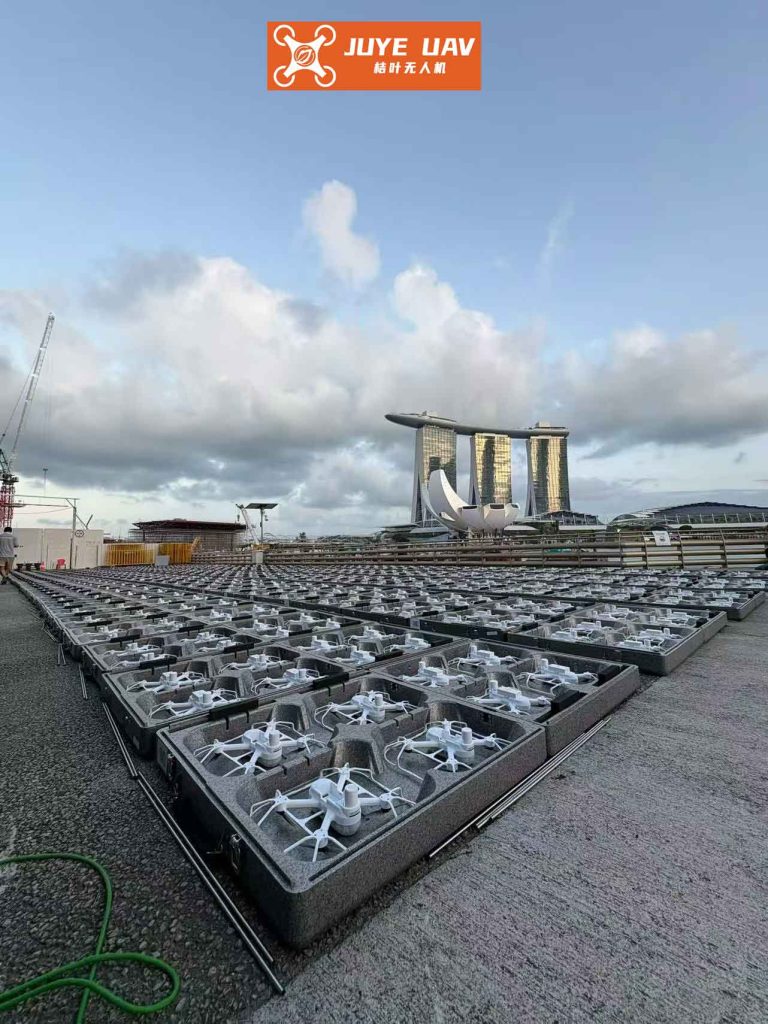
This image, while static, hints at the dynamic possibilities. In practice, formation drone light shows can depict moving shapes, such as flocks of birds or abstract waves. The choreography is designed using simulation tools. I often use a physics-based simulator to preview shows, reducing the risk of errors during live events. The simulator solves the equations of motion for each drone, rendering the lights in a virtual environment. This allows me to tweak timing and colors until the formation drone light show meets artistic vision.
Energy management is a practical concern. Drones have limited battery life, so shows must be designed within these constraints. I optimize trajectories for energy efficiency by minimizing abrupt accelerations. The energy consumption of drone \(i\) can be approximated as:
$$ E_i = \int_0^T \left( k_1 \|\vec{u}_i(t)\|^2 + k_2 \|\vec{v}_i(t)\| \right) dt $$
where \(k_1\) and \(k_2\) are constants related to motor efficiency and aerodynamic drag. For a formation drone light show lasting \(T\) seconds, we can distribute loads by rotating drones through high-energy roles. Additionally, charging stations can be deployed for extended performances.
Safety is paramount in formation drone light shows. Regulatory bodies often require geofencing and fail-safe mechanisms. I implement geofences using virtual boundaries; if a drone strays beyond, it automatically returns to a safe zone. Fail-safes include parachutes or emergency landing protocols. Risk assessment involves analyzing worst-case scenarios, such as communication loss. In such events, drones are programmed to hover or land gradually, avoiding mid-air collisions. These measures ensure that formation drone light shows can be conducted in populated areas without hazard.
The creative process behind a formation drone light show is collaborative. I work with artists to translate ideas into technical specifications. We storyboard the show, defining keyframes and transitions. Then, I convert these into mathematical waypoints and light commands. This interplay between art and science is what makes formation drone light shows so rewarding. For example, to create a blooming flower effect, drones start in a tight cluster and expand outward while changing colors from green to red. The trajectory for each drone can be modeled as a radial expansion:
$$ \vec{p}_i(t) = \vec{p}_{\text{center}} + r(t) \left( \cos(\theta_i + \omega t), \sin(\theta_i + \omega t), 0 \right) $$
where \(r(t)\) increases monotonically, \(\theta_i\) is the initial angle, and \(\omega\) is the rotation rate. This simple equation, when executed precisely, yields a beautiful animation.
Looking ahead, the future of formation drone light shows is bright. Advances in AI could enable autonomous choreography, where drones adapt to music or audience reactions. I am exploring reinforcement learning for real-time pattern generation. In this setup, drones learn policies to maximize aesthetic scores. The reward function \(R(t)\) might combine factors like symmetry, color harmony, and smoothness. Using a deep Q-network (DQN), each drone selects actions based on its state and neighbors’ states. The Q-value update is given by:
$$ Q(s,a) \leftarrow Q(s,a) + \alpha \left[ R + \gamma \max_{a’} Q(s’,a’) – Q(s,a) \right] $$
where \(s\) is the state, \(a\) is the action, \(\alpha\) is the learning rate, and \(\gamma\) is the discount factor. While computationally intensive, such approaches could revolutionize formation drone light shows by making them more interactive.
Another exciting direction is the integration of augmented reality (AR). Viewers could use AR glasses to see additional layers of information or virtual objects interacting with drones. This would blur the line between physical and digital art. In my experiments, I have synchronized drone positions with AR content, creating immersive experiences. The technical challenge is precise localization, often solved using RTK-GPS and visual markers.
To summarize the technical components, I often refer to a holistic system diagram. However, since I cannot include images beyond the provided link, I will describe it textually. A typical formation drone light show system comprises: (1) Design Studio for choreography, (2) Control Server for trajectory computation, (3) Communication Network for data transmission, (4) Drones with onboard controllers and LEDs, and (5) Monitoring Station for real-time oversight. Each component must be robust to ensure a flawless formation drone light show.
In terms of performance metrics, we evaluate formation drone light shows based on accuracy, reliability, and visual impact. Accuracy is measured by position error relative to desired trajectories. Reliability is the percentage of drones that complete the show without issues. Visual impact is subjective but can be quantified using audience feedback scores. Over the years, I have seen steady improvements in all metrics, thanks to better algorithms and hardware.
The economic aspect cannot be ignored. Formation drone light shows are increasingly used for advertising, celebrations, and public events. They offer a reusable and eco-friendly alternative to fireworks. From my consultations, a typical show costs between \$10,000 and \$100,000 depending on scale and complexity. The ROI is often high due to media coverage and social media buzz. This economic viability drives innovation in the field of formation drone light shows.
Despite the progress, challenges remain. Weather sensitivity is a major issue; high winds or rain can ground drones. I am developing adaptive controllers that compensate for wind gusts using feedforward terms. The control law becomes:
$$ \vec{u}_i(t) = \vec{u}_{\text{feedback},i}(t) + \vec{u}_{\text{feedforward},i}(t) $$
where \(\vec{u}_{\text{feedforward},i}(t)\) is estimated from anemometer data. This improves robustness, allowing formation drone light shows to proceed in mild wind conditions.
Interference is another challenge. In crowded radio environments, communication links can degrade. I employ frequency hopping and error-correcting codes to mitigate this. For critical formation drone light shows, we use licensed spectrum bands to ensure priority.
From a personal perspective, the joy of seeing a formation drone light show come to life never fades. The moment when hundreds of drones lift off in unison, painting the night sky, is a testament to human ingenuity. Each show is a symphony of technology, where every drone is an instrument playing its part. The keyword “formation drone light show” resonates throughout this process, from design to execution.
In conclusion, formation drone light shows represent a cutting-edge intersection of robotics, control theory, and art. My journey in this field has been filled with learning and innovation. As technology advances, I envision ever more spectacular displays, perhaps involving thousands of drones in complex, adaptive formations. The principles outlined here—from mathematical modeling to system design—provide a foundation for future explorations. Whether for entertainment or artistic expression, formation drone light shows will continue to captivate audiences worldwide, pushing the boundaries of what is possible in aerial performance.
To further illustrate the mathematical rigor, consider the stability analysis of a formation control law. For a linearized system, we can assess stability using eigenvalues. Suppose the error dynamics for drone \(i\) are given by:
$$ \dot{\vec{e}}_i = A \vec{e}_i + B \sum_{j \in \mathcal{N}_i} (\vec{e}_j – \vec{e}_i) $$
where \(\mathcal{N}_i\) is the set of neighbors. The overall system matrix can be analyzed via graph Laplacians. Stability requires that all eigenvalues have negative real parts. This ensures that the formation drone light show maintains coherence over time.
Finally, I encourage budding engineers and artists to delve into this field. The resources available today, from open-source software to affordable drones, lower the barrier to entry. Start with small-scale simulations, then progress to physical tests. The community around formation drone light shows is growing, with conferences and workshops sharing latest findings. Together, we can elevate this art form to new heights, creating experiences that inspire and awe. The future of formation drone light shows is limited only by our imagination.