
As a researcher in the field of unmanned aerial vehicles (UAVs), I have dedicated significant effort to developing robust control strategies for multi-drone systems, particularly in the context of formation drone light shows. These spectacular displays rely on precise coordination of dozens or even hundreds of drones to create dynamic aerial patterns, and my work focuses on applying advanced formation flight control techniques to ensure safety, efficiency, and artistic fluidity. In this article, I will delve into the mathematical foundations, control algorithms, and practical implementations that enable stunning formation drone light shows, drawing from principles like guidance route-based control, obstacle avoidance, and collision prevention. Throughout, I will emphasize how these methods enhance the reliability and creativity of formation drone light shows, making them a captivating intersection of technology and art.
The core challenge in formation drone light shows is maintaining precise relative positions among drones while executing complex maneuvers. To address this, I often start with a simplified kinematic model, treating each drone as a point mass in three-dimensional space. This approach allows me to capture essential dynamics without overcomplicating the control design. The motion of a drone can be described by the following equations:
$$ \dot{x} = v \cos \phi \cos \gamma $$
$$ \dot{y} = v \sin \phi \cos \gamma $$
$$ \dot{z} = v \sin \gamma $$
$$ \dot{v} = u_v $$
$$ \dot{\phi} = u_\phi $$
$$ \dot{\gamma} = u_\gamma $$
Here, \( (x, y, z) \) represents the drone’s position in longitude, latitude, and altitude; \( v \) is the airspeed; \( \phi \) and \( \gamma \) are the trajectory yaw and pitch angles, respectively; and \( u = [u_v, u_\phi, u_\gamma]^T \) serves as the control input for speed, yaw rate, and pitch rate commands. In formation drone light shows, these parameters must be tightly regulated to achieve synchronized movements, such as forming geometric shapes or transitioning between patterns. To ensure realistic behavior, I impose constraints similar to those in the reference:
$$ 0 < v_{\text{min}} \leq v \leq v_{\text{max}} $$
$$ a_{\text{min}} \leq \dot{v} = a \leq a_{\text{max}} $$
$$ |\dot{\phi}| = |\omega| \leq \omega_{\text{max}} $$
where \( a \) is acceleration and \( \omega \) is yaw rate. These limits are crucial for preventing excessive maneuvers that could destabilize a formation drone light show, especially when drones are closely spaced for visual effects.
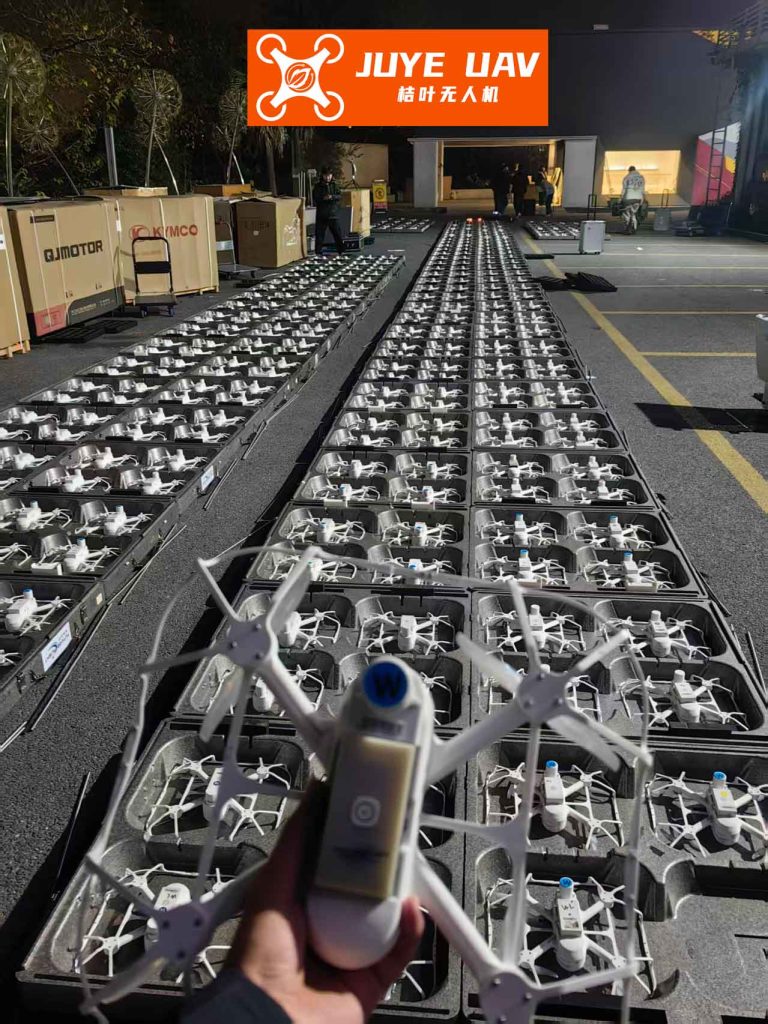
In my research, I have found that a guidance route-based control method is highly effective for formation drone light shows. This approach involves generating virtual paths, or “guidance routes,” for follower drones based on their position errors relative to desired locations and the leader’s state. For a formation drone light show, the leader might be a designated drone or a virtual point that dictates the overall pattern. The follower drones then track these induced routes to maintain formation, adjusting their speed and orientation accordingly. The generation of guidance routes can be summarized in a table that outlines the switching logic between different route types:
| Condition | Guidance Route Type | Description | Application in Formation Drone Light Shows |
|---|---|---|---|
| Large position error | Directing to desired position | Route from current to target position | Used when drones are far from their pattern points, ensuring rapid convergence. |
| Small position error | Parallel to leader’s heading | Route aligned with leader’s direction | Applied for fine-tuning during stable pattern holds in a formation drone light show. |
The equations for generating these routes are critical. For a follower drone \( i \) with actual position \( (x_i, y_i, h_i) \) and desired position \( (x_e, y_e, h_e) \) relative to a leader at \( (x_L, y_L, h_L) \) with yaw angle \( \phi_L \), the guiding points for the route are computed as:
$$ x_{l1} = x_i + d_k (x_e – x_i) – \delta_k \sin \phi_L $$
$$ y_{l1} = y_i + d_k (y_e – y_i) + \delta_k \cos \phi_L $$
$$ h_{l1} = h_i $$
$$ x_{l2} = x_{l1} – \delta_k \sin \phi_L $$
$$ y_{l2} = y_{l1} + \delta_k \cos \phi_L $$
$$ h_{l2} = h_e $$
Here, \( d_k \) is a parameter that smoothly transitions the route from the drone’s current location to the desired location, and \( \delta_k \) is a fixed offset. This method ensures that drones in a formation drone light show can adaptively adjust their paths, reducing oscillations and maintaining visual coherence. The desired position is derived from the formation geometry:
$$ x_e = x_L – D_F \cos \phi_L + D_W \sin \phi_L $$
$$ y_e = y_L + D_F \sin \phi_L + D_W \cos \phi_L $$
where \( D_F \) and \( D_W \) are the forward and lateral distances in the formation. For a formation drone light show, these distances define the spacing between drones in patterns like grids or circles, and I optimize them to balance aesthetic appeal and collision risks.
To track the guidance route, I implement control laws that compute desired speed, heading, and cross-track error. The desired speed \( v_e \) for a follower drone incorporates the projected distance along the route \( d \), the leader’s velocity component \( v_{Ld} \), and the velocity difference \( v_{Lg} \):
$$ v_e = k_1 d + v_{Ld} + k_2 v_{Lg} $$
$$ d = (y_e – y_i) \cos \phi_L + (x_e – x_i) \sin (-\phi_L) $$
$$ v_{Ld} = v_L \cos(\phi_L – \phi_d) $$
$$ v_{Lg} = v_L \cos(\phi_L – \phi_d) – v_i \cos(\phi_i – \phi_d) $$
with \( \phi_d \) determined by a switching condition based on the error magnitude. The heading error \( \phi_e \) and cross-track deviation are then used in a proportional control scheme for yaw and pitch adjustments. In practice, for a formation drone light show, I fine-tune gains like \( k_1 \) and \( k_2 \) to ensure smooth velocity transitions, preventing jerky movements that could disrupt the visual flow. The overall control architecture for each drone in a formation drone light show involves layered decision-making: a high-level planner generates patterns, a perception layer detects obstacles, and a flight controller executes commands via autopilot systems.
Obstacle avoidance is a vital aspect of formation drone light shows, as unexpected objects like birds or structures can intrude into the performance airspace. My approach involves dynamically reshaping the formation to navigate around threats while minimizing disruption to the show. When a drone detects an obstacle, it calculates a safe bypass distance, considering potential collisions with other drones. The modified formation distances are adjusted as:
$$ D_F’ = D_F + d_f $$
$$ D_W’ = D_W + d_e $$
where \( d_f \) and \( d_e \) are incremental changes in forward and lateral spacing. This allows the formation drone light show to temporarily shift from, say, a horizontal line to a vertical line to slip through narrow gaps, then seamlessly revert to the original pattern. I often simulate scenarios where a formation drone light show encounters a canyon-like obstacle; the drones sequentially adjust their positions, demonstrating the robustness of this method. The table below summarizes key parameters in obstacle avoidance for formation drone light shows:
| Parameter | Symbol | Typical Value | Role in Formation Drone Light Show |
|---|---|---|---|
| Minimum speed | \( v_{\text{min}} \) | 10 m/s | Ensures drones maintain motion for pattern continuity. |
| Maximum yaw rate | \( \omega_{\text{max}} \) | 0.5 rad/s | Limits turning sharpness to prevent pattern distortion. |
| Switching distance | \( d_0 \) | 50 m | Determines when to switch guidance routes for smooth transitions. |
| Formation spacing | \( D_F, D_W \) | 20-100 m | Defines pattern density in a formation drone light show. |
Collision prevention is another critical focus, especially in dense formation drone light shows where drones operate in close proximity. I have developed a collision avoidance algorithm based on predicted collision points and priority assignments. For two drones \( i \) and \( j \) with velocity vectors \( \mathbf{v}_i \) and \( \mathbf{v}_j \), the unit direction vector \( \mathbf{e}_{ij} \) is:
$$ \mathbf{e}_{ij} = \frac{\mathbf{v}_i \times \mathbf{v}_j}{\|\mathbf{v}_i \times \mathbf{v}_j\|} $$
The control effort \( u_i \) for avoidance is a function of the time to collision \( t_i \) and \( t_j \), and the altitude difference \( d_{ij} \):
$$ u_i = \frac{1}{k_i t_i^2 + k_{ij} (t_i – t_j)^2 + k_{de} d_{ij}^2} $$
where \( k_i, k_{ij}, k_{de} \) are tuning parameters related to the drone’s maneuverability. This control term is added to the baseline yaw and pitch commands:
$$ u’_\phi = u_\phi + k_\phi u_i $$
$$ u’_\gamma = u_\gamma + k_\gamma u_i $$
In a formation drone light show, I integrate this with a fuzzy logic system to assign collision priorities, ensuring that lower-priority drones yield to higher-priority ones, thus reducing overall disruption. The fuzzy sets for damage level and maneuverability potential are defined over domains like [1, 10], with membership functions for terms such as “severe” or “strong.” The rule base combines these inputs to output a priority level, which dictates avoidance actions. For instance, in a formation drone light show, the leader drone might have higher priority due to its role in pattern guidance, while followers adjust accordingly. This priority system enhances the safety and fluidity of formation drone light shows, allowing complex choreographies without collisions.
To validate these methods, I conduct extensive simulations using realistic drone models. For example, in a scenario with four drones forming a horizontal line for a formation drone light show, the initial dispersion and convergence are controlled via guidance routes. The drones achieve stable formation with synchronized speed, altitude, and yaw, as shown in trajectory plots. When obstacles are introduced, the formation dynamically reconfigures, such as switching to a vertical line to pass through narrow spaces, then returning to the horizontal line. The collision avoidance algorithm is tested by simulating close encounters; without it, drones breach safe distances, but with the control augmentation, they maintain separation. These simulations confirm that my approaches are effective for real-world formation drone light shows, where reliability is paramount.
In terms of application, formation drone light shows benefit immensely from these control strategies. They enable intricate patterns like spirals, waves, or even text displays in the sky, with drones acting as pixels in a dynamic canvas. The use of guidance routes allows for precise positioning, while obstacle and collision avoidance ensure safety in urban environments or crowded venues. I often collaborate with event planners to tailor formations for specific themes, adjusting parameters like spacing and speed to match musical rhythms or visual effects. The mathematical rigor behind these methods provides a foundation for scaling up to hundreds of drones, pushing the boundaries of what formation drone light shows can achieve.
Looking ahead, I am exploring enhancements such as machine learning for adaptive pattern generation and swarm intelligence for decentralized control. These could make formation drone light shows more resilient and creative, allowing real-time adjustments based on audience feedback or environmental changes. The integration of wireless communication and sensor networks will further improve coordination, enabling larger and more complex displays. As technology advances, formation drone light shows will continue to evolve, blending art and engineering in mesmerizing ways.
In conclusion, my work on formation flight control methods, centered on guidance routes, obstacle avoidance, and collision prevention, directly translates to the domain of formation drone light shows. By leveraging mathematical models and control algorithms, I ensure that these aerial performances are not only visually stunning but also safe and robust. The repeated emphasis on formation drone light show throughout this article underscores its significance as a driving application for multi-UAV research. As I continue to refine these techniques, I envision formation drone light shows becoming even more sophisticated, captivating audiences worldwide with their synchronized brilliance.