
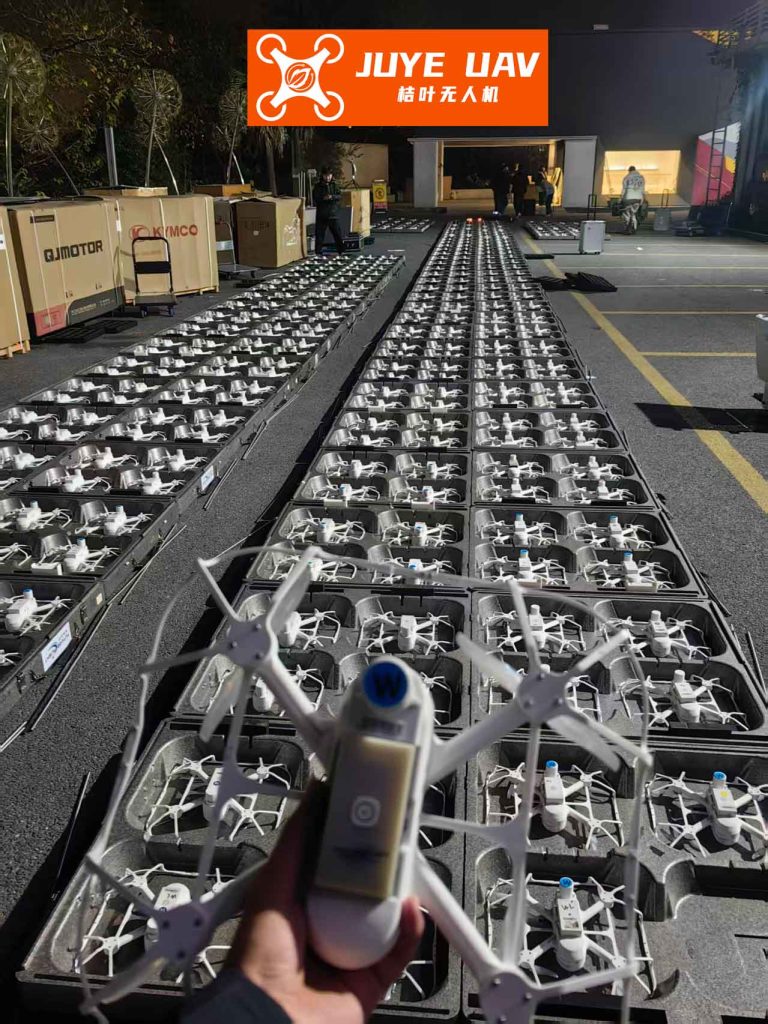
The modern spectacle of a formation drone light show represents a pinnacle of coordination, merging art with advanced autonomous guidance and control technology. At its core, every breathtaking aerial pattern is the result of solving a multitude of precise guidance problems: each drone must navigate to its designated position in a dynamic formation, often from dispersed starting points, while adhering to strict constraints on timing, collision avoidance, and energy efficiency. The transition from a random scatter of lights to a coherent, moving image in the sky is a direct application of sophisticated guidance laws. This article explores, from a first-person technical standpoint, the underlying guidance methodologies that enable these complex formation drone light show performances. We will dissect the mathematical foundations, from classical approaches to modern nonlinear strategies, and evaluate their applicability to the unique demands of large-scale, highly synchronized aerial displays. The guidance challenge in a formation drone light show is not merely about reaching a point but doing so in perfect harmony with hundreds of other agents, making it a rich field for the application and development of advanced guidance theories.
1. Problem Formulation for Formation Rendezvous
The fundamental problem for a single drone in a formation drone light show is a terminal guidance or rendezvous task. We must define the mathematical models that govern this process.
1.1 Planar Engagement Geometry
The guidance problem can often be decomposed and analyzed in two perpendicular planes. The classical planar engagement geometry for a single drone (Pursuer, P) moving towards its target waypoint (Target, T) in the formation is defined by the following variables and equations.
Let the relative separation between the drone and its target position be $\mathbf{R}$. The key kinematic parameters in the horizontal plane are:
- $V_P$: Speed of the drone.
- $V_T$: Speed of the target waypoint (often the speed of the formation’s reference frame).
- $\theta_P$: Drone’s heading angle.
- $\theta_T$: Target’s heading angle.
- $\lambda$: Line-of-sight (LOS) angle from the drone to the target.
The relative motion is governed by the closing velocity $V_c$ and the LOS rate $\dot{\lambda}$:
$$ V_c = -\dot{R} = V_T \cos(\theta_T – \lambda) – V_P \cos(\theta_P – \lambda) $$
$$ R \dot{\lambda} = V_T \sin(\theta_T – \lambda) – V_P \sin(\theta_P – \lambda) $$
Where $R = |\mathbf{R}|$ is the range. For a stationary target waypoint or one moving with constant velocity in a straight line (a common assumption for pre-planned show segments), $V_T = 0$ or $\theta_T$ is constant.
1.2 3D Kinematic Model and Formation State
For a full formation drone light show in three-dimensional space, the state of the $i$-th drone is defined as:
$$ \mathbf{X}_i = [x_i, y_i, z_i, V_i, \gamma_i, \chi_i]^T $$
where $(x_i, y_i, z_i)$ is position, $V_i$ is airspeed, $\gamma_i$ is flight path angle, and $\chi_i$ is heading angle. The guidance law must generate acceleration commands $\mathbf{a}_i = [a_{x,i}, a_{y,i}, a_{z,i}]^T$ (or equivalently, turn rates) to drive the drone from its initial state $\mathbf{X}_i(t_0)$ to a desired formation state $\mathbf{X}^d_i(t_f)$ at the final time $t_f$. The formation state is typically defined relative to a virtual leader or a predefined time-varying pattern:
$$ \mathbf{X}^d_i(t) = \mathbf{X}_{pattern}(t) + \mathbf{\Delta}_i $$
where $\mathbf{\Delta}_i$ is the fixed or slowly varying offset for drone $i$ within the formation drone light show pattern.
The core guidance objective is to minimize a cost function, often a combination of terminal miss distance, control effort, and time, subject to dynamic constraints and the critical collision avoidance constraint for all $i \neq j$:
$$ ||\mathbf{p}_i(t) – \mathbf{p}_j(t)|| \geq d_{safe}, \quad \forall t $$
where $\mathbf{p}_i = [x_i, y_i, z_i]^T$ and $d_{safe}$ is the minimum safe separation distance, a paramount safety requirement in any formation drone light show.
2. Classical and Enhanced Proportional Navigation-Based Guidance
Proportional Navigation (PN) is one of the most widely implemented guidance laws due to its simplicity and proven optimality under certain conditions. Its principle is directly applicable to guiding drones to their formation waypoints.
2.1 Fundamental Proportional Navigation Law
The classic Pure Proportional Navigation (PPN) law commands an acceleration normal to the drone’s velocity vector proportional to the LOS rate:
$$ \mathbf{a}_c = N V_c \dot{\lambda} \, \mathbf{\hat{n}} $$
where:
- $\mathbf{a}_c$ is the acceleration command vector.
- $N$ is the navigation constant, typically between 3 and 5.
- $V_c$ is the closing speed.
- $\dot{\lambda}$ is the LOS rate.
- $\mathbf{\hat{n}}$ is a unit vector perpendicular to the drone’s velocity vector (for PPN).
For a formation drone light show, where target waypoints are often non-maneuvering, PPN can provide zero miss distance with reasonable control effort. However, standard PN assumes constant velocity, which may not hold during aggressive formation transitions.
2.2 Variants and Enhancements for Formation Applications
Several variants have been developed to improve performance. True Proportional Navigation (TPN) commands acceleration normal to the LOS, while Generalized TPN accounts for varying target acceleration. For drone formations, PPN and its augmented forms are generally more suitable. Augmented Proportional Navigation (APN) includes a term to account for target acceleration:
$$ a_c = N V_c \dot{\lambda} + \frac{N}{2} a_T $$
where $a_T$ is the estimated target (or formation reference) acceleration. This is crucial for a formation drone light show where the entire pattern may be executing a coordinated maneuver (e.g., a rapid twist or flip).
Ideal Proportional Navigation (IPN) and All-Aspect PN (AAPN) are other variants designed to improve capture region and performance against maneuvering targets. Their core improvement often lies in a more sophisticated definition of the commanded acceleration direction or gain scheduling based on engagement geometry.
The following table summarizes key PN variants and their relevance to formation drone light show guidance:
| Guidance Law | Acceleration Command Principle | Key Advantage | Suitability for Formation Drone Light Show |
|---|---|---|---|
| Pure PN (PPN) | $\mathbf{a}_c = N V_c \dot{\lambda} \, \mathbf{\hat{n}}_V$ (Normal to vehicle velocity) |
Simple, optimal for constant velocity. | Good for basic waypoint tracking in calm conditions. |
| True PN (TPN) | $\mathbf{a}_c = N V_c \dot{\lambda} \, \mathbf{\hat{n}}_{LOS}$ (Normal to LOS) |
Easier analytical solution. | Less practical for high-performance drones. |
| Augmented PN (APN) | $a_c = N V_c \dot{\lambda} + \frac{N}{2} a_T$ | Compensates for target maneuver. | Excellent for tracking maneuvering formation patterns. |
| Ideal PN (IPN) | Modified based on optimal control theory. | Larger capture region. | Useful for drones joining formation from wide offsets. |
3. Optimal Guidance Laws (OGL) and Predictive Control
Optimal Guidance Laws formulate the guidance problem as an optimization task, minimizing a cost function (like integrated control effort) subject to dynamics and terminal constraints. This framework is highly adaptable to the multi-objective needs of a formation drone light show.
3.1 Linear Quadratic Formulation
A common OGL is derived from linear quadratic optimal control theory. By linearizing the engagement kinematics around the collision course, we obtain a state-space model. The cost function $J$ to minimize is typically:
$$ J = \frac{1}{2} s_f R(t_f) + \frac{1}{2} \int_{t_0}^{t_f} a_c^2(\tau) \, d\tau $$
where $s_f$ is the terminal miss (must be zero), $R(t_f)$ is a weighting, and the integral penalizes control effort. Solving this yields an optimal acceleration command that is a function of the estimated time-to-go ($t_{go}$). A classic form is:
$$ a_c(t) = \frac{3}{t_{go}^2} y(t) + \frac{3}{t_{go}} \dot{y}(t) $$
where $y$ is the relative displacement perpendicular to the intended LOS. This law explicitly drives both displacement and its rate to zero at $t_f$.
3.2 Time-to-Go Estimation and Receding Horizon Control (RHC)
The accuracy of OGL heavily depends on an accurate estimate of $t_{go}$. The simplest estimate is $t_{go} = -R / \dot{R}$. For a drone in a formation drone light show that may be accelerating, more sophisticated recursive estimators are used, such as those based on higher-order models of relative motion.
Receding Horizon Control (RHC), or Model Predictive Control (MPC), is a powerful framework for formation guidance. It solves a finite-horizon optimal control problem online at each time step, using the current state as the initial condition. Only the first control action is applied, and the process repeats. This is ideal for a formation drone light show because it can:
- Explicitly handle state and control constraints (e.g., maximum acceleration, collision avoidance zones).
- Incorporate predictions of the formation’s future trajectory.
- Adapt to disturbances in real-time.
The RHC optimization problem for drone $i$ at time $k$ can be formulated as:
$$ \min_{\mathbf{a}_i} \sum_{j=k}^{k+H-1} \left( ||\mathbf{p}_i(j|k) – \mathbf{p}^d_i(j)||^2_Q + ||\mathbf{a}_i(j|k)||^2_R \right) + V_f(\mathbf{X}_i(k+H|k)) $$
subject to:
$$ \mathbf{X}_i(j+1|k) = f(\mathbf{X}_i(j|k), \mathbf{a}_i(j|k)), \quad \text{(dynamics)} $$
$$ ||\mathbf{p}_i(j|k) – \mathbf{p}_m(j|k)|| \geq d_{safe}, \quad \forall m \neq i, \quad \text{(collision avoidance)} $$
$$ \mathbf{a}_{min} \leq \mathbf{a}_i(j|k) \leq \mathbf{a}_{max} \quad \text{(control limits)} $$
where $H$ is the prediction horizon, $Q$ and $R$ are weighting matrices, and $V_f$ is a terminal cost. The solution provides a locally optimal trajectory that respects all critical constraints of a safe formation drone light show.
4. Modern Nonlinear Guidance and Control Theories
The highly nonlinear dynamics and stringent requirements of a formation drone light show drive the need for advanced nonlinear guidance laws.
4.1 Differential Geometry and Differential Game Approaches
These methods treat the guidance problem in a geometric or game-theoretic framework. Using the Frenet-Serret frame, a drone’s 3D path can be described by its curvature ($\kappa$) and torsion ($\tau$), which become the control variables. A guidance law can be designed to shape these geometric properties to achieve rendezvous. Furthermore, differential game theory formulates guidance as a two-player game between the drone and adversarial uncertainty, leading to robust minimax strategies like the Linear Quadratic Differential Game guidance law, which can be highly robust for a formation drone light show operating in windy conditions.
4.2 Sliding Mode Control (SMC)
SMC is renowned for its robustness to model uncertainties and disturbances. A sliding surface $s$ is defined as a function of the tracking error. For a planar rendezvous, one might define:
$$ s = \dot{y} + c y $$
where $y$ is the lateral error and $c>0$. The guidance law is designed to force the system trajectory onto this surface ($s=0$) in finite time. Once on the surface, the system dynamics are governed by $\dot{y} = -c y$, guaranteeing exponential convergence of the error to zero. The control law has a discontinuous term:
$$ a_c = a_{eq} – K \cdot \text{sign}(s) $$
where $a_{eq}$ is the equivalent control needed to stay on the surface, and $K$ is a gain large enough to overcome uncertainties. This ensures precise tracking for a formation drone light show even with variable drone performance.
4.3 Intelligent and Learning-Based Guidance
With the rise of AI, data-driven methods are entering the field. These are particularly promising for adapting to the complex, non-ideal behaviors in a massive formation drone light show.
- Neural Network (NN) Guidance: A neural network can be trained to approximate an optimal guidance law or to adaptively compensate for nonlinearities and wind disturbances. The network maps the engagement state (e.g., $R, \dot{R}, \lambda, \dot{\lambda}, V, …$) directly to an acceleration command.
- Fuzzy Logic Guidance: Fuzzy rules can encode expert knowledge about guidance. For example: “IF the LOS rate is positive large AND the range is medium, THEN command a negative large acceleration.” This heuristic approach can handle the linguistic uncertainty inherent in complex environments.
- Reinforcement Learning (RL): An RL agent can learn a guidance policy through trial and error in simulation, optimizing a reward function that balances speed, accuracy, and energy use. This is a frontier approach for developing highly adaptive behaviors in autonomous formation drone light show fleets.
The following table compares these modern approaches:
| Method | Core Principle | Strengths | Challenges for Formation Drone Light Show |
|---|---|---|---|
| Sliding Mode Control | Drive system to a designed sliding manifold; use discontinuous control for robustness. | High precision, strong disturbance rejection. | Potential chattering (high-frequency switching) must be mitigated; requires accurate upper bounds on disturbances. |
| Neural Network | Universal function approximator trained on data or via optimization. | Can model complex nonlinear mappings; adaptive. | Requires extensive training data; verification and safety assurance are difficult; computational load. |
| Fuzzy Logic | Inference based on linguistic rules and membership functions. | Incorporates expert knowledge; handles imprecise inputs. | Rule base design can be ad-hoc; performance optimization is non-trivial. |
| Differential Geometry | Control path curvature and torsion directly in 3D space. | Provides elegant, smooth 3D trajectories. | Mathematically complex; real-time computation of geometric parameters. |
5. Synthesis for Formation Drone Light Show: A Hierarchical Architecture
A practical system for a large-scale formation drone light show likely employs a hierarchical or hybrid architecture, combining the strengths of multiple guidance laws.
High Level (Trajectory Planner): Generates a smooth, feasible reference trajectory $\mathbf{p}^d_i(t)$ for each drone over a long time horizon for the entire show. This may use splines, polynomial trajectories, or optimal control solvers, ensuring global collision avoidance at the planning stage.
Mid Level (Guidance Layer): This is the core layer discussed in this article. It takes the reference trajectory and the drone’s current state to produce acceleration or velocity commands. A robust law like APN, OGL with RHC, or SMC is used here. For a formation drone light show, the guidance law must have:
- Precise Terminal Accuracy: To ensure pixels (drones) are in the correct place.
- Robustness to Wind: SMC or NN-augmented laws are beneficial.
- Predictive Capability: RHC can account for upcoming formation maneuvers.
- Low Computational Burden: Must run in real-time on onboard hardware.
Low Level (Flight Control): The autopilot layer. It takes acceleration commands from the guidance layer and translates them into actuator commands (motor RPMs, control surface deflections) to achieve the desired acceleration using inner-loop stability augmentation systems (SAS).
The interaction can be described by a cascaded control diagram. Let the guidance law be a function $G$ and the flight controller be a function $F$. The overall system for drone $i$ is:
$$ \mathbf{a}_c^i(t) = G(\mathbf{X}_i(t), \mathbf{p}^d_i(t), \mathbf{p}^d_i(t+\Delta t), …) $$
$$ \mathbf{u}_i(t) = F(\mathbf{X}_i(t), \mathbf{a}_c^i(t)) $$
$$ \dot{\mathbf{X}}_i = f_{dynamics}(\mathbf{X}_i(t), \mathbf{u}_i(t)) $$
This closed-loop system enables the autonomous realization of a complex formation drone light show.
6. Comparative Analysis and Selection Framework
Choosing the right guidance law for a formation drone light show depends on multiple factors: scale of the formation, complexity of maneuvers, environmental conditions, and available computational resources.
| Factor / Requirement | Proportional Navigation (APN) | Optimal Guidance (RHC-based) | Sliding Mode Control | Intelligent (NN/RL) |
|---|---|---|---|---|
| Terminal Accuracy | High for non-maneuvering targets; good with augmentation. | Very High (explicitly minimizes miss). | Very High (theoretically perfect on sliding surface). | Potentially Very High (depends on training). |
| Robustness to Wind/Disturbances | Moderate (depends on gain). | High (can incorporate disturbance models). | Very High (inherent robustness). | High (can learn to compensate). |
| Explicit Constraint Handling | Poor (not designed for it). | Excellent (core feature of RHC). | Moderate (can be incorporated with care). | Poor to Moderate (difficult to guarantee). |
| Computational Complexity | Very Low (simple formula). | High (solving optimization online). | Low to Moderate. | High (forward pass for NN; very high for RL). |
| Ease of Tuning/Implementation | Easy (mainly tuning N). | Difficult (weights, horizon, solver). | Moderate (tuning surface and gains). | Very Difficult (training process). |
| Best Suited For | Smaller shows, simpler patterns, onboard resource-limited drones. | Large, complex shows with tight constraints and strong ground station support. | Shows requiring extreme precision in challenging weather. | Adaptive shows where drones must learn and compensate for unique characteristics or faults. |
7. Future Directions and Conclusions
The evolution of guidance laws is inextricably linked to the advancing ambitions of the formation drone light show industry. Future directions point towards greater autonomy, resilience, and scale.
7.1 Integrated Guidance and Health Management: Future systems will not only guide drones but also diagnose their health (e.g., battery fade, motor efficiency loss). The guidance law could then adapt, perhaps assigning less demanding positions to underperforming drones in the formation drone light show, enhancing overall system reliability.
7.2 Distributed and Swarm Intelligence: Moving beyond centralized control, truly distributed guidance laws where drones only communicate with neighbors will enable more scalable and fault-tolerant formation drone light show systems. Consensus algorithms and flocking rules (like Boids) combined with local collision avoidance will play a key role.
7.3 AI-Centric Co-Design: The entire process—trajectory design, guidance law, and controller—may be co-designed by AI. A neural network could take a high-level artistic intent (“morph from a whale to a lotus”) and output both the trajectories and the tailored guidance policy for each drone, optimizing the entire pipeline for a specific formation drone light show fleet’s capabilities.
In conclusion, the successful execution of a modern formation drone light show is a profound engineering achievement grounded in guidance theory. From the elegant simplicity of Proportional Navigation to the constrained optimization of Receding Horizon Control and the robust precision of Sliding Mode Control, each methodology offers tools to solve the fundamental problem of rendezvous and path following. The selection and potential fusion of these laws must be carefully matched to the specific requirements of scale, environment, and performance. As the technology progresses, the integration of learning and distributed intelligence promises to unlock even more complex, resilient, and awe-inspiring aerial displays, solidifying the formation drone light show as a dominant platform for both artistic expression and the demonstration of advanced autonomous systems technology. The continuous refinement of guidance laws remains the critical enabler for this dazzling convergence of art and engineering.