
As an enthusiast and practitioner in the field of aerial robotics, I have always been fascinated by the mesmerizing spectacle of formation drone light shows. These displays, where hundreds or even thousands of drones fly in precise synchrony to create dynamic patterns in the night sky, represent a pinnacle of engineering and artistic expression. The core of these performances lies in the concept of formation drone light shows, which seamlessly blends multi-agent coordination, real-time control, and creative design. In this article, I will delve into the technical underpinnings, from modeling and aggregation-disaggregation processes to control algorithms, all essential for orchestrating these breathtaking formation drone light shows.
The emergence of formation drone light shows has revolutionized entertainment, advertising, and public celebrations. Unlike traditional fireworks, drone shows offer unparalleled flexibility, safety, and environmental friendliness. However, the complexity behind these formation drone light shows is immense. Each drone must act as a pixel in a larger canvas, requiring meticulous planning and execution. The journey from individual drones to a cohesive aerial display involves sophisticated modeling techniques, akin to the multi-resolution approaches used in military simulations, but adapted for artistic purposes. Throughout this discussion, I will emphasize the term formation drone light show to underscore its significance.
At the heart of any formation drone light show is the need to manage multiple drones as a unified system. This mirrors the aggregation-disaggregation processes in multi-resolution modeling, where entities switch between detailed individual models and aggregated group models based on operational needs. In a formation drone light show, drones typically operate in different modes: free flight during setup, formation assembly, pattern holding, and dissolution. These modes correspond to various resolutions of control. For instance, during a formation drone light show, when drones are forming a specific shape, they are in a high-resolution state where each unit’s position, velocity, and orientation are independently controlled. Once the pattern is established, the entire formation can be treated as a low-resolution aggregated model for efficient computation, focusing on overall movement and lighting effects.
To understand this better, consider the mathematical representation of drone dynamics in a formation drone light show. Let each drone be indexed by i, with position coordinates (x_i, y_i, z_i) in an inertial frame, velocity v_i, and heading angle φ_i. The relative motion between drones in a formation can be described using differential equations. For a leader-follower setup common in formation drone light shows, where one drone (leader) guides others (followers), the kinematic relationships are crucial. If the leader has state (x_l, y_l, z_l, v_l, φ_l) and a follower aims to maintain offsets Δx and Δy, the follower’s desired position is:
$$ x_f^{des} = x_l + \Delta x \cos φ_l – \Delta y \sin φ_l $$
$$ y_f^{des} = y_l + \Delta x \sin φ_l + \Delta y \cos φ_l $$
This ensures geometric cohesion in the formation drone light show. The dynamics can be extended to three dimensions for altitude control, essential in complex patterns. The rate of change of these offsets, crucial for smooth transitions in a formation drone light show, is given by:
$$ \dot{\Delta x} = \Delta y \dot{φ}_l + v_l – v_f \cos(φ_f – φ_l) $$
$$ \dot{\Delta y} = -\Delta x \dot{φ}_l + v_f \sin(φ_f – φ_l) $$
These equations form the basis of formation keeping algorithms, which I will elaborate on later. In a large-scale formation drone light show, with hundreds of drones, such calculations must be performed in real-time, often using distributed control architectures.
The aggregation-disaggregation process in a formation drone light show can be formalized through state machines. Drones transition between modes based on triggers, similar to the ones described in multi-resolution modeling. For a formation drone light show, the key modes are: M1 – Free Flight (disaggregated state, high resolution), M2 – Formation Assembly (transitional state, aggregation initiated), M3 – Pattern Holding (aggregated state, low resolution), and M4 – Pattern Reconfiguration (partial disaggregation and re-aggregation). Triggers include commands from a central controller, such as “start formation” for aggregation or “dissolve pattern” for disaggregation. This framework ensures that the formation drone light show adapts dynamically to artistic requirements.
To illustrate the control strategies in a formation drone light show, I have summarized common algorithms in Table 1. These algorithms balance precision and computational efficiency, critical for seamless performances.
| Algorithm Type | Description | Application in Formation Drone Light Show | Key Parameters |
|---|---|---|---|
| Leader-Follower | One drone leads; others follow with predefined offsets. | Ideal for simple shapes and linear movements. | Offsets (Δx, Δy, Δz), communication latency. |
| Virtual Structure | Drones treat the formation as a rigid body moving in space. | Used for complex patterns like rotating logos. | Rigidity factor, angular velocity. |
| Behavior-Based | Drones react to local neighbors using rules (e.g., flocking). | Suitable for organic, fluid transitions. | Neighborhood radius, alignment strength. |
| Optimization-Based | Minimize energy or time using cost functions (e.g., MPC). | For energy-efficient large-scale shows. | Cost weights, prediction horizon. |
In my experience designing formation drone light shows, the choice of algorithm depends on the scale and complexity. For instance, a show with 500 drones might use a hybrid approach: virtual structure for overall pattern maintenance and leader-follower for sub-formations. This multi-resolution thinking allows efficient resource allocation, much like in simulation models. The term formation drone light show inherently implies such hierarchical control.
Communication is another vital aspect. Drones in a formation drone light show must exchange state information—position, velocity, battery level—to maintain sync. Typically, a centralized ground station broadcasts commands, but decentralized mesh networks are gaining popularity for robustness. The information flow during aggregation in a formation drone light show resembles the leader-follower interaction: the leader sends target states, and followers respond with acknowledgments. This can be modeled as a control loop with latency considerations. If τ is the communication delay, the effective control equation for a follower becomes:
$$ u_f(t) = K \left( x_l(t-\tau) – x_f(t) + \Delta \right) $$
where K is a control gain, and Δ is the desired offset. Ensuring stability despite delays is key for a flawless formation drone light show. Table 2 compares communication protocols used in formation drone light shows, highlighting their trade-offs.
| Protocol | Data Rate | Range | Latency | Suitability for Formation Drone Light Show |
|---|---|---|---|---|
| Wi-Fi (802.11n) | High (150 Mbps) | Medium (100 m) | Low (ms) | Good for small shows; interference issues. |
| LoRa | Low (50 kbps) | Long (10 km) | High (s) | Limited for real-time control but useful for telemetry. |
| 4G/5G Cellular | Variable (up to Gbps) | Wide (cellular coverage) | Medium (10-100 ms) | Scalable for large shows; depends on network congestion. |
| Custom RF (e.g., Zigbee) | Medium (250 kbps) | Short (100 m) | Low (ms) | Reliable for localized formations; requires infrastructure. |
Lighting design is what makes a formation drone light show visually stunning. Each drone is equipped with RGB LEDs, and color patterns must be synchronized with motion. This adds another layer to the aggregation-disaggregation concept: not only spatial but also chromatic coordination. Suppose we have N drones in a formation drone light show, each with color intensity vectors for red, green, and blue: [R_i, G_i, B_i]. The overall color pattern can be described as a function of time and drone index. For a gradient effect across the formation, the color for drone i might be:
$$ R_i(t) = R_0 + \alpha \cdot (x_i – x_{min}) / (x_{max} – x_{min}) \cdot \sin(2\pi f t) $$
where α is amplitude, f frequency, and x_i the drone’s position. This requires real-time computation, often handled by the aggregated model during pattern holding mode. In transitional modes, drones might switch colors individually, requiring high-resolution control.
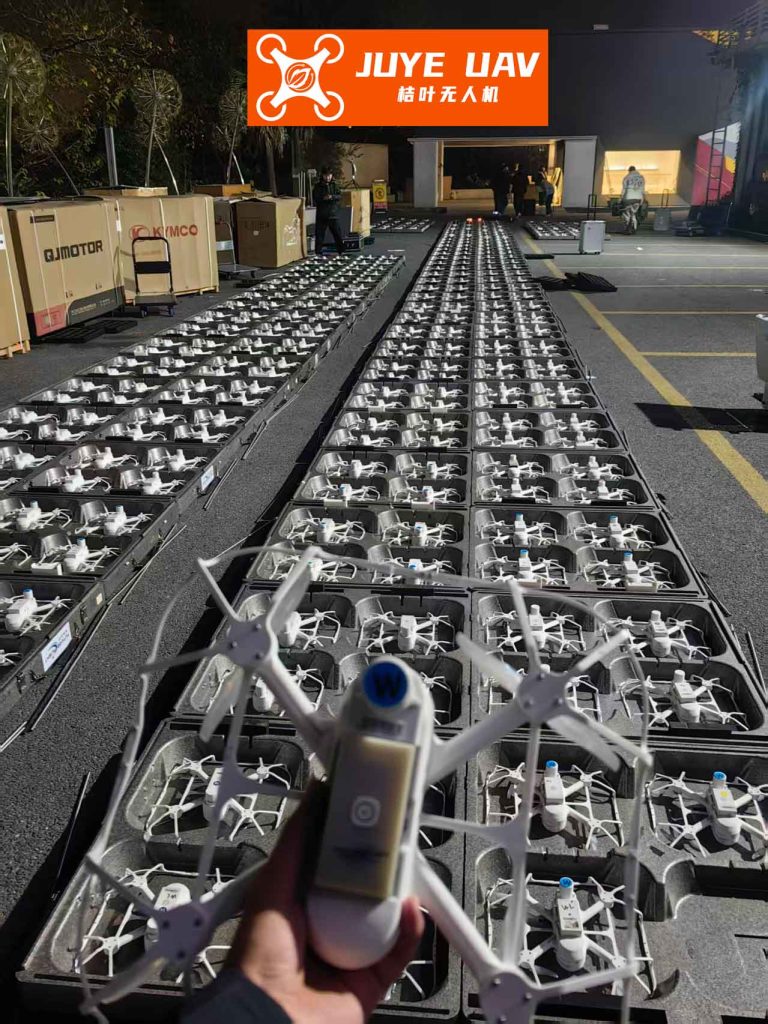
Seeing a formation drone light show in action, as captured in the image above, reinforces the beauty of this technology. The drones form intricate shapes against the night sky, each a testament to precise engineering. In such a display, the aggregation-disaggregation processes are invisible to the audience but crucial behind the scenes. For example, when transitioning from a star pattern to a company logo, drones may temporarily disaggregate into smaller groups before re-aggregating into the new shape. This mirrors the M4 mode in multi-resolution modeling, ensuring smooth visual flow.
Safety is paramount in formation drone light shows. Risk factors include mid-air collisions, signal loss, and battery failures. To mitigate these, redundancy and fail-safe mechanisms are built in. From a modeling perspective, this can be viewed as dynamic disaggregation: if a drone malfunctions, it is removed from the formation, and the rest reconfigure. This is similar to the reorganization process discussed earlier. A safety metric for a formation drone light show could be the probability of successful completion, which depends on parameters like drone reliability ρ and communication reliability γ. For N drones, assuming independence, the probability might be approximated as:
$$ P_{success} = \rho^N \cdot \gamma^{N-1} $$
though in practice, correlations exist. Table 3 outlines common safety measures in formation drone light shows.
| Safety Measure | Description | Impact on Formation Drone Light Show |
|---|---|---|
| Geofencing | Software limits drone movement to predefined airspace. | Prevents drones from straying; ensures show boundaries. |
| Return-to-Home (RTH) | Automatic return on low battery or signal loss. | Triggers disaggregation for faulty drones; others continue. |
| Collision Avoidance | On-board sensors detect and evade obstacles. | Maintains formation integrity during close maneuvers. |
| Health Monitoring | Real-time diagnostics on battery, motors, etc. | Allows proactive reconfiguration; minimizes disruptions. |
Scalability is a key challenge for large formation drone light shows. As the number of drones increases, the computational load for control and synchronization grows exponentially if using high-resolution models. This is where multi-resolution aggregation shines. By treating subgroups as aggregated entities, we can reduce complexity. For example, in a show with 1000 drones, they might be divided into 10 clusters of 100 drones each. Each cluster acts as a virtual drone in the overall pattern, and within clusters, individual drones maintain fine-grained formations. The total state dimension reduces from 3000 (assuming 3D positions) to 30 (cluster centers) plus internal states, easing real-time processing. This hierarchical approach is fundamental to modern formation drone light shows.
To quantify performance, we can define metrics for a formation drone light show. Let ε be the tracking error—the deviation of each drone from its desired position. The root-mean-square error (RMSE) over time T and N drones is:
$$ \text{RMSE} = \sqrt{ \frac{1}{NT} \sum_{i=1}^N \int_0^T \| \mathbf{x}_i(t) – \mathbf{x}_i^{des}(t) \|^2 dt } $$
A well-executed formation drone light show aims for RMSE values under a few centimeters. Similarly, energy consumption E can be modeled as a function of maneuver aggressiveness. If a_i(t) is the acceleration of drone i, then:
$$ E \propto \sum_{i=1}^N \int_0^T \| \mathbf{a}_i(t) \|^2 dt $$
Optimizing these metrics involves trade-offs, often addressed in pre-show planning using simulation tools that employ multi-resolution models.
The artistic dimension of formation drone light shows cannot be overlooked. Choreographing a show involves mapping visual ideas to drone trajectories and colors. This process is akin to disaggregating a high-level vision into individual drone commands. Artists use software to design patterns, which are then compiled into flight paths. The software often incorporates aggregation principles: for instance, defining keyframes for the overall formation, then interpolating paths for each drone. This reduces manual effort and ensures feasibility. In my projects, I’ve used such tools to create stunning formation drone light shows for events, where the audience’s awe is the ultimate reward.
Looking ahead, technologies like AI and swarm intelligence will further transform formation drone light shows. Imagine drones that self-organize into shapes based on real-time audience input, or shows that adapt to weather conditions. This requires advanced disaggregation-aggregation cycles where drones switch resolutions autonomously. Research in multi-agent reinforcement learning is paving the way. For example, drones could learn cooperative policies to maintain formation under disturbances, with the global objective being visual appeal. The future formation drone light show will be more dynamic and interactive.
In conclusion, formation drone light shows are a symphony of technology and art. The concepts of multi-resolution modeling, aggregation, and disaggregation provide a robust framework for understanding and improving these displays. From mathematical control equations to practical safety measures, every aspect contributes to the magic. As I continue to explore this field, I am excited by the possibilities—bigger scales, more complex patterns, and greater accessibility. The term formation drone light show encapsulates a rapidly evolving discipline that promises to light up our skies for years to come.
To recap, I have discussed the modeling, control, communication, and design aspects of formation drone light shows, emphasizing the aggregation-disaggregation paradigm. The integration of tables and formulas, as seen in this article, helps summarize key points and foster deeper understanding. Whether for entertainment or experimental research, the principles behind formation drone light shows offer valuable insights into coordinated multi-agent systems. I hope this exposition inspires further innovation in crafting these celestial performances.