
The mesmerizing spectacle of a coordinated formation drone light show represents a pinnacle of multi-agent control, where hundreds of unmanned aerial vehicles (UAVs) must converge from disparate starting points into a precise, predetermined geometric pattern and maintain cohesive motion. The foundational challenge enabling such displays is the formation assembly or forming control problem. This involves guiding a swarm of drones, initially scattered in space, to rapidly and accurately configure themselves into a stable target formation while achieving consensus in velocity and heading direction. While traditional leader-follower architectures offer one solution, they introduce a single point of failure. This article delves into a robust, decentralized optimal control methodology for assembly, particularly suited for scalable applications like large-scale formation drone light shows where a designated leader is impractical and peer-to-peer communication is essential.
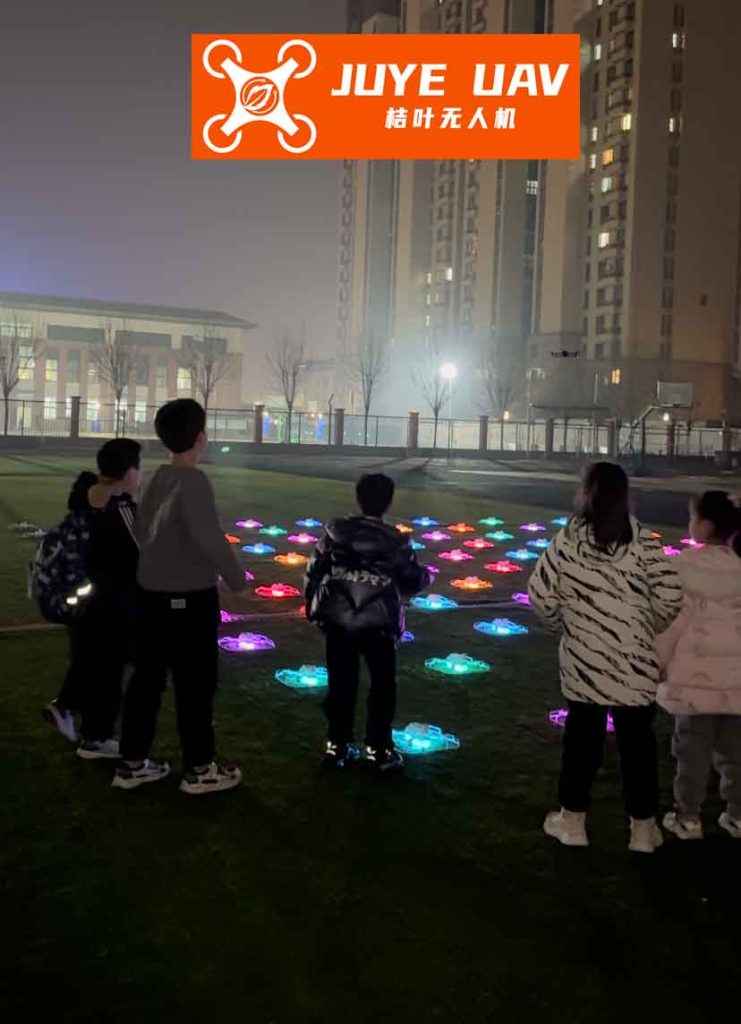
The core task is to synthesize local control laws for each drone so that the collective behavior emerges from interactions with only a subset of neighboring agents, as defined by a communication network. This approach enhances scalability and robustness, critical for a flawless formation drone light show.
1. Problem Formulation and Modeling
1.1. Individual Drone Kinematics
Considering motion in a planar environment (sufficient for designing the pattern layout of a formation drone light show), the kinematics of the i-th drone (UAVi) can be described by:
$$
\begin{align}
\dot{x}_i(t) &= v_i(t) \cos\theta_i(t) \\
\dot{y}_i(t) &= v_i(t) \sin\theta_i(t) \\
\dot{\theta}_i(t) &= \omega_i(t) \\
\dot{v}_i(t) &= a_i(t)
\end{align}
$$
where \((x_i, y_i)\) is the position, \(v_i\) is the speed, \(\theta_i\) is the heading angle, and \(\omega_i\) and \(a_i\) are the angular rate and linear acceleration control inputs, respectively. To facilitate linear control design, we apply a feedback linearization transformation. Define the state vector \(\mathbf{z}_i\) and a new input vector \(\mathbf{u}_i\) as:
$$
\mathbf{z}_i = \begin{bmatrix} z_{i1} & z_{i2} & z_{i3} & z_{i4} \end{bmatrix}^T = \begin{bmatrix} x_i & y_i & v_i \cos\theta_i & v_i \sin\theta_i \end{bmatrix}^T = \begin{bmatrix} x_i \\ y_i \\ \dot{x}_i \\ \dot{y}_i \end{bmatrix}
$$
$$
\mathbf{u}_i = \begin{bmatrix} u_{i1} \\ u_{i2} \end{bmatrix} = \begin{bmatrix} \cos\theta_i & \sin\theta_i \\ -\sin\theta_i/v_i & \cos\theta_i/v_i \end{bmatrix}^{-1} \begin{bmatrix} a_i \\ \omega_i \end{bmatrix}
$$
This yields a linear time-invariant (LTI) model for each agent:
$$
\dot{\mathbf{z}}_i = A \mathbf{z}_i + B \mathbf{u}_i
$$
with
$$
A = \begin{bmatrix} 0 & I_2 \\ 0 & 0 \end{bmatrix}, \quad B = \begin{bmatrix} 0 \\ I_2 \end{bmatrix}, \quad I_2 = \begin{bmatrix} 1 & 0 \\ 0 & 1 \end{bmatrix}.
$$
1.2. Swarm Aggregate Model
For a swarm \(\Omega = \{ \text{UAV}_i, i=1,\dots, N \}\), the aggregate state and input vectors are \(\mathbf{X} = [\mathbf{z}_1^T, \dots, \mathbf{z}_N^T]^T\) and \(\mathbf{U} = [\mathbf{u}_1^T, \dots, \mathbf{u}_N^T]^T\). The collective dynamics are:
$$
\dot{\mathbf{X}} = A_N \mathbf{X} + B_N \mathbf{U}
$$
where \(A_N = I_N \otimes A\) and \(B_N = I_N \otimes B\) (\(\otimes\) denotes the Kronecker product). The state can be partitioned into aggregate position \(\mathbf{X}_p = (I_N \otimes [I_2 \, 0]) \mathbf{X}\) and aggregate velocity \(\mathbf{X}_v = (I_N \otimes [0 \, I_2]) \mathbf{X}\).
1.3. Formation Geometry and Communication Topology
A formation is defined by both its spatial shape and the communication links enabling coordination. The spatial shape for a formation drone light show is specified by a constant vector \(\mathbf{h} = \mathbf{h}_p \otimes [1, 1, 0, 0]^T \in \mathbb{R}^{4N}\), where \(\mathbf{h}_p \in \mathbb{R}^{2N}\) defines the desired relative positions in the inertial frame.
Definition 1 (Formation Stability): The swarm converges to the formation \(\mathbf{h}\) if there exist vectors \(\mathbf{q}(t), \mathbf{w}(t) \in \mathbb{R}^2\) such that:
$$
\lim_{t \to \infty} (\mathbf{X}_p(t) – \mathbf{h}_p) = \mathbf{1}_N \otimes \mathbf{q}(t), \quad \lim_{t \to \infty} \mathbf{X}_v(t) = \mathbf{1}_N \otimes \mathbf{w}(t)
$$
where \(\mathbf{1}_N\) is an N-dimensional column vector of ones. This implies all drones eventually share the same velocity \(\mathbf{w}(t)\) and maintain the prescribed relative offsets defined by \(\mathbf{h}_p\).
The communication topology is modeled as an undirected graph \(\mathcal{G}=(\mathcal{V},\mathcal{E})\). Each node in \(\mathcal{V}\) corresponds to a drone, and an edge \(e_{ij} \in \mathcal{E}\) signifies a bidirectional communication link between UAVi and UAVj. The neighbor set for UAVi is \(\mathcal{N}_i = \{ \text{UAV}_j : e_{ji} \in \mathcal{E}, j \neq i \}\). The topology is encoded in the Laplacian matrix \(L = D – A_d\), where \(A_d\) is the adjacency matrix (\([A_d]_{ij}=1\) if \(j \in \mathcal{N}_i\), else 0) and \(D\) is the degree diagonal matrix. For a connected graph, \(L\) has a simple zero eigenvalue with eigenvector \(\mathbf{1}_N\). This property is fundamental to achieving consensus, the underlying principle for velocity alignment in a formation drone light show.
| Topology Description | Laplacian Matrix (L) |
|---|---|
| Four drones in a diamond with bidirectional links as shown: (UAV1 connected to 2,3,4; UAV2 connected to 1,3; UAV3 connected to 1,2,4; UAV4 connected to 1,3). |
$$ L = \begin{bmatrix} 3 & -1 & -1 & -1 \\ -1 & 2 & -1 & 0 \\ -1 & -1 & 3 & -1 \\ -1 & 0 & -1 & 2 \end{bmatrix} $$ |
2. Decentralized Optimal Control Design
The goal is to design a control law using only local error information. For UAVi, the local error with respect to a neighbor UAVj and the target formation is:
$$
\mathbf{y}_{ij} = (\mathbf{z}_i – \mathbf{z}_j) – (\mathbf{h}_i – \mathbf{h}_j)
$$
where \(\mathbf{h}_i\) is the segment of \(\mathbf{h}\) corresponding to UAVi. The composite local error for UAVi is the sum over its neighbors:
$$
\mathbf{y}_i = \sum_{j \in \mathcal{N}_i} \mathbf{y}_{ij} = \sum_{j \in \mathcal{N}_i} [(\mathbf{z}_i – \mathbf{h}_i) – (\mathbf{z}_j – \mathbf{h}_j)].
$$
The global stacked error vector \(\mathbf{Y} = [\mathbf{y}_1^T, \dots, \mathbf{y}_N^T]^T\) is:
$$
\mathbf{Y} = (L \otimes I_4) (\mathbf{X} – \mathbf{h}) \triangleq \mathcal{L}(\mathbf{X} – \mathbf{h}).
$$
We formulate an infinite-horizon linear quadratic regulator (LQR) problem for the swarm:
$$
\min_{\mathbf{U}} J = \int_{0}^{\infty} \left[ (\mathbf{X} – \mathbf{h})^T Q_\ell (\mathbf{X} – \mathbf{h}) + \mathbf{U}^T R_N \mathbf{U} \right] dt
$$
subject to: \(\dot{\mathbf{X}} = A_N \mathbf{X} + B_N \mathbf{U}\),
where \(Q_\ell = \mathcal{L}^T Q_N \mathcal{L}\) with \(Q_N > 0\), and \(R_N > 0\) is a block-diagonal weighting matrix.
Theorem 1 (Feasibility): For a swarm with a connected communication graph \(\mathcal{G}\), the formation stabilization problem has a feasible solution, ensuring the swarm can converge to the target formation \(\mathbf{h}\). This is underpinned by the stabilizability and detectability properties of the system when the graph is connected.
The standard optimal control solution yields a centralized state feedback law:
$$
\mathbf{U}^* = -R_N^{-1} B_N^T (P \mathbf{X} – \mathbf{g}),
$$
where \(P > 0\) satisfies the large-scale Algebraic Riccati Equation (ARE):
$$
P A_N + A_N^T P – P B_N R_N^{-1} B_N^T P + \mathcal{L}^T Q_N \mathcal{L} = 0,
$$
and \(\mathbf{g}\) is an auxiliary vector. This law requires each drone to know the states of all other drones, which is infeasible for a scalable formation drone light show.
2.1. Enforcing Decentralization via Structural Constraints
To achieve decentralization, we impose a structural constraint on the Riccati matrix \(P\) mirroring the communication topology. We parameterize \(P\) as:
$$
P = L \otimes \mathbf{p},
$$
where \(\mathbf{p} \in \mathbb{R}^{4 \times 4}\) is a symmetric positive definite matrix to be determined. This structure is key: if there is no communication link between UAVi and UAVj (i.e., \(L_{ij}=0\)), then the corresponding block in \(P\) is effectively zero. Consequently, the control input \(\mathbf{u}_i\) computed from \(\mathbf{U}^* = -R_N^{-1}B_N^T P \mathbf{X} + \text{…}\) will not depend on the state \(\mathbf{z}_j\) of non-neighboring drones. The control law for each drone becomes:
$$
\mathbf{u}_i = -R_i^{-1} B^T \left( \mathbf{p} \sum_{j \in \mathcal{N}_i} (\mathbf{z}_i – \mathbf{z}_j) \right) + \text{(feedforward term)},
$$
which depends only on the relative states of its neighbors—a fully decentralized strategy perfect for a formation drone light show.
2.2. Solution via Linear Matrix Inequalities (LMI)
Solving the large ARE with the structural constraint \(P = L \otimes \mathbf{p}\) is challenging. We reformulate it as a convex optimization problem with LMI constraints, which is computationally efficient. The condition for optimality can be relaxed and cast as:
$$
\begin{aligned}
& \max_{\mathbf{p}} \quad \text{trace}(\mathbf{p}) \\
& \text{subject to:} \\
& \begin{bmatrix}
(L \otimes \mathbf{p}) A_N + A_N^T (L \otimes \mathbf{p}) + \mathcal{L}^T Q_N \mathcal{L} & (L \otimes \mathbf{p}) B_N \\
B_N^T (L \otimes \mathbf{p}) & R_N
\end{bmatrix} \succeq 0, \\
& \mathbf{p} \succ 0.
\end{aligned}
$$
This LMI feasibility problem seeks a matrix \(\mathbf{p}\) that satisfies the linear matrix inequality constraint, guaranteeing closed-loop stability and performance. Solving this yields the local feedback gain matrix \(\mathbf{p}\). The global feedback matrix is then \(P = L \otimes \mathbf{p}\), and the decentralized optimal control law is obtained. This LMI-based approach systematically handles the structural constraint and is a powerful tool for synthesizing controllers for large-scale systems like drone swarms.
| Strategy | Communication Requirement | Robustness | Scalability for Light Shows | Key Challenge |
|---|---|---|---|---|
| Leader-Follower | Star topology (to leader) | Low (single point of failure) | Poor | Leader failure disrupts entire show |
| Centralized LQR | All-to-all (global state) | High (theoretically) | Very Poor | Communication/computation bottleneck |
| Decentralized Optimal (Proposed) | Sparse, local (neighbors only) | High | Excellent | Designing topology-aware gain matrix (solved via LMI) |
3. Simulation Analysis and Performance
To validate the proposed decentralized control method, consider a swarm of \(N=4\) drones tasked to form a 200m-side diamond shape. The initial conditions are randomized. The weighting matrices are chosen as \(Q_N = 500 \cdot I_{16}\) and \(R_N = 100 \cdot I_{16}\). The communication topology is the connected diamond graph.
| Drone | Initial x (m) | Initial y (m) | Initial Speed (m/s) | Initial Heading (°) |
|---|---|---|---|---|
| UAV1 | -100 | -100 | 28.30 | 45.0 |
| UAV2 | -500 | -300 | 31.63 | 71.6 |
| UAV3 | -400 | 200 | 25.20 | 52.5 |
| UAV4 | -100 | 200 | 33.50 | 63.4 |
The resulting trajectories show swift and precise convergence to the target diamond formation. The key performance metrics are formation accuracy and velocity consensus.
Formation Accuracy: The relative distance errors between drones converge to zero. For instance, the distance error between UAV1 and all other drones (\( \Delta l_{1j} = \| \mathbf{p}_1 – \mathbf{p}_j \| – \| \mathbf{h}_{p1} – \mathbf{h}_{pj} \| \)) rapidly decreases and settles at zero, confirming geometric accuracy.
Velocity Consensus: The velocities of all drones converge to a common value. Analysis reveals this final consensus velocity \( \bar{\mathbf{v}} = [\bar{v}_x, \bar{v}_y]^T \) is precisely the average of the drones’ initial velocity vectors:
$$
\bar{v}_x = \frac{1}{N} \sum_{i=1}^{N} v_i(0) \cos \theta_i(0), \quad \bar{v}_y = \frac{1}{N} \sum_{i=1}^{N} v_i(0) \sin \theta_i(0).
$$
This emergent property is a direct consequence of using the Laplacian-based error and ensures smooth, cohesive motion for the formation drone light show after assembly.
Multiple Monte-Carlo simulations with random initial positions and velocities within a 1000m radius circle consistently demonstrate successful formation assembly, proving the method’s robustness to initial conditions.
4. Implications for Large-Scale Formation Drone Light Shows
The proposed decentralized optimal control framework provides a solid foundation for the choreography of complex formation drone light shows. Its principal advantages are:
- Scalability: Each drone’s controller depends only on information from its immediate neighbors, not the size of the entire fleet. This makes the approach viable for swarms of hundreds or thousands of drones.
- Robustness: The absence of a central leader eliminates a critical failure point. The peer-to-peer communication network can also be designed with redundancy.
- Predictable Collective Behavior: The LQR formulation optimally trades off formation-keeping error and control effort, leading to smooth, energy-efficient transitions. The guaranteed velocity consensus results in fluid collective motion.
- Systematic Design: The LMI-based solution offers a direct computational method to synthesize local controllers for any given, possibly complex, communication topology required for a specific show pattern.
Future research directions essential for real-world formation drone light shows include extending this method to:
- Formation Tracking: Enabling the assembled formation to track a desired trajectory (e.g., moving across the night sky).
- Dynamic Topology & Reconfiguration: Allowing the communication graph and target formation \(\mathbf{h}(t)\) to change smoothly over time to enable dynamic shape morphing.
- Obstacle and Collision Avoidance: Integrating real-time constraints to ensure safety during assembly and tracking maneuvers.
5. Conclusion
This article presented a comprehensive decentralized optimal control strategy for the formation assembly of drone swarms. By modeling the communication topology with a graph Laplacian and defining the control objective based on local neighbor-state errors, we formulated a global LQR problem. The critical step was imposing a structural constraint (\(P = L \otimes \mathbf{p}\)) on the solution to decentralize the control law. This complex design problem was then transformed into a tractable convex optimization problem using Linear Matrix Inequalities (LMIs).
The resulting control law enables each drone to compute its control input using only the states of its directly communicating neighbors. Simulations confirm that this method drives drones from arbitrary initial conditions to a predefined geometric formation while achieving exact velocity consensus—a fundamental requirement for a stable and visually appealing formation drone light show. The method’s decentralized nature, robustness, and systematic design procedure make it a powerful and promising approach for the control architecture of large-scale aerial displays and other multi-robot cooperative tasks.