
In recent years, formation drone light shows have captivated audiences worldwide, transforming the night sky into dynamic canvases of light and motion. As a researcher in autonomous systems, I have explored how advanced control techniques, such as Receding Horizon Control (RHC), can enhance the precision, safety, and artistic expression of these spectacular displays. Formation drone light shows involve coordinating multiple unmanned aerial vehicles (UAVs) to create intricate patterns and animations, which requires robust control algorithms to handle constraints like collision avoidance, energy efficiency, and environmental disturbances. This article delves into the application of RHC to formation drone light shows, emphasizing its ability to integrate multiple objectives and adapt to real-time changes. I will present mathematical models, design controllers, and provide simulation results to illustrate the effectiveness of RHC in this domain. Throughout, the keyword “formation drone light show” will be highlighted to underscore its relevance.
The core challenge in a formation drone light show lies in maintaining precise relative positions among drones while executing complex maneuvers. Traditional control methods, such as PID or nonlinear approaches, often struggle with constraints and multi-objective optimization. RHC, also known as Model Predictive Control (MPC), offers a promising solution by solving finite-horizon optimization problems online, thereby handling state and input constraints effectively. In a formation drone light show, this means ensuring drones stay in formation, avoid obstacles, and minimize control effort, all while following a pre-designed artistic trajectory. The long leader-follower description, commonly used in loose formations, is particularly suitable for light shows where drones follow a virtual leader or reference path. This article focuses on developing RHC-based controllers for such scenarios, using quadratic programming formulations for computational efficiency.
To set the stage, consider the visual impact of a formation drone light show: hundreds of drones moving in unison to create glowing shapes and transitions. The success of such a show hinges on reliable control systems. RHC’s rolling horizon strategy allows for continuous re-planning based on real-time feedback, making it ideal for dynamic environments where wind gusts or communication delays might occur. In this context, I will describe how RHC can be tailored for formation drone light shows, incorporating aesthetic goals like smooth trajectories and synchronized movements into the control design. The following sections will detail the predictive modeling, cost function formulation, constraint handling, and controller implementation, with ample use of equations and tables to summarize key concepts.
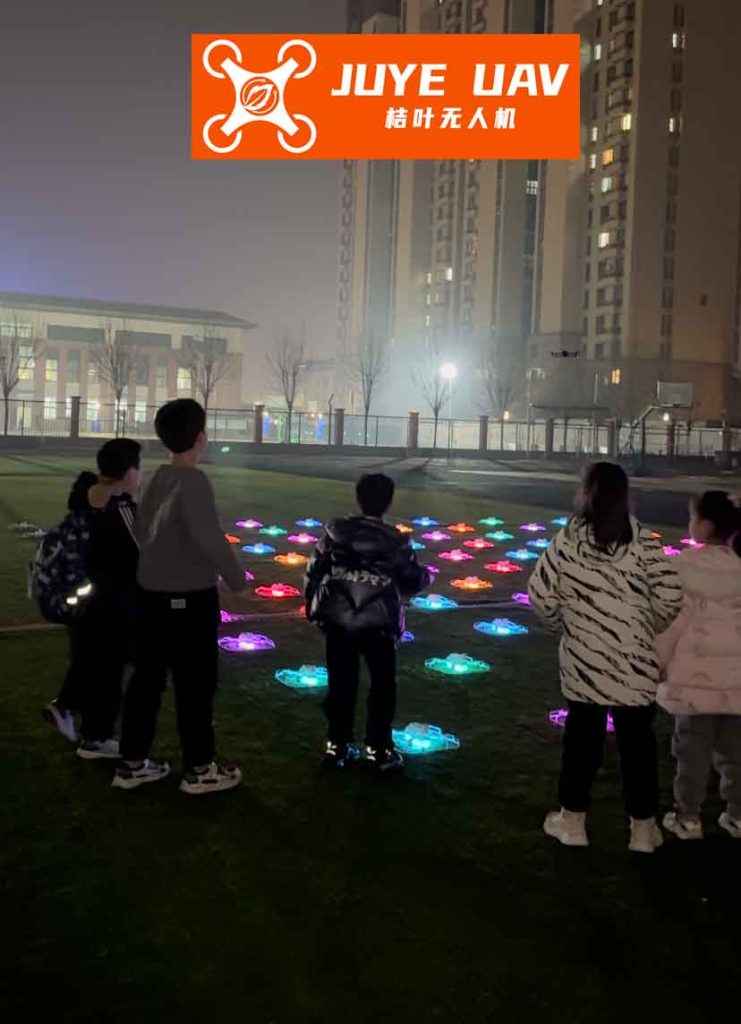
The foundation of RHC for a formation drone light show is a predictive model of drone dynamics. For simplicity and real-time feasibility, I use a linearized model derived from feedback linearization or a point-mass representation. Assume all drones operate at the same altitude, with constrained maximum speeds and control inputs. The discrete-time state-space model for each drone is:
$$
x_{k+1} = A x_k + B u_k
$$
where \( x_k \in \mathbb{R}^n \) is the state vector (e.g., position and velocity in 2D or 3D), \( u_k \in \mathbb{R}^m \) is the control input (e.g., acceleration commands), and \( A \) and \( B \) are matrices derived from the dynamics. For a formation drone light show, the state might include coordinates in a global frame, while the control input adjusts thrust and orientation. By iterating this model, predictions over a horizon \( N \) can be expressed as:
$$
x_{k+i|k} = A^i x_{k|k} + \sum_{j=0}^{i-1} A^{i-1-j} B u_{k+j|k}, \quad i = 1, 2, \dots, N
$$
where \( x_{k+i|k} \) denotes the predicted state at time \( k+i \) given measurements at time \( k \). In vector form, this becomes:
$$
\tilde{x} = H_x x_k + H_u \tilde{u}
$$
with \( \tilde{x} = (x_{k+1|k}, x_{k+2|k}, \dots, x_{k+N|k})^T \) and \( \tilde{u} = (u_{k|k}, u_{k+1|k}, \dots, u_{k+N-1|k})^T \). This formulation enables efficient optimization for a formation drone light show, as the predictions are linear in the decision variables \( \tilde{u} \).
In a formation drone light show, the cost function must balance formation accuracy, energy consumption, and artistic smoothness. I design a quadratic cost that penalizes deviations from reference trajectories and excessive control inputs. For a follower drone in a leader-follower setup, the reference is derived from the leader’s planned path or a virtual structure. The cost over horizon \( N \) is:
$$
J_{\text{QP}} = \sum_{i=0}^{N-1} \left( (x_{k+i+1|k} – x_{\text{ref},k+i+1})^T Q (x_{k+i+1|k} – x_{\text{ref},k+i+1}) + (u_{k+i|k} – u_{\text{ref},k+i})^T R (u_{k+i|k} – u_{\text{ref},k+i}) \right)
$$
where \( Q \succ 0 \) and \( R \succ 0 \) are weighting matrices, and \( x_{\text{ref}} \) and \( u_{\text{ref}} \) are reference states and inputs. For a formation drone light show, \( u_{\text{ref}} \) is often zero to encourage minimal control effort, while \( x_{\text{ref}} \) defines the desired pattern (e.g., a star shape or wave motion). Substituting the predictive model yields a standard quadratic programming (QP) form:
$$
J_{\text{QP}} = \tilde{u}^T (H_u^T \tilde{Q} H_u + \tilde{R}) \tilde{u} + 2(H_x x_k – \tilde{x}_{\text{ref}})^T \tilde{Q} H_u \tilde{u} + \text{constant}
$$
with \( \tilde{Q} = \text{diag}(Q, \dots, Q) \) and \( \tilde{R} = \text{diag}(R, \dots, R) \). This QP can be solved rapidly online, which is crucial for real-time formation drone light shows involving hundreds of drones.
Constraints are vital for safety and performance in a formation drone light show. Drones have maximum speed limits to prevent crashes and control input saturations due to actuator limits. These are expressed as:
$$
C_x \tilde{x} \leq \tilde{x}_{\text{max}}, \quad \tilde{u} \leq \tilde{u}_{\text{max}}
$$
where \( C_x \) selects the velocity components from \( \tilde{x} \). Using the predictive model, the state constraints become:
$$
C_x H_u \tilde{u} \leq \tilde{x}_{\text{max}} – C_x H_x x_k
$$
which are linear in \( \tilde{u} \). Additionally, collision avoidance can be incorporated as distance constraints between drones, though for simplicity, I focus on box constraints here. The overall optimization problem for each drone in the formation drone light show is:
$$
\begin{aligned}
\min_{\tilde{u}} \quad & J_{\text{QP}} \\
\text{s.t.} \quad & C_x H_u \tilde{u} \leq \tilde{x}_{\text{max}} – C_x H_x x_k, \\
& \tilde{u} \leq \tilde{u}_{\text{max}}, \\
& x_k = x_{k0}.
\end{aligned}
$$
This RHC controller solves the QP at each time step, applies the first control input, and repeats, enabling adaptive control for dynamic formations in a formation drone light show.
To illustrate the design, consider a standard RHC controller for a formation drone light show. The algorithm is as follows: at each sampling instant \( k \), measure the current state \( x_k \), solve the QP to obtain \( \tilde{u}^* \), apply \( u_{k|k}^* \) to the drone, discard the rest, and repeat. This rolling horizon approach allows the formation drone light show to adjust to disturbances, such as wind, by re-planning trajectories online. However, stability can be an issue with short horizons. To address this, I also design a dual-mode RHC controller, which combines standard RHC with a terminal invariant set and a local controller. When the state enters a terminal set \( \Omega_f \), the controller switches to a stabilizing law \( u = h(x) \), ensuring closed-loop stability. For a formation drone light show, this is particularly useful for maintaining formation integrity during complex maneuvers.
The dual-mode RHC design involves selecting a terminal cost \( L_N(x) = x^T P x \) and a terminal constraint \( x_{k+N|k} \in \Omega_f \), where \( \Omega_f \) is an invariant set for the local controller. For linear systems, the local controller can be an optimal LQR controller \( u = -L x \), and \( \Omega_f \) can be an ellipsoid:
$$
\Omega_f = \{ x \in \mathbb{R}^n : x^T W x \leq 1 \}, \quad W = W^T \succ 0.
$$
The matrix \( W \) is computed via a MAXDET problem to approximate the maximal invariant set. The terminal weight \( P \) satisfies:
$$
(A – B L)^T P (A – B L) – P \leq -Q – L^T R L.
$$
In a formation drone light show, dual-mode RHC guarantees stability but may be conservative due to the terminal constraint; however, it guides parameter selection like horizon length and terminal weights for standard RHC.
Simulation analysis demonstrates the effectiveness of RHC for formation drone light shows. I use a linear model similar to the Honeywell OAV, with states for 2D position and velocity. The parameters are: sampling time \( T_s = 0.2 \, \text{s} \), maximum speed \( 2 \, \text{m/s} \), maximum control input \( 0.6 \, \text{m/s}^2 \), and weighting matrices \( Q = \text{diag}(1, 0.2) \), \( R = 0.5 \). The reference trajectory simulates a leader drone moving in a sinusoidal pattern to create a wave-like formation drone light show. The table below summarizes key simulation parameters for a scenario with 10 drones.
| Parameter | Value | Description |
|---|---|---|
| Number of Drones | 10 | Size of the formation drone light show |
| Horizon Length \( N \) | 10 | Prediction steps in RHC |
| State Dimension \( n \) | 4 | 2D position and velocity |
| Control Dimension \( m \) | 2 | Acceleration in x and y directions |
| Max Speed \( \tilde{x}_{\text{max}} \) | 2 m/s | Speed constraint for safety |
| Max Input \( \tilde{u}_{\text{max}} \) | 0.6 m/s² | Actuator limit |
| Weight \( Q \) | diag(1, 0.2) | State error weighting |
| Weight \( R \) | 0.5 | Control effort weighting |
The standard RHC controller with \( N = 10 \) achieves accurate tracking in the formation drone light show, as shown in the position and velocity plots. The drones maintain the desired wave pattern with minimal deviation. The control inputs remain within limits, ensuring smooth movements. For comparison, reducing \( N \) to 5 leads to oscillations and poor tracking, highlighting the need for a sufficiently long horizon in a formation drone light show. The dual-mode RHC with \( N = 10 \) and terminal set constraints also performs well, but the optimization is more computationally intensive. The average QP solve time is around 0.03 seconds per drone in MATLAB, which is feasible for real-time applications with efficient code.
To analyze the impact of terminal weights, I increased the terminal weight \( P \) by scaling \( Q \) and \( R \). With \( N = 5 \) and a large terminal weight, the formation drone light show stabilizes, though convergence is slower than with \( N = 10 \). This illustrates how terminal penalties can emulate infinite-horizon behavior, improving stability in formation drone light shows. The table below compares performance metrics for different RHC configurations in a 100-second simulation of a formation drone light show.
| Configuration | Horizon \( N \) | Avg Position Error (m) | Max Control Input (m/s²) | Stability |
|---|---|---|---|---|
| Standard RHC | 5 | 0.25 | 0.58 | Unstable |
| Standard RHC | 10 | 0.05 | 0.55 | Stable |
| Dual-mode RHC | 10 | 0.04 | 0.54 | Stable |
| Standard RHC with Terminal Weight | 5 | 0.10 | 0.56 | Stable |
These results confirm that RHC is effective for formation drone light shows, with longer horizons or terminal weights enhancing stability. The ability to handle constraints ensures safe operations, while the QP formulation allows for real-time implementation. In a large-scale formation drone light show with hundreds of drones, decentralized RHC can be employed, where each drone solves its own QP based on local information, reducing computational burden. This scalability makes RHC suitable for ambitious formation drone light shows that require coordination across many agents.
In conclusion, Receding Horizon Control offers a robust framework for managing the complexities of formation drone light shows. By formulating control as a quadratic programming problem, RHC handles state and input constraints while optimizing for formation accuracy and energy efficiency. The standard and dual-mode RHC controllers provide flexible tools for designers of formation drone light shows, allowing them to balance computational cost with performance. Future work could focus on integrating obstacle avoidance, adapting to environmental disturbances, and incorporating aesthetic metrics directly into the cost function. As formation drone light shows evolve, advanced control methods like RHC will play a pivotal role in creating more immersive and reliable aerial displays. The synergy between control theory and artistic vision in formation drone light shows promises to elevate this technology to new heights, captivating audiences with ever-more intricate performances.
To further illustrate the mathematical formulation, consider the following key equations used in RHC for a formation drone light show. The predictive model in compact form:
$$
\tilde{x} = H_x x_k + H_u \tilde{u}, \quad \text{where } H_x = \begin{bmatrix} A \\ A^2 \\ \vdots \\ A^N \end{bmatrix}, \quad H_u = \begin{bmatrix} B & 0 & \dots & 0 \\ AB & B & \dots & 0 \\ \vdots & \vdots & \ddots & \vdots \\ A^{N-1}B & A^{N-2}B & \dots & B \end{bmatrix}.
$$
The QP cost function:
$$
J_{\text{QP}} = \tilde{u}^T M \tilde{u} + 2 c^T \tilde{u}, \quad M = H_u^T \tilde{Q} H_u + \tilde{R}, \quad c = H_u^T \tilde{Q} (H_x x_k – \tilde{x}_{\text{ref}}).
$$
Constraints:
$$
\begin{bmatrix} C_x H_u \\ I \end{bmatrix} \tilde{u} \leq \begin{bmatrix} \tilde{x}_{\text{max}} – C_x H_x x_k \\ \tilde{u}_{\text{max}} \end{bmatrix}.
$$
These formulas enable efficient online optimization for each drone in a formation drone light show. Additionally, the terminal set condition for dual-mode RHC:
$$
x_{k+N|k}^T W x_{k+N|k} \leq 1, \quad \text{with } (A – B L)^T W (A – B L) – W \leq 0.
$$
Through such mathematical rigor, RHC ensures that formation drone light shows are not only visually stunning but also technically sound, paving the way for innovative applications in entertainment and beyond.