
The rapid evolution of drone technology has transcended its initial military and hobbyist origins to become a cornerstone of modern technological applications. Among its most captivating and complex manifestations is the formation drone light show, where dozens or even hundreds of unmanned aerial vehicles (UAVs) operate in synchrony to create dynamic, luminous patterns in the night sky. This spectacle is not merely an artistic endeavor but a sophisticated demonstration of multi-agent systems, real-time communication, and precise coordinated control. The mastery required to design, program, and execute such a formation drone light show underscores a significant educational challenge. Traditional pedagogical methods, often reliant on theoretical instruction and limited, high-risk physical testing, are inadequate for imparting the intricate skills and intuitive understanding necessary for effective formation flight. This gap necessitates the development of an immersive, safe, and scalable educational framework. In this context, the integration of Virtual and Real elements—Virtuality-Reality Integration—emerges as a transformative paradigm. From my perspective as an educator and researcher, constructing and optimizing a teaching environment based on this fusion is paramount for training the next generation of engineers and operators capable of pushing the boundaries of applications like the large-scale formation drone light show.
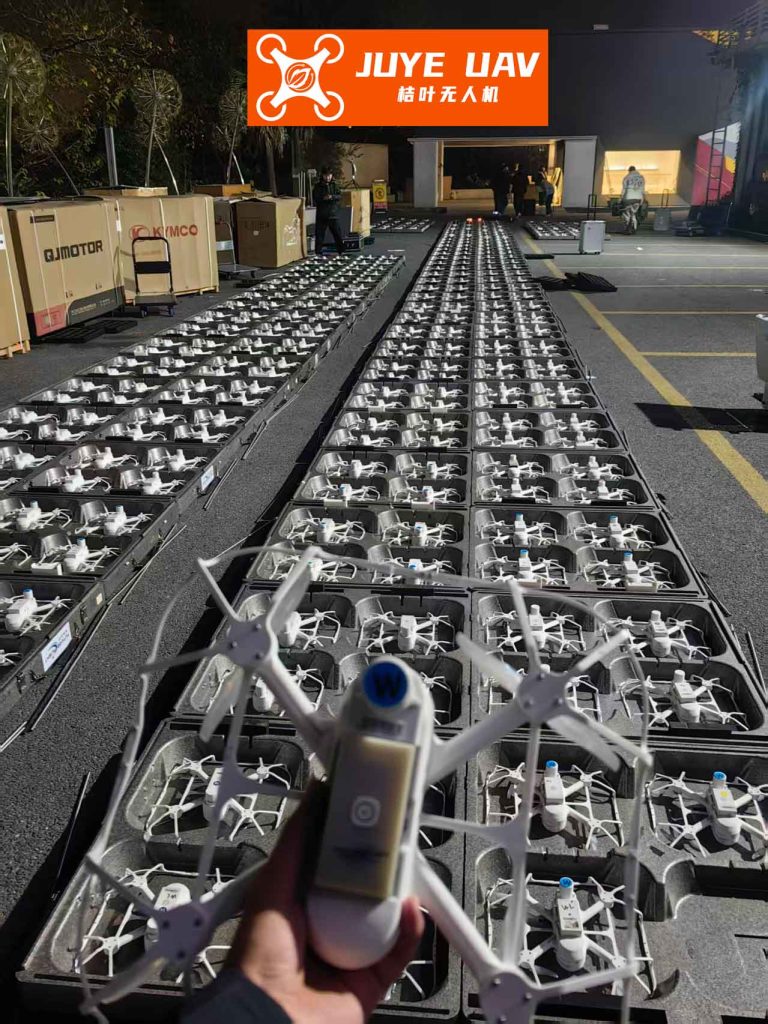
The core challenge in teaching drone formation lies in bridging the abstract world of algorithms and the tangible, often unpredictable, world of physical flight. Concepts like consensus algorithms, collision avoidance, and path planning are mathematically dense. A purely virtual simulation allows students to test algorithms but may lack the visceral feedback and real-world physics (e.g., wind gusts, battery decay, communication latency) critical for a robust formation drone light show. Conversely, training solely with physical drones is prohibitively expensive, risky, and constrained by weather, space, and time. Virtuality-Reality Integration dissolves this dichotomy. It creates a continuum where virtual models and real entities coexist and interact, enabling learners to experience the consequences of their decisions in a controlled yet realistic setting. This approach aligns perfectly with the demands of choreographing a formation drone light show, where virtual pre-visualization and real-world execution must be perfectly aligned.
Overview of Virtuality-Reality Integration Technology
Virtuality-Reality Integration is not a single technology but a spectrum of interactive experiences that blend computer-generated content with the physical environment. The foundational technologies include Virtual Reality (VR), Augmented Reality (AR), and Mixed Reality (MR).
- Virtual Reality (VR): Immerses the user in a completely synthetic, digital environment, occluding the physical world. For drone formation training, VR is ideal for mission rehearsal, allowing a designer to “stand” inside a virtual airspace and observe the planned formation drone light show from any perspective before a single real drone takes off.
- Augmented Reality (AR): Superimposes digital information (e.g., flight paths, drone status icons, safety boundaries) onto a live view of the real world via smartphones, tablets, or smart glasses. An instructor can use AR to overlay the intended formation pattern onto the actual flying field, providing students with real-time visual guidance during practice.
- Mixed Reality (MR): Represents the most integrated form, where virtual objects are not just overlaid but anchored to and interact with the real world in real-time. A student could see virtual drone models interacting with physical ones, simulating the addition of more units to a formation drone light show without the cost or risk of deploying them.
The technical pillars enabling this integration are real-time 3D rendering, precise spatial mapping and tracking, sensor fusion, and high-bandwidth, low-latency data communication. The pedagogical shift is profound: from instructor-led, passive knowledge transfer to a learner-centered, experiential, and collaborative model. Students transition from listening about formation algorithms to actively constructing, testing, and refining them within a responsive digital-physical sandbox. This is essential for understanding the dynamic constraints of a live formation drone light show.
| Technology | Immersion Level | Key Hardware | Primary Use Case in Formation Training | Advantage for Light Show Design |
|---|---|---|---|---|
| Virtual Reality (VR) | Full Immersion (Virtual World) | VR Headset, Motion Controllers | Mission planning, Algorithm simulation, Risk-free failure testing | Complete pre-visualization of complex light patterns and transitions. |
| Augmented Reality (AR) | Partial Overlay (Real World + Digital Info) | Tablet, Smartphone, AR Glasses | Real-time guidance, Maintenance assistance, Situational awareness for ground crew | Overlaying choreography timelines and safety zones during live rehearsals. |
| Mixed Reality (MR) | Seamless Blending (Virtual & Real Objects Interact) | Hololens, Magic Leap | Interactive design, Hybrid swarm testing (real + virtual drones), Advanced troubleshooting | Designing shows by physically “placing” virtual drones in real space, testing scalability. |
Constructing the Integrated Drone Formation Teaching Environment
Building an effective Virtuality-Reality teaching environment is a systematic engineering and pedagogical endeavor. The architecture must support a seamless flow from conceptual design in a virtual space to controlled execution in the physical world, with constant feedback loops between the two. The construction can be conceptualized as a multi-layered framework.
1. The Foundational Hardware and Simulation Layer: This layer comprises the physical drones, their onboard sensors (GPS, IMU, cameras), the ground control station (GCS), and a high-fidelity simulation engine (e.g., Gazebo with ROS, AirSim, or a custom engine). The simulation engine creates a dynamic, physics-based virtual replica of the real-world test environment. Crucially, it must model not just drone dynamics but also environmental factors like wind, lighting conditions (critical for a formation drone light show), and wireless communication characteristics. The drones and the simulator are connected via a middleware like Robot Operating System (ROS), allowing identical control code to run either in simulation (“software-in-the-loop” – SIL) or on the actual drones (“hardware-in-the-loop” – HIL).
2. The Virtuality-Reality Fusion Layer: This is the core integration plane. It uses spatial registration techniques to align the coordinate systems of the virtual simulation and the real flying arena. Technologies like motion capture systems (e.g., Vicon), UWB (Ultra-Wideband) localization, or visual SLAM (Simultaneous Localization and Mapping) provide centimeter-accurate real-time positioning of all physical drones. This data is fed into the simulation engine, which now operates not on purely simulated agents but on “digital twins” of the real drones. The state of each physical drone (position, velocity, battery) updates its virtual twin, and vice-versa, control commands can be issued interchangeably. This enables powerful training modalities: a student can control a mixed swarm of 5 real drones and 20 virtual drones, all behaving as a single coordinated entity, effectively prototyping a larger formation drone light show.
3. The Interactive Visualization and Interface Layer: This layer presents the fused environment to the learner and instructor. It can take multiple forms:
- A VR headset for an immersive, first-person view from within the swarm.
- An AR tablet displaying formation health metrics and intended paths overlaid on the live camera feed.
- A large situational awareness display in the GCS showing both the real drone video feeds and the comprehensive virtual overview.
The interface must allow intuitive interaction, such as dragging waypoints for the formation in the virtual view and seeing the corresponding commands generate for the real drones.
4. The Pedagogical and Assessment Layer: This top layer structures the learning experience. It defines curricula, from basic leader-follower patterns to complex emergent shapes for a formation drone light show. It incorporates scenario generators that can introduce faults (e.g., a drone losing power, a GPS outage) to train emergency response. Most importantly, it includes analytics and assessment tools that automatically log performance metrics, providing objective feedback to the student. Key Performance Indicators (KPIs) for a formation task might include:
- Formation Keeping Error: The mean squared deviation of drones from their designated positions in the formation. For a formation drone light show, this directly impacts the visual crispness of the shapes.
- Collision Avoidance Success Rate: The percentage of potential collisions successfully mitigated.
- Energy Efficiency: Total energy consumption of the swarm normalized by the mission duration and complexity.
| System Layer | Core Components | Exemplary Technologies | Pedagogical Function |
|---|---|---|---|
| Hardware & Simulation | Physical Drones, Test Field, Simulation Engine | Crazyflie, DJI SDK, Gazebo+ROS, AirSim | Provides the real and virtual substrates for all operations. |
| Fusion & Data Bridge | Localization System, Communication Network, Middleware | Vicon/Mocap, UWB, ROS/ROS2, LTE/5G | Creates and maintains the “digital twin” linkage between real and virtual entities. |
| Visualization & Interface | VR/AR/MR devices, Ground Control Software, Visualizers | Unity3D, Unreal Engine, RViz, QGroundControl | Presents the integrated environment to users, enabling interaction and control. |
| Pedagogy & Analytics | Learning Management System (LMS), Scenario Editor, Assessment Algorithms | Custom Python modules, Data Loggers, KPI Dashboards | Structures learning tasks, generates challenges, and provides quantitative feedback. |
The mathematical foundation for formation control, which students experiment with in this environment, often involves algorithms like the Consensus Protocol. A basic linear consensus protocol for position synchronization in a decentralized network can be modeled as:
$$ \dot{x}_i(t) = u_i(t) = \sum_{j \in N_i} a_{ij} (x_j(t) – x_i(t)) $$
where \( x_i(t) \) is the state (e.g., desired relative position) of drone \( i \), \( u_i(t) \) is its control input, \( N_i \) is its set of neighbors, and \( a_{ij} \) are the adjacency weights of the communication graph. In a formation drone light show, this state \( x_i(t) \) could represent the drone’s target coordinates within a time-varying shape. The integrated environment allows students to adjust the graph topology \( N_i \) or weights \( a_{ij} \) in simulation and immediately observe the stability and convergence properties of the real-physical swarm, linking abstract theory to tangible outcomes.
Optimization Strategies for Formation Flight Pedagogy
Merely constructing the environment is insufficient; its use must be strategically optimized to maximize learning outcomes. Optimization revolves around aligning teaching strategies with the unique affordances of the technology and the specific competencies required for mastering formation flight, particularly for precise applications like a formation drone light show.
1. Classification and Characteristics of Teaching Strategies:
We can categorize strategies along a spectrum from directive to exploratory, each suitable for different learning phases.
| Strategy Type | Characteristics | Role of Virtuality-Reality Tech | Example Activity for Light Show Training |
|---|---|---|---|
| Direct Instruction (Guided Simulation) | Instructor-led, step-by-step task completion. Focus on procedural knowledge and safety. | VR simulation provides a perfectly controlled, repeatable environment for initial skill drilling (e.g., manual failsafe landing). | Guided tutorial on programming a basic geometric shape (a circle) into the show choreography software. |
| Scenario-Based Learning | Learners solve problems within a realistic, contextualized narrative. Focus on application and decision-making. | The fusion environment generates complex, dynamic scenarios (e.g., sudden wind, one drone lagging). | Mission: “Modify the show’s transition pattern in real-time to avoid a newly detected no-fly zone represented by a virtual obstacle.” |
| Collaborative Project-Based Learning | Student teams undertake extended projects to create a complex artifact. Focus on design, integration, and teamwork. | Enables distributed collaboration; one team designs in VR, another tests with a few real drones, a third analyzes performance data. | End-to-end project: Design, simulate, and execute a full 2-minute formation drone light show with a musical soundtrack. |
| Competitive & Gamified Learning | Uses game elements (points, leaderboards, challenges) to motivate. Focus on performance optimization and innovation. | Real-time scoring based on KPIs (formation error, energy use) is automated by the system, providing instant feedback. | Challenge: “Achieve the most stable formation while performing a sequenced flip maneuver. Lowest average tracking error wins.” |
2. Defining Optimization Objectives and KPIs:
Clear, measurable objectives are needed to guide optimization. For a formation flight curriculum, overarching objectives (O) and their corresponding quantifiable Key Performance Indicators (KPI) can be defined as follows:
- O1: Enhance Conceptual Understanding of Multi-Agent Systems.
- KPI1.1: Score on pre/post-tests assessing knowledge of consensus, flocking, and potential field algorithms.
- KPI1.2: Ability to correctly predict swarm behavior in a novel simulated scenario.
- O2: Develop Robust Practical Operation Skills.
- KPI2.1: Mean mission success rate across increasingly difficult physical formation tasks.
- KPI2.2: Mean time to diagnose and mitigate a simulated system fault (e.g., communication dropout).
- O3: Foster Creative Design and Choreography Ability.
- KPI3.1: Complexity and visual appeal of a student-designed formation drone light show sequence, judged via rubric.
- KPI3.2: Efficiency of the generated flight paths (total distance traveled vs. minimum theoretical distance).
3. Methods for Optimizing the Strategy:
Optimization is a dynamic process of tailoring the strategy based on learner performance and feedback.
A. Adaptive Learning Pathways: The system uses logged KPI data to adjust the difficulty and focus of subsequent tasks. If a student struggles with KPI2.1 (formation keeping), the system can propose more foundational exercises on PID tuning in the simulator before returning to physical flight. A student excelling at KPI3.1 might be given advanced tools for choreographing smoother Bezier curve transitions for their formation drone light show.
B. Leveraging Data for Micro-Optimizations: Every flight in the integrated environment generates rich telemetry. Machine learning models can analyze this data to provide personalized tips. For example, the system might identify that a student consistently overshoots waypoints when turning, suggesting a need to adjust the velocity or look-ahead parameters in their path-following algorithm, which is critical for the sharp transitions in a light show.
This optimization loop can be formalized. Let the student’s competency state be a vector \( \mathbf{C} = [c_1, c_2, …, c_n] \) where each \( c_i \) corresponds to a skill (e.g., \( c_1 \)= understanding of graph theory, \( c_2 \)= PID tuning skill). After a training task \( T_j \), the system measures an outcome vector \( \mathbf{O}_j \) (the KPIs). An optimization function \( F \) maps the current state and outcome to the next recommended task:
$$ T_{j+1} = F(\mathbf{C}_j, \mathbf{O}_j, \mathbf{H}) $$
where \( \mathbf{H} \) is the student’s historical data. The goal is to choose \( T_{j+1} \) to maximize the progress of \( \mathbf{C} \) towards the target competency profile for an expert formation drone light show engineer.
C. Hybrid Scaffolding: The environment itself provides scaffolds that fade as competence grows. In the beginner mode, AR overlays might show strong guidance lines and imminent collision warnings. As proficiency increases, these aids are removed, forcing greater reliance on the situational awareness display and raw telemetry, mirroring the progression from a supervised training exercise to an autonomous live show operation.
Results, Discussion, and Future Trajectories
The implementation of a Virtuality-Reality integrated teaching environment demonstrably transforms the learning process for drone formation flight. Empirical observations and pilot studies consistently show several key outcomes. Firstly, there is a marked increase in student engagement and time-on-task; the immersive and game-like qualities of controlling a swarm in VR or seeing AR overlays make complex practice sessions more compelling. Secondly, and most critically, the transition from theoretical knowledge to operational skill is accelerated and deepened. Students can immediately visualize the effect of changing a control gain or communication protocol, receiving visceral feedback from both the virtual simulation’s data plots and the physical drones’ behavior. This iterative “think-model-simulate-test” cycle is invaluable for internalizing the dynamics of a multi-agent system.
For the specific domain of the formation drone light show, the benefits are even more pronounced. Students can design a show in a graphical editor, run it in a photorealistic night-time simulation with virtual lights, analyze performance bottlenecks (e.g., times when motor commands are saturated), and then deploy a scaled-down version with real drones—all within a single, cohesive environment. This drastically reduces the cost, risk, and time associated with show development, while simultaneously elevating the learner’s role from a passive coder to an integrated designer-engineer-operator.
| Metric | Traditional Lecture + Lab | VR-Integrated Teaching Environment | Implication for Light Show Application |
|---|---|---|---|
| Time to First Successful Formation | Weeks (due to setup time, weather, safety briefings) | Hours (within first simulation sessions) | Rapid prototyping of show concepts becomes feasible. |
| Understanding of 3D Spatial Relationships | Abstract, based on 2D plots and equations | Intuitive, based on immersive 3D visualization and interaction | Critical for designing complex 3D shapes and transitions in a show. |
| Ability to Troubleshoot Failures | Limited by infrequent, high-stakes real tests | High, due to safe, frequent exposure to fault-injected scenarios in simulation | Develops resilience for handling real-world show malfunctions. |
| Team Collaboration Efficiency | Sequential (design, then test) | Parallel and Interactive (co-designing in shared VR, testing concurrently) | Mirrors the industry pipeline for large-scale show production. |
However, the path forward is not without challenges. The initial cost of setting up a high-fidelity motion capture system and VR/AR equipment can be significant. There is also a technical learning curve for both instructors and students to master the integrated toolchain. Furthermore, ensuring that the virtual models remain perfectly synchronized with real-world physics—a necessity for valid training—requires constant calibration and validation.
Future research and development should focus on several frontiers. The integration of Artificial Intelligence co-pilots within the training environment is promising. An AI could observe a student’s performance, predict potential failure modes in their designed formation drone light show, and offer proactive suggestions or generate tailored practice scenarios. Another frontier is the move towards fully cloud-based simulation and orchestration, allowing geographically dispersed teams to collaborate on designing and testing formations in a shared virtual airspace. Finally, increasing the fidelity of simulated environmental effects—such as realistic aerodynamics for very dense formations or wireless interference models—will close the remaining gaps between simulation and reality, making the virtual training even more transferable to grand, real-world spectacles.
In conclusion, the construction and optimization of a Virtuality-Reality integrated teaching environment is not merely an enhancement to existing methods; it is a foundational shift for educating professionals in the field of coordinated drone systems. By providing a safe, scalable, and deeply engaging platform that bridges abstract theory and physical practice, it unlocks the potential for learners to master the intricate art and science behind applications ranging from automated logistics to the mesmerizing beauty of a perfectly synchronized formation drone light show. The strategies outlined here—from layered system architecture to adaptive, data-driven pedagogy—provide a blueprint for developing the skilled innovators who will define the future of autonomous aerial collaboration.