
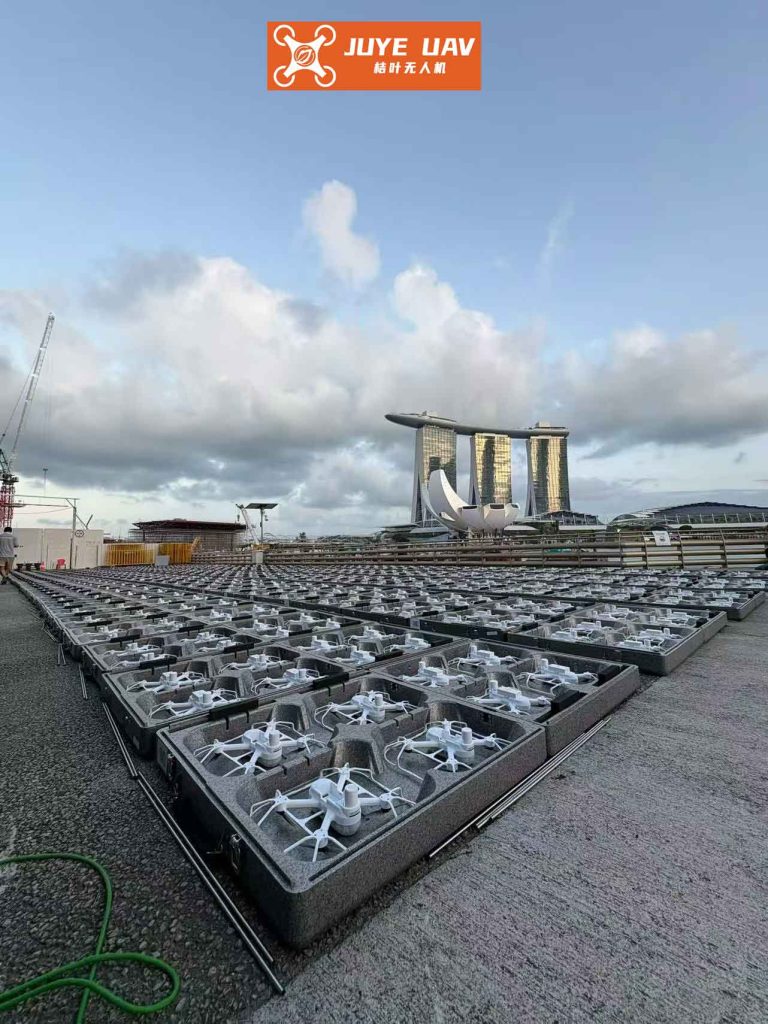
The coordinated flight of multiple unmanned aerial vehicles (UAVs), or swarms, represents a significant leap in autonomous systems technology. While applications in surveillance, mapping, and logistics are well-documented, one of the most publicly visible and technically demanding applications is the modern formation drone light show. This spectacle, where hundreds or thousands of drones act as luminous pixels in the night sky, is not merely an artistic endeavor but a profound demonstration of precision real-time control, robust communication, and sophisticated swarm intelligence. This article delves into the core architecture of a ground-based command and control (C2) system essential for managing such swarms and details the design of formation-keeping controllers, highlighting their pivotal role in enabling breathtaking formation drone light show performances.
I. The Ground Control Station (GCS): The Neural Center of Swarm Operations
At the heart of any multi-UAV operation lies the Ground Control Station (GCS). It serves as the mission’s brain, responsible for monitoring, commanding, and coordinating all aerial assets. For a formation drone light show, the GCS must evolve from a single-vehicle monitor to a “one-to-many” command hub capable of handling a fleet with stringent synchronization requirements.
1.1 Overall System Architecture
The proposed GCS architecture is modular, comprising five key subsystems that work in concert:
- Central Processing Module: This is the computational core, typically consisting of multiple high-performance computers. Each computer may host a dedicated software platform (e.g., for status monitoring, map display, trajectory tracking, and payload/mission management), ensuring data processing and visualization tasks are distributed and efficient.
- Human-Machine Interface (HMI) Module: This provides the operator with situational awareness. It integrates several visual platforms: a multi-drone status dashboard, a digital map with real-time positioning, a detailed flight path tracker, and a mission-specific control panel (e.g., for managing light effects in a formation drone light show).
- Command Input Module: This subsystem captures the operator’s intentions, translating physical inputs from control sticks, keyboards, or touchscreens into digital command streams for both flight control and, in the case of a show, the payload (LEDs).
- Wireless Communication Module: This is the critical data link. It consists of ground-based radio transceivers and their counterparts on each drone, establishing a bidirectional communication network for telemetry downlink and command uplink.
- Command Hub Interface: For large-scale operations, the GCS may interface with a higher-level command center, receiving overarching mission objectives and relaying aggregated swarm status.
| Module | Key Components | Primary Function | Relevance to Formation Drone Light Show |
|---|---|---|---|
| Central Processing | Server/Workstation Computers | Data fusion, computation, logics | Renders show animation into individual drone trajectories; runs formation control algorithms. |
| HMI | Multi-screen displays, GUI Software | Situational awareness, operator input | Displays real-time swarm health, battery status, and formation integrity during the show. |
| Command Input | Joysticks, Programmable Keypads | Translates human intent to commands | Allows for manual override or live adjustments to the show’s choreography. |
| Wireless Comms | Data Radios, Antennas, Networking SW | Reliable data link with all drones | Transmits synchronized time, trajectory waypoints, and LED color commands to every drone in the swarm. |
| Command Hub I/F | Network Interface, API | Connects to higher authority | Receives the show script or triggers from an event management system. |
1.2 Hardware Infrastructure
The hardware realization is purpose-driven for reliability and low latency. The Central Processing Module uses industrial-grade computers. The Command Input Module employs specialized hardware like flight control joysticks and programmable keyboards. The most critical component is the Wireless Communication Module, which utilizes high-throughput, low-latency data radios operating in licensed or unlicensed spectrums, designed to maintain stable links with dozens or hundreds of drones simultaneously.
1.3 Software and Communication Protocol
The software ecosystem binds the hardware together. The HMI is developed using frameworks that allow integration of mapping services (like Google Earth API for geospatial context) and custom visualization widgets. The core challenge is the one-to-many communication protocol.
To avoid data collisions and ensure deterministic timing—absolutely vital for a synchronized formation drone light show—a Time Division Multiple Access (TDMA) scheme is employed. In a fixed-allocation TDMA system, the communication timeline is divided into repeating frames, and each drone in the swarm is assigned a unique, fixed time slot within that frame.
| Time Slot | Duration (ms) | Purpose | Data Direction |
|---|---|---|---|
| Sync Beacon | 10 | Broadcast master clock sync | GCS -> All Drones |
| Guard Time | 5 | Prevent overlap | – |
| Slot 1 (Drone A) | 20 | Cmd to A + Telemetry from A | Bidirectional |
| Slot 2 (Drone B) | 20 | Cmd to B + Telemetry from B | Bidirectional |
| Slot 3 (Drone C) | 20 | Cmd to C + Telemetry from C | Bidirectional |
| Slot 4 (Drone D) | 20 | Cmd to D + Telemetry from D | Bidirectional |
| Guard Time | 5 | Prevent overlap | – |
The network initialization follows a strict sequence: Drones power on and listen. The GCS broadcasts a synchronization signal, aligning all swarm clocks. Drones then respond in their pre-assigned slots, establishing the network. Once operational, each drone only transmits and listens during its specific slot, eliminating interference. This guaranteed access scheme is what allows a formation drone light show to maintain perfect timing, as every drone receives its updated instructions at a predictable, periodic interval.
II. Formation Flight Control: The Algorithms Behind the Art
With a robust communication backbone in place, the next layer is the intelligent control that maintains precise geometric relationships between drones. This is the essence of formation flight and the engine of any formation drone light show.
2.1 Kinematic Modeling for Leader-Follower Formations
A common and effective strategy is the “Leader-Follower” approach. One drone (the leader) follows a predefined trajectory, while other drones (followers) maintain a specific offset relative to the leader. Let’s analyze a two-dimensional case for a pair of drones. We define a relative coordinate frame attached to the follower drone.
Let:
$V_L$, $\psi_L$ = Velocity and heading angle of the Leader.
$V_W$, $\psi_W$ = Velocity and heading angle of the Follower (Wingman).
$\psi_E = \psi_L – \psi_W$ = Relative heading error.
$x, y$ = Relative position of the Leader with respect to the Follower, expressed in the Follower’s body frame (x-axis aligned with its velocity vector).
$x_c, y_c$ = Desired or commanded relative position (the formation setpoint).
The relative kinematics can be derived as:
$$\dot{x} = V_L \cos(\psi_E) – V_W + \dot{\psi}_W y$$
$$\dot{y} = V_L \sin(\psi_E) – \dot{\psi}_W x$$
For the altitude channel (vertical formation), the dynamics are simpler:
$z = h_L – h_W$ is the altitude difference, and $\dot{z} = \dot{h}_L – \dot{h}_W$.
These equations describe how the relative position $(x, y)$ changes based on the states of both drones. The control objective is to drive $(x, y, z)$ to their desired values $(x_c, y_c, z_c)$.
2.2 A Two-Tiered Control Architecture
A hierarchical control structure is advantageous. It separates high-level navigation from low-level stabilization, a concept that scales effectively to a full formation drone light show swarm.
- Upper-Tier (Formation Guidance): This layer considers the entire formation as a single entity. It generates a reference trajectory—specifying the swarm’s collective center position, velocity, and heading over time. For a formation drone light show, this trajectory is derived from the show’s choreography, determining the path of the virtual shape being drawn in the sky.
- Lower-Tier (Individual Tracking & Formation Keeping): This layer decomposes the swarm trajectory into individual setpoints for each drone. It compares a drone’s actual relative position to its assigned slot in the formation and generates corrective commands. This is the core “formation keeping” controller that actively corrects errors.
The Lower-Tier control is naturally divided into three decoupled channels: Longitudinal (managing forward/backward spacing and speed matching), Lateral (managing left/right spacing and heading alignment), and Vertical (managing altitude separation).
2.3 Design of the Formation-Keeping Controller
For practical implementation, a Proportional-Integral (PI) controller is an excellent choice due to its simplicity, robustness, and ability to eliminate steady-state error. We design a separate PI controller for each channel, acting on the follower drone.
1. Longitudinal Channel Controller:
The error signal $\Delta X$ combines spacing and velocity errors:
$$ \Delta X = k_x (x – x_c) + k_V (V_L – V_W) = k_x \Delta x + k_V \Delta V $$
where $k_x$ and $k_V$ are tuning gains. The PI controller then outputs a velocity command for the follower:
$$ V_{W_c}(t) = K_{xp} \Delta X + K_{xi} \int_0^t \Delta X \, d\tau $$
where $K_{xp}$ and $K_{xi}$ are the proportional and integral gains.
2. Lateral Channel Controller:
The error signal $\Delta Y$ combines lateral spacing and heading errors:
$$ \Delta Y = k_y (y_c – y) + k_{\psi} (\psi_L – \psi_W) = k_y \Delta y + k_{\psi} \Delta \psi $$
The PI controller outputs a heading command for the follower:
$$ \psi_{W_c}(t) = K_{yp} \Delta Y + K_{yi} \int_0^t \Delta Y \, d\tau $$
3. Vertical Channel Controller:
The error signal is simply the altitude difference:
$$ \Delta Z = k_z (z_c – z) = k_z \Delta z $$
The PI controller outputs an altitude command:
$$ h_{W_c}(t) = K_{zp} \Delta Z + K_{zi} \int_0^t \Delta Z \, d\tau $$
| Control Channel | Error Signal $\Delta$ | Controller Output | Typical Gains (Example) |
|---|---|---|---|
| Longitudinal (Speed) | $k_x \Delta x + k_V \Delta V$ | Follower Velocity Command $V_{W_c}$ | $k_x=-5.0, k_V=8.0, K_{xp}=25.1, K_{xi}=10.3$ |
| Lateral (Heading) | $k_y \Delta y + k_{\psi} \Delta \psi$ | Follower Heading Command $\psi_{W_c}$ | $k_y=-2.1, k_{\psi}=10.0, K_{yp}=1.5, K_{yi}=0.01$ |
| Vertical (Altitude) | $k_z \Delta z$ | Follower Altitude Command $h_{W_c}$ | $k_z=10.0, K_{zp}=1.0, K_{zi}=0.1$ |
2.4 Simulation Analysis of Control Performance
To validate the design, a numerical simulation is conducted. A leader drone is commanded to perform maneuvers (changes in speed, heading, altitude), while the follower, equipped with the PI formation-keeping controller, attempts to maintain a fixed offset (e.g., 500m in x and y). Initial conditions are set with errors present.
The simulation results demonstrate key characteristics:
- Stability: All state errors ($\Delta V$, $\Delta \psi$, $\Delta x$, $\Delta y$, $\Delta z$) converge to zero after a transient period.
- Zero Steady-State Error: The integral action in each PI controller ensures that the follower eventually matches the leader’s state exactly at the prescribed offset, despite constant disturbances like the leader’s maneuvers.
- Acceptable Dynamics: The response speed and overshoot, dictated by the chosen gains, are suitable for the dynamics of typical small to medium UAVs. The follower smoothly tracks the leader’s changes.
These results confirm that the linear PI controller, when applied to the derived kinematic model, provides an effective solution for maintaining a rigid formation. This precise tracking is the fundamental requirement for creating stable, sharp geometric shapes in a formation drone light show.
2.5 Integrating “Human-in-the-Loop” Supervision
While the autonomous formation controller handles continuous regulation, the human operator remains a crucial part of the control loop, especially during a live formation drone light show. This “human-in-the-loop” paradigm provides a critical safety and contingency layer.
- Primary Control: The autonomous formation-keeping controller runs continuously on the GCS, sending corrective commands to each follower drone.
- Human Supervision & Override: The operator monitors the swarm’s status on the HMI. If an anomaly is detected (e.g., a drone drifts due to a sudden gust, a battery warning appears), the operator can manually intervene. Using the command input module, they can issue direct commands to a specific drone to re-acquire its position, execute an emergency landing, or safely exit the formation. This supervisory control ensures the reliability and safety of the entire formation drone light show operation.
III. Application to Formation Drone Light Shows: A Symphony of Technology
The transition from a basic two-drone formation to a massive formation drone light show involves scaling the described technologies and adding a critical layer: artistic choreography and payload control.
1. Choreography as Trajectory Generation: A show is first designed as a 4D animation (3D space + time), where each frame defines the desired color and position for every drone. The GCS’s upper-tier guidance layer breaks this master animation into a time-sequence of target formation shapes and a collective path.
2. Role of the GCS: The GCS becomes a real-time render farm. It calculates individual reference trajectories $(x_{c,i}(t), y_{c,i}(t), z_{c,i}(t))$ for each of the N drones. These are the setpoints fed into the formation-keeping controllers.
3. Formation Control at Scale: The leader-follower concept can be extended to virtual structures or behavioral rules (e.g., “maintain position relative to your 4 nearest neighbors”). The core control principle remains: each drone’s controller minimizes the error between its assigned target and its measured state. The precision of the PI controllers ensures the swarm holds shapes like logos, text, and complex 3D objects without blurring.
4. Synchronized Payload Command: Alongside flight commands, the GCS uses the same TDMA link to send precisely timed commands to each drone’s LED system, controlling color and intensity. The tight synchronization of the communication protocol ensures that color changes happen simultaneously across the entire swarm, creating crisp visual effects.
Thus, a formation drone light show is the ultimate integration test: a scalable ground control system, a robust TDMA network guaranteeing synchronous data delivery, and hundreds of independent but cooperating formation-keeping controllers, all orchestrated to create a seamless aerial display.
IV. Future Challenges and Conclusion
The system described provides a solid foundation for multi-UAV control, directly applicable to formation drone light show operations. However, the frontier continues to advance. Key research and development directions include:
| Challenge Area | Description | Impact on Formation Drone Light Shows |
|---|---|---|
| AI-Enhanced Controllers | Replacing linear PI with adaptive or learning-based controllers (e.g., Neural Network PID, Reinforcement Learning) to handle nonlinear dynamics and wind disturbances more effectively. | More resilient shows in adverse weather, smoother transitions between shapes. |
| Decentralized & Mesh Networking | Moving beyond star-topology TDMA to ad-hoc mesh networks where drones relay data, improving scalability and robustness to single-point failure. | Enabling much larger shows with thousands of drones and more complex communication patterns. |
| Dynamic Formation Algorithms | Algorithms for real-time, collision-free reconfiguration from one shape to another, optimizing paths for energy and time. | Faster, more fluid, and spectacular morphing sequences between show segments. |
| Advanced “Human-Swarm” Interfaces | Using AR/VR, gesture control, and predictive AI to allow a single operator to intuitively manage increasingly complex swarms. | Simpler show design and real-time manipulation of formations during live performances. |
In conclusion, the engineering of a ground-based control system for UAV swarms is a multidisciplinary feat combining robust hardware, deterministic networking, and intelligent control theory. The formation drone light show stands as a compelling and public demonstration of this technology’s maturity. From the kinematic modeling of relative motion to the design of practical PI controllers and their integration into a scalable command station, each component plays a vital role in transforming digital artistry into a perfectly synchronized aerial ballet. As the underlying technologies in communication, autonomy, and human-computer interaction evolve, the scale, complexity, and intelligence of these swarms—and the shows they produce—will reach ever more astonishing heights.