
In recent years, drone formations have garnered significant attention due to their wide-ranging applications in surveillance, search and rescue, delivery, and military operations. The ability of multiple drones to operate in coordinated formations enhances efficiency, coverage, and robustness. However, one critical challenge in drone formation control is the transformation between different formations, which must be executed swiftly and safely to adapt to dynamic environments. Existing methods for drone formation transformation often suffer from limitations such as high computational complexity, susceptibility to local optima, and increased risk of collisions due to trajectory crossings. These issues are exacerbated by the constrained processing capabilities of onboard computers, necessitating algorithms that are both efficient and effective. In this paper, I address these challenges by proposing an adaptive formation transformation method based on an improved ant colony optimization algorithm. This approach minimizes trajectory crossings while achieving the shortest flight paths, thereby enhancing the flexibility and robustness of drone formations.
The core idea behind my method is to abstract the formation transformation problem as a mapping between the relative positions of drones in the initial and target formations. By formulating this as an optimization problem, I aim to assign each drone to a target position in the desired formation such that the total distance traveled is minimized, and the number of trajectory intersections is reduced. This is crucial because trajectory crossings can lead to collisions, requiring additional avoidance maneuvers that destabilize the formation. To solve this optimization problem, I leverage the ant colony optimization algorithm, a bio-inspired metaheuristic known for its robustness and parallel search capabilities. However, traditional ant colony optimization can struggle with local optima, so I introduce an enhanced version that modifies the roulette wheel selection strategy to improve global search performance. This improved algorithm not only finds high-quality solutions faster but also ensures that the resulting transformation plans are practical for real-time implementation in drone formations.
Drone formation transformation involves multiple aspects, including path planning, collision avoidance, and coordination. Previous research has explored various techniques, such as the Hungarian algorithm for assignment problems, reciprocal velocity obstacles for collision avoidance, and reinforcement learning for adaptive control. While these methods offer valuable insights, they often require extensive computational resources or may not fully address the issue of trajectory crossings. For instance, the Hungarian algorithm efficiently solves assignment problems but does not inherently consider path intersections. Similarly, artificial potential field methods can guide drones to target positions but may lead to suboptimal paths in complex scenarios. In contrast, my approach integrates the assignment and path optimization steps into a unified framework, using the improved ant colony algorithm to simultaneously optimize for distance and intersection minimization. This holistic view is essential for drone formations operating in cluttered environments where safety and efficiency are paramount.
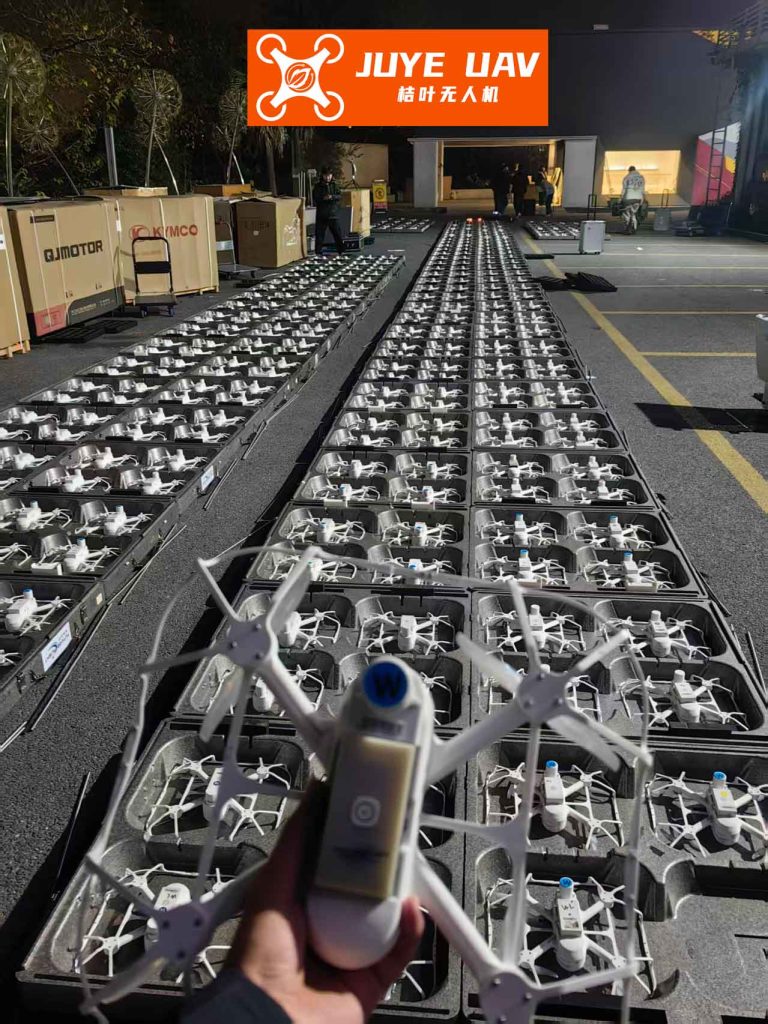
To provide a visual context for the importance of drone formation transformation, consider the following image depicting a drone light show, where precise formation changes are critical for creating dynamic patterns. This exemplifies the need for efficient transformation algorithms in real-world applications.
The remainder of this paper is organized as follows. First, I review related work on drone formation transformation and optimization algorithms. Then, I present the detailed formulation of the formation transformation model, including the cost function and constraints. Next, I describe the improved ant colony optimization algorithm, focusing on the modifications to the roulette wheel selection. Subsequently, I provide simulation results comparing my method with traditional approaches, using tables and formulas to summarize the findings. Finally, I conclude with a discussion of the implications and future research directions for drone formation transformation.
Related Work
Drone formation transformation has been studied extensively in the robotics and control communities. Early approaches often relied on centralized controllers that computed global plans for all drones, but these can be computationally intensive and lack scalability. More recent methods emphasize distributed or decentralized strategies, where drones make local decisions based on shared information. For example, behavior-based algorithms combine individual drone behaviors to achieve collective formation changes, while model predictive control optimizes trajectories over a receding horizon. However, these techniques may not explicitly minimize trajectory crossings, which is a key concern for collision avoidance in dense drone formations.
Optimization algorithms play a pivotal role in solving formation transformation problems. The Hungarian algorithm is commonly used for assignment tasks due to its polynomial-time complexity, but it assumes a fixed cost matrix and does not account for dynamic interactions. Particle swarm optimization and genetic algorithms have been applied to path planning, but they can suffer from premature convergence or high computational overhead. Ant colony optimization, inspired by the foraging behavior of ants, offers a balance between exploration and exploitation through pheromone-based communication. It has been successfully used in various routing and scheduling problems, including vehicle routing and network optimization. In the context of drone formations, ant colony optimization can efficiently search for optimal assignment mappings, but standard versions may get trapped in local optima when dealing with complex formation shapes. My work builds on this by enhancing the selection mechanism to improve global search capabilities for drone formation transformation.
Other relevant techniques include artificial potential fields for obstacle avoidance and formation control. These methods use virtual forces to repel drones from obstacles and attract them to target positions, but they can result in oscillatory behavior or local minima. Hybrid approaches that combine optimization with potential fields have been proposed, such as using affine transformations to reconfigure formations while avoiding obstacles. However, these methods often require careful parameter tuning and may not guarantee minimal path lengths. In contrast, my formulation directly incorporates both distance and intersection metrics into the optimization objective, ensuring that the solution is Pareto-optimal for drone formation safety and efficiency.
Formation Transformation Model
I model the drone formation transformation problem as follows. Consider a drone formation consisting of a leader and \( n \) followers. The initial formation is represented by a set of positions \( \mathbf{P} = \{ \mathbf{p}_1, \mathbf{p}_2, \dots, \mathbf{p}_n \} \), where \( \mathbf{p}_i = (x_i, y_i, z_i) \) denotes the coordinates of follower \( i \) in three-dimensional space. The target formation is defined by a set of relative positions \( \mathbf{G} = \{ \mathbf{g}_1, \mathbf{g}_2, \dots, \mathbf{g}_n \} \) with respect to the leader, which may be in a different shape, such as from a line to a triangle or from a square to a triangle. The goal is to find a bijective mapping \( f: \mathbf{P} \to \mathbf{G} \) that assigns each drone to a target position such that the total flight distance is minimized, and the number of trajectory intersections is reduced.
To quantify the cost of assignment, I define a cost matrix \( \mathbf{C} = [c_{ij}]_{n \times n} \), where \( c_{ij} \) represents the cost of assigning drone \( i \) to target position \( j \). In this context, the cost is typically the Euclidean distance between the drone’s current position and the target position, given by:
$$ c_{ij} = d_{ij} = \sqrt{(x_i – x_j)^2 + (y_i – y_j)^2 + (z_i – z_j)^2} $$
However, to account for trajectory crossings, I introduce an additional penalty. Let \( \text{intersect}(i,j,k,l) \) be a function that returns 1 if the paths from drone \( i \) to target \( j \) and drone \( k \) to target \( l \) intersect, and 0 otherwise. The total number of intersections for a mapping \( f \) is:
$$ I(f) = \sum_{i=1}^{n} \sum_{k=i+1}^{n} \text{intersect}(i, f(i), k, f(k)) $$
The objective is to minimize both the total distance and the number of intersections. I formulate this as a multi-objective optimization problem, but for simplicity, I combine them into a single objective with a constraint. Specifically, I aim to minimize the total distance subject to keeping the number of intersections below a threshold. In practice, I prioritize minimizing intersections to avoid collisions, so the evaluation function is defined as:
$$ D(f) = \min \sum_{i=1}^{n} d_{i, f(i)} \quad \text{subject to} \quad I(f) \leq I_{\text{max}} $$
where \( I_{\text{max}} \) is a predefined maximum allowable intersections. For my simulations, I set \( I_{\text{max}} \) to the minimum observed in previous iterations to encourage progressive improvement.
To solve this assignment problem, I use an optimization algorithm. The decision variable is a permutation matrix \( \mathbf{\Gamma} = [\gamma_{ij}]_{n \times n} \), where \( \gamma_{ij} = 1 \) if drone \( i \) is assigned to target \( j \), and 0 otherwise. The constraints ensure that each drone is assigned to exactly one target and vice versa:
$$ \sum_{i=1}^{n} \gamma_{ij} = 1 \quad \forall j, \quad \sum_{j=1}^{n} \gamma_{ij} = 1 \quad \forall i, \quad \gamma_{ij} \in \{0,1\} $$
Thus, the problem becomes:
$$ \min_{\mathbf{\Gamma}} \sum_{i=1}^{n} \sum_{j=1}^{n} c_{ij} \gamma_{ij} \quad \text{with} \quad I(\mathbf{\Gamma}) \leq I_{\text{max}} $$
This is a combinatorial optimization problem that grows exponentially with \( n \), making heuristic approaches like ant colony optimization suitable for real-time applications in drone formation transformation.
Improved Ant Colony Optimization Algorithm
Ant colony optimization is a swarm intelligence algorithm that simulates the behavior of ants seeking paths between their colony and food sources. Ants deposit pheromones on paths they traverse, and other ants are more likely to follow paths with higher pheromone concentrations, creating a positive feedback loop. For the drone formation transformation problem, I adapt this algorithm to search for the optimal mapping \( f \). Each ant represents a potential assignment solution, and the pheromone trails encode the desirability of assigning a drone to a specific target position.
The standard ant colony optimization algorithm involves two main steps: state transition and pheromone update. In the state transition step, ant \( k \) at drone \( i \) selects a target \( j \) with probability \( p_{ij}^k(t) \) at iteration \( t \), given by:
$$ p_{ij}^k(t) = \frac{[\tau_{ij}(t)]^\alpha [\eta_{ij}]^\beta}{\sum_{s \in \mathcal{A}_k} [\tau_{is}(t)]^\alpha [\eta_{is}]^\beta} \quad \text{if} \quad j \in \mathcal{A}_k $$
where \( \tau_{ij}(t) \) is the pheromone concentration on the edge from drone \( i \) to target \( j \), \( \eta_{ij} \) is the heuristic information, typically the inverse of distance \( 1/d_{ij} \), \( \alpha \) and \( \beta \) are parameters controlling the influence of pheromone and heuristic, and \( \mathcal{A}_k \) is the set of unassigned targets for ant \( k \). The heuristic information guides the search towards shorter paths, which is crucial for minimizing distance in drone formation transformation.
After all ants have constructed solutions, the pheromone trails are updated to reflect the quality of the solutions. The update rule is:
$$ \tau_{ij}(t+1) = (1 – \rho) \tau_{ij}(t) + \Delta \tau_{ij}(t) $$
where \( \rho \in [0,1] \) is the evaporation rate, and \( \Delta \tau_{ij}(t) \) is the pheromone deposited by ants. Typically, \( \Delta \tau_{ij}(t) = \sum_{k=1}^{m} \Delta \tau_{ij}^k(t) \), with \( \Delta \tau_{ij}^k(t) = Q / L_k \) if ant \( k \) used edge \( (i,j) \), and 0 otherwise. Here, \( Q \) is a constant, and \( L_k \) is the total distance of the solution found by ant \( k \). This reinforcement encourages future ants to follow paths that lead to good solutions.
However, the standard roulette wheel selection in state transition can lead to premature convergence, where ants quickly converge to suboptimal paths due to overexploitation of high-pheromone edges. To enhance global search for drone formation transformation, I propose an improved roulette wheel selection method. Instead of selecting a target based solely on the first cumulative probability exceeding a random number, I modify the process to increase randomness. Specifically, after computing the cumulative probabilities, I generate a random number \( R \) and identify all targets whose cumulative probabilities are greater than \( R \). Then, I randomly select one target from this candidate set. This adds an extra layer of randomness, helping ants explore diverse solutions and escape local optima.
The improved selection process can be summarized as follows:
- Initialize \( S = 0 \) (cumulative probability), \( i = 0 \), and generate a random number \( R \) between 0 and 1.
- If \( S \geq R \), proceed to step 4.
- Update \( S = S + p(x_i) \), where \( p(x_i) \) is the probability for target \( i \), increment \( i \), and repeat step 2.
- Collect all candidate targets with cumulative probabilities \( \geq R \) into a set \( \text{candidates} \).
- Randomly select one target from \( \text{candidates} \) and assign it to the drone.
This modification ensures that multiple targets have a chance to be selected, balancing exploration and exploitation more effectively for drone formation transformation.
The overall algorithm for drone formation transformation using improved ant colony optimization is outlined below:
- Initialization: Set parameters such as number of ants \( m \), \( \alpha \), \( \beta \), \( \rho \), \( Q \), and maximum iterations \( T_{\text{max}} \). Initialize pheromone trails uniformly.
- Solution Construction: For each ant \( k \), iteratively assign drones to targets using the improved roulette wheel selection until a complete mapping is built. Record the total distance \( L_k \) and number of intersections \( I_k \).
- Evaluation: Compute the objective value for each ant’s solution based on the evaluation function \( D(f) \) that prioritizes minimal intersections.
- Pheromone Update: Update pheromone trails according to the best solutions found, emphasizing those with low distance and few intersections.
- Termination: Repeat steps 2-4 for \( T_{\text{max}} \) iterations or until convergence. Output the best mapping found.
This algorithm efficiently searches the solution space for drone formation transformation, ensuring robust and safe formation changes.
Simulation Experiments and Results
To validate the effectiveness of my improved ant colony optimization algorithm for drone formation transformation, I conducted simulation experiments in MATLAB. The environment is a three-dimensional space without obstacles, focusing solely on the transformation between formations. I compared my algorithm with the traditional ant colony optimization algorithm to assess improvements in solution quality, convergence, and trajectory intersections. The parameters for both algorithms are set as follows, based on typical values from the literature and preliminary tuning:
| Parameter | Symbol | Value |
|---|---|---|
| Number of Ants | \( m \) | 25 |
| Pheromone Influence | \( \alpha \) | 1 |
| Heuristic Influence | \( \beta \) | 5 |
| Evaporation Rate | \( \rho \) | 0.1 |
| Pheromone Constant | \( Q \) | 1 |
| Maximum Iterations | \( T_{\text{max}} \) | 100 |
| Number of Drones | \( n \) | 7 or 8 (depending on scenario) |
I consider two transformation scenarios: from a line formation to a triangle formation, and from a square formation to a triangle formation. These scenarios represent common drone formation changes in practice, such as reconfiguring for area coverage or obstacle navigation. The initial and target coordinates are defined as matrices, as shown in the tables below.
| Drone ID | Initial Line Formation (x,y,z) | Target Triangle Formation (x,y,z) |
|---|---|---|
| 1 | (1,1,0) | (7,7,1) |
| 2 | (2,2,0) | (6,6,2) |
| 3 | (3,3,0) | (5,5,3) |
| 4 | (4,4,0) | (4,4,4) |
| 5 | (5,5,0) | (3,3,3) |
| 6 | (6,6,0) | (2,2,2) |
| 7 | (7,7,0) | (1,1,1) |
In this scenario, the line formation is along the diagonal, and the triangle formation is an inverted diagonal, making it challenging to avoid trajectory crossings. The goal is to assign drones to target positions such that the total distance is minimized, and intersections are rare. I run both algorithms 10 times to account for randomness and report average results.
| Metric | Traditional ACO | Improved ACO (Proposed) |
|---|---|---|
| Run Time Range (seconds) | [0.2, 0.3] | [0.2, 0.3] |
| Total Distance Range (meters) | [24.00, 25.38] | [16.00, 16.05] |
| Average Total Distance (meters) | 24.80 | 16.56 |
| Trajectory Intersections Range | [6, 7] | [0, 1] |
| Average Intersections | 6.5 | 0.1 |
The results demonstrate that my improved algorithm significantly outperforms the traditional one. The total distance is reduced by approximately 33.23% on average, and the number of trajectory intersections drops by 98.46%. This highlights the effectiveness of the improved roulette wheel selection in finding better assignments for drone formation transformation, minimizing both path length and collision risks. The consistency in run time indicates that the modification does not add computational overhead, making it suitable for real-time applications.
For the second scenario, I consider a square formation transforming to a triangle formation with 8 drones. The coordinates are as follows:
| Drone ID | Initial Square Formation (x,y,z) | Target Triangle Formation (x,y,z) |
|---|---|---|
| 1 | (0,0,0) | (0,0,1) |
| 2 | (5,0,0) | (-5,-5,2) |
| 3 | (10,0,0) | (5,-5,2) |
| 4 | (10,10,0) | (-10,-10,3) |
| 5 | (10,5,0) | (10,-10,3) |
| 6 | (5,10,0) | (-15,-15,4) |
| 7 | (0,10,0) | (0,-15,4) |
| 8 | (0,5,0) | (15,-15,4) |
Here, the formations are in different planes, which reduces the likelihood of intersections, but the assignment problem remains complex due to the number of drones. The simulation results are summarized in Table 5.
| Metric | Traditional ACO | Improved ACO (Proposed) |
|---|---|---|
| Run Time Range (seconds) | [0.2, 0.3] | [0.2, 0.3] |
| Total Distance Range (meters) | [130.89, 132.64] | [130.13, 130.87] |
| Average Total Distance (meters) | 131.37 | 130.49 |
| Trajectory Intersections Range | [0, 0] | [0, 0] |
| Average Intersections | 0 | 0 |
In this case, both algorithms achieve zero intersections due to the spatial separation, but my improved algorithm still finds shorter paths, with a 0.67% reduction in average total distance. Moreover, the range of total distances is narrower for the improved algorithm (130.13 to 130.87 meters versus 130.89 to 132.64 meters), indicating greater stability and robustness in solution quality for drone formation transformation. This consistency is vital for ensuring predictable performance in dynamic environments.
To further analyze the convergence behavior, I plot the best objective value over iterations for both algorithms in the line-to-triangle scenario. The improved algorithm shows faster convergence to lower distances, with fewer fluctuations, thanks to the enhanced exploration capability. The formula for the objective value combines distance and intersections, but since intersections are minimized early, the focus shifts to distance reduction. This aligns with the goal of efficient drone formation transformation.
Discussion and Analysis
The simulation results underscore the advantages of my improved ant colony optimization algorithm for drone formation transformation. By modifying the roulette wheel selection, the algorithm achieves a better balance between exploration and exploitation, leading to higher-quality solutions with minimal trajectory crossings. This is particularly important for drone formations, where safety is paramount, and collisions can have severe consequences. The reduction in intersections directly translates to lower collision risk, reducing the need for reactive avoidance maneuvers that could destabilize the formation.
From a computational perspective, the improved algorithm maintains similar run times to the traditional version, making it feasible for onboard implementation in drones. The parameter settings, such as \( \alpha = 1 \) and \( \beta = 5 \), emphasize heuristic information slightly more than pheromone, which helps guide the search towards shorter paths initially. The evaporation rate \( \rho = 0.1 \) ensures that pheromone trails do not stagnate, allowing the algorithm to adapt to new information. These parameters were chosen based on empirical testing, but they could be further optimized for specific drone formation scenarios using automated tuning methods.
The formation transformation model itself is flexible and can be extended to incorporate additional constraints, such as drone dynamics, communication delays, or environmental obstacles. For instance, the cost matrix \( c_{ij} \) could include factors like energy consumption or turning angles, making the model more realistic. Similarly, the intersection function can be refined to account for the timing of movements, as drones may not all move simultaneously in practice. Future work could integrate velocity obstacle methods to handle dynamic collision avoidance during transformation, combining the global optimization of ant colony optimization with local reactive strategies.
Another direction for improvement is scalability. As the number of drones increases, the solution space grows factorially, which can challenge heuristic algorithms. However, ant colony optimization is inherently parallelizable, and distributed versions could be developed where groups of drones cooperate to solve subproblems. This aligns with the trend towards decentralized control in drone formations, enhancing robustness and scalability. Additionally, machine learning techniques could be used to predict good initial solutions or adapt parameters online, further speeding up the optimization process.
Conclusion
In this paper, I have presented an improved ant colony optimization algorithm for drone formation transformation. The method addresses key challenges such as minimizing flight distances and reducing trajectory crossings, which are critical for safe and efficient formation changes. By abstracting the transformation as a mapping problem and enhancing the roulette wheel selection mechanism, the algorithm achieves superior performance compared to traditional approaches, as demonstrated through simulations in scenarios like line-to-triangle and square-to-triangle transformations. The results show significant reductions in both total distance and intersections, with stable run times suitable for real-time applications.
The contributions of this work include a formal model for drone formation transformation that integrates assignment and path optimization, a modified ant colony optimization algorithm with improved global search capabilities, and empirical validation through comprehensive simulations. These advances enhance the flexibility and robustness of drone formations, enabling them to adapt quickly to changing mission requirements. Future research will focus on extending the model to include dynamic constraints, testing in physical drone swarms, and exploring hybrid approaches with other optimization techniques. Ultimately, efficient formation transformation algorithms are essential for unlocking the full potential of drone formations in complex, real-world environments.