
In recent years, the advancement of unmanned aerial vehicles (UAVs), commonly referred to as drones, has revolutionized various fields, including military operations, surveillance, and disaster response. One critical area of focus is drone formation control, where multiple drones coordinate to achieve a common objective. This article explores the intricacies of multi-task drone formation control, combining loose and tight formation strategies to enhance协同作战 capabilities. The study presents a comprehensive approach to designing flight control systems for a three-drone formation, emphasizing航迹跟随, formation maintenance, and task allocation. Through mathematical modeling, control law design, and simulation, we demonstrate the effectiveness of the proposed methods in achieving stable and adaptive drone formation flight. The drone formation concept is central to this research, as it enables efficient resource utilization and mission success in complex environments.
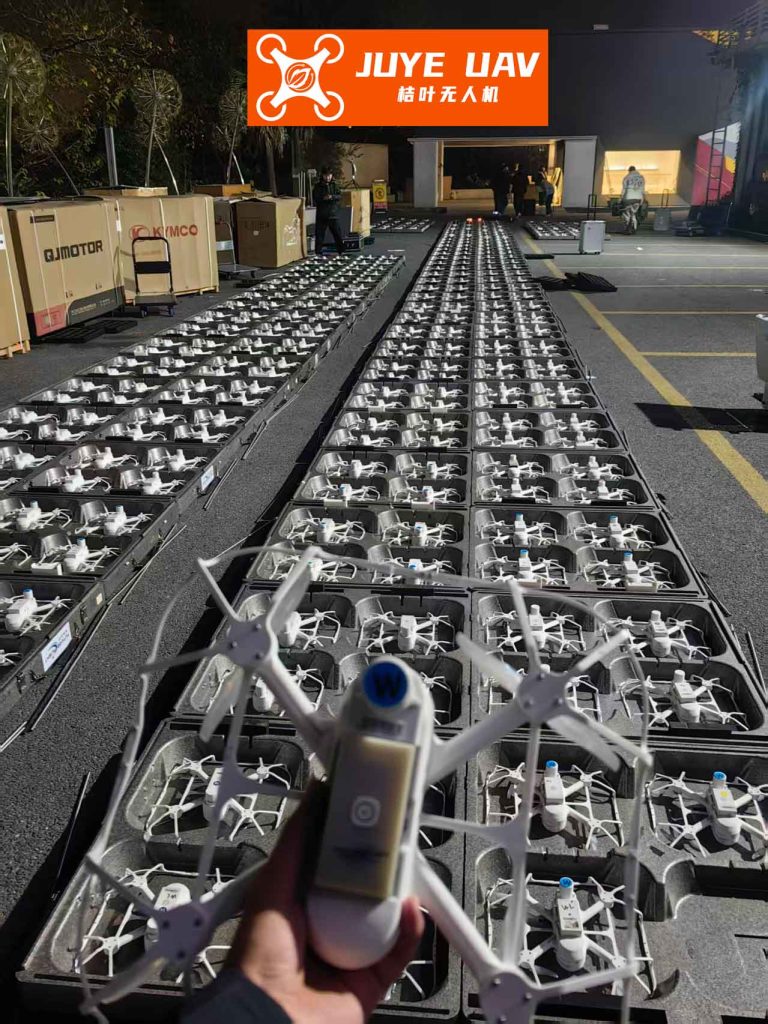
The foundation of drone formation control lies in understanding the动力学模型 of multiple drones operating together. For a three-drone formation, we consider a leader-follower架构, where one drone acts as the leader, and two others as wingmen. The inertial coordinate system is used to describe the relative positions and movements. The motion equations for the drone formation are derived as follows, capturing the relative dynamics between the leader and wingmen:
$$ \dot{x} = V_L \cos(\phi_E) + \dot{\phi}_w y – V_w $$
$$ \dot{y} = V_L \sin(\phi_E) – \dot{\phi}_w x $$
Here, \( x \) and \( y \) represent the relative distances in the inertial frame, \( V_L \) and \( V_w \) are the velocities of the leader and wingman, respectively, \( \phi_L \) and \( \phi_w \) are their heading angles, and \( \phi_E = \phi_L – \phi_w \) is the heading angle偏差. These equations form the basis for modeling the drone formation behavior. To simplify the dynamics for control design, we assume first-order lag models for velocity and heading angle responses, leading to the following set of equations:
$$ \dot{V}_L = -\frac{1}{\tau_{vL}} V_L + \frac{1}{\tau_{vL}} V_{Lc} $$
$$ \dot{V}_w = -\frac{1}{\tau_{vw}} V_w + \frac{1}{\tau_{vw}} V_{wc} $$
$$ \dot{\phi}_L = -\frac{1}{\tau_{\phi L}} \phi_L + \frac{1}{\tau_{\phi L}} \phi_{Lc} $$
$$ \dot{\phi}_w = -\frac{1}{\tau_{\phi w}} \phi_w + \frac{1}{\tau_{\phi w}} \phi_{wc} $$
$$ \dot{x} = -V_w – \frac{y_0}{\tau_{vw}} \phi_w + \frac{y_0}{\tau_{vw}} \phi_{wc} + V_L $$
$$ \dot{y} = \frac{x_0}{\tau_{\phi w}} \phi_w – V_L \phi_w – \frac{x_0}{\tau_{\phi w}} \phi_{wc} + V_L \phi_L $$
In these equations, \( \tau_{vw} \) and \( \tau_{\phi w} \) are time constants for velocity and heading angle, respectively, while \( \phi_{wc} \) and \( V_{wc} \) are the control inputs for the wingman. This model captures the essential interactions in a drone formation, allowing for the design of effective control strategies. The drone formation dynamics are crucial for ensuring that the wingmen can accurately follow the leader while maintaining a specified formation shape, such as a V-formation or line abreast.
To achieve precise control of individual drones within the formation, we design a basic flight controller using eigenstructure assignment. This method allows us to specify desired eigenvalues and eigenvectors for the lateral dynamics of the drone, ensuring stability and performance. For a typical drone, the lateral state variables include sideslip angle \( \beta \), roll rate \( \omega_x \), yaw angle \( \gamma \), and yaw rate \( \omega_y \). The desired eigenvalues are chosen to represent key modes: Dutch roll, rapid roll, and spiral. For instance, we set:
$$ \lambda_d = [-2 + 2i, -2 – 2i, -3, -2] $$
The corresponding desired eigenvectors are selected to prioritize certain state responses. For example:
$$ V_d = \begin{bmatrix} 1 & \times & 0 & 0 \\ 0 & \times & 1 & 0 \\ 0 & \times & 0 & 1 \\ \times & 0 & \times & 0 \end{bmatrix} $$
Here, \( \times \) denotes unconstrained elements. The eigenstructure assignment process involves computing the actual eigenvector subspaces and projecting the desired vectors onto them. Given the system matrices \( A \) and \( B \), we define the subspace for each desired eigenvalue \( \lambda_d^i \) as:
$$ L_i = (\lambda_d^i I – A)^{-1} B $$
Then, we select rows corresponding to the matrix \( N \) (which represents output constraints) and compute the projection vector \( p_i \). The actual eigenvector \( V_a^i \) is obtained by \( V_a^i = L_i p_i \), where \( p_i \) is determined through least-squares fitting. After assembling the actual eigenvectors into a matrix \( V \), we perform a similarity transformation using the singular value decomposition of \( B \). Let \( B = U \Sigma V^T \), and construct the transformation matrix \( T = [B, U_{m+1}, \dots, U_n] \), where \( m \) is the rank of \( B \). The transformed state-space matrices are:
$$ \bar{A} = T^{-1} A T, \quad \bar{B} = T^{-1} B = \begin{bmatrix} I_m \\ 0 \end{bmatrix}, \quad \bar{C} = C T $$
The transformed eigenvectors are \( \bar{V} = T^{-1} V \). We then extract the first \( m \) rows of each transformed eigenvector to form matrix \( Z \), and compute the feedback gain matrix \( K \) as:
$$ K = \text{real} \left[ (Z – \bar{A}_1 \bar{V}) (\bar{C} \bar{V})^{-1} \right] $$
This gain matrix ensures that the closed-loop system achieves the desired eigenstructure, providing robust lateral control for each drone in the formation. The drone formation benefits from such controllers by enabling precise maneuvering and stability during flight.
For formation maintenance, we design a编队控制器 based on PID control. In a leader-follower drone formation, the wingmen must track the leader’s trajectory while maintaining relative distances. The control inputs for the wingman are velocity \( V_{wc} \) and heading angle \( \phi_{wc} \), calculated as:
$$ V_{wc} = k_{xp} e_x + k_{xi} \int_0^t e_x \, dt + k_{xd} \dot{e}_x $$
$$ \phi_{wc} = k_{yp} e_y + k_{yi} \int_0^t e_y \, dt + k_{yd} \dot{e}_y $$
Here, \( k_p \), \( k_i \), and \( k_d \) are proportional, integral, and derivative gains, respectively. The error signals \( e_x \) and \( e_y \) are defined as:
$$ e_x = k_x (x – x_0) + k_v V_E $$
$$ e_y = k_y (y – y_0) + k_\phi \phi_E $$
where \( x_0 \) and \( y_0 \) are the desired relative positions in the formation, \( V_E = V_L – V_w \) is the velocity error, and \( \phi_E \) is the heading angle error. The gains \( k_x \), \( k_y \), \( k_v \), and \( k_\phi \) are tuned to achieve fast and stable tracking. This PID-based approach allows the wingmen to adjust their speed and heading in real-time, ensuring that the drone formation remains intact even during maneuvers like turns or accelerations. The drone formation control is critical for协同作战, as it enables coordinated movements and resource sharing.
To manage complex missions, we integrate a航路规划 system and task allocation机制. The航路规划 system generates flyable trajectories based on waypoints, considering performance constraints. The侧向偏离修正控制系统 uses ailerons to control roll and correct lateral deviations \( Z \). The dynamics of lateral deviation are approximated as:
$$ \frac{dZ}{dt} = -V_0 (\sin \psi \cos \beta – \cos \psi \cos \gamma \sin \beta) $$
where \( V_0 \) is the nominal velocity, \( \psi \) is the heading angle, \( \beta \) is the sideslip angle, and \( \gamma \) is the flight path angle. For协同作战 task allocation, we employ a centralized approach where the leader evaluates target threats and assigns tasks to wingmen. Let \( n \) be the number of drones and \( m \) the number of targets. The综合优势函数值 \( S_{ij} \) represents the effectiveness of drone \( i \) against target \( j \), forming a matrix \( S = \{ S_{ij} \} \). The objective is to maximize the total advantage:
$$ J_{\text{max}} = \sum_{i=1}^n \sum_{j=1}^m S_{ij} x_{ij} $$
subject to \( x_{ij} \in \{0, 1\} \), where \( x_{ij} = 1 \) if drone \( i \) attacks target \( j \). The leader computes the maximum cost for each target and assigns the task to the most suitable wingman. This process involves信息交换,任务角色指派, and成员响应, ensuring efficient resource utilization in the drone formation. The协同作战 flowchart includes stages like target detection, decision-making, and attack execution, all coordinated within the drone formation framework.
Simulations are conducted to validate the proposed drone formation control system. We consider a scenario with three drones: one leader and two wingmen. The initial formation is a trailing pattern, which transitions to a V-formation during flight. The leader follows a predefined航迹, while the wingmen use the编队控制器 to maintain relative positions. Key parameters for the drone formation are summarized in the table below:
| Parameter | Value | Description |
|---|---|---|
| \( x_1, x_2 \) | 100 m | Desired relative distances in x-direction for wingmen |
| \( y_1 \) | 100 m | Desired relative distance in y-direction for wingman 1 |
| \( y_2 \) | -100 m | Desired relative distance in y-direction for wingman 2 |
| \( V_L \) | 245 m/s | Leader velocity |
| \( \tau_{vw} \) | 0.5 s | Velocity time constant for wingman |
| \( \tau_{\phi w} \) | 0.3 s | Heading angle time constant for wingman |
The control gains for the PID编队控制器 are tuned empirically. For instance, we set \( k_{xp} = 0.8 \), \( k_{xi} = 0.1 \), \( k_{xd} = 0.05 \), \( k_{yp} = 0.7 \), \( k_{yi} = 0.08 \), and \( k_{yd} = 0.04 \). The error gains are chosen as \( k_x = 0.5 \), \( k_y = 0.6 \), \( k_v = 0.3 \), and \( k_\phi = 0.4 \). These values ensure stable tracking without excessive oscillations. During simulation, the drone formation executes a reconnaissance mission, with the leader detecting a target at 380 seconds. Following the协同作战 protocol, the leader assigns the attack task to wingman 1, which disengages from the formation, destroys the target, and returns to base. The simulation results demonstrate that the drone formation maintains stability during maneuvers, with wingmen accurately tracking the leader’s path. The lateral deviation control system effectively corrects deviations, and the task allocation algorithm optimizes mission performance. The drone formation’s ability to adapt to dynamic tasks highlights the robustness of the proposed approach.
To further analyze performance, we examine key response curves for velocity, heading angle, and lateral parameters. The drone formation shows smooth transitions during formation changes, with minimal overshoot. The table below summarizes the performance metrics for the drone formation control system:
| Metric | Leader | Wingman 1 | Wingman 2 |
|---|---|---|---|
| Max velocity error (m/s) | 0.5 | 1.2 | 1.0 |
| Max heading error (deg) | 0.3 | 0.8 | 0.7 |
| Formation maintenance error (m) | N/A | 0.5 | 0.6 |
| Task completion time (s) | N/A | 25 | N/A |
These metrics indicate that the drone formation controller achieves high precision, with errors within acceptable limits for军事 applications. The协同作战 task is completed efficiently, showcasing the practicality of integrating formation control with mission management. The drone formation’s success relies on the seamless interaction between individual drone controllers and the higher-level coordination algorithms.
In conclusion, this study presents a holistic approach to multi-task drone formation control, combining tight formation strategies with协同作战 capabilities. By designing eigenstructure-based basic controllers and PID-based formation controllers, we enable stable and adaptive drone formation flight. The integration of航路规划 and task allocation systems further enhances mission effectiveness. Simulations validate the proposed methods, demonstrating robust performance in reconnaissance and attack scenarios. The drone formation control framework is scalable and can be extended to larger formations or more complex tasks. Future work may focus on incorporating人工智能 techniques for autonomous decision-making and addressing三维 formation control for applications like aerial refueling. Overall, this research contributes to the advancement of drone formation technologies, paving the way for more sophisticated UAV operations in diverse fields.
The drone formation concept is not only pivotal for military operations but also for civilian applications such as environmental monitoring and entertainment shows. As drone technology evolves, the need for efficient formation control will grow, making studies like this essential. The mathematical models and control designs presented here provide a foundation for further innovations in drone formation management. By continuously refining these approaches, we can unlock new potentials for collaborative UAV systems, ultimately leading to safer and more efficient aerial operations.