
In recent years, the field of unmanned aerial vehicles (UAVs), commonly known as drones, has witnessed exponential growth due to their vast applications in search and rescue, surveillance, aerial mapping, and photography. Among these advancements, multi-drone autonomous formation flight stands out as a frontier area, enabling the execution of complex tasks by leveraging the synergy of multiple drones. The concept of drone formation involves coordinating a group of drones to fly in a predefined pattern, enhancing efficiency and robustness compared to single-drone operations. However, achieving stable and adaptive drone formation control remains a significant challenge, especially in dynamic environments. Inspired by the social behaviors of biological groups, particularly pigeon flocks, we propose a novel approach to autonomous drone formation control. This article delves into the behavior mechanisms observed in pigeon flocks, models these mechanisms using graph theory and artificial potential fields, and designs a controller for drone formation that mimics these natural phenomena. We will explore the underlying principles, present mathematical formulations, and validate our approach through simulations, emphasizing the keyword “drone formation” throughout.
Biological systems, such as bird flocks, fish schools, and insect swarms, exhibit remarkable collective behaviors without centralized control. These systems achieve cohesion, collision avoidance, and velocity matching through simple local interactions, making them ideal models for multi-agent systems like drone formations. Specifically, pigeon flocks demonstrate a unique context-dependent hierarchy where individuals follow specific leaders based on spatial and social contexts. This hierarchical structure ensures efficient navigation and formation maintenance, which parallels the requirements for drone formation in terms of communication constraints and robustness. By studying pigeon flock behavior, we can derive insights into decentralized control strategies for drones, reducing reliance on global communication and enhancing adaptability. In this work, we focus on modeling the hierarchical behavior of pigeons and applying it to drone formation control, aiming to achieve autonomous formation keeping even under complex leader motions.
The core of our approach lies in modeling the pigeon behavior mechanism, which involves two key aspects: the hierarchical structure and the leadership interactions. We use directed graphs to represent the hierarchy, where each node corresponds to a drone (analogous to a pigeon), and edges indicate leadership relationships. This model captures the idea that in a drone formation, not all drones need to follow a single leader; instead, they can follow multiple superiors based on their rank, similar to pigeons. For instance, in a pigeon flock, the leader pigeon (head) is followed by first-level followers, who in turn are followed by second-level followers, and so on. This creates a directed acyclic graph that defines the topology of the formation. Let us denote the set of drones as \( V = \{1, 2, \dots, n\} \), where \( n \) is the number of drones. The leadership relationships are represented by a directed graph \( D = (V, E) \), where \( E \) is the set of edges. For each drone \( i \), we define \( N_i \) as the set of superior drones that influence it. For example, in a formation with one leader and four followers, we might have:
- Drone 1 (leader): \( N_1 = \emptyset \)
- Drone 2 (first-level follower): \( N_2 = \{1\} \)
- Drone 3 (second-level follower): \( N_3 = \{1, 2\} \)
- Drones 4 and 5 (third-level followers): \( N_4 = \{1, 2, 3\} \), \( N_5 = \{1, 2, 3\} \)
This structure ensures that each follower has a defined set of leaders, reducing communication overhead and improving reliability. To quantify the interactions, we use artificial potential fields to model the attractive and repulsive forces between drones, akin to how pigeons maintain distances while flocking. The potential function for drone \( i \) relative to its superior \( j \) is given by:
$$ P_{ij}(\| \mathbf{X}_{ij} \|) = \ln \left( \| \mathbf{X}_{ij} \|^2 + \frac{d_{ij}^2}{\| \mathbf{X}_{ij} \|^2} \right) $$
where \( \mathbf{X}_{ij} = \mathbf{X}_i – \mathbf{X}_j \) is the relative position vector between drones \( i \) and \( j \), \( \| \cdot \| \) denotes the Euclidean norm, and \( d_{ij} \) is the desired distance between them. This function combines attraction (to maintain formation) and repulsion (to avoid collisions), ensuring that drones converge to the desired spacing. The control input for drone \( i \), denoted \( \mathbf{u}_i \), is derived from the gradient of this potential field, along with velocity alignment terms. Specifically, for horizontal control, we have:
$$ \mathbf{u}_{i,1:2} = \left( -K_p \sum_{j \in N_i} \nabla_{\| \mathbf{X}_{ij,1:2} \|} P_{ij} – K_v \sum_{j \in N_i} (\mathbf{v}_{i,1:2} – \mathbf{v}_{j,1:2}) – m_i (\mathbf{v}_{i,1:2} – \mathbf{v}_{1,1:2}) \right) \cdot w_1 + k_i \mathbf{v}_{i,1:2} $$
and for vertical control:
$$ \mathbf{u}_{i,3} = \left( -K_h (X_{i,3} – X_{j,3}) – K_v \sum_{j \in N_i} (v_{i,3} – v_{j,3}) – m_i (v_{i,3} – v_{1,3}) \right) \cdot w_2 + k_i v_{i,3} $$
Here, \( K_p \), \( K_v \), and \( K_h \) are gain factors; \( w_1 \) and \( w_2 \) are scaling factors; \( m_i \) is the mass of drone \( i \); \( \mathbf{v}_i \) is its velocity; and \( k_i \) is a damping coefficient. These equations encapsulate the pigeon-inspired behavior: drones adjust their positions based on their superiors’ states, promoting formation cohesion and stability.
To apply this to drone formation, we consider a simplified drone model with autopilot loops for speed, heading, and altitude. Each drone is described by a six-state model:
$$ \begin{align*}
\dot{x}_i &= V_i \cos \psi_i \\
\dot{y}_i &= V_i \sin \psi_i \\
\dot{h}_i &= \lambda_i \\
\dot{V}_i &= \frac{1}{\tau_v} (V_{i,c} – V_i) \\
\dot{\psi}_i &= \frac{1}{\tau_{\psi}} (\psi_{i,c} – \psi_i) \\
\dot{\lambda}_i &= -\frac{1}{\tau_{\lambda}} \lambda + \frac{1}{\tau_h} (h_{i,c} – h_i)
\end{align*} $$
where \( (x_i, y_i, h_i) \) is the position, \( V_i \) is the horizontal speed, \( \psi_i \) is the heading angle, \( \lambda_i \) is the vertical speed, and \( V_{i,c} \), \( \psi_{i,c} \), \( h_{i,c} \) are control inputs to the autopilot. The time constants \( \tau_v \), \( \tau_{\psi} \), \( \tau_{\lambda} \), and \( \tau_h \) characterize the response dynamics. Practical constraints include speed limits, turn rate limits based on maximum lateral load, and vertical speed limits. Our autonomous drone formation controller integrates the pigeon behavior model with this drone dynamics. The controller consists of three main components: the pigeon behavior mechanism model, a control instruction solver, and a state transformer. The pigeon behavior model outputs desired control inputs \( \mathbf{u}_i \), which are then converted into autopilot commands via the solver:
$$ \begin{align*}
V_{i,c} &= \tau_v (u_{i,1} \cos \psi_i + u_{i,2} \sin \psi_i) + V_i \\
\psi_{i,c} &= \frac{\tau_{\psi}}{V_i} (u_{i,2} \cos \psi_i – u_{i,1} \sin \psi_i) + \psi_i \\
h_{i,c} &= h_i + \frac{\tau_h}{\tau_{\lambda}} \lambda + \tau_h u_{i,3}
\end{align*} $$
The state transformer maps the drone states to inputs for the pigeon model, closing the loop. This setup allows each drone to autonomously adjust its flight based on local interactions, mimicking the self-organization seen in pigeon flocks.
We conducted extensive simulations to validate our drone formation controller. The scenario involved five drones flying in a three-dimensional space, with parameters summarized in Table 1. The formation aimed to achieve a “V” shape, similar to pigeon flocks, with desired distances derived from geometric calculations. The leader drone followed a predefined trajectory, while followers used our controller to maintain formation. The simulation lasted 120 seconds, with a sampling time of 0.05 seconds, and included phases of steady flight, diving, and climbing to test robustness.
| Parameter | Description | Value |
|---|---|---|
| \( \tau_v \) | Speed time constant | 3 s |
| \( \tau_{\psi} \) | Heading time constant | 0.75 s |
| \( (\tau_{\lambda}, \tau_h) \) | Altitude time constants | (0.3, 1) s |
| \( (V_{\text{max}}, V_{\text{min}}) \) | Speed limits | (5, 1) m/s |
| \( n_{\text{max}} \) | Maximum lateral load | 10 g |
| \( (\lambda_{\text{max}}, \lambda_{\text{min}}) \) | Vertical speed limits | (5, -5) m/s |
The hierarchical structure for the drone formation is outlined in Table 2, defining the leader-follower relationships. This structure is crucial for ensuring that the drone formation achieves the desired pattern without explicit global coordination.
| Drone ID | Level | Superior Drones ( \( N_i \) ) |
|---|---|---|
| 1 | Leader | — |
| 2 | First-level follower | {1} |
| 3 | Second-level follower | {1, 2} |
| 4 | Third-level follower | {1, 2, 3} |
| 5 | Third-level follower | {1, 2, 3} |
The simulation results demonstrated that the drone formation successfully converged to the “V” shape within approximately 96 seconds and maintained it throughout the flight, even during leader maneuvers. The trajectories, speeds, and headings of the followers closely matched those of the leader, indicating effective formation keeping. To quantify formation accuracy, we defined a performance metric \( Q \):
$$ Q = \sum_{i=2}^n \sum_{j \in N_i} \left( | \, \| \mathbf{X}_{ij,1:2} \| – d_{ij} \, | + \| X_{ij,3} \| + \| \mathbf{v}_{ij} \| \right) $$
where \( \mathbf{v}_{ij} = \mathbf{v}_i – \mathbf{v}_j \). This metric captures deviations in position and velocity from the desired formation. As shown in the results, \( Q \) decreased over time, with minor fluctuations during leader dynamics, confirming the stability of our approach. The ability to maintain drone formation under varying conditions highlights the robustness inspired by pigeon flock behavior.
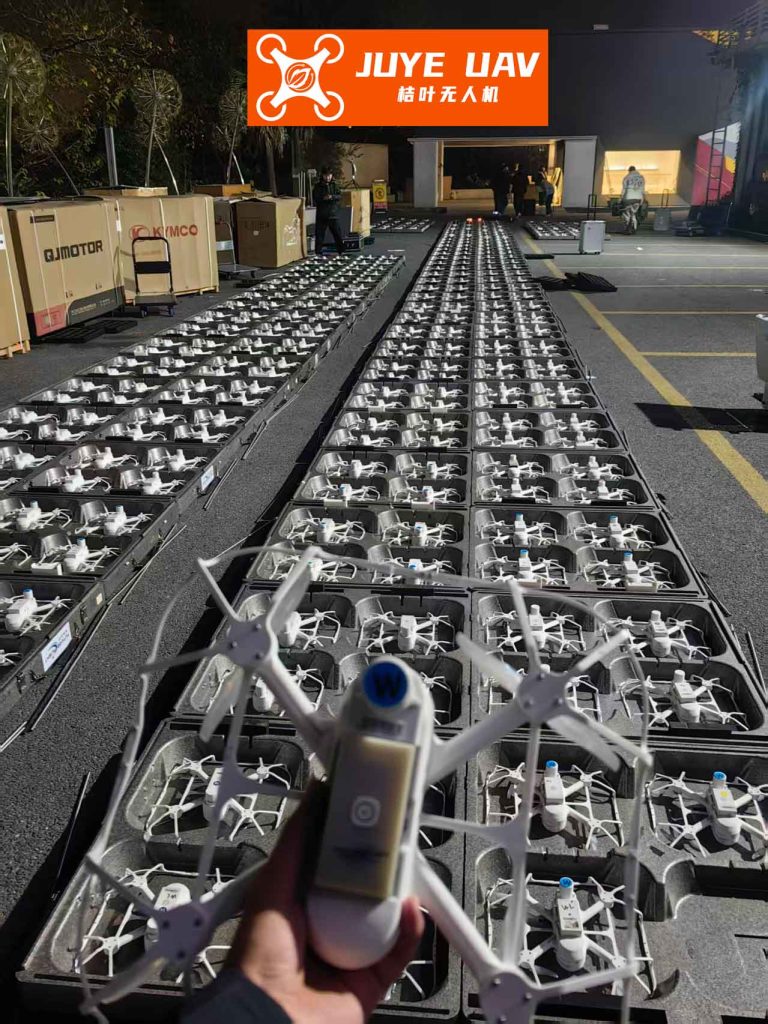
The integration of biological principles into drone formation control offers several advantages. Firstly, the hierarchical model reduces communication demands, as drones only need information from their superiors, which is often within local range. This is particularly beneficial in environments with limited bandwidth or high interference. Secondly, the use of artificial potential fields provides a smooth and continuous control law, avoiding abrupt maneuvers that could destabilize the formation. Moreover, the decentralized nature of this approach enhances scalability; adding or removing drones from the formation requires minimal reconfiguration, as the hierarchy can be dynamically adjusted. In practice, this means that drone formations can adapt to task requirements, such as changing from a “V” shape to a line or circle, by simply updating the desired distances \( d_{ij} \) and the graph structure. This flexibility is key for applications like aerial shows, where intricate patterns are desired, or in search missions, where formations must spread out to cover larger areas.
To further illustrate the mathematical foundation, let’s delve into the stability analysis of the drone formation controller. Considering the Lyapunov function candidate \( L = \sum_{i=1}^n \left( \frac{1}{2} m_i \| \mathbf{v}_i \|^2 + \sum_{j \in N_i} P_{ij} \right) \), we can show that under the control law, the derivative \( \dot{L} \) is negative semi-definite, ensuring convergence to an equilibrium where drones maintain desired distances and velocities. This analysis mirrors the stability properties observed in biological flocks, where individuals naturally settle into coordinated motion. In our simulations, this translates to the drone formation achieving a steady state without oscillations or collisions, validating the theoretical underpinnings.
Another critical aspect is the real-time implementation of the controller. Given the computational simplicity of the potential field and velocity alignment terms, the control algorithm can run efficiently on onboard processors of typical drones. This enables autonomous decision-making without relying on ground stations, which is essential for missions in remote or GPS-denied environments. For instance, in a drone formation performing aerial mapping, each drone can adjust its position based on neighbors, ensuring consistent coverage even if communication with the leader is temporarily lost. This resilience is a direct result of the pigeon-inspired hierarchy, where followers have multiple references to fall back on.
We also explored variations in the formation geometry by adjusting the desired distances \( d_{ij} \). For a “V” shape with an angle \( \theta = 60^\circ \) and a baseline distance \( R = 10 \) meters, the distances are computed as shown in Table 3. These values ensure that the formation is geometrically consistent, allowing drones to fly efficiently with minimal drag, similar to birds in migration. The ability to specify such parameters makes our approach customizable for different applications, from tight military formations to loose civilian swarms.
| Drone Pair (i, j) | Desired Distance \( d_{ij} \) |
|---|---|
| (1,2) | 10 |
| (1,3) | 10 |
| (2,3) | 10 |
| (1,4) | 20 |
| (2,4) | 10 |
| (3,4) | 17.32 |
| (1,5) | 20 |
| (2,5) | 17.32 |
| (3,5) | 10 |
In terms of performance, we compared our pigeon-inspired controller with traditional methods like leader-follower and consensus-based approaches. The key difference lies in the hierarchical topology, which reduces the risk of single-point failures. In a standard leader-follower setup, if the leader drone malfunctions, the entire formation may disintegrate. However, in our model, followers have multiple superiors, so they can continue operating based on other references, enabling graceful degradation. This is especially important for drone formation in hazardous environments, where reliability is paramount. Simulation tests with random drone failures confirmed that the formation could reconfigure and persist, showcasing the adaptive nature of the biological inspiration.
Looking ahead, there are several directions for extending this work. One area is integrating obstacle avoidance into the drone formation controller. By augmenting the potential field with repulsive terms from obstacles, drones can navigate cluttered spaces while maintaining formation, akin to pigeons weaving through trees. Another direction is to incorporate learning algorithms, allowing drones to optimize their hierarchy based on past experiences, further enhancing autonomy. Additionally, experimental validation with physical drones would bridge the gap between simulation and real-world deployment, addressing challenges like wind gusts and sensor noise. The ultimate goal is to develop fully autonomous drone formations that can perform complex tasks with minimal human intervention, inspired by the elegance of nature’s designs.
In conclusion, this article presents a comprehensive framework for autonomous drone formation control based on pigeon flock behavior mechanisms. By modeling the hierarchical structure with directed graphs and leadership interactions with artificial potential fields, we designed a controller that enables drones to form and maintain formations adaptively. Simulations demonstrated the effectiveness and robustness of this approach, even under dynamic leader motions. The principles drawn from biology not only provide theoretical insights but also practical solutions for multi-drone systems. As drone technology continues to evolve, such bio-inspired methods will play a crucial role in achieving reliable and scalable drone formation for diverse applications, from entertainment spectacles to critical missions. The journey from observing pigeon flocks to implementing drone formations exemplifies the power of cross-disciplinary innovation, paving the way for smarter and more cohesive aerial systems.