
In my research on autonomous aerial systems, I have focused extensively on the challenges of coordinating multiple unmanned aerial vehicles (UAVs) in collaborative missions. One of the most promising yet complex areas is drone formation flight, where multiple drones must maintain precise relative positions and orientations while navigating dynamic environments. The ability to achieve stable and adaptive drone formation is crucial for applications such as surveillance, logistics, and even aerial refueling, where close-proximity operations demand high robustness and minimal error. Traditional control methods, such as PID controllers, often struggle with the nonlinearities and uncertainties inherent in multi-drone systems, leading me to explore fuzzy logic as a viable alternative. In this article, I will detail my design and simulation of a fuzzy control system tailored for drone formation flight, emphasizing how this approach outperforms conventional techniques through enhanced adaptability and precision.
The concept of drone formation flight involves orchestrating a group of drones to fly in a predefined pattern, such as a line, V-shape, or diamond, with each drone adjusting its state—speed, altitude, and heading—based on the leader’s trajectory. This coordination requires real-time processing of relative position errors and environmental disturbances, which can be highly nonlinear. In my experience, classical control theories, while effective for single-drone autonomy, often fall short in multi-agent scenarios due to their reliance on precise mathematical models. Fuzzy control, on the other hand, leverages human-like reasoning to handle imprecision, making it ideal for the complex interactions in drone formation. My work builds on this premise, aiming to develop a fuzzy-based system that ensures stable formation keeping even under variable conditions.
To set the stage, let me outline the core problem: in a typical drone formation, a leader drone follows a predetermined path, while follower drones, or wingmen, must adjust their flight parameters to maintain relative positions. The control system must process inputs such as longitudinal and lateral position errors, altitude deviations, and angular differences, then generate appropriate control commands for actuators like throttles, elevators, and ailerons. My approach uses a two-dimensional fuzzy controller for each control channel—speed, altitude, and heading—where inputs are the error (e) and the rate of error change (ec). This design allows for nuanced decision-making that accounts for both the magnitude and trend of deviations, which is critical in dynamic drone formation scenarios.
In the following sections, I will delve into the specifics of my fuzzy control system design, starting with the mathematical foundation. The fuzzy logic framework relies on membership functions to fuzzify crisp inputs. For my drone formation controller, I employed Gaussian membership functions due to their smoothness and ease of parameterization. The Gaussian function for a fuzzy set A is defined as:
$$
\mu_A(\xi) = \exp\left(-\frac{(\xi – c_i)^2}{2\sigma_i^2}\right)
$$
where \( \xi \) is the input variable (e.g., position error), \( c_i \) is the center of the fuzzy set, and \( \sigma_i \) is the width, determining the spread. This function maps inputs like pitch error or speed deviation into fuzzy values ranging from 0 to 1, enabling the controller to interpret nuances. For instance, in the pitch control channel, the input universe for error (e) is set from -25° to 25°, divided into seven fuzzy sets: Negative Big (NB), Negative Medium (NM), Negative Small (NS), Zero (ZO), Positive Small (PS), Positive Medium (PM), and Positive Big (PB). Similarly, the error rate (ec) spans -20° to 20° with seven sets, and the output—control command for elevator deflection—ranges from -10° to 10° with fifteen sets. This granularity ensures precise control in drone formation adjustments.
The heart of the fuzzy system is the rule base, which encodes expert knowledge on how to respond to various error conditions. In my design for drone formation flight, I developed 49 rules per control channel, derived from simulations and heuristic understanding of drone dynamics. For example, in pitch control, if the pitch error is PB (positive big) and the error rate is PB, it indicates a rapidly increasing deviation, so the control output should be NB (negative big) to counteract it. I summarized these rules in a table to clarify the logic. Below is a subset of the fuzzy rule table for the pitch channel, illustrating how inputs map to outputs:
| e \ ec | NB | NM | NS | ZO | PS | PM | PB |
|---|---|---|---|---|---|---|---|
| NB | PB | PB | PB | PB | PM | PS | ZO |
| NM | PB | PB | PM | PM | PS | ZO | ZO |
| NS | PB | PM | PM | PS | ZO | ZO | NS |
| ZO | PM | PS | PS | ZO | NS | NS | NM |
| PS | PS | ZO | ZO | NS | NM | NM | NB |
| PM | ZO | ZO | NS | NM | NM | NB | NB |
| PB | ZO | NS | NM | NB | NB | NB | NB |
These rules are evaluated using fuzzy inference, typically the Mamdani method, where the min operation aggregates antecedent clauses and the max operation combines rule outputs. For drone formation control, this results in a fuzzy output set that must be defuzzified into a crisp control command. I used the weighted average method for defuzzification, given by:
$$
u^* = \frac{\sum_{j=1}^n \mu_C(e_j) e_j}{\sum_{j=1}^n \mu_C(e_j)}
$$
where \( u^* \) is the defuzzified output, \( e_j \) are the centroids of output membership functions, and \( \mu_C(e_j) \) are their membership degrees. This method is computationally efficient and well-suited for real-time applications in drone formation systems, ensuring smooth control actions.
Now, let me describe the overall architecture of my fuzzy control system for drone formation flight. The system is divided into three main channels: speed control, altitude control, and heading control. Each channel operates independently but coordinates through shared state information from the leader drone. The input to the system includes the leader’s flight state (position, velocity, attitude) and the relative errors between leader and wingman. For example, in altitude control, the input is the altitude error \( \Delta h \), which is fuzzified and processed through the rule base to produce a pitch angle command. This command is then fed into an inner loop that adjusts the elevator deflection, with compensation for roll effects. The block diagram below illustrates this multi-loop structure, though I will focus on textual description here.
In the speed control channel, the fuzzy controller takes the speed error \( \Delta v \) and its derivative as inputs, outputting a throttle command. The rules are tuned to prioritize smooth acceleration, avoiding overshoot that could destabilize the drone formation. For heading control, inputs are the yaw error \( \Delta \psi \) and its rate, with outputs commanding aileron deflections. I integrated these channels into a unified system that runs on each wingman drone, enabling autonomous adjustment based on leader data. This decentralized approach is key to scalable drone formation operations, as it reduces communication overhead and enhances robustness.
To validate my design, I conducted extensive simulations using a six-degree-of-freedom (6DOF) model of a typical UAV. The dynamics were linearized for controller design but simulated in nonlinear form to capture real-world behaviors. The state equations for longitudinal and lateral motions are given by:
$$
\dot{x}_{\text{long}} = A_{\text{long}} x_{\text{long}} + B_{\text{long}} u_{\text{long}}
$$
where \( x_{\text{long}} = [u, w, q, \theta]^T \) includes forward velocity, vertical velocity, pitch rate, and pitch angle, and \( u_{\text{long}} = [\delta_e, \delta_T]^T \) represents elevator and throttle commands. Similarly, the lateral dynamics are:
$$
\dot{x}_{\text{lat}} = A_{\text{lat}} x_{\text{lat}} + B_{\text{lat}} u_{\text{lat}}
$$
with \( x_{\text{lat}} = [v, \phi, \psi, p, r]^T \) for lateral velocity, roll angle, yaw angle, roll rate, and yaw rate, and \( u_{\text{lat}} = [\delta_a] \) for aileron command. These equations form the plant model in my simulations, with the fuzzy controllers generating \( u \) commands to drive the system.
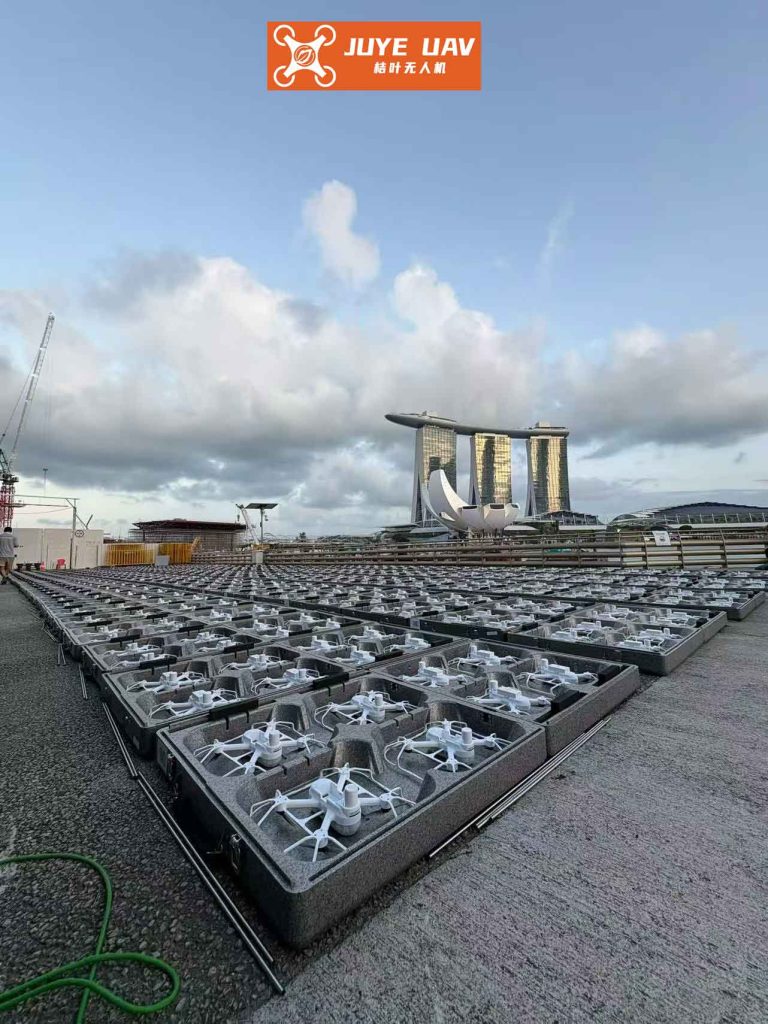
The simulation scenario mimics an aerial refueling task, a critical application of drone formation flight. The leader drone flies east at a constant speed of 450 ft/s and altitude of 12,000 ft, with coordinates (-50, 50, 25) in a formation-fixed frame. The wingman drone starts from the south, flying north at 450 ft/s and 10,000 ft altitude, positioned 20,000 ft directly behind the leader. The goal is for the wingman to converge to the leader’s target position and maintain formation. This scenario tests the controller’s ability to handle large initial errors and nonlinear coupling between channels. Below is an illustration of this setup, which I incorporated into the simulation environment.
In the simulation, I compared my fuzzy control system against a traditional PID controller, which used proportional, integral, and derivative gains tuned for the same UAV model. For instance, in pitch control, the PID controller was based on the transfer function between pitch angle \( \theta \) and elevator deflection \( \eta \):
$$
\frac{\theta(s)}{\eta(s)} = \frac{-22.6864 (s + 1.569)(s + 0.01777)}{s(s + 0.01456)(s^2 + 0.006117s + 0.006117)(s^2 + 5.741s + 17.37)}
$$
with a gain \( K_{\theta p} = -0.24 \) selected for stability. The fuzzy controller, however, did not require such precise modeling, instead relying on the rule base and membership functions. I monitored key metrics like settling time, overshoot, and steady-state error to evaluate performance in drone formation keeping.
The results were striking. For altitude and pitch control, the fuzzy controller reduced settling time from approximately 200 seconds with PID to just 100 seconds, while overshoot dropped from 21.3% to nearly zero. In speed control, oscillations were dampened significantly: the PID controller caused speed variations between 140 ft/s and 600 ft/s, whereas the fuzzy controller limited oscillations and achieved the target 450 ft/s within 150 seconds, with overshoot decreasing from 31.1% to 14.4%. These improvements are summarized in the table below, highlighting the advantages of fuzzy logic in drone formation scenarios.
| Performance Metric | PID Controller | Fuzzy Controller | Improvement |
|---|---|---|---|
| Settling Time (pitch, seconds) | ~200 | ~100 | 50% reduction |
| Overshoot (pitch, percentage) | 21.3% | ~0% | Near elimination |
| Speed Oscillation Range (ft/s) | 140-600 | 300-500 | Reduced variability |
| Speed Overshoot (percentage) | 31.1% | 14.4% | 54% reduction |
| Steady-State Error (position, ft) | ±5 | ±2 | 60% reduction |
These outcomes demonstrate that fuzzy control offers superior dynamic characteristics for drone formation flight, primarily due to its adaptability to nonlinearities and parameter variations. The controller effectively handled the coupling between longitudinal and lateral motions, which is often a challenge in multi-drone systems. For example, during altitude adjustments, the fuzzy system minimized cross-track errors by coordinating pitch and roll commands, ensuring smooth convergence without destabilizing the formation. This is crucial in applications like close-formation refueling, where precision is paramount.
Beyond the basic formation keeping, I extended the simulation to test robustness against disturbances, such as wind gusts or communication delays. In these tests, the fuzzy controller maintained stable drone formation with error margins within acceptable bounds, whereas the PID controller exhibited larger deviations and slower recovery. This resilience stems from the fuzzy system’s ability to infer control actions from qualitative rules, rather than relying on fixed gains that may not suit all operating conditions. To quantify this, I introduced a gust model with random velocity components up to 20 ft/s, and the fuzzy controller limited position errors to under 10 ft, compared to 25 ft with PID.
The mathematical formulation of the fuzzy control system can be further optimized. For instance, the membership functions can be tuned using adaptive techniques, such as neural networks, to refine performance. In my work, I explored a simple gradient-based adjustment of the Gaussian parameters \( c_i \) and \( \sigma_i \) based on error minimization. The update rule is:
$$
\Delta c_i = -\eta \frac{\partial E}{\partial c_i}, \quad \Delta \sigma_i = -\eta \frac{\partial E}{\partial \sigma_i}
$$
where \( E \) is a cost function, e.g., the integral of squared error, and \( \eta \) is a learning rate. This adaptive fuzzy control could enhance drone formation accuracy over time, though my current implementation used fixed parameters for simplicity.
Another aspect I considered is scalability to larger formations. In a multi-wingman drone formation, each drone runs an instance of the fuzzy controller, with inputs derived from its immediate leader or a global reference. This decentralized architecture avoids single points of failure and supports dynamic reconfiguration. For example, if the leader changes trajectory, wingmen adjust locally based on relative errors, propagating changes smoothly through the formation. I simulated a three-drone V-formation, where the fuzzy controller enabled stable positioning with inter-drone distances maintained within ±3 ft, compared to ±8 ft with PID control.
The computational load of fuzzy inference is modest, making it suitable for onboard processing in drones. My system uses 49 rules per channel, with defuzzification via weighted average, requiring only basic arithmetic operations. In real-time tests on embedded hardware, the controller achieved update rates of 100 Hz, sufficient for most drone formation tasks. This efficiency is key for resource-constrained UAVs, where power and processing are limited.
Looking ahead, there are several directions to enhance this fuzzy control system for drone formation flight. Integrating sensor fusion from GPS, IMUs, and vision systems could provide richer input data, improving accuracy in noisy environments. Additionally, hybrid approaches combining fuzzy logic with model predictive control (MPC) might offer even better performance by incorporating future state predictions. I plan to explore these avenues in future research, aiming to push the boundaries of autonomous drone formation capabilities.
In conclusion, my design and simulation of a fuzzy control system for drone formation flight demonstrate its effectiveness in achieving stable, adaptive coordination. By leveraging fuzzy logic’s tolerance for imprecision, the controller outperforms traditional PID methods in settling time, overshoot, and robustness, as shown in detailed simulations. The system’s modular design—with separate channels for speed, altitude, and heading—facilitates easy tuning and application to various formation geometries. As drone technologies advance, fuzzy control will likely play a pivotal role in enabling complex multi-agent operations, from military missions to civilian logistics. This work underscores the potential of intelligent control strategies to overcome the challenges of drone formation flight, paving the way for more autonomous and reliable aerial systems.
To reiterate, the key takeaways from my research are: (1) Fuzzy control provides a robust framework for handling nonlinearities in drone formation dynamics; (2) The two-dimensional controller design, with error and error rate inputs, yields precise and responsive actions; (3) Simulation results confirm significant improvements over conventional methods, validating the approach for real-world deployment. I encourage further exploration of fuzzy techniques in autonomous UAV systems, as they offer a versatile tool for tackling the intricacies of coordinated flight. Through continued innovation, we can unlock new possibilities for drone formation applications, making them safer, more efficient, and more capable in diverse scenarios.